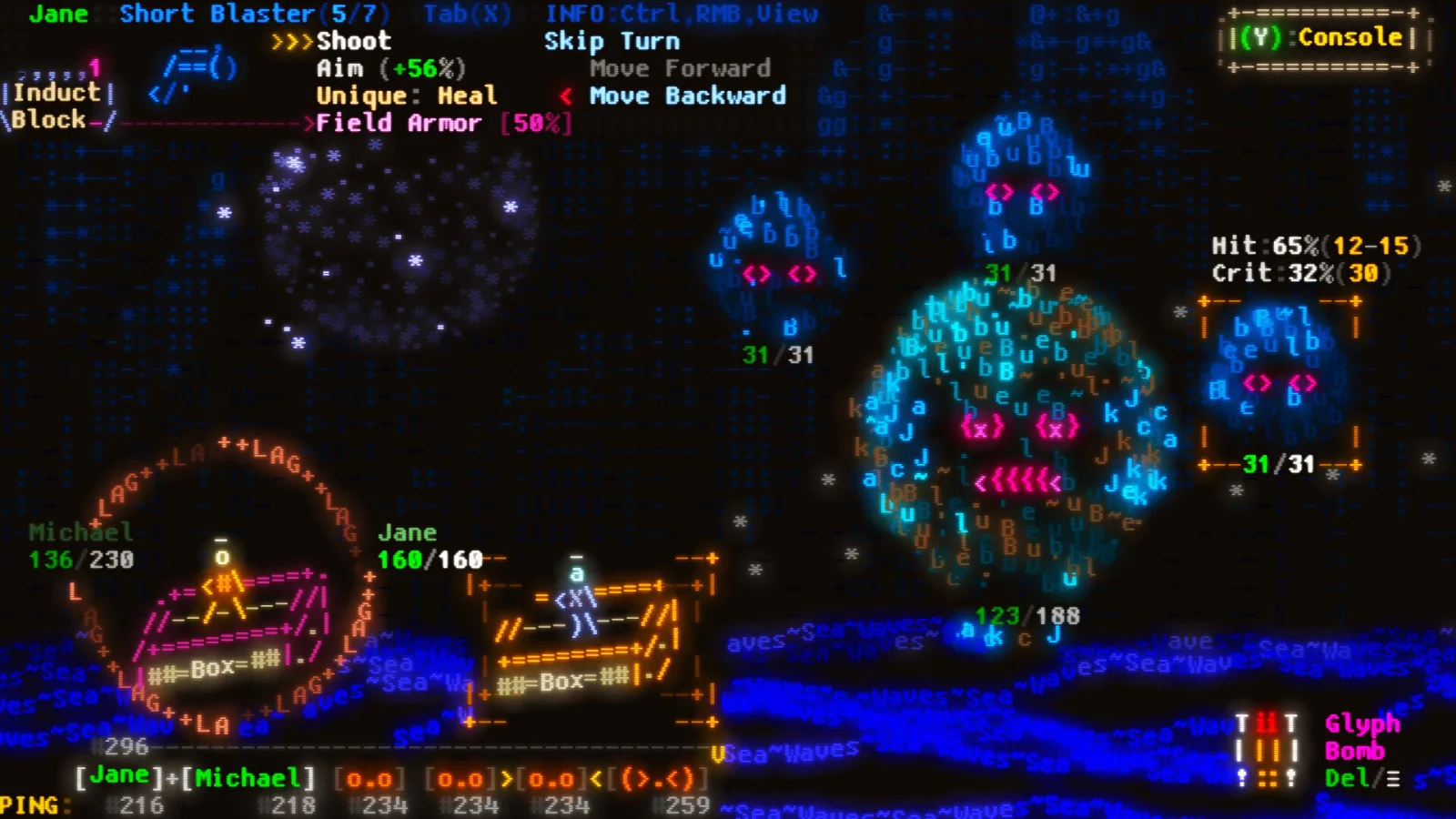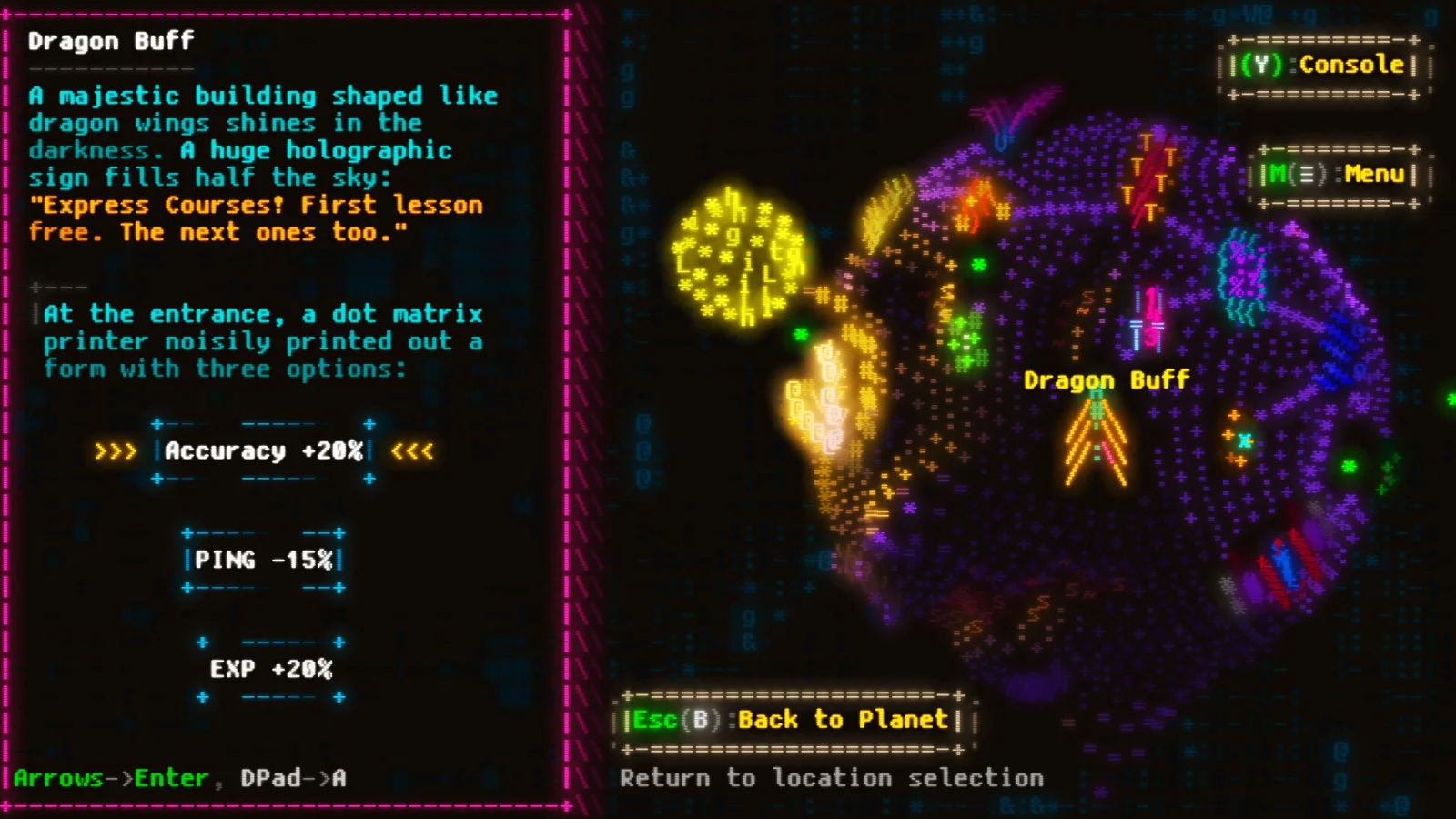
Effulgence RPG is a PC tactical RPG from developer and publisher Andrei Fomin with an immediately unusual visual and mechanical proposition. Its science-fiction world is formed from text characters arranged into three-dimensional shapes representing creatures, machines, scenery, and effects. Its tactical battles feature four heroes, skills, weapons, cartridges, and mechanisms. Most distinctively, the official feature description says defeated enemies break into particles, which players can collect to print equipment, including during combat.
That combination is more interesting than a checklist of familiar RPG nouns because of the connections it proposes. Turn-based tactics often asks players to assess danger, preserve a party, and convert limited actions into an advantage. Crafting, by contrast, is frequently separated from an encounter: materials are gathered, then turned into gear outside the immediate pressure of a fight. Effulgence RPG’s stated enemy-to-particle-to-equipment loop potentially collapses those categories into one decision space. An opponent is not only an obstacle to overcome; after defeat, it may become part of the resource calculation shaping the rest of the encounter.
This is an unscored design spotlight based on the game’s official current feature description rather than hands-on testing. The central question is not whether the system succeeds in practice, but what it is positioned to ask of players if its battlefield economy is clearly communicated and meaningfully integrated with tactical combat.
A battle economy with immediate consequences
The particle system has the potential to make defeating an enemy feel like the beginning of another decision rather than simply the end of one. In many turn-based games, removing a target chiefly reduces danger and advances the fight toward a conclusion. Here, collecting particles and printing equipment during combat could make the aftermath of a defeat part of the same rhythm as using skills, considering weapons, managing available tools, and trying to keep a four-hero party in command of the situation.
That possibility matters because it could create tension between immediate safety and future capability. A party may need to eliminate a threatening enemy quickly, while the equipment enabled by its particles could be relevant to another danger in the same battle. Conversely, an available print option may matter only if the party has enough room to make use of it. The stated design does not establish exactly how printing works, what it costs, or which choices it permits, so those specifics should not be assumed. But the core idea points toward an appealing form of tactical causality: an action can alter both the number of enemies remaining and the player’s available tools.
The strongest version of this kind of system is not merely an extra reward screen inserted into combat. It is a loop where resource conversion changes priorities. If equipment a player can print influences how they respond to a boss rule, support a threatened hero, or prepare for a later part of an encounter, then collecting particles becomes a tactical choice with a recognizable purpose. If its connections are communicated poorly, the same idea could become opaque: players may know they received a resource without understanding what it enables, when it should be spent, or why one printing decision is more appropriate than another. The design’s promise is consequently tied to clarity as much as novelty.
Effulgence RPG also officially includes weapons, cartridges, and mechanisms. Those terms indicate several equipment-related categories, but the available information does not define their relationships, customization limits, or combat effects. It is more useful to treat them as areas for evaluation than as evidence of a particular build structure. When a game asks players to create equipment under combat pressure, each available option benefits from a readable role and an understandable consequence.
Four heroes, one shared tactical conversation
A party of four gives Effulgence RPG a focused tactical frame. Four heroes can support interdependence while keeping the number of simultaneous decisions manageable. The official description confirms skills for the party but does not specify individual roles, action rules, or named synergy effects. There is no basis to invent a healer, defender, damage specialist, or any particular class structure. Still, the four-character format creates a useful design opportunity: a choice can be judged not only by what it does for one hero, but also by what it opens for the remaining three.
In a satisfying party tactics game, synergy does not require a long list of elaborate combinations. It can emerge when sequencing matters, when one action makes another more valuable, or when limited options create a meaningful division of responsibility. In Effulgence RPG, the particle-printing premise could add another dimension to that conversation. One hero’s contribution may help secure a defeat; the resulting particles may then feed an equipment decision whose value is measured across the whole group. That would make the party feel less like four isolated turns and more like a shared economy of timing and opportunity.
The key criterion is whether the game gives players enough information to understand that chain. Tactical depth is not synonymous with withholding explanations. A player can make an interesting choice only when relevant trade-offs are legible: what is threatening the party, what has changed after an enemy falls, what can be printed, and what practical difference that choice is likely to make. Clear feedback would be especially important in a game whose aesthetics and systems both depart from common genre expectations.
For a broader lens on how RPG structure can draw force from choices and consequences, see this RPG drama analysis. Effulgence RPG’s stated concept is different, but it likewise invites attention to how systems make a decision feel consequential rather than decorative.
Boss rules could give crafting a reason to matter
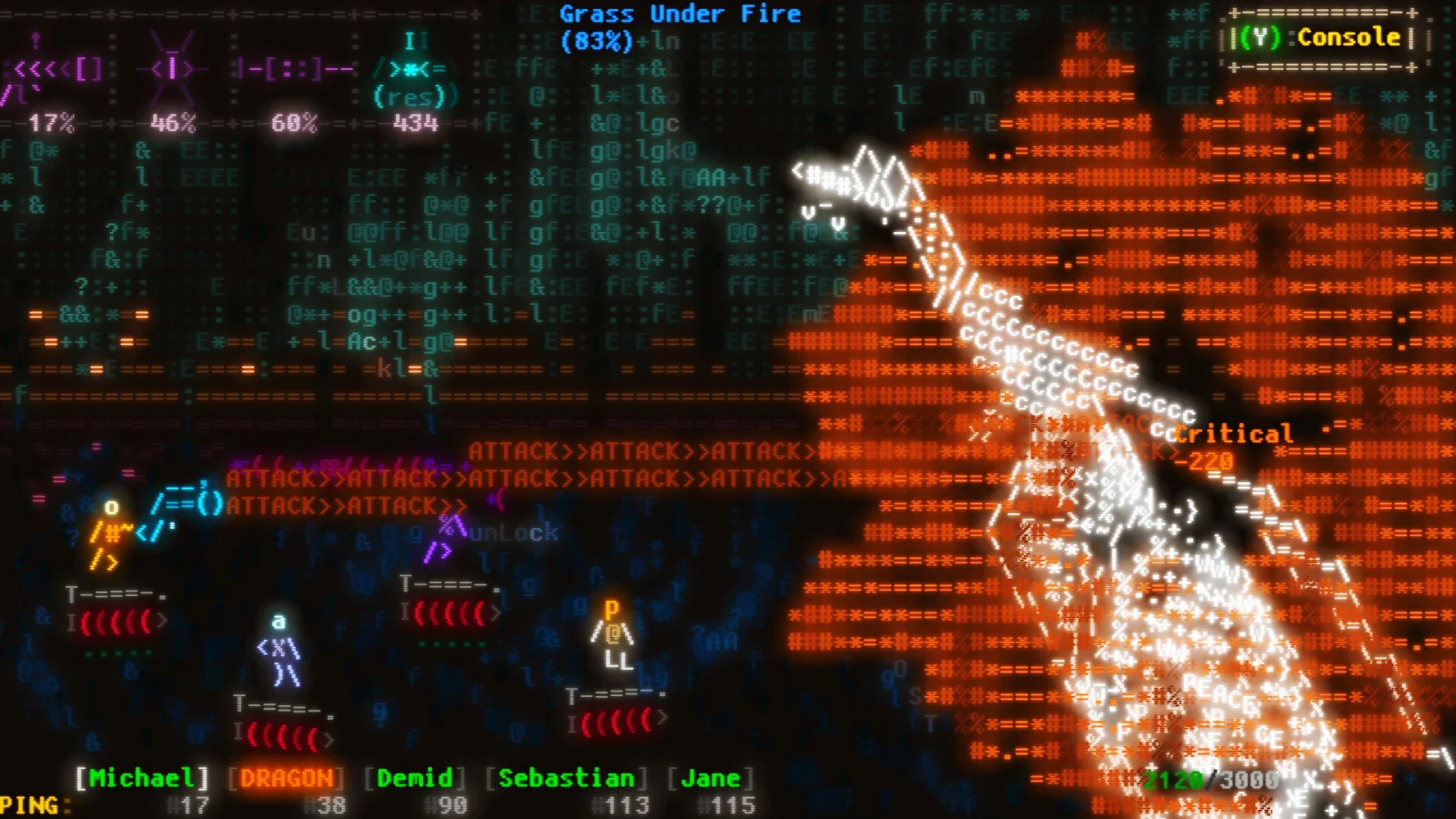
Effulgence RPG’s official description states that different bosses have their own rules and mechanics. That is an important detail because bosses can provide the clearest test of whether a tactical system asks for adaptation or simply asks players to repeat a reliable routine. A boss with a distinct rule can change what counts as a useful action and encourage a reassessment of priorities.
Combined with in-combat printing, boss-specific rules could be where the game’s central premise becomes most expressive. If an encounter’s special condition makes certain equipment choices more useful, then particle collection and printing are not merely an economy running alongside combat. They become part of interpreting the encounter. The ideal result would be a battle that asks players to recognize a rule, adjust their approach, and use tools produced by the battle itself as part of that response.
That is conditional design analysis, not a claim that every boss functions this way. The official material does not list individual boss rules, describe encounters, or establish how printed equipment interacts with them. But distinct boss mechanics are promising in principle because they can discourage a combat system from settling into one answer repeated without thought. The evaluation point is straightforward: do boss rules create intelligible new priorities, and do the game’s printing and party systems provide meaningful ways to address them?
Text characters as world-building and interface
The visual presentation may be Effulgence RPG’s most immediately recognizable trait. Text characters arranged as three-dimensional forms are officially used to depict creatures, machines, scenery, and effects. In a science-fiction setting, that approach can make the world feel computational, schematic, or assembled from signals rather than conventional painted surfaces. It has the potential to give terrain, machinery, and living forms a shared visual language.
However, unusual abstraction brings a fundamental readability question. Tactical games ask players to interpret combatants, environmental information, effects, and changing states. A text-character visual language can be striking precisely because it asks the eye to identify familiar forms in unfamiliar material. It must also distinguish information that matters. If creatures, machines, scenery, and effects all occupy the same broad visual vocabulary, contrast, silhouette, animation, and interface communication become especially important design considerations.
This is not an assertion that Effulgence RPG is difficult to read; no hands-on basis supports that claim. It is a standard against which the design can be considered. The abstract art will be doing more than setting a mood. It will also carry combat information. When that relationship works, a distinctive style can make a game’s rules feel inseparable from its world. When it does not, visual novelty can compete with a player’s ability to form a plan. Effulgence RPG’s character-built 3D imagery is compelling because it has the chance to perform both jobs at once.
Minigames and blueprints: breadth needs a clear role
Officially, Effulgence RPG includes three minigame types and dozens of blueprints. It also names mechanisms including a combat sparrow and flamethrower copter. These details broaden the picture beyond one loop of party battles and particle conversion. The mechanisms fit the game’s science-fiction machinery and equipment language, while blueprints naturally connect to the stated ability to print gear.
What remains unconfirmed is how these elements are structured, how frequently they appear, and what role each minigame type plays. The important analytical question is not whether more activities automatically equal more variety. It is whether those activities support the game’s central identity. A minigame can provide contrast, a different kind of interaction, or a fresh way to engage with the world. It can also feel disconnected if its stakes and rewards do not relate back to the tactical and crafting ideas defining the larger design.
Similarly, dozens of blueprints could support experimentation if their purposes are differentiated clearly enough to make selection meaningful. Quantity alone does not establish depth. The promising interpretation is that a large blueprint pool gives the particle system many possible destinations, allowing players to turn battlefield resources into choices rather than a single automatic upgrade track. The practical test would be whether the alternatives are comprehensible and situationally relevant.
System pacing should make each idea feel purposeful
The official material describes a tactical RPG with several possible points of emphasis: a four-hero party, skills, weapons, cartridges, mechanisms, blueprints, boss rules, minigames, and particle printing. The relevant pacing question is not simple scale, but whether the game gives these elements room to inform one another. A coherent progression structure would ideally introduce and revisit them in a way that lets each system deepen the others rather than compete for attention.
That is a criterion, not a verified account of Effulgence RPG’s structure. The available facts do not establish its narrative format, chapter arrangement, progression cadence, or how systems become available. Still, the stated design has a useful opportunity: its most unusual mechanic can provide continuity across different kinds of content. Whether a player is considering equipment, confronting a boss rule, or encountering a mechanism, the underlying question may remain connected to transforming matter from a fight into a new tactical possibility.
Effulgence RPG stands out on its official design grounds because it does not frame crafting solely as a distant reward for combat. It places the possibility of equipment printing inside the fight itself, where timing and risk may matter. Alongside a four-hero party, boss-specific rules, blueprints, mechanisms, minigames, and a text-character 3D science-fiction aesthetic, that makes it worth approaching with specific questions rather than generic expectations.
Its practical strengths will depend on the relationship between its systems: whether enemy particles are valuable enough to shape decisions, whether printed equipment has a clear tactical purpose, whether bosses reward adaptation, and whether the visual language keeps combat information understandable while remaining distinct. Those are substantial conditions, but they arise from a genuinely individual premise. Effulgence RPG’s official feature set suggests a tactical RPG interested in making destruction productive: defeat an opponent, collect what remains, and potentially turn that aftermath into the next answer. That is a strong conceptual loop, and this feature-based assessment leaves the final judgement unscored.