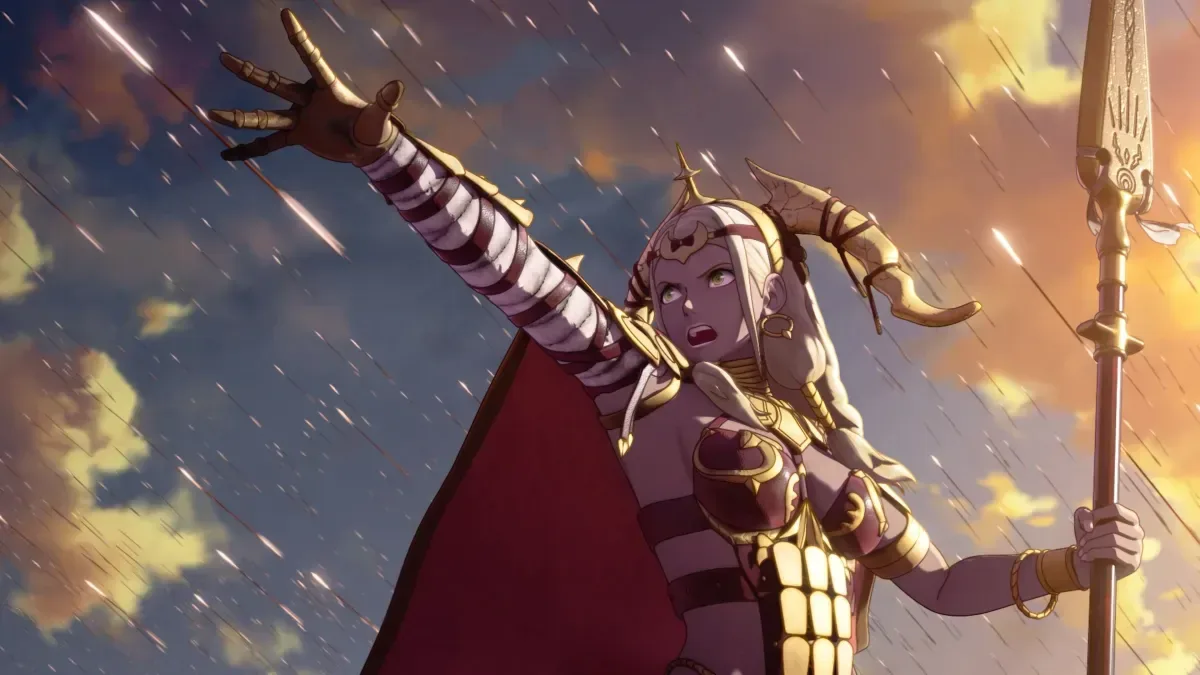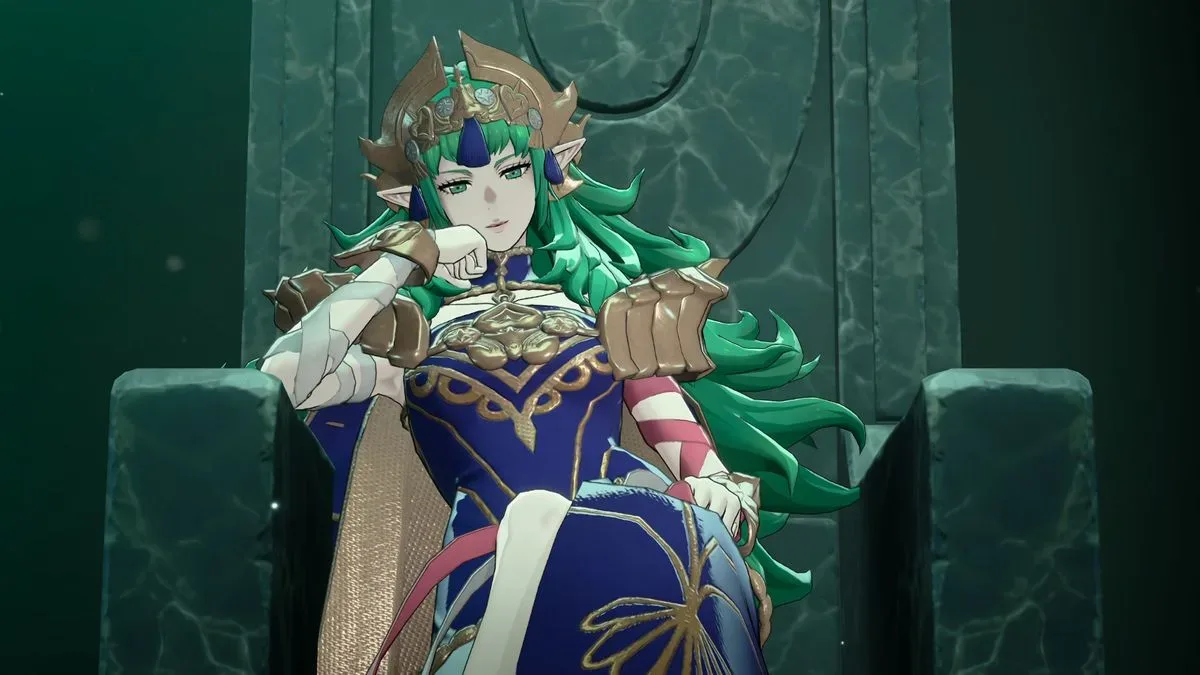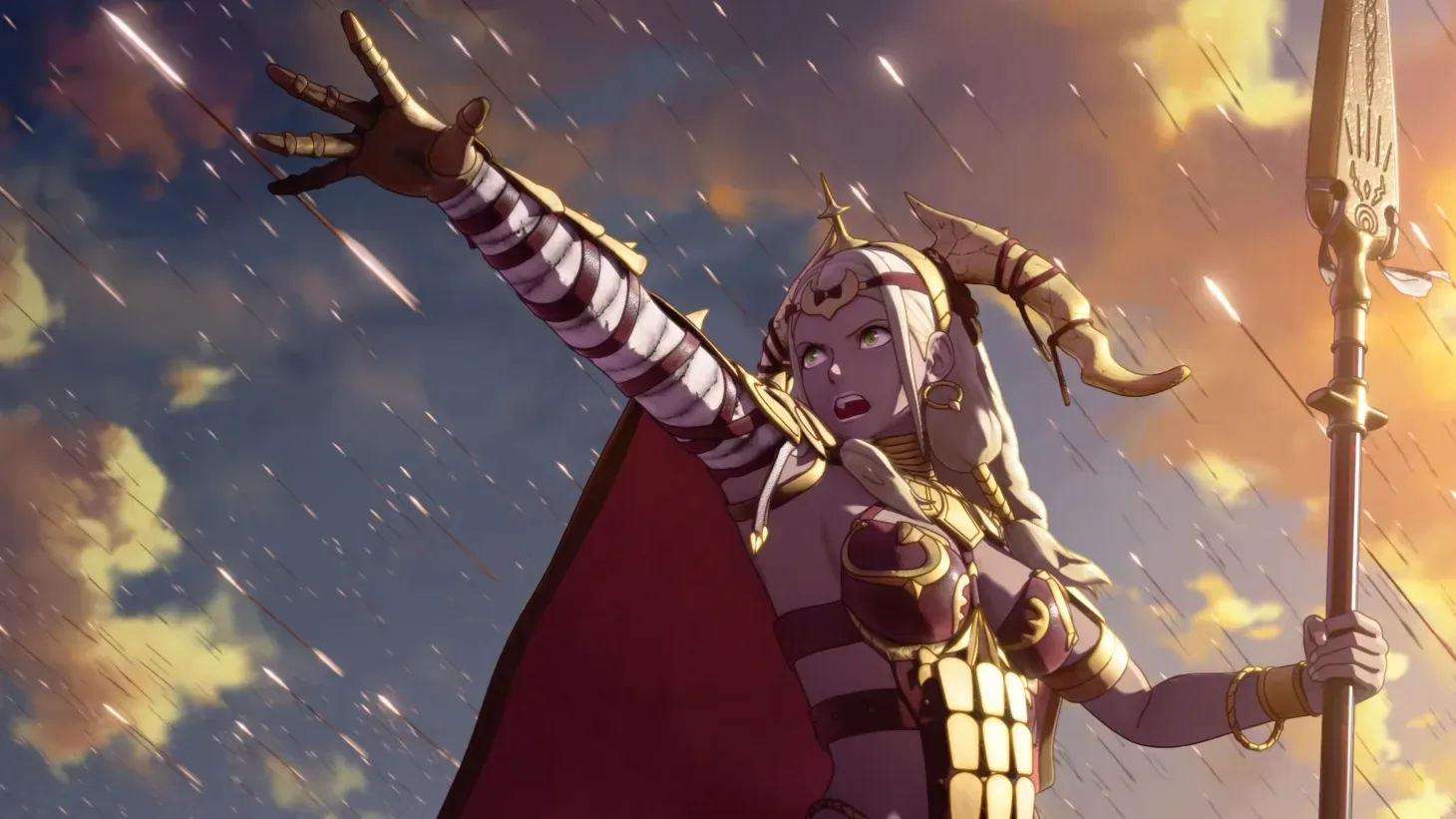
Fire Emblem: Fortune’s Weave is built around a tantalizing contradiction: it is both eager to let players hurry toward its ultimate confrontation and determined to surround that confrontation with an enormous amount of history, war, social maintenance, optional combat, and character-building. Its three-act structure makes the journey feel genuinely consequential. The cost is that the game’s finest ideas—especially its arena-centered tactical maps—must share space with systems that can feel repetitive long before the broader story has finished unfolding.
The premise opens amid collapse. A player-created Pale Raven and Fortuna, a goddess of fate, survive a ruined world haunted by the living dead. Their answer is not simply to charge at Balor, the lord of the underworld, but to retreat to a chamber outside time and alter the fates of four Flame Lords of Dagda: Cai, Theodora, Dietrich, and Leda. Each is drawn to Dagsion for the Heroic Games, where Divine Emperor Solel promises a wish to the winner.
That setup gives Fortune’s Weave an unusually useful sense of scale. The player can challenge Balor at any point, but recruiting more lords and their allies makes the final campaign more manageable. This is not merely a menu-driven route choice: completing a lord’s story changes who may stand in the final fight. The design makes the campaign’s branching structure feel tied to its central concern with causality, mortality, and the legacies people choose to leave behind.
Four paths, one increasingly tangled world
The first act follows each lord through the Heroic Games. Cai seeks to save his imprisoned father; Theodora wants to reclaim land vital to her people; Leda pursues revenge for her father’s murder; and Dietrich enters for the thrill of battle. They are distinct motivations, and the shared setting pays dividends as characters and incidents reappear from new perspectives. Seeing an exchange during one route and later understanding its larger context from another is exactly the sort of structural payoff this premise needs.
The narrative grows from personal objectives into conspiracies, bargains, old secrets, and wider political and divine conflicts. More importantly, it apparently finds room to make its lore matter at the character level. Theodora’s route considers a people commanded by their patron god not to write down their history, and the risk that tradition itself may erase that history over time. Leda’s story engages with grief, revenge, and music. Dietrich’s route opens onto mysteries beyond its battle-hungry lead. Fortune’s Weave has a great deal to say, and its multi-route format gives many of those ideas the room to develop instead of treating them as quick flavor text between maps.
The later acts raise the stakes further. Finishing a Heroic Games route unlocks a war-focused second section for that lord, after which that leader and recruited units can join the campaign against Balor. Part Three has its own day-and-activity cycle alongside an additional layer of grand strategy. It is a huge structure, and it sounds rewarding for players who enjoy seeing early narrative seeds pay off much later. It also demands patience: reaching the credits can take more than 130 hours, with scenes and events still left unseen.
When the board fills up, Fortune’s Weave shines
The tactical battles are the clearest reason to make time for this journey. Overworld encounters are described as comparatively straightforward, but the major chapter battles have far more personality. The Dagsion arena maps, in particular, give the Heroic Games their proper theatrical weight. Charging chariots, mechanisms to decipher, and specialized combat spaces make these encounters feel more like set-piece puzzles than routine skirmishes. The best maps ask players to understand their roster and use it intelligently rather than simply advance toward an objective.
Character development supports that variety. Unit archetypes have multiple upgrade paths, allowing builds that meaningfully change a character’s role. A mercenary such as Mu can become a critical-hit-focused sword fighter, while Cai can be developed toward mounted magic use as a Caldarius. These examples suggest a system with enough flexibility for players to pursue unusual directions without abandoning each unit’s identity.
Fortune’s Weave also drops the weapon triangle in favor of more direct counters: magic is useful against armor, while lances answer horses. That adjustment places greater attention on enemy composition, weapon roles, and Combat Arts. Training toward a fighter’s strengths therefore has a clearer tactical purpose. The lords add another layer through individual Blaze Arts, including Leda’s spellsongs and Dietrich’s shadowstep. These tools should help players engineer decisive turns and give the central cast a mechanical presence beyond their place in the story.
For a closer look at the wider conversation around its strongest battles and daunting scale, see Fire Emblem: Fortune’s Weave reviews and its enormous scope.
A campaign that confuses abundance with momentum
The trouble is not a lack of things to do. It is that Fortune’s Weave repeatedly asks players to do familiar things after their novelty has worn off. Each chapter mixes major battles with free time in and beyond the capital. Early on, meals build rapport, recruits are pursued, and skills are trained at an arena. Later, the game opens into continental roaming, overworld fights, dungeons, lord-specific resource systems, side quests, and paralogues.
Some of this works best under pressure. Deadlines on quests and paralogues can create satisfying prioritization: recruit the needed archer, earn enough renown, prepare for an approaching battle with flying enemies. Those moments turn planning into a tactical extension of the map game. But too many weeks appear to become a mechanical loop of training, eating, automated activities, and checking for small map indicators that may signal random events. When progression requires routine upkeep rather than difficult decisions, a generous feature set starts to resemble administrative labor.
The dungeon component is the weakest example. These small-party excursions use strike-to-engage exploration and turn-based combat, translating the larger strategy formula into a dungeon-crawling format. Yet their fights do not become more interesting or challenging over time. Frequent returns and repeated encounter rhythms can make auto-battle feel less like a convenience and more like the sensible response to content that has stopped asking for attention. Resource collection can add another layer of friction, particularly when it is needed for progress rather than pursued as a meaningful choice.
This creates a difficult recommendation to calibrate. Players who want a tightly paced tactical campaign may find the game’s downtime increasingly exhausting. Players who enjoy optimizing supports, collecting side content, experimenting with recruits, and living in a setting for dozens upon dozens of hours will have far more tolerance for its sprawl. Cross-path progression boosts and cleared side quests do provide welcome quality-of-life relief for anyone determined to explore every route, but they cannot entirely solve the basic pacing issue.
A world worth lingering in, even when the checklist is not
Fortunately, Fortune’s Weave has the atmosphere to sustain a long stay. Its Romanesque gladiatorial vision, gods walking among mortals, vihuela-led musical identity, character designs, and class designs give Dagda a strong personality. The supporting cast also seems to have room to emerge through banter, support conversations, and battlefield stories. Fabio, Lilian, Mu, Anatolia, Dante, Talimun, and Orchel are among the warriors positioned to gain dimension beyond their initial recruitment utility.
The result is a grand, frequently excellent tactical RPG whose reach occasionally exceeds its ability to keep every system engaging. Its best maps rank among its most persuasive achievements, while its world and interlocking routes give the long haul emotional and thematic weight. But the same game that offers an impressive number of meaningful options can make players spend too much time processing low-stakes routines and repeating underdeveloped dungeon combat.
Fortune’s Weave is therefore best approached as a slow-burn commitment, not a brisk strategy fix. Those willing to accept a cumbersome middle and late-game maintenance burden will find striking arena battles, flexible unit growth, and a richly layered cast waiting on the other side. Those with little patience for repeated activities should be aware that the road to its strongest payoffs is deliberately, and sometimes unnecessarily, long.