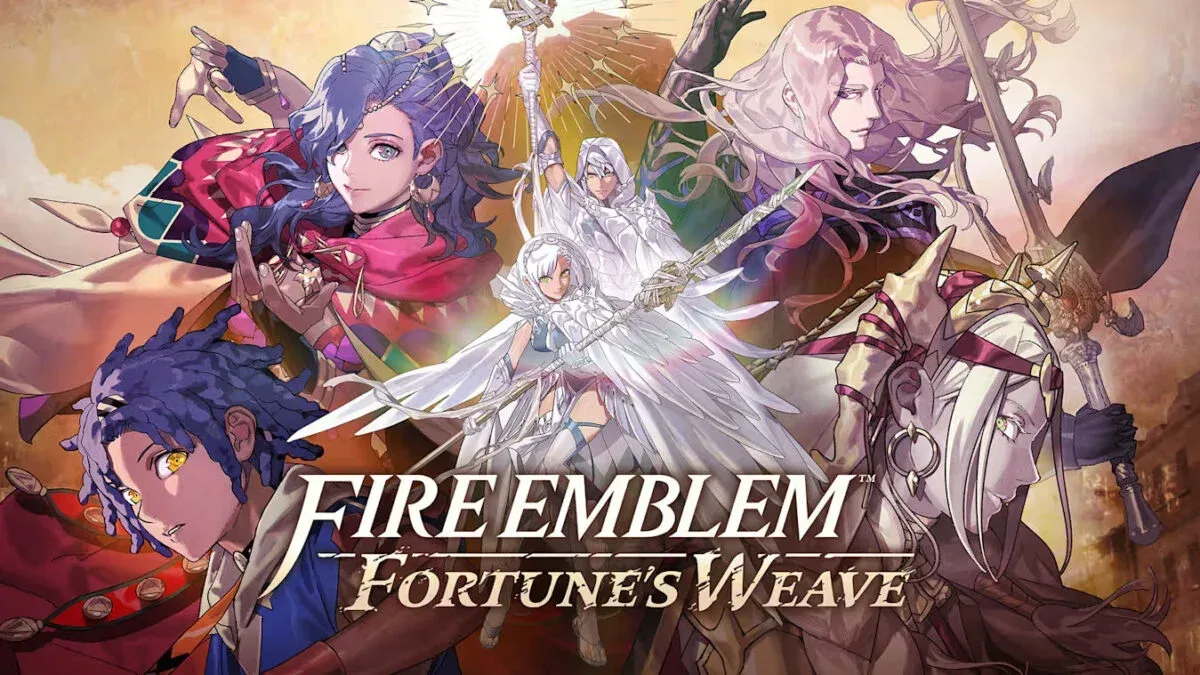
Fire Emblem: Fortune’s Weave has arrived to a notably enthusiastic critical response, with a clear caveat attached: this is apparently an enormous strategy RPG that expects an enormous amount of time in return. The new Nintendo and Intelligent Systems game is being praised for challenging grid-based battles, extensive route-specific material, polished presentation and management systems that meaningfully connect to combat. But recurring concerns over pacing, grind, map administration and exploration suggest that its ambition may be as intimidating as it is impressive.
Reports place a full tour through the game’s routes somewhere between roughly 70 hours and well beyond 100. That scale is not a simple bullet-point boast. It is central to the reception. For players who want a sprawling Fire Emblem with multiple hero stories, political intrigue, social elements and tactical problems to solve, Fortune’s Weave looks designed to be a substantial long-term project. For people hoping for a brisker, battle-first campaign, the same abundance may feel like friction.
The broad critical picture is therefore less “big game good” than “big game with a strong sense of what it wants from its audience.” Fortune’s Weave appears to repeatedly ask players to juggle battlefield planning, time management, expeditions, progression and narrative paths. Its best moments reportedly make those responsibilities feed one another. Its weaker stretches are where the systems appear to slow the game’s momentum instead.
Tactical combat remains the headline strength
The most consistent praise is reserved for the turn-based tactical battles. In Fire Emblem terms, that means encounters fought on a grid, where unit placement, movement range, offensive matchups and the order of actions can determine whether a plan succeeds. Reviews describe the battles in Fortune’s Weave as polished, tense, demanding and memorable, with several calling the combat among the series’ best.
That consensus matters because Fortune’s Weave is not being framed as a retreat to a stripped-down, traditional format. It layers exploration and management around the fights. Yet even reviews that are less convinced by those additions generally acknowledge that the core battles are excellent. One assessment says the game’s scale only slightly distracts from tactics because the combat eventually finds its footing and produces unforgettable scenarios. Another argues that the game gives players a constant flow of new challenges and new tools, rather than allowing strategy to become static.
Strategy RPG, or SRPG, is the useful shorthand here: a role-playing game whose primary challenges revolve around tactical decision-making rather than real-time action alone. Fortune’s Weave seems to take that framework seriously, with four story paths and systems that become more intricate over time. A review describes the combined scale of its battles and management mechanics as remarkably ambitious even for one storyline, let alone four.
That is a promising signal for returning players who value a campaign’s mechanical endurance. A strategy game can have satisfying individual maps yet lose force when its broader systems fail to evolve. The reviews suggest Fortune’s Weave instead keeps broadening the player’s options and responsibilities. Whether each extra responsibility is welcome is a separate question, but there is little doubt that the game is aiming for depth rather than repetition.
Four routes make replaying less punishing—on paper
Multiple story paths are a major contributor to the game’s length. Fortune’s Weave reportedly provides four hero routes, each with its own twists, and the differences between them encouraged reviewers to see how the journeys diverged before the final act. Cross-path progression boosts and shared side-quest completion are also cited as quality-of-life measures intended to make completion more manageable.
Related coverage includes Fire Emblem: Fortune's Weave Reviews Hail Its Tactical Depth, but Its Massive Scale Divides Critics.
Those terms deserve unpacking. Cross-path progression means advancement earned in one route can benefit a later run on another route. Side-quest clears carrying over means players may not have to repeat every optional task when they begin a fresh path. Both systems can soften the traditional replay burden of a branching RPG: instead of treating each route as a completely isolated save file, the game recognizes some prior investment.
For completion-minded players, that could be the difference between a compelling long-form structure and a punishing checklist. The practical implication is straightforward: Fortune’s Weave may be built to reward a gradual approach rather than a rushed attempt to exhaust every route at once. The reviews do not establish exactly how these carryovers operate or how much time they save, so players should avoid assuming that all repeated content disappears. Still, their presence shows an awareness that a multi-route game of this size needs to respect prior progress.
It is also worth separating length from variety. A 100-hour-plus total is only appealing if the routes, battles and character arcs supply different reasons to continue. The positive reviews argue that Fortune’s Weave has enough distinct hero-path material and evolving systems to support that scale. The critical reservations argue that sheer volume sometimes overwhelms the pacing. Both can be true: the game may have a lot worth seeing while still being difficult to sustain at a satisfying rhythm.
Exploration and management are the dividing lines
Fortune’s Weave’s most contested elements seem to sit between its set-piece battles. Reviews highlight an imposing world map, expedition planning, time management and a greater emphasis on exploration. One favorable assessment calls mapping expeditions a surprise highlight, particularly because persistence opens more ways to direct armies against emerging threats. Another says the time-management structure integrates satisfyingly with almost everything the player does.
Time management in this context refers to deciding how to use limited periods between major encounters. Rather than moving directly from battle to battle, players may need to choose priorities such as preparing forces, pursuing activities or handling available threats. Such a system can create meaningful trade-offs: choosing one benefit may mean foregoing another. It can make campaign planning feel as important as positioning a unit during combat.
However, that same structure demands that players enjoy its surrounding routines. A more skeptical view says the game lets real-time dungeons and open-world busywork bury its otherwise brilliant grid battles. Another cites grindy map management and a complicated protagonist hierarchy as contributors to later pacing problems. “Grindy” here does not necessarily mean impossible; it means activities can feel like repeated work performed to maintain progress rather than engaging decisions with a fresh payoff.
This is the key buying consideration emerging from the reviews. Players excited by the blend of social-simulation-style activity, broader travel and army management may find the connective tissue as rewarding as the fights. Players chiefly interested in classic tactical maps should note that these surrounding systems are not incidental. Fortune’s Weave apparently gives them a major role, even if social-simulation elements can be skipped.
That optionality is important but should not be overstated. Skipping one category of activity does not mean the game becomes a minimal, combat-only Fire Emblem. The reviews still describe map planning, exploration and management as fundamental pieces of the overall design. Anyone looking for a game with a huge menu of things to do may see that as excellent value. Anyone craving focus may see it as the game’s biggest obstacle.
High production values, but less agreement on the story
Fortune’s Weave is also receiving praise for its visuals, soundtrack, art direction and voice acting. Several reviewers call it beautiful or visually striking, while one describes the overall presentation and battle-to-battle loop as helping make it a standout on Switch 2. These responses reinforce the impression of a lavishly built release rather than an experiment whose ambition exceeds its finish.
The narrative response is less uniform. Some reactions praise the game’s characters, political intrigue and emotional weight, including the way route-specific stories build toward the final act. Others are much more reserved, with one review finding the central plot hard to invest in even while valuing the gameplay, music and visuals. Another cites uneven pacing rather than condemning the story outright.
That divide may be especially relevant to players comparing Fortune’s Weave with prior Fire Emblem games. The supplied reviews repeatedly position it as combining aspects associated with Fire Emblem: Three Houses, released in 2019, and 2023’s Fire Emblem Engage: character and storytelling ambitions on one side, clean tactical combat on the other. One reviewer also identifies a party-based battle feature reminiscent of Fire Emblem Echoes: Shadows of Valentia. These are comparisons of emphasis, not a guarantee that every player will agree with the result.
For a series with fans who often prioritize different things—supports and character relationships, map design, difficulty, world-building, or efficient replayability—that mixed story response is unsurprising. The more revealing point is that the game’s mechanical strengths are receiving remarkably steady approval even where the narrative does not land as well.
What the review consensus means for players
Fortune’s Weave appears to be an easy recommendation for players who want a demanding, content-rich strategy RPG and are prepared to let it dominate their game time for a while. The route structure, carryover progress, formidable battles and expansive management layer all point toward a game meant to be lived in rather than cleared over a weekend.
- Likely best suited to: players who enjoy lengthy tactical RPGs, branching narratives, character-focused systems and planning beyond individual battles.
- Worth approaching cautiously if: you prefer a compact campaign, dislike open-world chores, or want tactical missions with minimal exploration and administration.
- Potentially valuable for completionists: cross-path progression boosts and shared side-quest clearing may reduce duplicated work, though the overall multi-route commitment remains substantial.
- For returning Fire Emblem fans: the evidence points to exceptional combat, but not necessarily to a return to a simpler battle-only format.
The enthusiasm around Fortune’s Weave is substantial, and it is not based solely on its size. Reviewers point to battles that remain stressful and exciting, management systems that can generate satisfying decisions, multiple routes with meaningful distinctions, and a high level of audiovisual craft. Yet the cautions are equally specific: the game can sprawl, late pacing can sag, and systems intended to make its world feel expansive can get in the way of the tactical experience some players came for.
In other words, the game’s apparent success and its potential drawback are closely linked. Fortune’s Weave wants to be a maximal Fire Emblem: a wide-ranging campaign that delivers strategy, social activity, travel, progression and multiple narrative perspectives in one package. Early reviews indicate that it often pulls that off. They also indicate that players should treat its length as a real commitment, not merely a number to admire. For anyone already preparing a very long campaign, the critical verdict is encouraging. For the rest, it may be wise to decide whether the appeal is the battlefield itself—or everything the game puts around it.
For another look at how gaming fandom can extend beyond the screen, see our examination of the strange difficulty of buying official video game T-shirts.