Cozy Liora is not presenting itself as a sprawling simulation that demands a second monitor, a color-coded calendar, and a minor in municipal planning. Its stated ingredients are much smaller and more personal: daily journaling, mood reflection, plant care, miniature games, music selection, milestone books, daily totems, a cat companion, and anonymous letters exchanged between players. On PC, it is an Early Access project whose appeal rests on whether those modest actions can become a welcome routine rather than a list of tiny chores wearing a cozy cardigan.
That distinction matters. A game built around brief check-ins can be satisfying precisely because it does not ask much of the player. There is room for a digital space that encourages someone to pause, make a small record of their day, tend a plant, choose some music, and leave. The risk is equally clear: simplicity needs focus. When several light activities are gathered without a compelling connection between them, calm can begin to resemble thinness. Cozy Liora’s Early Access proposition is promising for players who want a low-pressure daily companion, but it remains an uncertain fit for anyone expecting the systems, agency, or sustained goals of a substantial life simulation.
A ritual-first design, not a life-sim substitute
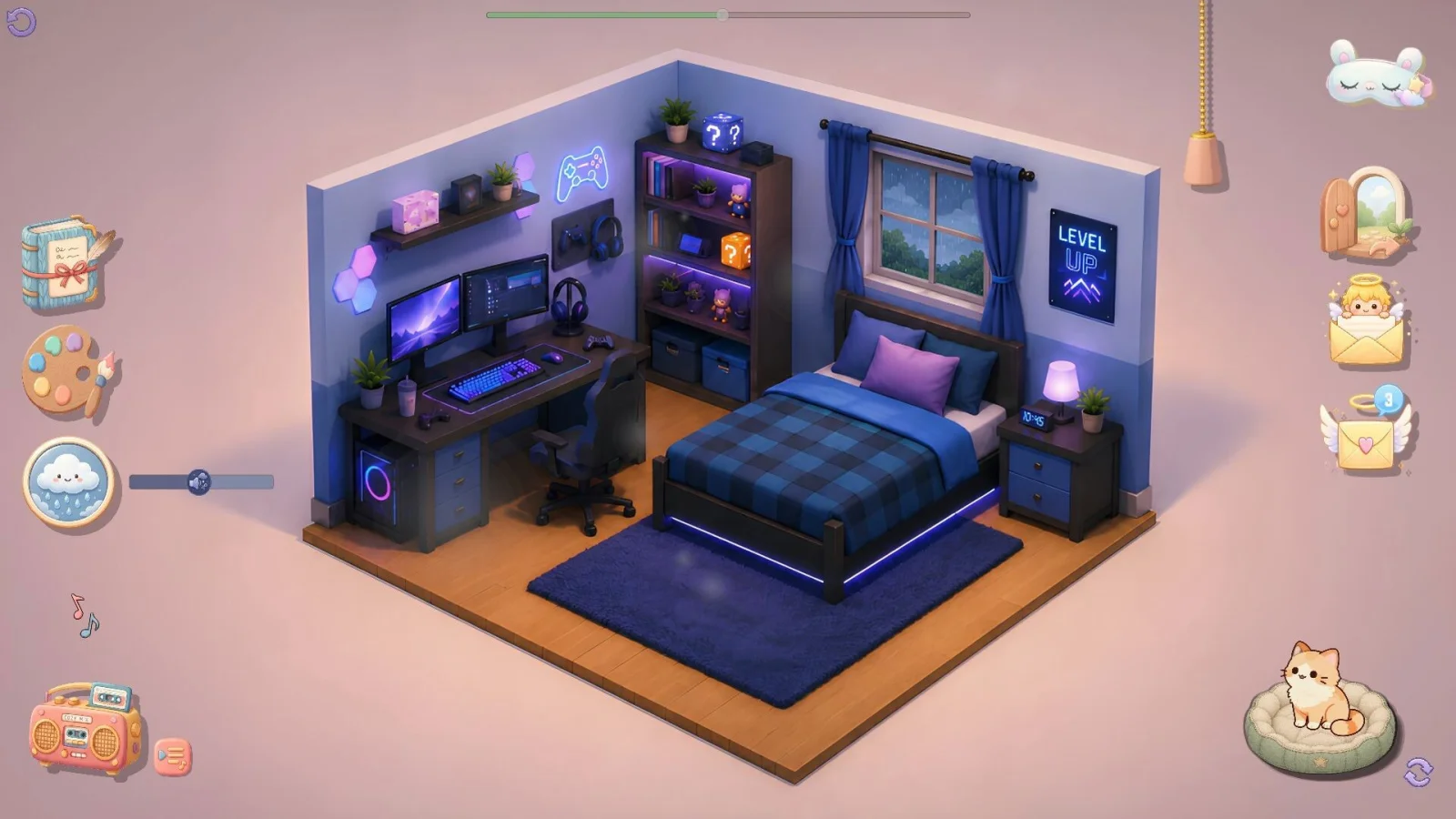
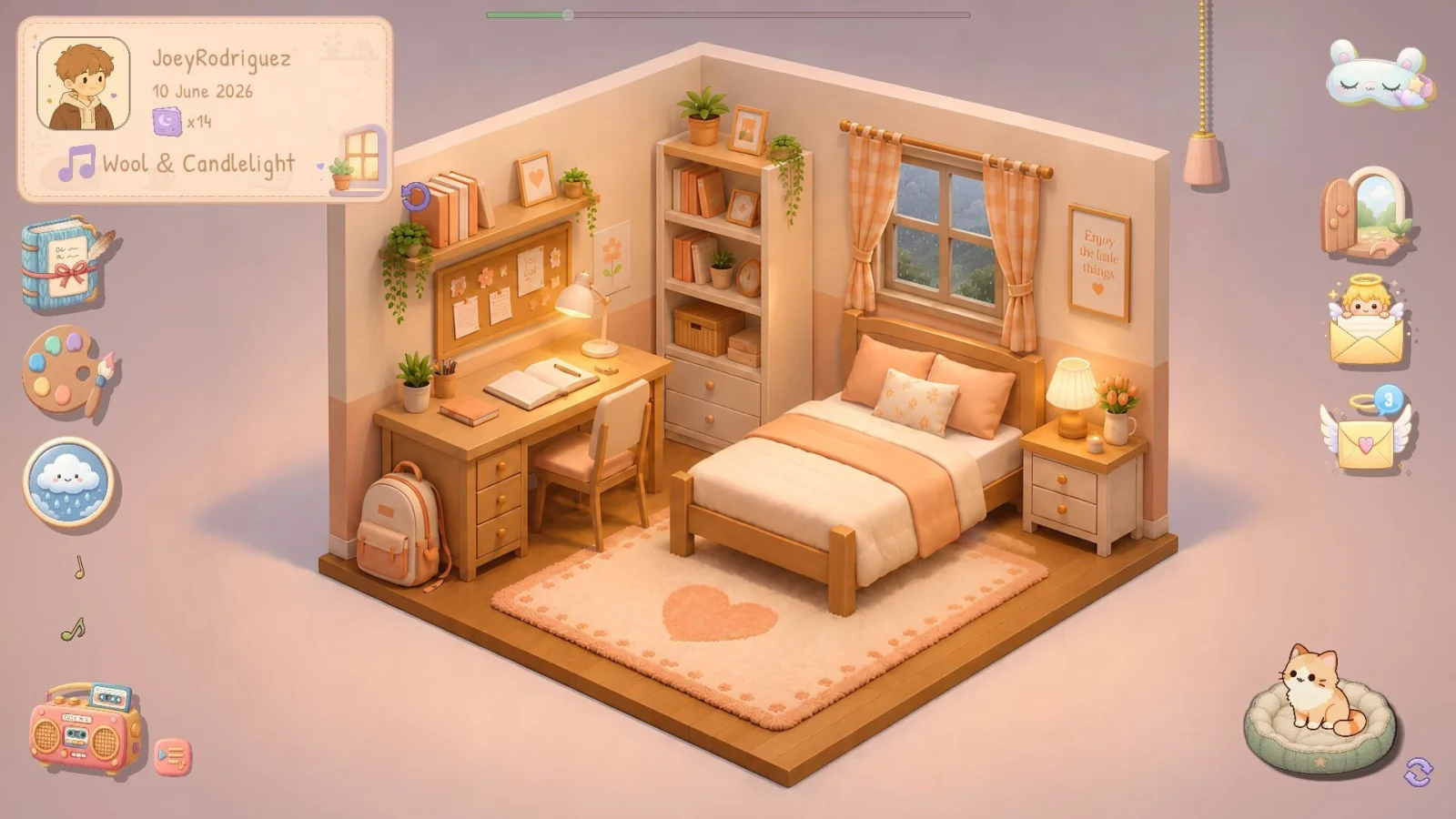
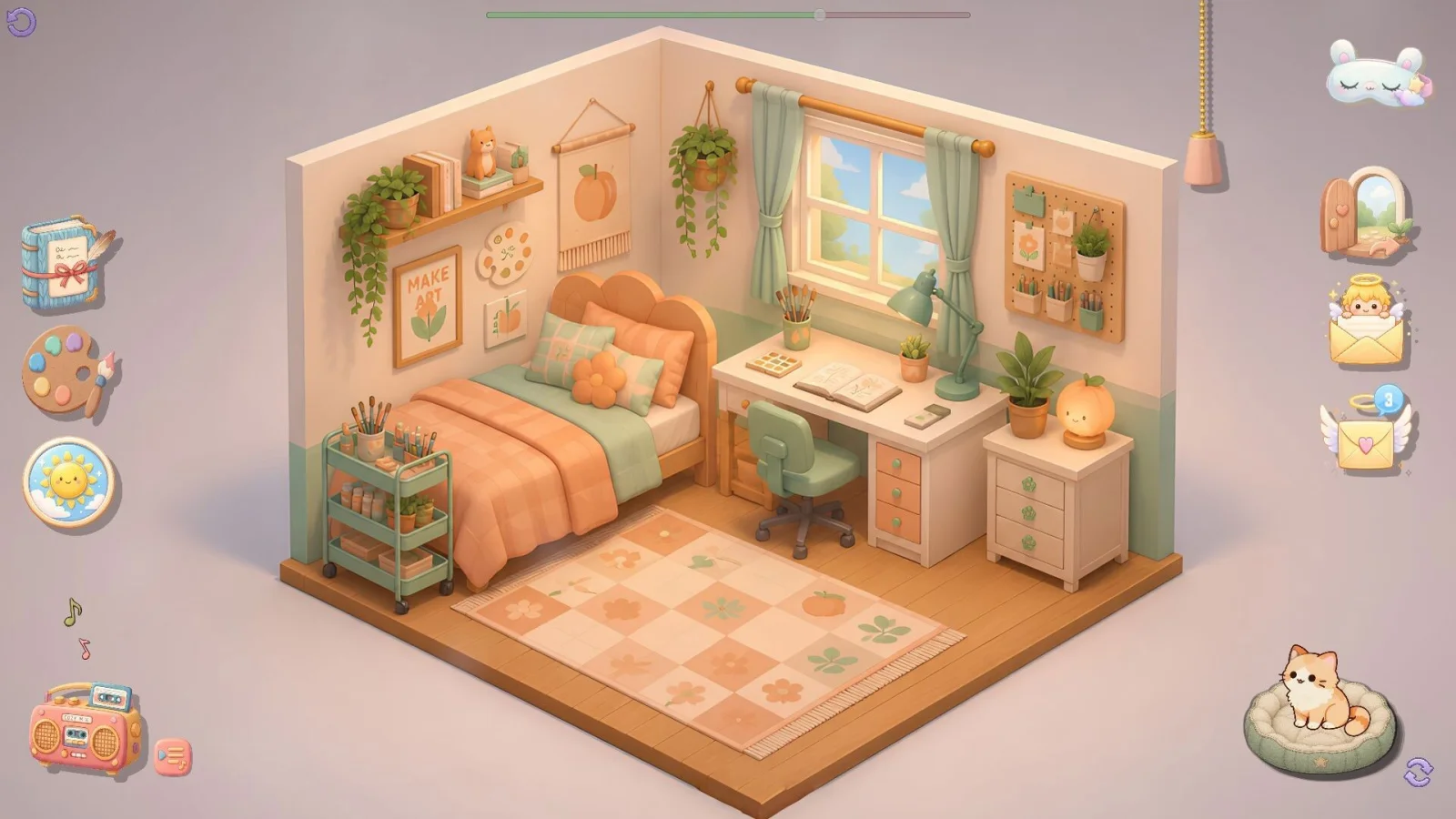
The confirmed feature set suggests a game organized around personal routine instead of conventional progression. Journaling and mood reflection put self-expression at the center, while daily totems and milestone books imply a structure for returning over time. Plant care, music selection, miniature games, and the cat companion add different kinds of small-scale engagement around that core. Steam Cloud support and achievements are also listed, which may be welcome for players who want their records and milestones associated with the game to carry across PC use.
There is a sensible coherence to this collection. A player interested in a brief evening ritual may appreciate having several activities available without being pushed toward a grand objective. Journaling need not compete with reflex challenges; a miniature game can simply offer a change of pace between quieter tasks. Likewise, the presence of milestones may give repeated visits some shape without turning reflection into an obligation. The strongest reading of Cozy Liora is not as a game that must fill every spare hour, but as one that wants to occupy a small, repeatable corner of a day.
Still, the official list alone cannot establish how well these elements reinforce one another. It does not confirm the range of journal tools, the scope of plant care, how music selection functions, or what milestones require. It also does not show whether daily activities develop in meaningful ways across weeks of use. Those omissions are not faults by themselves—Early Access is inherently unfinished—but they are central buying considerations. Prospective players should be drawn by the idea of gentle repetition, not assume the kind of layered customization, evolving simulation, or elaborate management loop found in more system-heavy games.
Companionship is part of the pitch, with defined limits
The cat companion is a confirmed part of the base experience and fits the game’s domestic, low-stakes framing. For some players, a small recurring companion presence may be an important part of making a daily check-in feel inviting. But it is worth keeping expectations specific. There is no basis to assume extensive interaction options, complex pet behavior, or broader care systems beyond what is explicitly described. The dog companion is separate DLC and should not be treated as included with the base game.
Similarly, room interactivity should be approached as an aspiration rather than a purchase guarantee. Expanded room interactivity is identified as a development aim, not confirmed functionality. There is no support for claims of freely arranging furniture or building a personalized room layout. That gap is important because decorating and spatial customization can radically change how much ownership a player feels over a cozy game. For now, Cozy Liora is better understood through its verified everyday activities than through an imagined future version with a deeper interactive home.
The social feature is warm in concept, uncertain in practice
Anonymous letters are potentially the most distinctive and most complicated element in the package. They introduce the possibility that a private-feeling routine can brush up against another person’s day: a kind note or small message from elsewhere may suit the game’s reflective tone. That possibility can make a largely solitary set of activities feel less sealed off.
But anonymity is not an automatic synonym for comfort. The available information does not establish whether letters can be disabled, how they are matched or retained, whether they support conversations, how moderation or filtering works, or what privacy practices apply. It would be irresponsible to promise safe or consistently uplifting messages without those details. The feature is best viewed as a design tradeoff: it may add human warmth and unpredictability, while also introducing uncertainty that some players will prefer to avoid. Anyone especially sensitive to unwanted social contact should seek clearer, up-to-date information about this system before making it central to their decision.
What a dated August preview observed
A PC preview published on August 19, after the April 27 Early Access launch, described an appealing quiet atmosphere but questioned whether the activities formed a strong overarching loop. It noted limited pet interactions, preset room backgrounds rather than free furniture placement, brief daily rituals, and some miniature-game rules that were not immediately clear. It also found the anonymous-letter idea capable of producing either welcome warmth or inappropriate messages. These observations concern the unspecified PC version covered at that time, not a current-build test, and later changes are possible. Even so, they usefully underline the key question facing Cozy Liora: whether its individual pleasant touches add up to a durable reason to return.
That question is not unique to this game. Small routine-led projects often need to decide whether their chief value is atmosphere, expression, collection, mastery, or social surprise. Trying to be all of them at once can leave each element underfed. A comparison point from elsewhere on the site is Oops! You’re the Hero! Review: A Promising Fantasy Detour Still Waiting for Its Quest Log: they are very different kinds of games, but both raise the broader Early Access question of whether a charming premise has yet found enough structure around it. Cozy Liora does not need quests or combat to answer that question. It needs its chosen daily actions to feel deliberate, varied enough for its intended cadence, and connected to the player’s sense of personal space.
Early Access makes expectation-setting essential
Cozy Liora launched into PC Early Access on April 27, 2026, and no final release date is confirmed. That status should be treated as meaningful, not as a footnote attached to a finished product. Development aims may be realized, revised, or delayed. There is no performance data or current-build testing available here, so claims about stability, technical polish, or recent changes would go beyond the evidence. There is also no basis for a final-game verdict.
The developer has explicitly disclosed the use of AI-generated visuals. That transparency gives players a clear point to weigh against their own preferences. For some, the disclosure may be enough to make an informed choice; for others, it may be a decisive concern. Either way, it belongs in the purchasing context rather than being obscured by the game’s gentle presentation.
Player comments show divided emphasis: some value the low-pressure companion feeling and small activities, while others want substantially more interaction. Those impressions are anecdotal rather than a verified consensus, but they align with the clearest divide in Cozy Liora’s appeal. This is likely best suited to players who welcome a small digital ritual and can accept limited scope while development continues. Players seeking deep customization, detailed pet simulation, robust social controls, or a dense loop of long-term goals should wait for clearer evidence of how the project grows.
Who should keep Cozy Liora on their radar
- Potentially a fit: Players who enjoy short, reflective PC sessions built around journals, mood check-ins, plant care, music, and small activities.
- Approach cautiously: Players who need confirmed control over social features, or who expect anonymous interaction to be consistently pleasant and safeguarded.
- Probably wait: Players looking for freeform room design, expansive companion interaction, a fully developed life simulation, or confidence in a final feature set.
For now, Cozy Liora’s most persuasive quality is restraint. It has a clearly identifiable niche: a compact, companionable-looking space for recurring personal rituals. Its biggest limitation is that the evidence does not yet show how far that niche extends once the novelty of those rituals fades. Early Access can be the right place for players comfortable supporting an evolving small project, but the game’s gentle intentions should not be mistaken for proof of long-term depth. Cozy Liora is worth watching for people who want less game-shaped pressure in their day; it is not yet clearly established as the richer, more customizable cozy world that some may be hoping to find.