A Second Computer Beneath the Mega Drive
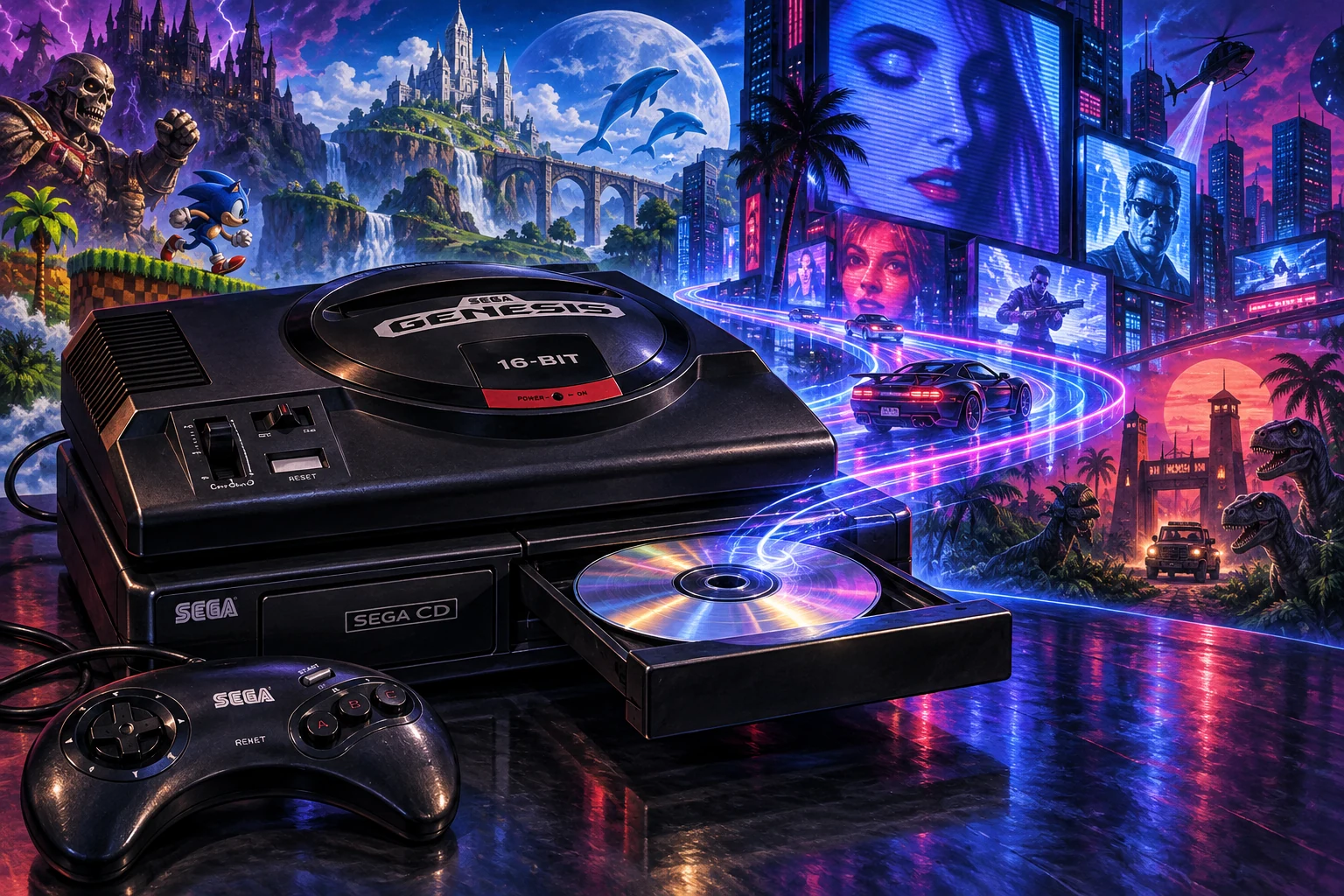
The Sega CD began as an answer to a problem the cartridge-based Mega Drive could not solve elegantly: how to give a 16-bit console the capacity and presentation of optical media without discarding the console already in millions of homes. It was the Mega-CD in Japan and Europe and the Sega CD in North America. Either way, it was an expansion computer that depended on an attached Mega Drive or Genesis for part of its operation.
That relationship is the starting point for understanding both the hardware and its later software history. The add-on supplied a second Motorola 68000 processor, dedicated memory, a compact-disc controller, PCM audio, battery-backed storage and specialist graphics circuitry. The original console still supplied its own processor, video hardware and cartridge interface. A title therefore had to coordinate two computers with different responsibilities rather than simply run on a faster version of the Genesis.
Sega’s hardware documentation identifies the Mega Drive’s main processor as a roughly 7.6 MHz 68000—7.67 MHz in the cited NTSC specification—and the CD unit’s sub-processor as a 12.5 MHz 68000. The latter was not a transparent upgrade that made every existing cartridge game run faster. It had its own mappings, registers and software environment. Communication between the processors involved defined interfaces and shared or banked memory, so developers had to decide which processor would handle decompression, disc access, animation preparation, sound control or ordinary game logic.
That arrangement gave the Sega CD unusual flexibility for its time. A game could stream music from the disc, load larger quantities of data, use sampled speech or effects, and delegate selected workloads to the second processor. It could also continue using the Mega Drive’s established tile-and-sprite display system. The add-on’s rotation and scaling hardware transformed graphics data and assisted with effects, but it was not a polygon accelerator. The system was specialized rather than universally more powerful.
The Optical Drive Changed the Software Contract
A cartridge presents a console with a relatively direct relationship between program and memory. The Sega CD inserted several layers between the application and its data. The optical drive had to locate sectors, the CD controller had to decode them, the BIOS had to initialize the system and interpret the disc’s boot structure, and the application had to manage the delays of removable media. The disc could hold far more information than a typical cartridge, but capacity did not mean instant access.
Sega’s development material separates physical disc tracks from logical sectors, the system area from application data, and CD-DA playback from CD-ROM access. That separation matters because compact-disc audio and program data traveled through different paths. A title could use Red Book-style audio tracks for music while reserving the CD unit’s PCM engine for speech, effects or short musical samples. The two forms of sound were complementary, not interchangeable.
The dedicated PCM hardware was an eight-channel stereo system with 512 kilobits of waveform memory and a maximum sampling rate of 32 kHz. “Eight-channel stereo PCM” describes eight PCM channels mixed to stereo output; it should not be read as eight independent stereo pairs. Developers could alter playback frequency and volume, making a sample play higher, lower, louder or softer, but that did not expand the physical number of channels or raise the hardware’s sample-rate ceiling. The Sega CD therefore added a useful sampled-sound system without becoming an unrestricted modern mixer.
Those limits shaped the character of the software. A game with lavish CD music could still have relatively modest interactive effects if its PCM resources were crowded. A title built around speech had to organize waveform data and memory carefully. Meanwhile, the original Mega Drive’s FM synthesizer and PSG remained part of the wider audio picture. The Sega CD was not a clean replacement for the console’s sound hardware; it was another audio subsystem connected to it.
The same principle applied to graphics. The CD unit’s word RAM and rotation/compression facilities could support transformed sprites, large image sequences and data-heavy effects, but the attached Mega Drive still imposed its own display rules. Developers had to move data between memory areas, synchronize the processors and schedule access to the disc. In this sense, the Sega CD was closer to a specialized co-processor expansion than to the later generation of fully unified 32-bit consoles.
Model 1, Model 2, and the Problem of Calling It One Machine
The first Mega-CD and Sega CD was a large front-loading unit designed to sit beneath the original Mega Drive or Genesis. Its motorized tray made the add-on look like a compact hi-fi component, reinforcing the impression that Sega had attached a home audio device to its console. The later Mega-CD 2 and Sega CD 2 adopted a thinner top-loading design intended to accompany the smaller second-generation console. The physical redesign also brought different boards, drive assemblies and service requirements.
Those revisions should not be treated as a simple performance ladder. Sega’s published specifications retain broadly similar headline capabilities across the models, including the 12.5 MHz CD-side processor, eight-channel PCM, CD-DA mixing and battery-backed memory. The change was principally one of mechanical design, manufacturing and integration with later console styling. Individual board and drive revisions can still matter when diagnosing an aging unit, but the Model 2 should not be presented as a faster Sega CD merely because it is newer or smaller.
The distinction is historically important because modern accounts often treat the add-on as a single standardized object. Service documentation instead shows a family of related designs. A front-loading tray, a top-loading mechanism, different optical assemblies and different board layouts can produce different maintenance symptoms. A failure to read a disc is not automatically evidence of the same fault across every model. The original hardware was an electromechanical system whose behavior depended on both its firmware and its physical condition.
The external relationship with the Mega Drive also changed the meaning of compatibility. The CD unit did not operate in isolation: its expansion connector, cartridge slot, audio path and attached console all mattered. Regional console variants, video standards and BIOS revisions could affect whether a title initialized correctly. Even apparently minor differences in the surrounding hardware could become significant when software assumed a particular processor, timing environment or audio connection.
What Happened Before a Game Started
The Sega CD’s security story begins before anyone discusses unofficial discs or replacement firmware. At power-on, the system did not simply treat any optical disc as a program. The CD BIOS initialized the drive, examined the documented system and boot structures, interpreted identifiers and performed boot processing before exposing the application environment. Sega’s developer documentation gives the BIOS a substantial role in drive control, CD-ROM access, CD-DA playback, subcode handling, backup memory and related system services. It was firmware with operating-system-like responsibilities, not merely a logo screen.
This evidence establishes BIOS-mediated initialization and booting, defined startup data, disc identifiers and regional behavior. Sega’s technical bulletin also documents regional merchandise BIOSes, development BIOSes, security-code behavior and software or boot-area requirements in the documented development environment. It does not establish that every retail model used one universal anti-copy routine. Regional versions embedded differences in branding, language and compatibility behavior, and the precise checks can vary by revision. Claims should therefore be tied to a particular ROM, machine or development document rather than generalized across the platform.
The software contract had several layers. The attached Mega Drive or Genesis had its own cartridge-side conventions. The CD BIOS had its own regional and boot behavior. The disc contained identifiers and startup information that the BIOS expected to find. Later discussions often collapse these into a single idea of “the region lock,” but the original system was dealing with multiple pieces of information distributed across the console, firmware and disc. Regional incompatibility, BIOS or disc-structure validation, and anti-copy authentication are related questions, not synonyms.
Sega’s technical bulletins reveal that this environment was not frozen from the first development document onward. They refer to changes involving security codes, boot ROM replacement and development-board configurations. That evidence shows Sega refining the platform’s development and startup arrangements, but it does not prove that every retail model used every experimental or later-described security method. Development hardware and consumer hardware must remain separate categories.
A Sega patent filed with priority in 1992 describes a CD-ROM security approach involving identifiers, a security region, boot-sector checks and associated code. It is useful evidence that Sega investigated and claimed methods for controlling CD software. It is not, by itself, a service manual for every retail Mega-CD, nor proof that the described method was deployed unchanged in all regions and revisions. Patents describe claims and possibilities; they do not automatically document production implementation.
Why the Sega CD Was Not a PlayStation
The original PlayStation is a useful comparison precisely because its authentication system was different. Its physical disc-authentication method should not be projected backward onto Sega’s add-on. Sega’s documented startup structures instead place the BIOS and logical disc layout at the center of the explanation.
Sega’s published development material describes ordinary CD data organization, a system area, logical sectors, identifiers and BIOS-mediated boot processing. From that documentation, it is reasonable to infer that the relevant startup information was represented in the disc’s logical data, unlike the physical authentication method associated with the original PlayStation. The reviewed Sega documents do not establish a universal CD-R compatibility result across media, recorders, mastering methods, drive revisions or BIOS revisions.
The famous Sega v. Accolade decision belongs nearby but not inside the optical-drive explanation. The Ninth Circuit case concerned Genesis cartridges, Sega’s initialization code and Accolade’s efforts to achieve compatibility. The court’s 1992 decision, later amended in January 1993, treated intermediate copying and disassembly in that compatibility context. It did not decide how Sega CD discs authenticated, whether aftermarket BIOS replacements were lawful, or whether distributing game images was permitted. Its relevance is historical: Sega’s platform-access strategy already involved software initialization and trademark consequences before the CD add-on arrived.
Memory, Batteries, and an Official Expansion Cartridge
The Sega CD also expanded the console’s relationship with saved data. The unit contained battery-backed internal memory listed by Sega at 64 kilobits. That memory allowed compatible games to retain progress when the machine was switched off, but it depended on a power source and was subject to aging. A failed battery could erase saves without indicating that the optical mechanism or main processors had failed. A healthy drive and a healthy save battery solve different problems for an owner returning to a long game.
Sega’s documentation treats backup RAM as a defined system resource, complete with management routines and software expectations. Sega’s official Japanese listing dates the Backup RAM Cartridge to March 20, 1992, prices it at ¥6,300, and describes approximately sixteen times the internal Mega-CD storage. It provided removable, portable save storage for compatible systems. It was not a modchip, a boot device or a cartridge that executed Sega CD games; it used the ordinary cartridge slot for an authorized memory function.
That distinction matters because modern discussions often group every cartridge inserted into the Mega Drive under “hardware modification.” Sega’s Backup RAM Cartridge was part of the original product ecosystem. A contemporary replacement using flash memory or nonvolatile RAM belongs to a different historical category, even if it performs a similar practical function. Likewise, replacing a battery is maintenance of an original memory design, not evidence that the console was modified to bypass its software boundaries.
The internal and external memories should not be treated as automatically interchangeable. Titles could present their own save-management behavior, and compatibility belonged to individual software. Sega’s official accessory expanded the available storage and made saves portable; it did not erase the design assumptions of the internal backup system. That small distinction illustrates the wider history of the Mega-CD: Sega was adding capabilities around an existing console, not replacing every existing convention at once.
Development Boards Before the Aftermarket Era
The earliest experiments with the platform are easier to document as a changing development environment than as a single breakthrough by a named hacker. Sega’s manuals describe the target architecture, while technical bulletins record corrections, addenda and development-board revisions. Some material refers to interface boards, altered security-code handling and replacement boot ROMs for development configurations. Those references show that Sega’s own engineers and licensed developers were working with hardware that could differ materially from retail units.
That difference affected both security and software testing. A development board might offer ways to load code, inspect memory or replace startup firmware that were never exposed on a consumer Mega-CD. A prototype could use a different memory arrangement or boot expectation from the final product. Consequently, a surviving development image that fails on retail hardware is not necessarily corrupt, and a retail disc that behaves differently on a development board is not automatically evidence of a hidden consumer feature.
SN Systems’ SNASM documentation provides evidence of at least one commercial 68000 and Mega-CD-oriented toolchain. Its manuals describe host-side development hardware, cross-assembly and associated workflows. That record is valuable because it shows how developers could work with the two-processor platform without suggesting that every studio used SNASM or that one universal kit existed. Other vendors and internal publisher tools may have served different needs, but the reviewed evidence does not justify assigning a single first private devkit or first independent hacker.
The technical barrier was therefore not simply a locked optical drive. Developers had to understand the CD boot structure, BIOS services, processor communication, memory modes, PCM engine, graphics functions and disc timing. The Sega CD’s earliest security boundary was inseparable from its development boundary: the machine expected software to arrive through a carefully defined startup environment, while the tools needed to create that software remained concentrated among Sega and licensed partners. The later history of unofficial software would inherit that complexity rather than merely defeat a single lock.
When the Hardware Became a Community Problem
The surviving Sega documentation helped, but it did not eliminate the problem. Hardware manuals explained registers and mappings; software-development material described BIOS calls, disc access, Word-RAM modes, backup memory and the rotation/compression subsystem; technical bulletins corrected or revised earlier information. That collection was valuable precisely because it revealed how many separate contracts a title had to satisfy. It was less like a single programming manual than a set of engineering papers assembled around a specialized computer.
Retrodev’s documented Sega CD notes and experiments addressed practical gaps between knowing that a register existed and knowing how to construct a bootable, testable program around it. Megadev later assembled C and 68k support, headers, utilities, examples and documentation for Mega Drive and Mega CD development. Those projects support a narrower historical claim: named developers and maintainers converted scattered technical knowledge into more usable tools. They do not, by themselves, prove a single continuous movement or establish who first achieved private development.
Those tools matter because they turn a description of the machine into a practical starting point. A register map can tell a programmer where a function lives, but an example project shows how initialization, data placement and communication fit together. That makes the difference between understanding an isolated instruction and having a small working program to extend.
Building for Two Processors and a Slow Disc
Modern developers quickly encountered the same design tension that had shaped commercial software: the Sega CD offered more resources, but they were divided resources. The Genesis-side processor and the CD-side processor did not share one seamless address space or one automatic task scheduler. Code had to be assigned to the appropriate processor, data had to be placed in usable memory, and communication had to be synchronized through the system’s documented interfaces. A program that simply moved more work to the second 68000 could create contention rather than speed.
The optical drive added another constraint. A cartridge can expose program data with relatively predictable access, while a compact disc introduces seeking, buffering and transfer delays. Developers had to decide which assets belonged in resident memory and which could be fetched during play. Large music and video files were attractive because the disc supplied capacity, but interactive software still needed responsive graphics, input and sound effects while data was arriving. A well-designed title hid or organized those delays; a poorly planned one made them visible as pauses, loading screens or awkward transitions.
The memory arrangement made those choices sharper. Sega’s specifications list six megabits of total CD-side RAM, but that figure is not one undifferentiated pool available to every task. The documented arrangement includes program RAM and Word RAM, with Word RAM configurable for different uses, alongside separate 512 kilobits of PCM waveform memory, 128 kilobits of CD-ROM cache and 64 kilobits of battery-backed memory. A game might gain room for animation or decompression in one Word-RAM mode while changing how conveniently another task could access it.
The graphics accelerator was also powerful only within its intended role. Rotation and scaling could transform sprite-like data and assist with effects that would otherwise burden the processors, but the system retained the Mega Drive’s tile-and-sprite display model. It had no general polygon pipeline and no modern framebuffer waiting to accept arbitrary rendered scenes. Community projects that treated the add-on as a small Saturn quickly met the same limits that commercial teams had faced: palette organization, transfer bandwidth, display memory, processor time and the cost of preparing transformed imagery.
These constraints encouraged focused homebrew rather than straightforward imitation of late-generation console software. A small team could make good use of CD music, speech, larger graphics sets or decompression without recreating a publisher’s full video production pipeline. The most convincing projects generally selected a few features that suited their design. The Sega CD was not necessarily at its best when asked to demonstrate every capability at once; it was more revealing when a developer understood which resources were genuinely complementary and which merely competed for time and memory.
Small Releases, Real Constraints
Good Deal Games marketed Mighty Mighty Missile as an unaffiliated aftermarket Sega CD release. Its historical importance here is straightforward: developers could still produce and distribute physical software for the add-on after Sega’s original commercial support had ended. A finished disc had to satisfy the same basic startup, memory and display constraints as the older library.
For creators, the practical lesson was restraint. CD-DA could supply expansive music, PCM could add voices and effects, and the extra processor could assist with decompression or data management. None of those resources removed the need to design around the original display hardware. A project that used the disc as a warehouse, the CD processor as a dedicated support unit and the Mega Drive video system as the final display engine was often more plausible than one that tried to simulate a later polygon-based console. Homebrew’s strongest results came from treating the machine’s compromises as design parameters rather than pretending they did not exist.
FPGA Convenience Has Architectural Limits
Terraonion describes its MegaSD as a complete FPGA recreation of Mega-CD behavior, while Krikzz’s Mega EverDrive Pro manual describes a built-in Mega-CD core alongside separate RAM-cartridge and BIOS-swap functions for an attached original unit. These are manufacturer descriptions of distinct products and operating modes, not independent certification that either device reproduces every original behavior.
The specific conflicts are documented more narrowly than broad bus theories suggest. Krikzz says the internal core’s registers conflict with those of an external Mega-CD and that the 32X occupies address space required by the internal core. Terraonion documents restrictions involving original CD hardware, 32X combinations, Multi-Mega and CDX configurations, and a separate adapter for certain 32X-CD arrangements. These product-specific statements are enough to explain the incompatibilities without claiming that Sega itself documented a general rule about two devices competing for the same functions.
Console identity matters as well. The Nomad and Genesis 3 do not present cartridge audio in the same way as compatible earlier consoles. Krikzz’s June 23, 2026 manual identifies missing audio-input lines on those systems, while Terraonion records comparable limitations and, in the Nomad’s case, a hardware modification requirement for certain audio arrangements. A title may therefore execute correctly while its CD music is absent or routed incorrectly. “Boots” is not the same as “reproduces the complete original audiovisual experience.”
The same caution applies to 32X-CD software. A successful result on a Mega Drive with a 32X, a cartridge adapter and a particular core does not establish universal compatibility across every 32X revision or console combination. The 32X occupies address space and changes the expansion environment. The original Sega CD, a cartridge-based FPGA core and a software emulator may each resolve that conflict differently. Exact claims should identify the core, firmware, console, BIOS, video standard, audio path and attached hardware used in testing. The cited limitations here are features of the June 23, 2026 Mega EverDrive Pro manual and the current published MegaSD documentation, not timeless guarantees about every future revision.
A Legacy Defined by Translation
The Sega CD’s modern history is therefore a history of translation. Engineers translate a mechanical drive into an FPGA data path. Reverse engineers translate proprietary development knowledge into public documentation. Tool authors translate processor registers and BIOS conventions into libraries. Preservationists translate physical discs and aging hardware into archival records. New developers translate the add-on’s constraints into games that do not need to imitate its most famous failures.
The Sega CD was not a failed preview of the PlayStation, nor merely a delivery system for filmed actors. It was an ambitious second computer attached to a 16-bit console, and its complicated afterlife is a fitting continuation of that design.
Explore more modding histories
Compare these experiments with our original PlayStation modding history, original Xbox modchip and homebrew history and Dreamcast boot discs and homebrew story. Find more long reads in Editorial Spotlight and explore our game walkthrough library.