A Small Console With a Surprisingly Complicated Boundary
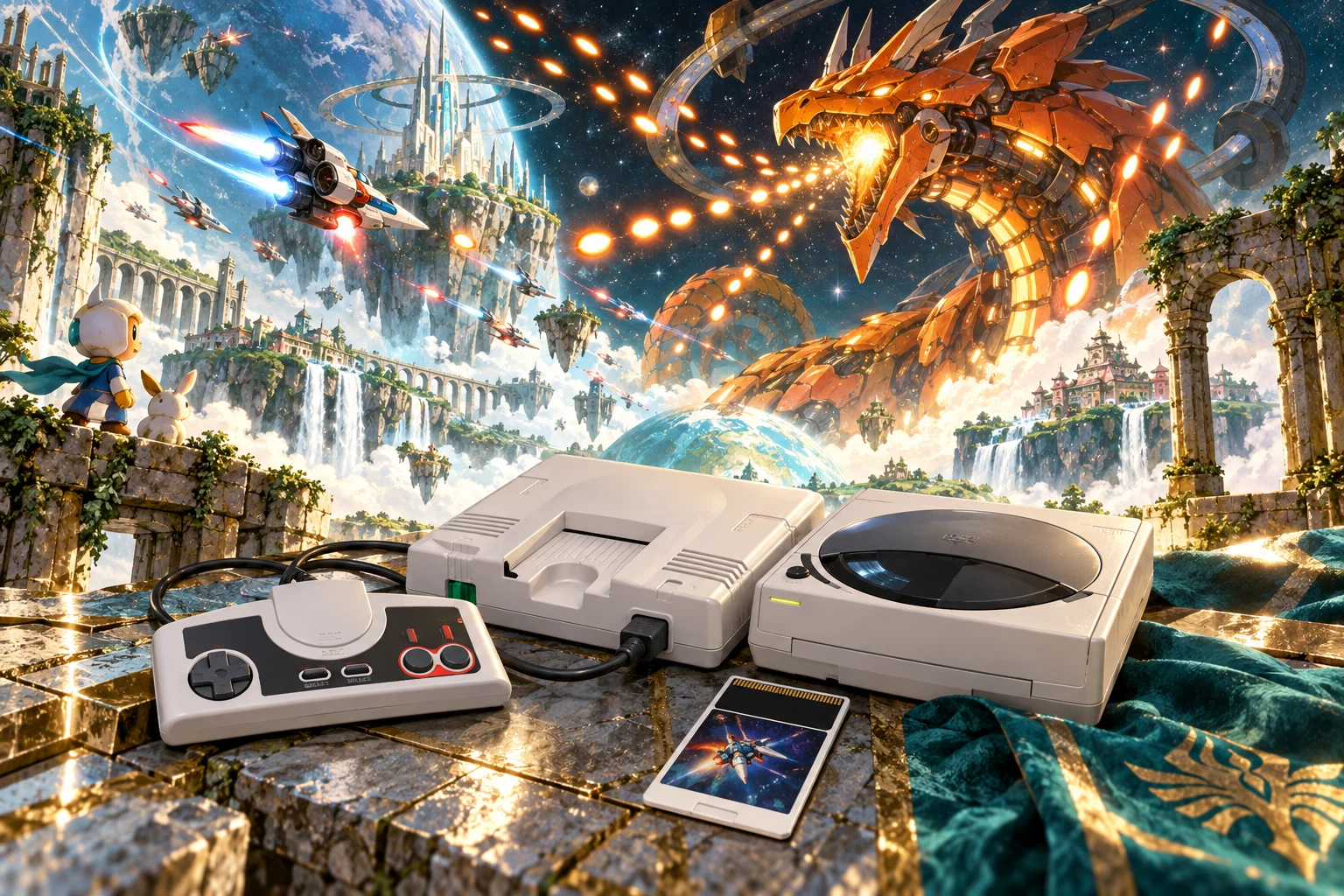
The PC Engine looked as though it had been designed to make consoles smaller, not more mysterious. NEC and Hudson Soft packed the Japanese machine into a compact case and placed its games on thin HuCards, plastic cartridges closer in appearance to credit cards than to the bulky ROM cartridges used by many contemporaries. In North America, the related TurboGrafx-16 presented the same basic idea under a different name and with different hardware details. That apparent simplicity concealed a platform whose software access, regional behavior and expansion paths were distributed across several components rather than guarded by one obvious lockout device.
The family is best understood as a collection of related machines. The original PC Engine, later CoreGrafx revisions, SuperGrafx, CD-ROM² combinations, PC Engine Duo models, TurboGrafx-16, TurboGrafx-CD and TurboDuo share a lineage, but they do not expose identical buses, memory arrangements or system software. A HuCard inserted into a console is not entering the same environment as a CD-ROM² disc, and a SuperGrafx title is not merely a larger ordinary game. Those differences shaped the earliest experiments with compatibility and modification long before modern flash cartridges and FPGA accessories made the subject easier to discuss.
The Hardware Behind the HuCard
At the centre of the system is the HuC6280, an 8-bit CMOS processor derived from the 65C02 family. Calling it simply a 65C02 would be misleading. NEC and Hudson added memory-management registers, timers, I/O facilities, block-transfer functions and a six-channel programmable sound generator. The processor still presents software with a 64-kilobyte logical address space, but that space is divided into eight 8-kilobyte windows. Each window can select a different physical bank, allowing the machine to reach a much larger address space than the CPU could expose at one time.
That arrangement explains how a physically small HuCard could hold software larger than the processor’s immediate view. A game does not see its entire program and all of its graphics at once. Instead, different banks are selected into the address windows as the program needs them. This was not an exotic add-on invented by later hobbyists; it was part of the console’s intended design. The same architecture later became a central consideration for homebrew programmers and flash-cartridge designers, because loading a game image is only half the task. The replacement hardware must also present the mapper behaviour that the software expects.
The graphics system adds another layer to the distinction between the CPU and the console as a whole. The HuC6280 does not itself draw the PC Engine’s tiled backgrounds and sprites. Those duties belong primarily to the HuC6270 video display controller, with the HuC6260 handling colour encoding. The result is a machine whose CPU is 8-bit while its specialised graphics hardware performs work through its own dedicated memory and transfer arrangements. Its sound likewise comes from the HuC6280’s programmable waveform generator, not from the later FM or sample-oriented architectures that often dominate discussions of console audio.
This division of labour mattered to anyone trying to reproduce or alter the machine. A device that merely supplied the right bytes to the CPU could still fail to reproduce the timing, graphics registers, audio behaviour or memory arrangement on which a title depended. The PC Engine was compact, but it was not electrically simple.
Regional Separation Without a Single Lockout Chip
The most visible early compatibility problem was the divide between Japanese PC Engine software and North American TurboGrafx-16 software. The boundary was partly built into the HuCard connector itself. The two regions used different presentations of the data bus: the relevant data lines were reversed between the Japanese and North American arrangements. What the PC Engine treated as one data bit appeared in a different position to the TurboGrafx-16. This was a physical interface distinction, not merely a matter of translating Japanese text or changing the television standard.
That wiring explains why an ordinary Japanese HuCard would not simply operate in an unmodified TurboGrafx-16, and why an American TurboChip would not directly run in an ordinary Japanese PC Engine. It is more accurate to describe the arrangement as regional separation implemented through cartridge wiring and software-visible identity than as a universal lockout chip. The platform did not use one NES-style authentication processor to decide whether every cartridge was genuine. Its regional behaviour was distributed across the interface and the software environment.
The important historical point is not a recipe for changing the wiring, but the design philosophy revealed by it: NEC and Hudson placed part of the market boundary in the physical bus and part in what software could observe. Regional compatibility therefore became an inviting target for aftermarket adapters and console modifications, even though the underlying system had no single security gate to defeat.
Regional adapters, internal video modifications and copiers changed different parts of the platform. Some addressed display standards or cartridge compatibility; others reproduced or replayed software. Their mechanisms tell us more than applying the same broad label to them all.
Why the CD Family Changed the Question
The arrival of CD-ROM² hardware made the regional and security picture more layered. A CD game was not simply a large HuCard image presented through the cartridge connector. The optical drive connected through an interface unit, while a removable System Card supplied the boot environment, working memory and software needed to initialise the drive and launch a disc. In later Duo systems, much of that System Card functionality was built into the console.
This meant that CD compatibility was governed principally by the System Card or built-in firmware, the host machine and the software’s expected memory environment. The discs did not use the same direct data-pin reversal that separated Japanese and North American HuCards. That is why the shorthand claim that PC Engine CDs are “region-free” is both useful and incomplete. The optical media did not carry the same cartridge wiring boundary, but the surrounding system still mattered. A disc could be mechanically readable while the available System Card or host environment prevented it from starting correctly.
The memory differences were substantial. The early CD-ROM² arrangement used a standard System Card environment with limited working memory. Super CD-ROM² software expected a larger environment supplied by a Super System Card or the equivalent functionality built into a Duo. Arcade CD-ROM² software went further, using the much larger memory resource provided by an Arcade Card. These were not simply new labels attached to identical boot software. Additional RAM changed how much data a game could stage, how often it needed to return to the disc and how much decompression or animation could be handled between reads.
The names also reflected different host configurations. The Arcade Card Duo was intended for Duo or Super CD-ROM²-class systems, while the Arcade Card Pro combined the expanded system environment with the larger memory resource for an original CD-ROM² setup. A PC Engine Duo was an authorised integrated product, not merely an original console with an aftermarket add-on. Likewise, a TurboDuo was a North American integrated machine rather than a generic description for every PC Engine-family system with CD capability.
The SuperGrafx complicated the expansion story in a different direction. It added a second HuC6270-class video processor, a priority/compositing device and additional memory, creating another graphics environment while retaining compatibility with ordinary PC Engine HuCards. It was not simply a faster PC Engine. Most ordinary software did not gain enhanced graphics automatically, while dedicated SuperGrafx titles depended on hardware absent from a standard machine. Its physical design also meant that connecting it to the original CD-ROM² arrangement required a dedicated adapter. Compatibility was therefore determined by the relationship among the console, the card, the CD interface and the software—not by a single upgrade ladder.
A 1993 Copier Documented in Period Literature
The clearest located period evidence for a PC Engine copier is a 1993 entry for the Magic Super Griffin in Richard Gibbs’s Complete PC Engine Guide Book. The guide describes an external unit occupying the HuCard port, using its own power supply and connecting to an external 3½-inch high-density floppy drive. Its menus handled disk formatting, file deletion and card copying, after which a selected image could be loaded back through the device as a card-like software source.
That account is valuable precisely because it is limited. It documents one copier offered for sale in the period and gives a contemporary price estimate, but it does not establish the first PC Engine copier, the identity of its original manufacturer, total sales, market penetration or complete compatibility range. The safest description is therefore “a copier documented for sale in a 1993 period guide,” not “the first PC Engine copier” or “the standard method used by everyone.”
Technically, the device exposed an important quality of the HuCard format. Software could be captured onto removable magnetic media and replayed through hardware that supplied the console with an expected cartridge-like interface. Its historical importance lies in showing how a bank-switched ROM architecture could be imitated outside NEC’s manufactured-card system. That history should not be confused with modern homebrew flash cartridges or preservation devices, whose documented purposes and software practices are different.
The legal context must remain equally precise. The Federal Circuit affirmed a preliminary injunction in Atari Games Corp. v. Nintendo of America, finding that Nintendo had shown a likelihood of success on its infringement claims. The opinion distinguished permissible intermediate copying of legitimately possessed object code for reverse engineering from Atari’s unauthorized source-code acquisition and later program similarities. Lewis Galoob Toys v. Nintendo, by contrast, held under the facts presented that Game Genie’s temporary altered displays were not infringing derivative works and affirmed denial of Nintendo’s injunction request. Neither decision adjudicated the Magic Super Griffin or established a general rule for PC Engine copying hardware.
A regional adapter, a video-output modification, a replacement optical assembly, a copier and an authorized CD peripheral each occupied a different technical and legal category. The absence of one famous lockout processor did not mean that every boundary was informal, nor did either Nintendo case settle questions about HuCard duplication. The platform’s early modification history is better understood as a series of narrower experiments in regional interfaces, CD system environments, storage substitution and hardware reproduction.
The Limits of a Small Software Scene
The PC Engine’s compact physical design encouraged experimentation, yet its development constraints discouraged casual experimentation. A programmer had to think in banks, not merely in total program size. The HuC6280 could address only a limited window at any one time, and code, graphics, sound data and tables competed for those windows. A routine that worked while assembled in one bank could become troublesome when moved, while pointers and interrupt code had to respect the boundaries imposed by the mapper.
The video hardware created a second set of constraints. The HuC6270 maintained its own video memory and expected data to be transferred through its registers and access patterns. Graphics were not simply copied into a universal frame buffer. Developers had to prepare tile data, name tables, sprite attributes and palettes in forms the video controller could consume. The CPU’s block-transfer facilities could help move data, but they did not eliminate the need to schedule transfers around display timing and available bandwidth.
The sound generator imposed a similarly direct relationship between software and hardware. The six-channel PSG was programmable and flexible, but it was not a general-purpose sample engine. Music drivers had to manage waveform data, pitch, volume and channel roles while leaving processor time for the game itself. CD-ROM² added streamed audio and voice possibilities, yet those capabilities belonged to a larger system environment with its own memory and interface assumptions. A developer moving a HuCard project into the CD world was not merely adding tracks to a larger release; the program had to account for another layer of hardware and system software.
These constraints gave the community a distinct technical vocabulary. “Banking” meant more than selecting a larger ROM. “System Card support” meant reproducing an expected software and memory environment. “SuperGrafx support” meant access to another graphics processor and compositing logic. A successful project had to identify which of those environments it targeted before its code or assets were organised. The machine rewarded careful planning and punished assumptions borrowed from simpler cartridge systems.
Tools That Made Original Software Practical
The HuC development system provided a documented route into original software development. Its importance was not that it removed the need to understand the hardware, but that it made a portion of that understanding expressible in C. The compiler translated a restricted subset of the language into code suited to the HuC6280, while PCEAS handled assembly, layout and platform-specific directives. Developers could build a game without writing every routine in assembly, but they still had to understand where code and data would live and how the resulting binary would be divided across banks.
Later maintenance work turned that old toolchain into a more usable development environment. The enhanced HuC project added improvements to language handling, preprocessing, allocation, code size and performance, alongside tests and host-system fixes. It also provided libraries for SuperGrafx and Arcade Card work. Those changes mattered because preservation is not only the recovery of old binaries. It also involves keeping the ability to create new programs after the original commercial toolchains and development machines have disappeared.
The community’s newer repositories show how development broadened beyond one compiler. Disassemblers made it easier to inspect existing software; emulator branches supplied controlled debugging environments; controller documentation recorded signalling behaviour; and hardware adapters allowed developers to move builds onto physical machines. A FeRAM adapter project addressed another practical problem by replacing vulnerable backup-memory components with non-volatile memory. The software may remain unchanged, but its ability to retain a player’s progress can depend on a component now several decades old.
That combination of tools encouraged a feedback loop unusual for a platform once regarded as commercially exhausted. A programmer could write code in a modern environment, assemble it with PCEAS, inspect it in an emulator, transfer a build through a development-oriented flash device and then compare the result with an original console. Each stage answered a different question. The emulator was useful for repeatable debugging; the flash device exposed real controller, timing and display behaviour; the original machine preserved the electrical environment that no desktop program could fully reproduce.
Flash Cartridges as Development Instruments
A conventional HuCard flash cartridge replaces the HuCard’s stored ROM and supplies the host with the mapper and any documented cartridge-specific RAM or registers required by the selected software. It does not need to reproduce the HuC6280, HuC6270, HuC6260 or PSG, because those remain in the host console. The accessory’s responsibilities are instead to present the selected program data and reproduce the cartridge-side behavior that the software expects.
That arrangement changed the economics of homebrew. Earlier Turbo EverDrive hardware could load a HuCard image from writable storage while the original console still executed the program and supplied its video, sound, controller and timing hardware. The device was an aftermarket cartridge replacement, not an emulator running on a general-purpose computer.
Community discussion sometimes uses “TurboED” as shorthand for older Turbo EverDrive hardware, but features should be assigned only to a specified revision. Krikzz publishes separate documentation for the PRO and CORE; those documents should not be retroactively applied to earlier models. The PRO product page reports that the model is out of stock as of September 16, 2026, so no current retail availability should be inferred here.
The PRO is a different class of device. Krikzz documents a Cyclone IV FPGA, 16 MB of PSRAM, a built-in CD-ROM² core, Arcade Card functions, Ten no Koe 2 support and USB development access. Krikzz also documents that the built-in CD-ROM² core does not operate when an external CD-ROM or Ten no Koe 2 device is connected, and that CD games cannot run through the core on Duo systems. The documentation states the restriction; any explanation of the electrical reason should be treated as an architectural inference rather than as a manufacturer-documented mechanism.
Krikzz also warns that CD and HuCard audio do not work through RF output on the relevant configuration because of the console’s mixing circuit. Successful booting therefore does not establish correct audio output. The development interface exposes resource regions and mode identifiers, useful for programmers but not a title-by-title compatibility guarantee. Physical testing remains valuable because an emulator, a feature list and a storage-capacity figure answer different questions.
Expansion-Port Emulation and Its Boundaries
Terraonion’s Super SD System 3 and Super HD System 3 Pro pursue a different architecture from a cartridge-slot flash device. They occupy the console’s external expansion bus and combine storage with CD-ROM² and System Card emulation, backup storage and video functions. The SHDS3 Pro adds HDMI and revised output processing. These devices are therefore participants in the console’s expansion and display architecture, not merely larger HuCards.
The Super SD System 3 guide documents a precise original-card limitation. When an original HuCard is detected, HuCard emulation is disabled while the CD-ROM block remains active. Because the accessory cannot identify the HuCard type, extra Super CD-ROM² RAM and Arcade Card emulation are disabled, and backup uses the common filename BACKUP.BUP rather than per-game naming. This is a documented operating mode, not a general statement about every expansion device.
Terraonion’s documentation supports SuperGrafx operation for software selected from storage, while distinguishing that path from original SuperGrafx HuCards inserted through the pass-through route. An original card does not necessarily trigger the accessory’s SuperGrafx simulation. The precise claim is therefore support for SuperGrafx images loaded from storage, not transparent support for every physical SuperGrafx card.
This difference illustrates why “supports SuperGrafx” requires a qualifier. A developer can target original SuperGrafx hardware, an emulator with documented SuperGrafx behavior, or an expansion accessory whose image-loading mode explicitly supplies the second video environment. FPGA status alone does not prove that a product reproduces a second VDC, priority hardware, video memory or every associated timing behavior.
Preservation Means Choosing What to Preserve
Modern accessories change the preservation tradeoff. An original CD-ROM² setup retains the physical interface, drive mechanism, disc-loading process and period user experience, but it carries mechanical and electrical risks. Optical pickups, transport parts, spindle assemblies, capacitors, power sections and backup-memory components can age differently. Those are categories of possible failure, not a universal diagnosis for every model.
An expansion-port CD emulator removes ordinary use of the optical mechanism and can reduce wear on drives and discs. It may load data more quickly, provide modern video outputs and offer convenient backup storage. In exchange, it replaces the original optical path with an FPGA model whose timing, audio handling and unusual edge cases must be evaluated title by title. It preserves the console shell and controller environment more closely than a desktop emulator, but it is not the original drive.
A cartridge-slot FPGA device makes a different compromise. It can preserve the original console’s HuCard execution path while supplying a virtual CD environment where the host configuration permits it. Its limitations include documented coexistence restrictions, Duo compatibility and audio-output considerations. It should not be described as an architectural conversion of a TurboGrafx-16 into a TurboDuo.
Save data adds another distinction. Native backup RAM, file-backed game saves and save states are different things. A save state records an execution snapshot, while a game’s own backup memory preserves data in the format expected by its software. Modern devices may support both, but a large SD card does not guarantee identical persistence timing, naming or failure behavior to the original hardware.
Legitimate homebrew and preservation projects benefit from this variety. New software can be tested on original machines, FPGA platforms and emulators; openly licensed releases can use flash hardware as a distribution and development medium; and researchers can compare an original console against a modern implementation without treating preservation tools as interchangeable with copyrighted commercial files.
The Second Life Is a Reconstruction, Not a Single Replacement
The PC Engine’s modern ecosystem succeeds because it reconstructs the platform in layers. Flash cartridges reproduce HuCard access. FPGA cores can model special mappers, CD environments and Arcade Card memory. Expansion-port devices add video and audio paths. HuC and PCEAS preserve a route for new software, while emulators provide repeatable debugging and analysis. FeRAM and file-based saves address the fragility of aging memory.
The durable preservation strategy is plural: keep original hardware functioning where practical, maintain accurate software and save documentation, use emulators for analysis, and treat FPGA accessories as testable implementations rather than unquestionable substitutes. A modern device can be more reliable and more useful for development than an aging optical drive while still preserving a different slice of the historical experience.
The small console’s second life is therefore not a story about finally defeating a lock. It is a story about learning which parts of the machine were separate all along—and rebuilding those parts carefully enough that new software, old saves and specialised graphics modes can continue to meet one another.
Explore more modding histories
Compare these experiments with our original PlayStation modding history, original Xbox modchip and homebrew history and Dreamcast boot discs and homebrew story. Find more long reads in Editorial Spotlight and explore our game walkthrough library.