A Different Kind of Handheld Target
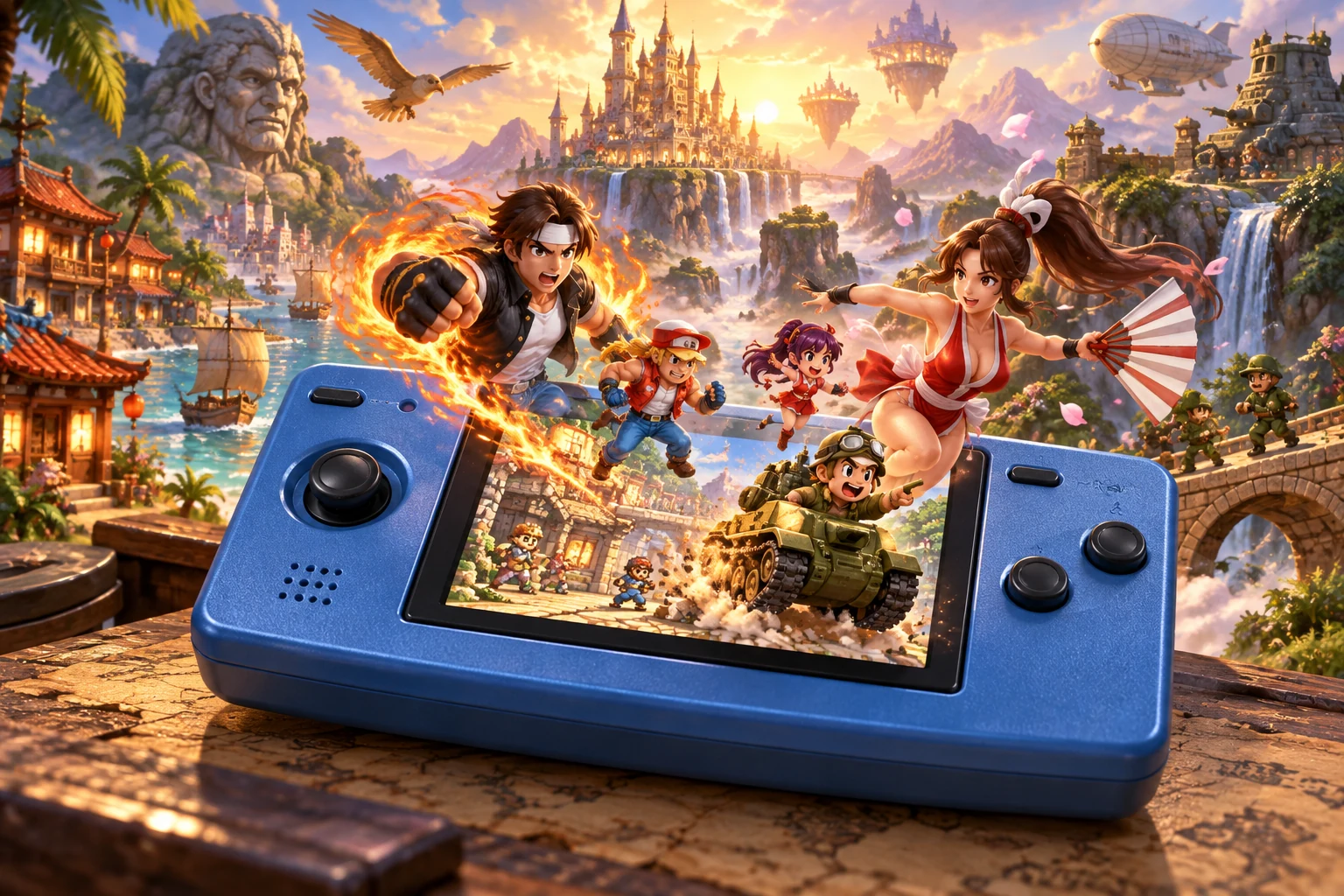
When SNK entered the handheld market in 1998, it did not shrink the Neo Geo AES and place it behind a small screen. The Neo Geo Pocket was a new machine with a different processor, a different display system, a distinctive control, and a cartridge design that would later make it unusually approachable to hobbyist developers. Its importance to modding history begins with that distinction: people were not discovering a miniature version of the company’s arcade hardware, but an idiosyncratic Toshiba-based computer whose internal logic had to be understood on its own terms.
The original Neo Geo Pocket was monochrome. The Neo Geo Pocket Color followed in 1999, retaining enough of the first machine’s architecture to run explicitly compatible software while adding a color display environment of its own. The relationship was practical rather than absolute. SNK’s manuals and packaging identified games that supported both systems, while other cartridges were marked for the Color machine alone. A Color Pocket was therefore not simply a monochrome console with a palette switch, and the original Pocket was not a universal host for later software.
That compatibility arrangement became important once programmers began looking beyond commercial releases. A developer needed to know which machine a program targeted, how the cartridge identified itself, and what the graphics hardware expected before a test build could be trusted. The same questions would later matter to flash-cartridge makers, emulator authors, and preservationists. The platform’s modding history was shaped less by a single security breakthrough than by a gradual accumulation of technical knowledge. The evidence supports a history of reverse engineering, development hardware, homebrew, emulation, and physical modification—not a verified universal unlocking event.
The Hardware Beneath the Shell
The Pocket’s main processor belonged to Toshiba’s TLCS-900/H family. Later emulator and development documentation models an integrated device containing that CPU core, a Z80 core, graphics and sound logic, a real-time clock, RAM and ROM resources. In that reconstructed model, K1GE and K2GE are the conventional labels for the monochrome and Color display configurations. The terminology describes the community’s technical understanding rather than a complete public SNK engineering specification. Software divided work between the main processor and a Z80-based audio environment.
The sound architecture added another layer. The Z80 core and PSG-style audio hardware gave developers a dedicated audio environment, but also required communication between two processor cores. Modern technical references reconstruct BIOS vectors, interrupt behavior, sound routines, and hardware registers from observed machines and software. They are valuable evidence, but they should not be mistaken for an original retail SDK released by SNK. The surviving record supports a picture of a capable but specialized platform whose development tools were never as widely documented as those for Nintendo’s handhelds.
The control system was equally unconventional. Rather than a flat directional pad, the Pocket used a small clicky joystick with a tactile, microswitch-like action. Its feel became one of the system’s defining traits, particularly in fighting games. The two-button layout forced arcade-derived software to reinterpret attacks and commands rather than reproduce a full arcade control panel. SNK and Capcom’s portable fighters used simplified inputs, selectable styles, and timing-oriented systems that suited the hardware. That made the Pocket interesting to programmers: its limitations were visible, but they were also specific enough to encourage deliberate design rather than straightforward downsizing.
Understanding the Cartridge and Its Saves
Experimentation centered on the cartridge interface: how the BIOS recognized software, how a program described its size and hardware, and how writable cartridge storage behaved. A modern console’s encrypted executable and signature checks are the wrong starting assumptions for this history. Researchers needed to understand the machine they actually had, rather than search for the equivalent of a later console’s jailbreak.
MAME’s reconstruction identifies Toshiba, Sharp, and Samsung flash parts, multiple capacities and block layouts, two-chip arrangements in some 32-megabit games, protected regions, and a system-reserved block. The BIOS and cartridge interface therefore had to recognize and address more than one physical implementation. This evidence supports a platform in which cartridge layout and identification mattered to execution; it does not establish one universal lockout mechanism or one uniform retail memory design.
Reverse-engineered cartridge documentation identifies flash devices and reserved writable regions in the platform; later linker documentation shows flash-based save handling on aftermarket cartridges. The exact memory arrangement was not necessarily identical across every retail title. The console itself used two AA batteries for normal operation and a separate CR2032 coin cell for retained system information and clock-related functions. That coin cell should not automatically be described as the battery inside a game cartridge.
This differs from the assumptions owners may bring from many contemporary Game Boy cartridges, where battery-backed SRAM was common, without implying that every Game Boy cartridge used that arrangement. Flash has its own write-cycle and retention considerations, and different Pocket cartridges could reserve different regions for saves. Manuals document user-facing save commands and resume behavior; they do not, by themselves, disclose the memory technology underneath.
The evidence does not identify a documented first Pocket hacker, first homebrew author, or first successful security experiment. Those labels appear attractive in retrospective histories, but the surviving record is too incomplete to support them confidently. The safer account is cumulative: emulator developers, hardware researchers, and hobbyist programmers gradually reconstructed enough of the cartridge, BIOS, graphics, and sound behavior for experimentation to become practical.
From Parallel Ports to Computer-Written Cartridges
Among the documented aftermarket devices was Bung’s Pocket Linker, also associated with UFO or Mr. Flash branding. Surviving software documentation identifies it as a parallel-port device from the late-1990s and early-2000s flash-cartridge ecosystem. Its purpose was to communicate with a writable Neo Geo Pocket cartridge through a PC, making it useful for development, backup, and experimentation.
Parallel ports were a familiar part of desktop computing when this class of equipment circulated. They provided a direct way for a computer utility to communicate with external hardware, but tied the development setup to ports, operating systems and drivers that would later become uncommon. Preserving the cartridge adapter alone was therefore not enough to preserve a usable workstation. The computer-side software and a compatible host mattered too.
Later software documentation credits DarkFader and Jeff Frohwein with a flashing utility associated with the Pocket Linker ecosystem. That attribution establishes their connection to surviving tools, but it does not prove that either person was the first Pocket hacker or the first developer to produce unofficial software.
A parallel-port linker changed development from an abstract exercise into a physical test cycle. A programmer could compile a small program, transfer an image, run it on an original console, and observe the result. The process was slow, and it depended on period computer hardware, but it connected source code, a writable cartridge, and repeatable testing. An official SNK link cable served a different purpose: multiplayer or title-specific data exchange between compatible consoles running supported software. The shared use of a communication interface did not make the two accessories equivalent.
Copiers, Development Tools, and the Legal Shadow
Bung’s name also appears in Nintendo’s late-1990s legal campaign against game-copying equipment. That wider business context helps explain the contentious reputation of flash hardware. It does not turn a Pocket development cartridge into a Nintendo product or establish a Pocket-specific court ruling. The useful historical question is what each device did and how it was used.
A development interface, a flash cartridge, a copier, and an authorized link cable can share technical ancestry while serving different purposes. Historical writing loses accuracy when the entire aftermarket is collapsed into one category. For the Pocket, the useful distinction is between an instrument for writing and testing software and a device marketed around reproducing a commercial library. Early hobbyist tools could support freeware, experiments, and development builds, even though the same general type of writable cartridge could also be used for unauthorized copies. The hardware’s potential did not determine the user’s purpose.
That is why the early scene is best understood as infrastructure rather than as a single exploit. The important developments were the identification of cartridge behavior, reconstruction of BIOS services, creation of tools that moved test images between a PC and a cartridge, and preservation of enough hardware knowledge for others to reproduce the process. Each step reduced uncertainty without erasing the boundaries between original SNK hardware, unofficial software, and aftermarket accessories.
From Original Software to an Open Question
Commercial games supplied many of the clues later researchers needed. Manuals documented user-facing saving, cartridge operation, link requirements, and compatibility labels. They did not generally document the exact memory parts, BIOS routines, or underlying hardware relationship between the two Pocket models. Games such as SNK vs. Capcom: The Match of the Millennium demonstrated how two handhelds could exchange data through an official cable, while Dreamcast-linked titles showed that the Pocket’s interface could participate in carefully designed cross-platform features. Those functions were title-specific, not evidence of a universal bridge into another system.
The manuals reveal how much of the Pocket’s identity was visible at the user level. Players encountered explicit save commands, compatibility labels, and link instructions without being told the exact memory technology underneath. Later reverse-engineering had to connect those observations to cartridge behavior and processor activity. That separation between what the manual promised and what the hardware actually did became a recurring feature of Pocket research.
By the early 2000s, the platform occupied an unusual position. It was commercially underrepresented beside Nintendo’s handhelds, yet its architecture was sufficiently distinctive to reward technical investigation. Its cartridge saves did not follow assumptions drawn from many Game Boy cartridges. Its Color successor was compatible but not identical. Its audio and video systems required specialized knowledge. And its first computer interfaces belonged to an aftermarket scene whose chronology is only partly documented.
The result was a foundation for later flash cartridges, emulators, display modifications, and homebrew frameworks, but those later developments should not be projected backward into the first experiments. The early Pocket scene was smaller and more improvised: parallel ports instead of USB, reconstructed behavior instead of a complete public SDK, and uncertain community chronology instead of a verified list of pioneers. What can be established is the gradual reconstruction of a commercial platform through technical observation, physical interfaces, and software written specifically for SNK’s unusual handheld architecture.
Designing for Two Small Screens
That scarcity shaped the culture. Knowledge circulated through emulator source, technical notes, disassembly, personal experiments, and small development communities rather than through a single authoritative SDK. Later project templates preserve pieces of that lineage in a more usable form. Those surviving attributions document important foundations, but they do not establish a first developer or a complete chain of credit for every technique.
Commercial games such as The King of Fighters R-2, SNK vs. Capcom: The Match of the Millennium, and Samurai Shodown! 2 demonstrated how arcade-derived ideas could be redesigned for a two-button handheld. Their lessons were practical: complex rules could be represented through selectable styles, compact animation, and carefully chosen inputs. They were design precedents as much as technical ones, but they should not be mistaken for documentation of SNK’s private development tools.
Homebrew Tools and the Emulator Boundary
Homebrew development on the Pocket was never just a matter of finding a compiler. The TLCS-900/H was unusual enough that programmers needed a processor-aware assembler or compiler setup, startup code that established the console’s expected environment, and libraries for graphics, input, sound, and cartridge access. The separate Z80 audio side made sound particularly revealing: a game could run on the main processor while still requiring a suitable driver, communication protocol, and data format before it produced music reliably.
The platform’s graphics imposed another set of choices. A small display rewards tile reuse, compact animation, and careful control of backgrounds and sprites, while the Color machine’s palette handling introduces decisions that do not exist in the same way on the monochrome model. A project aimed at both systems needs a fallback visual language and testing on the actual monochrome display path. Color-only work can use resources unavailable to the first Pocket, but immediately narrows its compatible audience.
Modern project templates descend from older frameworks and package cartridge headers, libraries, save helpers, build scripts, and emulator hooks. Documentation attributes an early framework layer to Ivan Mackintosh, but that does not establish sole authorship of the wider homebrew toolchain. The practical value of a template is that it moves recurring questions—binary layout, startup behavior, save addressing, and test-image launching—into reusable infrastructure rather than pretending those questions have disappeared.
Reverse-engineering tools add another layer. Ghidra support for the TLCS-900/H helps researchers inspect an architecture that mainstream retro-development tools rarely foreground. MAME supplies an inspectable hardware model, while Mednafen’s documentation distinguishes strong commercial-game compatibility from its recommendation of MAME for homebrew development. NGPDS is a later emulator and portability project for Nintendo DS-family hardware; it can contribute to preservation by making software usable on later hardware, within its documented limitations, but it is not a physical-console modification.
NgpCraft reports hardware-calibrated timing work, flash wait-state handling, BIOS research, real-hardware checks, and testing against a stated cartridge corpus. Those are developer-reported results; this article does not independently reproduce the project’s full test procedure. Its associated documentation repository describes an effort to organize platform knowledge and examples; that stated purpose does not establish that generated code universally works on original hardware. Emulators and automated tools can accelerate research, but original hardware remains important for timing-sensitive behavior, display quirks, sound interaction, and cartridge saves.
The Cartridge Turned Into a Development Medium
The early parallel-port linkers introduced the idea that a Pocket cartridge could be written and tested, but later projects made that process less dependent on period desktop hardware. Flash Masta’s Neo Linkmasta provided a later USB version of the computer-connected workflow. Its documentation describes save backup, restoration, and writing software to writable cartridges. It also records an eleven-unit limited edition for the first Neo Pocket Linkmasta; later units were identified as Neo Linkmasta. The distinction matters: the eleven-unit limitation belongs to the first limited edition, not necessarily to every later Neo Linkmasta unit.
A different Flash Masta product placed the computer connection inside the cartridge itself. The current product page says the cartridge accepts one or two files via USB. An earlier Flash Masta announcement described the 32-megabit design as two selectable 16-megabit slots; that capacity and switch arrangement should be attributed to the announcement rather than assumed from every current page.
The USB cartridge favors computer-driven iteration: revise a program, transfer it, test it on a real Pocket, and preserve save data or owner-created development and archival data using the documented tools. It is not the same as a menu-driven library cartridge, and its capacity and save behavior should not be generalized to every later device or commercial game.
RetroHQ’s manual documents the GameDrive’s flash-and-memory-card workflow, `.NGP`/`.NGC` handling, installation, and saving files back to the card. RetroHQ’s product page separately states the 15 MB onboard capacity, link play, unsupported resume functionality, and broad retail-game/homebrew compatibility claims. Those broad claims remain manufacturer claims rather than independently demonstrated universal results.
The GameDrive therefore offers access to compatible files stored on a memory card, with selected files installed into the cartridge’s onboard flash before launch. Its menu-driven design makes playback convenient and can support preservation workflows, while the USB cartridge suits repeated computer-led development. Neither device was an SNK accessory, and neither erases the differences among monochrome, full-sized Color, and Slim hardware. Together, these products show how improved interfaces changed the practical relationship between a hobbyist, a cartridge, and an original console.
Display Modding Rewrote the Meaning of Original Hardware
The display scene developed along a different path. A flash cartridge changes how software reaches the console; an IPS kit changes the console itself. The Neo Geo Pocket’s original unlit display was part of its late-1990s design, with viewing conditions and battery expectations that belonged to the period. The modern backlight movement reflects a new baseline: players expect indoor visibility, adjustable brightness, and sometimes selectable pixel effects.
The clearest documented kits target the full-sized Neo Geo Pocket Color. Flash Masta’s listing for a third-party Super OSD kit identifies brightness and palette controls, image positioning, pixel-effect options, and touch sensors, while explicitly excluding the monochrome Pocket and the Slim. The three machines differ in display hardware, enclosure dimensions, bezel geometry, and internal layout. A solution designed for one cannot be assumed to fit another.
The modification market includes both parts and installed systems. Flash Masta’s refurbished-console listings show how a display replacement became a finished product, with shell and front-lens choices rather than merely an electronic component. The replacement lens may not match the original color exactly, illustrating that preservation is not always visual restoration. A modified console can retain the original motherboard and controls while presenting a contemporary screen and altered exterior details.
A bright IPS panel improves visibility, but it also changes the visual rhythm for which the original display was designed. Optional pixel effects attempt to bridge those expectations by simulating a more period-like presentation on modern hardware. The result is neither simply untouched original hardware nor emulation: it is original Pocket software and core electronics viewed through a replacement display system.
The Controller Is Part of the Experience
The Pocket’s clicky stick also gives hardware restoration a purpose that a new screen cannot fulfill. A handheld game is read through the fingers as much as the eyes. Direction changes, diagonal inputs and repeated button presses determine whether a fighting game feels responsive. A beautifully illuminated display does little for a console whose controls no longer register consistently. That makes the condition of the original input assembly a separate consideration from the condition of the LCD.
For a homebrew designer, two face buttons are a design brief rather than merely a shortage. A single action can mean something different while moving, standing still or holding another input. That can make a compact control scheme expressive, but it also creates opportunities for accidental commands. Testing should distinguish whether an awkward move is a software decision, a worn control or a mismatch between an emulator’s keyboard mapping and the handheld’s physical input.
An emulator can preserve the rules of a game while changing how those rules meet the player. Conversely, restoring the original controls can preserve a familiar physical response even when an IPS panel changes the visual presentation. The two goals are compatible, but they are not identical. That is one reason a small, distinctive handheld can remain worth maintaining after its games become playable elsewhere.
Official Links Became Preservation Targets
SNK’s official link strategy gave later researchers an important example of what the Pocket could do beyond running a cartridge alone. Pocket-to-Pocket cables supported multiplayer and data exchange in selected games. The Dreamcast connection went further, but only in carefully defined title pairings. SNK vs. Capcom and Capcom vs. SNK could exchange points or trigger game-state effects, while other Pocket and Dreamcast combinations used their own protocols and benefits. The cable did not turn the handheld into a Dreamcast controller, transfer complete games, or create a universal bridge between the machines.
That narrowness was a strength from a design perspective. Developers could build a small exchange around an unlock flag, a score, an item, or another piece of state. Regional editions could differ, so even an official feature must be tied to a particular title and release rather than to the hardware label alone.
As the commercial platform receded from the contemporary market, these features became preservation targets. Researchers had to compare manuals with cartridge behavior and software execution, then document which functions belonged to specific games. Homebrew authors could treat link communication and save handling as engineering targets rather than rumors. The work was not a single jailbreak; it was the conversion of scattered commercial behavior into reusable technical knowledge.
An official link feature is a particularly interesting target because it depends on more than one surviving object. A working handheld and cartridge may still leave the experience incomplete if the correct partner game, console or cable is missing. Documenting the pairing and the exchanged information can preserve knowledge that a screenshot of the main game would never capture.
Preservation Without a Single Unlocking Moment
Neo Geo Pocket preservation operates across several layers that answer different questions. A linker can preserve save data or inspect cartridge contents. A flash cartridge can put a development build on original hardware. An emulator can reproduce execution on another machine. A metadata database can identify a dump and verify its integrity. An IPS modification can keep an original console usable when its screen no longer satisfies modern viewing conditions. None replaces the others.
Libretro’s Neo Geo Pocket Color metadata records names, serial numbers, file sizes, CRC32 values, MD5 hashes, and SHA-1 hashes. Such records do not distribute copyrighted game data; they provide identifiers by which researchers and owners can determine whether a personal archival file is complete or misidentified. Without stable metadata, preservation can retain files while losing confidence about what those files represent.
MAME adds another form of preservation by documenting the machine in executable form. Its driver models the processor arrangement, conventional K1GE and K2GE graphics configurations, cartridge flash behavior, BIOS relationships, and other platform details. Source code is not an original SNK engineering manual, and it can contain approximations or later corrections, but it makes the current state of technical understanding inspectable. NGPDS, RACE!, and related projects add portability and emulation layers rather than physical modifications, which can help preserve access to software by making it usable on later hardware while also exposing their own limitations.
The Pocket’s lasting achievement is the range of people who can still do useful work with it. A programmer can target its unusual architecture, an owner can improve a tired display, and an emulator author can refine an inspectable model of the machine. These are different projects, but together they keep a short-lived commercial platform available for far more than nostalgia.
Explore more modding histories
Compare these experiments with our original PlayStation modding history, original Xbox modchip and homebrew history and Dreamcast boot discs and homebrew story. Find more long reads in Editorial Spotlight and explore our game walkthrough library.