The disk that looked ordinary
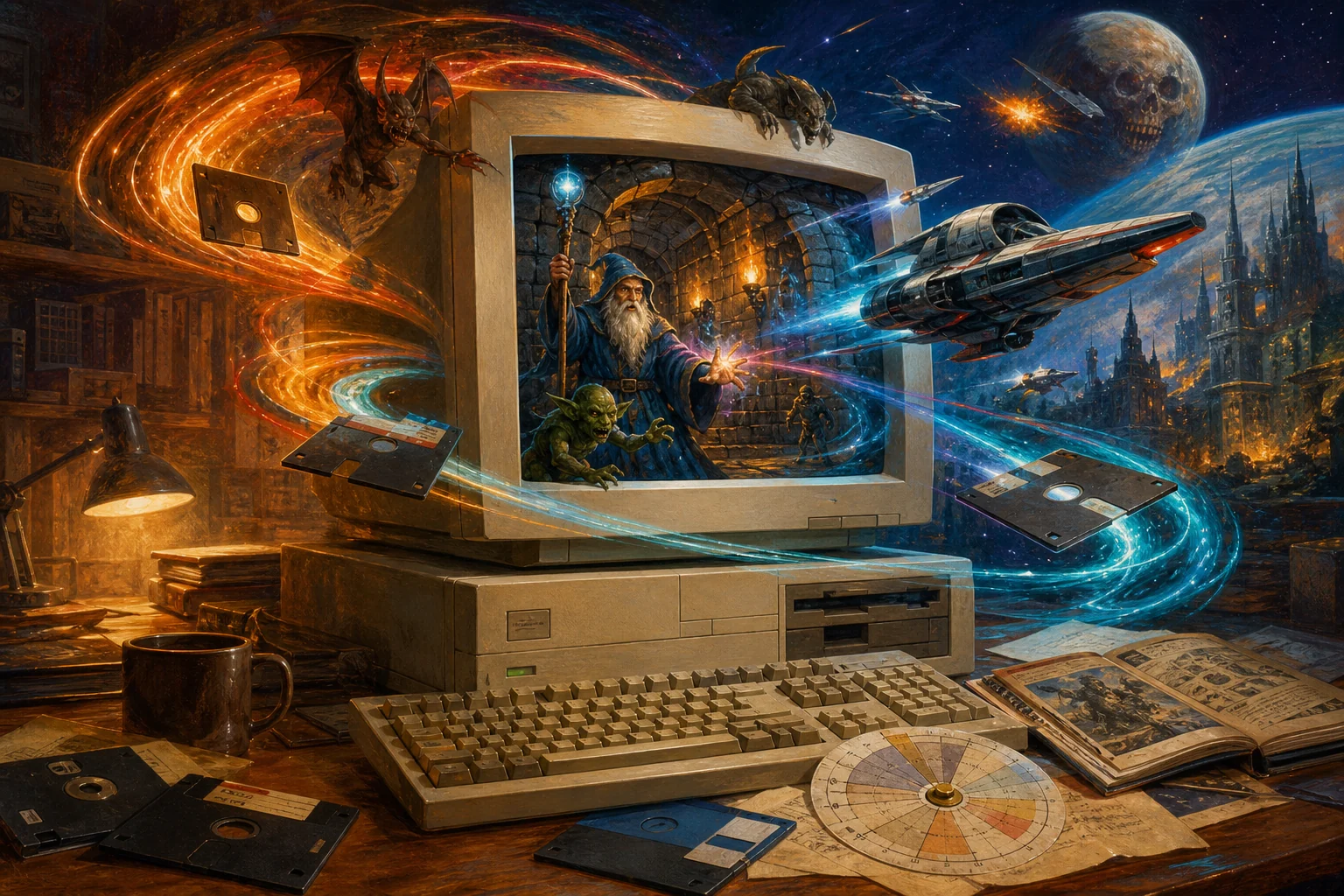
A command prompt could tell a convincing half-truth. On an MS-DOS computer, a protected floppy might list its files, copy several of them to a hard disk, and boot a program that appeared entirely normal—until the application asked for the original disk and rejected it. To the user, that looked like a mysterious filesystem. Technically, it was often the opposite: the visible filesystem was ordinary, while the test lived beneath the layer DOS usually showed.
The crucial distinction is between a disk format and a disk’s physical recording. MS-DOS presented files, directories, logical sectors, and allocation units. The floppy drive and its controller dealt with tracks, magnetic transitions, address marks, gaps, timing, and error signals. Software publishers learned to place an authenticity test in the space between those descriptions. A disk could be perfectly intelligible to DIR and COPY yet contain physical behavior that a routine duplication process did not reproduce.
That gap shaped both commercial copy protection and the early culture of software investigation. It also explains why later preservation work cannot always treat an old DOS disk as a bag of files. Before following the protection schemes, however, it helps to understand the machine that made them possible.
DOS was a layer, not the whole computer
An ordinary application reached a file through DOS services. DOS found the file’s directory entry, followed its chain of clusters through the File Allocation Table, or FAT, and requested the required sectors from the lower-level system. A cluster was simply the unit DOS used to allocate space; on a floppy it might contain one or more 512-byte sectors. The FAT recorded which clusters belonged to a file and which were free, reserved, or unusable.
Below DOS sat the BIOS, the Basic Input/Output System. IBM’s PC BIOS offered diskette services through software interrupt 13h, commonly called INT 13h. An interrupt was a controlled transfer to a system routine: a program placed requested values in processor registers, invoked the interrupt, and received either data or a status result. For disk operations, the conventional interface dealt in cylinder, head, and sector coordinates, not filenames.
That arrangement was convenient but not confining. A program could bypass DOS’s file routines and call the BIOS directly. More demanding software could communicate with the floppy-disk controller itself, or replace portions of the normal disk-handling path with its own routines. The controller’s job was narrower and more physical: it searched a track for the requested identification field, decoded the data, checked its cyclic redundancy check, and reported whether the operation succeeded.
A CRC, or cyclic redundancy check, is a compact mathematical value used to detect corruption in a block of data. It does not explain why a read failed; it tells the controller that the recovered bits do not match the expected relationship. To DOS, several very different physical situations might become the same unhelpful message: data error, sector not found, or read failure. A protection program could recognize the lower-level result even when the filesystem could not distinguish its cause.
This layered design was not an accidental invitation to piracy. It was part of the PC’s useful openness. Diagnostics, formatting utilities, operating systems, and specialist applications all needed access below the file level. But a publisher could write a program that asked a question ordinary file copying never asked: does this track contain the expected sector identifier, does the controller report the expected error, or does a repeated read behave in a particular way?
Three meanings of format
The word format hides several separate decisions. At the filesystem level, DOS used FAT12 on the small diskettes common to the early IBM PC. That structure described a root directory and chains of allocation units. At the controller level, the disk had an arrangement of tracks and sectors, with identifiers, lengths, gaps, address marks, and checksums. At the recording level, the drive translated digital information into magnetic transitions governed by a scheme such as MFM, or modified frequency modulation.
MFM did not place a neat row of eight-bit bytes on the surface. The controller wrote synchronization patterns, an address field identifying the track and sector, a data field, CRC values, and spaces separating those regions. The drive head sensed changes in magnetization, and the controller reconstructed a stream of bits from the resulting electrical signal. A standard sector image normally preserves the reconstructed bytes, not every transition or every deliberate irregularity that produced them.
This is why the phrase “weird filesystem” can mislead. A protected disk might have a normal FAT and ordinary files, while its special feature existed in an unusual sector header or in a location DOS did not allocate to a visible file. Conversely, a disk with an apparently bad area might contain nothing more exotic than a damaged surface. The filesystem’s record of a bad cluster was not proof of a physical protection mark.
Microsoft’s documentation for the DOS FORMAT utility makes that distinction unusually clear. Formatting was not merely the act of writing a blank directory and FAT. When the process encountered bad sectors, DOS could translate them into unavailable allocation units and mark the corresponding FAT entries so that later file operations would avoid them. That was a logical warning to DOS. It did not preserve the exact physical reason the controller had rejected a read.
A protection author could deliberately create a region that produced an error, an unusual sector number, an unexpected sector count, or a track layout a standard formatter would normalize. The resulting symptom might resemble a genuine defect, but the program knew where and when to expect it. The distinction mattered because a normal copy could either omit the region entirely or convert it into an ordinary, stable sector.
What the floppy controller knew
The controller’s vocabulary reveals how far below DOS these checks operated. Documentation for the Intel 8272 and NEC uPD765 families describes format, read, write, and scan commands, along with status conditions for missing address marks, wrong cylinders, deleted-data marks, bad CRCs, and missing data fields. These were responses from a device interpreting the recording protocol, not concepts stored in a directory entry.
A conventional BIOS read asked for a particular sector and expected a conventional answer. The controller searched for the matching ID field, attempted to decode the data, and returned a status. A protection routine could deliberately request something that should fail in a controlled way, then treat the failure itself as evidence that the disk had not been rewritten by an ordinary copying tool. The test was not necessarily looking for a secret string. It could be looking for a characteristic refusal.
This also explains why a sector copier was not automatically a physical duplicator. A file copier reproduced the bytes exposed through DOS. A BIOS-level copier reproduced sectors that the controller could read and that the software knew to request. Neither necessarily preserved unusual gaps, malformed identifiers, weakly recorded transitions, extra sectors, or a carefully positioned CRC failure. Even when a copier encountered the protected area, writing a successfully decoded value back to another disk could erase the very instability that made the original distinctive.
“Flux-level” is useful shorthand for the physical layer, but it should not be applied carelessly. Contemporary PC protection did not always involve an instrument recording raw analog magnetism in the modern archival sense. Many schemes relied on controller-visible behavior: a missing mark, a nonstandard sector length, a deliberately incorrect CRC, or a timing relationship at the edge of what the electronics would decode. The physical cause and the software-visible symptom were related, but they were not identical.
Weak regions and deliberate failures
A weak bit was a region whose magnetic state did not settle reliably into one repeatable digital value. Repeated reads might return different results, or a controller might fail to decode the area consistently. A normal digital copy has an unintuitive effect here: it reads one result and writes that result back in a more stable form. The copy can therefore be easier to read than the original while losing the behavior the protection test expected.
Other techniques used deliberately malformed or marginal sectors. A sector might carry an identifier that a standard operating system never requested, have a data field whose CRC did not validate, or occupy a track with an unusual length or sequence. These features were not all the same, and the terminology in later accounts sometimes blurs them. The safe common description is that protection authors exploited information the ordinary DOS abstraction discarded or normalized.
The patent record from the period documents several such ideas, including ambiguous recording, unreadable regions, nonstandard track lengths, and checks involving the position of a feature relative to the disk index. A patent proves what its authors claimed or disclosed; it does not prove that every commercial disk used every technique in the document. That limitation matters especially when later folklore assigns a precise mechanism to a named product without a surviving engineering manual.
The hardware environment added another source of variation. A typical 360 KB diskette conventionally used 40 tracks per side and nine 512-byte sectors per track. The later 1.2 MB high-density 5.25-inch format used 80 tracks per side and 15 sectors per track. Those numbers described common layouts, not an absolute limit on what the controller could encounter. Sector order, gap lengths, data rates, track density, and address marks could all vary within the broad world of IBM-compatible media.
A program that knew its expected anomaly could distinguish an original from a disk rewritten by a standard formatter. That did not require every protected disk to be visibly damaged. Indeed, the more effective schemes often left the directory and main program files looking unremarkable. Their unusual evidence appeared only when the loader addressed the medium in a way that normal DOS use did not.
The machine mattered as much as the medium
The labels on floppy disks were not complete descriptions of their behavior. A 360 KB 5.25-inch disk and a 1.2 MB 5.25-inch disk differed in track count, sector density, controller data rate, head geometry, and spindle speed. IBM’s AT documentation identifies the high-density drive as an 80-cylinder, double-sided mechanism with 15 sectors per track rotating at 360 revolutions per minute. Older 360 KB mechanisms used a different physical arrangement and were not simply slower versions of the AT drive.
This is why IBM guidance warned about interchange between 360 KB and 1.2 MB drives. The higher-density mechanism wrote narrower tracks, and a disk written by one drive could be read unreliably by another, particularly when alignment, head condition, or media characteristics were marginal. A drive that could mechanically accept the disk was not guaranteed to reproduce the same electrical signal or controller status.
PROLOK Gives the Disk a Fingerprint
Prolok is often described through a vivid story about a disk bearing a tiny laser-made hole. That account may reflect a real manufacturing method associated with physical signatures, but the surviving court record supports a narrower statement. In Vault Corporation v. Quaid Software, the Fifth Circuit described PROLOK as a system involving a disk “fingerprint” and a requirement that the original protected diskette be present. The opinion establishes the protected-disk concept and its role in validation more securely than it establishes the exact way every fingerprint was manufactured.
A later patent from the same protection era discusses physical signatures produced through damaged recording media, specially unwritable material, and related surface differences. It provides useful technical context for why a disk might possess a feature that software could detect but ordinary duplication could not reproduce. It remains, however, a patent disclosure rather than a product manual proving that every PROLOK release used a particular laser process.
Superlok and the inconvenient original
SUPERLoK’s documentation shows how copy protection could become part of installation rather than a single test at program startup. The guide says that its system disk had to be writable during installation and removal because an installation count was updated on the disk. It describes a maximum installation count of one, damaged installation records, hard-disk records, and a key-disk approach for environments in which ordinary installation was unreliable.
That arrangement changed the protected object. The customer might possess the executable files and still lack the expected state that made them usable. The distribution disk was not merely a read-only container; it also acted as a token whose condition changed during authorized use. A hard disk could hold the working program while the original floppy retained a role in authentication and administration.
The same manual records assumptions about drive types, FAT layouts, hard-disk formatting, caches, networks, memory-resident programs, and processor speed. It distinguishes arrangements expected on IBM PC and XT-compatible systems from those associated with AT-compatible machines. Such details reveal a protection system treating DOS storage as a concrete arrangement of bytes and sectors rather than as an abstract service. A third-party formatter could produce a valid-looking DOS volume that nevertheless placed structures somewhere the installer did not expect.
The manual's requirements could become support problems for a legitimate owner. It described Ashton-Tate distribution on 360 KB diskettes and required a 1.2 MB drive to operate in the appropriate 360 KB mode. Alignment, speed, controller behavior and resident utilities could also interfere with validation. The protection scheme had to work with a real customer's computer, not just the publisher's reference setup.
The open machine became a workshop
The same architecture that let a publisher inspect a disk also made MS-DOS unusually approachable to independent programmers. DOS did not place applications inside sealed processes. A program occupied conventional memory alongside the operating system, could inspect the interrupt vector table, and could install handlers for hardware or software interrupts. Microsoft’s documentation described terminate-and-stay-resident, or TSR, programs that performed initialization, left a portion of themselves in memory, and returned control to the command prompt. Later DOS versions supplied a preferred service for making that resident portion official, while the multiplex interrupt gave TSRs a way to identify an installation that was already present.
That openness had respectable uses. Utilities added keyboard hotkeys, print spooling, disk caching, screen capture, serial communication, or support for hardware that DOS did not understand on its own. A small resident program could mediate between an application and a device without replacing the operating system. Developers also learned that the boundary between “application” and “system software” was permeable: an executable could alter interrupt vectors, examine memory ownership, communicate with the BIOS, and restore the machine when it finished.
The arrangement was fragile. A TSR had to preserve registers and interrupt state, avoid calling DOS while DOS was already busy, and leave enough memory for the program that followed. A poorly behaved resident utility could corrupt a file, steal a keystroke, or make a game fail during its hardware checks. Those hazards were not side issues. They taught programmers where DOS services ended, where BIOS behavior began, and how much of a PC’s personality came from timing and convention rather than from a formal operating-system contract.
Microsoft’s DEBUG utility made a modest version of this knowledge available with the operating system itself. DEBUG could load and inspect a file, examine memory, assemble small sequences of machine code, and transfer control to them. It was intended as a development and diagnostic aid, not as a dedicated piracy tool. Yet its presence mattered culturally: the machine arrived with a means of looking inside its own executable environment. Curious users did not need a protected laboratory or a proprietary development workstation to begin asking what a program did between the command prompt and the screen.
From inspection to scene identity
The DOS cracking scene developed around that accessible machine environment. Releases circulated with group identities and increasingly elaborate introductions, turning technical competition into a recognizable visual culture. A modification hidden inside a program could be advertised through something immediately visible on the screen.
What can be described securely is the form the scene took. A modified release might carry a small introduction before the original program began. The crack intro, or cracktro, often displayed a group name, scrolling credits, greetings, music, colored text, and hardware-specific effects. It converted an invisible modification into a public signature. The altered branch or loader check was hidden inside the software, but the intro announced that somebody had examined the executable, understood its assumptions, and added a new layer of code.
The cracktro’s compactness shaped its style. A small .COM program could take control of text mode, write directly to display memory, use the PC speaker or an AdLib-compatible sound card, and hand execution to another file. The limited hardware encouraged dense presentation: scrolling messages, animated character sets, synthesized music, and carefully timed effects. These techniques overlapped with the emerging demoscene, whose participants generally created original audiovisual programs rather than modifying commercial software. The shared skills were real—direct hardware access, compact assembly code, custom music, and timing tricks—but the purposes and ethics of the two cultures were different.
Loaders, debuggers, and the protection contest
Publishers and scene programmers were reacting to one another across several layers. A commercial loader could verify a protected disk, inspect a controller result, compare an expected value, or confirm installer state. A scene-made loader might prepare memory, redirect execution, or arrange for a program to continue under different assumptions. The details varied by title and protection family, but the larger contest was between software that treated the machine as an observable system and software that tried to make a particular observation decisive.
A debugger was not the same thing as a loader. A debugger paused or inspected execution so a programmer could observe registers, memory, and instructions. A loader prepared an environment or transferred control to another component. A TSR remained available after returning to DOS. In practice, the same technically confident user might employ all three categories, which is why retrospective accounts sometimes blur them. Keeping the distinctions visible prevents every low-level utility from being described as a crack and prevents every crack from being treated as an ordinary file patch.
The scene’s response was cultural as well as technical. A successful modification could be packaged with a compact introduction, credits, music, or a group signature. That made an otherwise invisible change legible to a distributed community. The release identified expertise—memory management, executable analysis, graphics, music, or disk behavior—without proving that one person had invented the underlying technique. Contemporary artifacts are strongest as evidence that a particular release or intro existed, not as automatic proof of every attribution in its credits.
When protection became a package problem
Disk-based authentication was only one answer to the publisher’s concern. Other systems moved the check into the physical package: a key disk, a printed manual, a code wheel, or a hardware device. These approaches avoided some of the uncertainty of marginal magnetic media, but they made the purchased object larger than the executable and created new preservation dependencies.
Printed checks shifted the task to the manual or packaging. SSI documentation identifies named products that required an enclosed wheel before play. A code wheel was a rotating printed lookup device: the program supplied a prompt, the player aligned symbols or numbers, and the resulting code was entered. Such protection was application-level rather than a feature of DOS, and it could vary between versions or ports of the same title.
The preservation consequence was immediate. A disk without its wheel, key disk, or relevant manual was not necessarily a complete record of the original product. At the same time, a surviving accessory did not prove that the software used an unusual floppy format. The authentication object must be identified from the exact platform release and package rather than inferred from the title alone.
Dongles supplied another form of application-specific authentication. Attached through a serial, parallel, or specialized port, they answered queries from professional software and were generally more practical for expensive applications than for mass-market games. A dongle was not part of DOS, an ordinary expansion card, or an authorized console peripheral. It was an additional object whose model, interface, and driver could become part of the software’s historical environment.
The courtroom enters the floppy era
Vault Corporation v. Quaid Software provides the clearest legal record for this period. The Fifth Circuit affirmed judgment for Quaid on the copyright claims at issue, holding that RAMKEY did not infringe Vault’s reproduction right and did not constitute contributory infringement or an unauthorized derivative work under the theories presented. The court also held Vault’s anti-decompilation and disassembly license provision unenforceable under the circumstances of the case.
The decision concerned the claims and licensing terms before that court. Its historical importance was the collision between a commercial protection system and software designed to work around its restrictions. It was an outcome in a particular legal dispute, rather than a worldwide rule covering every later form of reverse engineering.
Preservation begins with choosing the right machine
The earlier history established why a DOS program could depend on more than its visible files. Modern preservation adds a decision about the historical machine being reconstructed. A command prompt is not a hardware specification. The same executable may behave differently on an IBM 5150, an 8088 clone, a 386 with a faster bus, or a late Pentium system running a compatibility environment. Video timing, keyboard behavior, memory size, sound hardware, floppy-controller behavior, and processor speed can all become part of the software’s practical identity.
DOSBox Staging is aimed at practical DOS-game compatibility and modern host usability, whereas DOSBox-X exposes broader DOS, development, and Windows-era configuration options. The distinction is one of project focus, not a universal ranking. A configuration that runs a game conveniently may still abstract away the particular controller, timing, or peripheral behavior that a historical investigation is trying to examine.
DOSBox-X is useful when the subject includes ordinary DOS programs, development environments, Windows 3.x or 9x, unusual memory arrangements, or applications that need more visible control over the emulated machine. DOSBox-X’s official project pages identified version 2026.08.31 as the current release on September 15, 2026; the project homepage gives August 31, 2026 as its release date, while the GitHub release record shows publication on September 1, 2026. That is a dated project-status observation, not a promise about future support.
86Box asks a different question. Rather than offering a generalized DOS environment, it models families of period PC hardware: CPU generations, BIOSes, video cards, sound cards, storage controllers, and peripheral combinations. That makes it valuable when a program’s failure is historically meaningful. A title that crashes on an emulated 8088 but runs on a 286 may be revealing a real timing or instruction-set assumption, not an arbitrary emulator defect. A demo that depends on a particular CGA behavior needs a machine model capable of representing the relevant display system, not simply a larger conventional-memory setting.
PCjs provides a related historical laboratory in a browser. Its emulated IBM configurations connect runnable DOS versions with period manuals, listings, boot sectors, and debugger views. That combination is useful for teaching and comparison: a researcher can see an early DOS environment as a configured machine rather than as an isolated executable. It is not a replacement for every specialized emulator, but it makes the relationship between documentation and behavior unusually visible.
A modern toolbox for legitimate investigation
Contemporary reverse engineering has also moved beyond the tools that happened to ship with DOS. DEBUG remains historically important, but modern researchers can combine DOSBox-X’s debugging facilities with disassemblers, emulators, binary viewers, and source-level tools on the host operating system. Ghidra and comparable analysis environments can identify code, data, relocations, interrupt calls, and probable control flow in executables produced for DOS. Their output is an interpretation, not an original source listing: packed code, self-modifying routines, overlays, and compiler conventions can still mislead automated analysis.
The most useful modern workflow is therefore comparative rather than magical. A researcher can inspect an executable statically, observe it in an emulator, compare its behavior under different DOS and machine configurations, and consult period manuals to determine whether an apparent oddity was intentional. This helps separate a copy-protection check from a sound-driver failure, a timing dependency, or an assumption about a particular memory layout. It also discourages the tempting but unreliable practice of treating one emulator’s behavior as definitive evidence of what the original software did.
There is a parallel history in compatibility layers and community modifications. A configuration file that changes CPU speed, sound hardware, or video timing is not the same thing as modifying the executable. A fan-made translation, widescreen patch, controller remap, or bug fix may alter the software while leaving its original protection intact. A cracked executable, by contrast, changes the commercial distribution itself. Public preservation writing should name these categories precisely instead of calling every altered file a mod or every working package a port.
FreeDOS and the living DOS ecosystem
MS-DOS preservation is not limited to recreating Microsoft’s releases. FreeDOS keeps the command-line environment active as a current open-source operating system, with its own kernel, utilities, documentation, and development community. It is compatible with a substantial body of DOS software, but compatibility is not identity. A program that works under FreeDOS has demonstrated that it can operate within a DOS-like environment; it has not necessarily behaved exactly as it did under PC DOS 2, MS-DOS 5, or a vendor-specific OEM release.
That difference is useful rather than inconvenient. FreeDOS provides a practical home for new utilities and modern hardware experiments, while historical emulators provide controlled evidence about old systems. Its tools can be used to prepare disks, manage files, compile programs, and test command-line behavior without treating an original Microsoft installation as the only legitimate DOS environment. Researchers should record the kernel and utility versions because seemingly ordinary commands can differ in switches, error handling, device support, and memory use.
Modern DOS development also benefits from compilers that did not exist in the early PC era. Open Watcom supports 16-bit DOS targets and can build substantial C and C++ programs for real-mode environments. DJGPP brought a protected-mode 32-bit development model to DOS, allowing programs to use far more memory than conventional real-mode applications while retaining DOS as their launch environment. Those toolchains demonstrate that “DOS software” is a family of execution models, not a single memory ceiling or compiler style.
That distinction matters for preservation. A tiny .COM program, a conventional .EXE, a DOS extender application, and a Windows 3.x program launched from DOS may all share a directory, yet they make different demands on memory, interrupts, and hardware. A modern compiler can reproduce the target platform while generating code with different timing, memory, or floating-point assumptions. Rebuilding a historic program from source is therefore not automatically equivalent to preserving its original binary.
The same ecosystem supports legitimate new work. Developers continue to create command-line utilities, graphical demos, text-mode applications, and games for real or emulated DOS machines. These projects are valuable not because they imitate nostalgia perfectly, but because they test which parts of the old environment remain usable. A new DOS program can serve as a controlled experiment in filesystem behavior, video timing, sound support, or memory management without altering a commercial title.
Homebrew proves the machine is still a medium
The 2015 demo 8088 MPH is a striking example of new work for early IBM PC hardware. The creators' final-version documentation targets IBM 5150, 5155 and 5160 machines with a 4.77 MHz 8088 and IBM CGA. That specificity is part of the artistic challenge: the production explores what a narrowly defined old computer can do rather than relying on a modern machine to make everything easier.
Area 5150 continued that creative tradition as another original DOS demo by CRTC and Hornet. Its creators' release material makes the intended hardware and presentation part of the work itself. These productions are new audiovisual programs, not additions attached to a copied commercial game.
These productions complicate the idea that DOS development ended when commercial publishers moved to Windows. The platform remained attractive because its interface to the machine was exposed. A programmer could choose to target a specific CPU, video mode, sound card, or memory arrangement rather than depend on a universal abstraction. That freedom imposes a cost: the resulting program may be difficult to port, and a faithful recording of its behavior may require a precise machine profile.
Homebrew games and utilities make a different preservation point. A new title built for DOS can document the practical limits of a compiler, extender, sound driver, or emulator at a known date. If its source code, build tools, binary releases, and test configurations survive together, future researchers gain more than a disk image. They gain a reproducible account of how a DOS program was made.
The distinction from the historical cracking scene remains explicit. Both communities may use assembly language, interrupt hooks, direct video access, and compact loaders. A demo or homebrew game is an original production distributed with its creators’ authorization. A cracktro is an added layer attached to an altered commercial release. Similar techniques do not erase different purposes or rights.
Preserving evidence without flattening it
The capture is still a measurement with provenance. Drive model, head condition, alignment, spindle behavior, interface electronics, capture software, retry policy, and disk condition can affect the result. Metadata and checksums therefore belong with the image. Repeated captures may help identify drive-specific artifacts, but they do not remove the need to describe what the equipment actually measured.
A preservation set can keep several clearly labeled derivatives alongside the capture record. A convenient image for an emulator need not displace the material used to create it. Keeping their relationship visible allows somebody else to revisit an interpretation when better tools or new information become available.
The same principle applies to package material. A disk may need its manual, code wheel, key disk, dongle, or installation documentation to represent the original product. A surviving accessory does not prove a particular disk format, and a complete sector image does not prove that the original physical distribution has been preserved. The archive should identify the medium, package, machine profile, and derived files as related but distinct records.
The security afterlife of old software
Later optical protection illustrates why the operating-system boundary matters. SafeDisc and SecuROM were primarily Windows-era systems, and Microsoft’s documentation identified secdrv.sys as a kernel driver used by games employing SafeDisc. The resulting security and compatibility problems belonged to a Windows driver model, not to the core floppy-based DOS architecture. A DOS game distributed on CD might instead use a DOS loader, an ordinary filesystem check, audio tracks, or a Windows installer; the disc itself does not identify the protection technology.
For preservation, old drivers are often more problematic than old executables. A modern Windows system may refuse a vulnerable authentication component, while DOSBox can run a game binary without reproducing the original driver environment. That may be the right practical choice for play, but it changes the object being preserved. The researcher should say whether the goal is to run the game, reproduce the original installation, document the protection, or retain evidence of the disc’s structure.
The current regulation contains separate, conditional exemptions. One covers lawfully acquired games whose external authentication server has ceased providing access, including specified personal local-gameplay uses. Another covers preservation of complete, lawfully acquired games that are no longer reasonably commercially available by eligible libraries, archives, and museums. The institutional preservation provisions require noncommercial activity and restrict the preserved game from being distributed or made available outside the institution’s physical premises. These are not blanket permissions to distribute protected software or bypass every check.
The Floppy Left More Than Files Behind
Copy protection made ownership of a DOS program unusually physical. A customer could have the files and still depend on a particular disk, a working drive, an installation state or a printed accessory. The resulting friction shaped technical competition, customer support and the way people learned to investigate their own computers.
That history is worth preserving because it explains behavior a directory listing cannot. The strange pause, rejected copy or request for a wheel was part of the original experience. Modern tools can make old programs accessible again while leaving enough evidence to explain what changed. The best outcome is both a game people can enjoy and a history that remains understandable.
Explore more modding histories
Compare these experiments with our original PlayStation modding history, original Xbox modchip and homebrew history and Dreamcast boot discs and homebrew story. Find more long reads in Editorial Spotlight and explore our game walkthrough library.