Before the Lynx Had an Atari Name
The Atari Lynx’s security story began before the handheld was called the Lynx, and before Atari Corporation had a commercial product to protect. Its first identity was Handy, the portable game system developed at Epyx during the second half of the 1980s. That distinction matters because the machine’s unusual hardware and its cartridge controls were already present in the Epyx design documents later inherited by Atari. Atari supplied the manufacturing, branding, distribution and continuing platform support; it did not originate every idea that made the handheld technically distinctive.
The surviving 1987 Handy documentation describes a self-contained color game computer with a backlit liquid-crystal display, a cartridge reader, an expansion connector and a nominal cartridge address space far larger than the memory in the console itself. It presents a machine designed not merely to display fixed sprites but to transform them in hardware, communicate with other units and alter the screen’s orientation. The retail Lynx would change in details, packaging and production implementation, but its underlying character was already visible in that development-stage description.
That makes the earliest Lynx security experiments a hardware-history subject rather than a story about a later software lockout. The question was not simply how to stop somebody copying a finished game. Engineers had to decide how a cartridge would identify itself to the machine, how the startup code would find a program, how a production game would be distinguished from an unfinished development build and how much control the platform holder would retain once cartridges left the factory. Those decisions were made inside a system whose processor and graphics functions were tightly interwoven with its custom chips.
A Portable Computer Built Around Two Custom Chips
The Handy architecture was organized around Mikey and Suzy, two custom digital integrated circuits that divided responsibilities in a way later simplified specifications often obscure. Mikey incorporated the 65C02-family processor environment along with timers, audio, input, serial communication and display-related functions. Suzy provided the sprite engine and hardware mathematics. Calling one chip the CPU and the other a graphics processor is convenient, but incomplete: the display pipeline depended on their cooperation, and several system functions crossed the boundaries suggested by those labels.
Suzy’s contribution was especially important to the machine’s identity. A Lynx game could describe sprites through structured data and ask the hardware to perform operations such as scaling, mirroring, clipping and distortion. That did not make the console a modern three-dimensional machine, nor did it remove the need for careful programming. It did move repeated visual work away from the 65C02-compatible processor. A developer could spend CPU time on game rules, input and communications while Suzy handled much of the mechanical work of composing the scene.
The display itself was similarly unconventional. The 160-by-102 screen could operate in multiple orientations, including the two landscape directions intended for left- or right-handed play and a portrait arrangement. The feature was not just a menu option that rotated a completed picture. It was part of the display and rendering model. Software had to account for how sprites, coordinates and controls behaved when the player reversed the handheld. A protection system operating at startup therefore sat inside a platform whose basic presentation model was already more flexible than that of many contemporary cartridge consoles.
The schematics reinforce the picture supplied by the programming manuals. They show the custom chips connected to memory, cartridge circuitry, display electronics and external connectors as parts of one system rather than as independent modules. The surviving board documentation is valuable precisely because it prevents the security discussion from drifting into generic console language. A cartridge did not plug into an abstract processor with a separate graphics card. It entered a bus controlled by a particular arrangement of chips, address lines, startup logic and memory devices.
Encrypted Frames, Loader Stages and the Production Gate
The Lynx did not treat a cartridge as an undifferentiated block of executable bytes. At reset, Mikey’s fixed boot ROM processed the first encrypted or obfuscated frame and jumped to address $0200. That address led into the cartridge’s first-stage loader. The loader then obtained and decrypted the second stage before continuing the startup sequence. Describing this as “Mikey decrypts the cartridge header” is convenient but too imprecise: the surviving reconstruction distinguishes encrypted frames, header data and cartridge-resident loader code.
The later loader performed the integrity check. Original loader variants did not necessarily inspect one identical region on every cartridge. The specified checksum or hash began after the protected header and covered cartridge regions whose extent depended on the loader generation and ROM size. The safe historical description is therefore that the production loader validated defined portions of the cartridge image before loading the main program, rather than that one universal hash covered every byte on every release.
The word “signing” also needs qualification. The Lynx did not use a modern certificate hierarchy. Contemporary development material supports a controlled production process for preparing the bootable cartridge image, while later technical reconstruction describes an RSA-based operation with a small public exponent and additional obfuscation. The detailed public algorithmic reconstruction is later preservation evidence, not an Atari-published cryptographic specification.
The production step should be attributed narrowly. Later documentation describes Atari-controlled preparation or encryption of the final boot structures, but the surviving public record does not establish the exact division of labor between Atari and Epyx. Ordinary development builds and debugging images should not therefore be called cryptographically signed, nor should the evidence be used to identify a first unauthorized cartridge or a single first reverse engineer.
This protection was meaningful without being an isolated modern secure-boot environment. Before ordinary game code ran, the fixed ROM and cartridge loader imposed format, decryption and integrity requirements. Once validation succeeded, the program used the same exposed Mikey, Suzy, memory, display and cartridge-bus resources as other Lynx software. Studying those resources eventually made legitimate original homebrew and preservation work possible, but that later accessibility does not show that a retail Lynx owner in 1989 could freely create a compatible production cartridge.
How Developers Encountered the Gate
The commercial development environment shows why the startup process was significant. Epyx’s Handy kit included more than a compiler: HandyASM, HandyROM, Handebug, graphics and sound utilities, sample code, macro libraries and specialized hardware. Howard and Howdy belonged to that engineering environment, not to the retail handheld. The workstation could help a team build, inspect and transfer software while the game was still being developed, but a production cartridge required a different level of preparation.
The distinction between a development image and a finished game was practical. During development, programmers needed to download builds repeatedly, examine memory and registers, test sprite behavior, tune music and investigate crashes. A production cartridge needed a stable startup structure that a consumer Lynx could read without the debugging equipment attached. The boot process and protected header were therefore connected to manufacturing discipline as well as to anti-copying intent. They helped define what counted as a finished, bootable release.
Handebug documentation and cartridge-download material belong to this less visible history. They show a platform being engineered for people who would work beside the console rather than only in front of it. Later development environments such as the Pinky and Mandy arrangements attempted to reduce the cost or complexity of that process, but they should not be confused with retail revisions of the Lynx. They were tools for creating and testing cartridges, and their existence demonstrates how far the commercial platform was from a consumer-friendly, plug-in programming computer.
The host environment was closely associated with the Amiga. A studio assembling Lynx software required a cross-development setup with assembler, linker, sound and graphics support, ROM-building utilities and debugging hardware. That expense created a barrier between the machine’s technical potential and the number of teams able to exploit it. It also meant that knowledge of the cartridge startup procedure lived partly in specialist documentation and production tools rather than in the retail owner’s manual. Players saw a game card and a booting handheld; developers saw a chain of tools that had to produce the correct data before the console would accept the result.
Atari’s later developer support did not erase that division. Contemporary Atari material describes the company continuing to support Lynx development after the original Epyx phase, including a dedicated support operation in Lombard, Illinois. The institutional story is therefore one of transition rather than a clean break: Epyx’s Handy documents preserve the original design identity, while Atari’s staff and publications show an effort to turn that design into an ongoing commercial platform.
ComLynx Reveals the Same Design Philosophy
The expansion connector provides another way to understand the early engineering priorities. Handy documentation describes a bidirectional serial interface intended for communication between multiple units, while Atari’s consumer material later promoted ComLynx multiplayer. The port was not an afterthought added once the handheld reached stores. Multiplayer support, like the rotating display and sprite hardware, belonged to the platform’s original conception.
ComLynx also shows why the Lynx cannot be reduced to its cartridge security. Mikey handled serial communication alongside timing, sound and input, while developer support material supplied software routines for managing messages and reserved memory. A game using multiplayer had to coordinate its own state with other handhelds over a wired connection. The platform’s security and platform features therefore met at the same practical level: both depended on developers understanding registers, interrupts, buffers and the timing behavior of the custom chips.
The retail manual presented ComLynx as an external, wired interface and warned that unsuitable cables could cause interference. That detail separates the original system from later wireless accessories, emulators and modern cartridge peripherals. The Lynx’s official multiplayer design was a physical serial network running through the exposed connector. Its advertised maximum number of linked players was a platform capability, not a guarantee that every game supported that many simultaneous participants.
This emphasis on interfaces carried into the cartridge process. The console was ambitious because it exposed useful capabilities to software, but exposure also made those capabilities subjects for examination. Developers needed access to the hardware to create games; later preservationists could study the same documented relationships among Mikey, Suzy, memory and the cartridge bus. The machine’s openness was never unlimited, yet its most important behaviors were visible enough that the platform could eventually be reconstructed without inventing a new console around it.
By the time Atari presented the Lynx to consumers in 1989, the system was therefore the commercial form of a much longer engineering experiment. The June Consumer Electronics Show introduction and the staged regional rollout marked Atari’s public handoff of the machine to players, not the beginning of its technical history. Behind the Atari branding remained Handy’s custom-chip architecture, its specialist development stations and its guarded cartridge startup path—the combination that would define every later attempt to study, preserve or extend the handheld.
When the Commercial Pipeline Began to Fray
The Lynx’s first middle era was defined by a mismatch between technical ambition and commercial continuity. Atari had inherited a sophisticated platform, but its creator, Epyx, was under increasing financial pressure. For developers, that meant the important question was not only whether the hardware could produce impressive results, but whether the documentation, tools and support needed to exploit it would remain available. A console can survive a disappointing sales period; a specialist development ecosystem is less resilient when the companies behind it are reorganizing or disappearing.
Atari’s contemporary publications present the company as an active custodian of the platform rather than a passive owner of an abandoned design. By the early 1990s, Atari described a continuing Lynx support operation and highlighted personnel working with outside developers. That support mattered because the machine’s unusual programming model could not be reduced to a few pages of generic 6502 advice. Studios needed information about sprite control blocks, display timing, sound routines, cartridge construction and multiplayer communication, along with help diagnosing failures that might occur in custom hardware rather than in ordinary game code.
The institutional handoff was nevertheless imperfect. Epyx’s original Handy documentation remained central to understanding the machine, while Atari’s later material represented the commercial platform and its support practices. The result was a layered archive rather than one seamless manual set. Some documents describe a design-stage system; others describe a retail Lynx or an updated development environment. Revision notes, tool releases and surviving schematics are consequently more informative than a single retrospective specification. They show a platform changing hands while retaining the assumptions of its first engineering team.
Epyx’s collapse also changed the social geography of Lynx expertise. Knowledge that had once been concentrated in commercial studios and expensive Amiga-based workstations gradually appeared in enthusiast archives, developer exchanges and reverse-engineering projects. That was not an immediate liberation. Scanned manuals could be incomplete, difficult to search or detached from the hardware they described. But once those materials circulated, the Lynx became approachable as an engineering subject instead of merely a closed commercial product.
The Workbench Became a Community Archive
The earliest independent Lynx programmers did not inherit the convenience of a modern integrated development environment. They had to reconstruct a workflow from fragments: an assembler or cross-compiler, a linker configuration, graphics conversion utilities, sound tools, emulator support and some means of putting a test image on hardware. The old commercial kit had supplied those pieces as a coordinated workstation. Community development separated them and rebuilt the chain one component at a time.
This separation encouraged a different style of learning. A programmer could study the Handy hardware description to understand a register, inspect a schematic to check its relationship with memory or the cartridge connector, and compare that information with code written by another enthusiast. The practical knowledge of the platform became distributed across examples, header files, tutorials and discussions. No single community document replaced Atari’s original development kit, but together these materials made experimentation possible without access to Howard, Howdy or the commercial production pipeline.
The BLL tradition illustrates the transitional nature of that period. Download-oriented images and tools were useful when a developer wanted to transfer a test build into a compatible environment rather than produce a finished retail-style cartridge image. A build intended for rapid development was not automatically equivalent to a production cartridge. That distinction helped preserve a valuable iteration loop: write a small change, transfer it, observe the result and repeat. It also meant that enthusiasts had to understand which parts of an image belonged to the console’s boot expectations and which belonged to a particular loader or development device.
Later cross-development through cc65 made the process more accessible to programmers who did not have the original host environment. Its Lynx target did not remove the platform’s limitations; it supplied a contemporary way to express them. C code still compiled for a 65C02-family processor, still linked against a Lynx-specific memory arrangement and still had to use graphics and sound resources appropriate to the hardware. The achievement was organizational. A modern computer could become the authoring workstation while the original Lynx remained the execution target.
The community’s documentation also preserved less glamorous knowledge that commercial manuals often compressed: how memory was divided between screen buffers and collision data, how sprite structures were laid out, how a game’s sound routines interacted with timing, and how cartridge images differed from one another. Such details determined whether a project was a playable game or only a promising demonstration. They also gave later developers a shared vocabulary for discussing failures without treating every malfunction as a mysterious security lock.
Homebrew Had to Negotiate a Narrow Machine
Lynx homebrew was shaped by limits that modern development tools can conceal but never remove. The 160-by-102 display encourages bold silhouettes, economical animation and deliberate color use. Suzy can scale, mirror, clip and distort sprites, but transformed images still consume sprite data and drawing time. Hardware assistance changes the balance of work; it does not make resources infinite.
Memory planning is often the central design problem. Two screen buffers can improve animation by preventing partially updated frames from appearing, but they consume space that might otherwise hold level data, music or graphics. Collision data and runtime structures impose further costs. A game built around large character art may leave little room for maps or varied enemies, while a music-heavy project must make comparable trade-offs.
Because Mikey presents a single IRQ model in current Lynx SDK documentation, timing-sensitive software has to schedule hardware activity carefully. That statement describes the documented hardware model; it does not by itself prove that every sound, input, serial and rendering interaction produces the same bottleneck in every game. The practical consequences depend on the program’s interrupt use, timing requirements and chosen libraries.
Cartridge size and mapping also influence design. A standard image is not simply copied into unlimited storage. Modern flash cartridges can offer larger or more flexible storage, but software using a cartridge-specific service is targeting that modern peripheral as well as the base console. A self-contained game and a GameDrive-aware project are therefore different hardware targets, even when both display Lynx graphics.
The display-orientation feature remains a creative opportunity with a technical price. Portrait games can use the handheld in ways unavailable on many competing systems, while reversible landscape play accommodates different players. Coordinates, controls and artwork must nevertheless agree about the selected orientation. The feature rewards developers who treat the Lynx as a complete physical interface rather than as a generic framebuffer.
From Demonstrations to Small, Finished Games
For years, a substantial portion of retro-platform experimentation took the form of technical demonstrations: a sprite effect, a sound test, a rotating image or a proof that a newly understood cartridge format could boot. Those experiments were valuable because they established feasibility. They did not, by themselves, create a sustainable software culture. The Lynx’s community became more visible when programmers began completing compact games with rules, menus, progression and a form suitable for other people to play.
The organizer’s retrospective for the Lynx’s thirtieth-birthday competition in 2019 records eleven entries, ranging from game projects to less finished technical demonstrations. The organizer also describes recurring programming competitions and lists LynxJam events. Their compact scope gave volunteers a defined period in which to finish and share something playable, rather than leaving an ambitious project indefinitely unfinished.
These contests also functioned as integration tests for the wider ecosystem. A programmer had to move from source code to a cartridge image, and players needed a way to run that image in an emulator, through an aftermarket cartridge or on original hardware. Graphics conversion, sound playback, input handling and cartridge formatting all became visible in the finished result. A project that worked in one environment but failed in another exposed a practical compatibility question that a technical demo might never encounter.
The community’s publishing vocabulary expanded at the same time. Free homebrew, competition entries, commercial aftermarket cartridges and unreleased works were separate categories, even when they circulated through the same forums or storefronts. A small publisher could manufacture a boxed cartridge without becoming Atari. A creator could release a downloadable image without surrendering copyright. An emulator could make a project widely playable without demonstrating that every timing detail matched a physical Lynx. Keeping those distinctions clear prevented the platform’s revival from being confused with the unauthorized redistribution of commercial software.
The new games also changed what counted as a useful tool. A compiler was judged not only by whether it could assemble a test program, but by whether it supported a repeatable project workflow. Graphics libraries had to make sprite data manageable. Sound support had to be usable by someone composing a complete game rather than merely probing audio registers. Documentation had to explain memory and cartridge behavior well enough that a newcomer could finish a project. Homebrew development became a test of usability as much as a demonstration of reverse-engineering skill.
Flash Cartridges Became the Modern Cartridge Layer
Modern SD-based cartridges changed the route from a compiled image to a physical Lynx, but they did so by adding intelligence in the cartridge rather than by transforming the console into an SD-card computer. RetroHQ’s Lynx GameDrive documentation describes a cartridge-side controller that manages removable storage and presents selected data through the Lynx cartridge interface. The handheld still executes Lynx code through Mikey and Suzy; the additional processor belongs to the aftermarket peripheral.
The `lynxcc` documentation describes an opt-in GameDrive interface for directory access, file streaming and persistent data. Those capabilities can support menus, larger content sets or cartridge-assisted saving, but they are not part of the original Lynx operating environment. A program that depends on them targets a particular modern accessory as well as the console. A conventional self-contained homebrew image remains a different hardware target.
RetroHQ’s firmware 1.08 documentation records compatibility work involving older Lynx II boards and a BennVenn replacement LCD. That is evidence of the project’s evolving support history, not a complete compatibility matrix. BennVenn’s stated ElCheapoSD specifications identify a 512-kilobyte image limit and EEPROM saving to the SD card; these are the manufacturer’s current specifications, not independent certification of every game, console revision or save implementation.
AgaCart can be identified from the surviving project record as an SD-based Lynx flash cartridge associated with Rafał Jankowski. The available evidence is less complete than the later GameDrive and ElCheapoSD documentation, so features should not be transferred from those products by assumption. Their image handling, APIs, save behavior and hardware targets are not automatically interchangeable.
These devices shortened the distance between emulator testing and physical play. Their historical importance lies in making repeatable hardware testing and legitimate homebrew distribution practical for small teams, while leaving the original console’s processor, display and memory limits intact.
Modifications, Revisions and the Return of Hardware Testing
The renewed software scene encouraged people to use original hardware, which in turn exposed the age and variation of the Lynx’s physical components. The Lynx I and Lynx II share the platform’s basic software identity but differ in size, circuitry, audio implementation and other construction details. Motherboard revisions also alter connectors, shielding, component placement and wiring points. For hardware modifications and some documented cartridge/display combinations, connector layout, wiring and board revision can affect the installation or compatibility result.
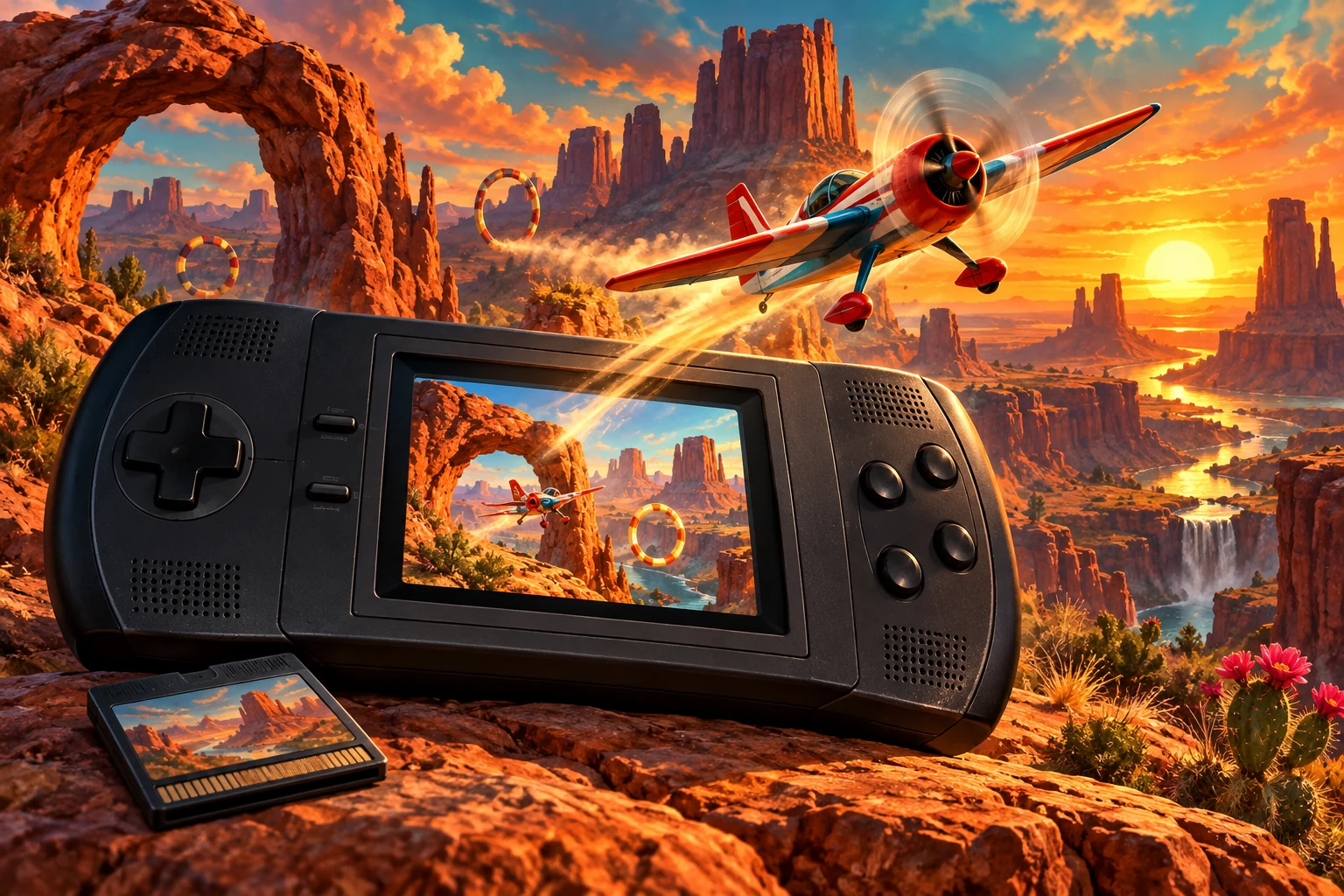
Replacement LCDs became one of the most visible interventions. McWill, BennVenn and other projects documented separate approaches for the two Lynx models, with different installation requirements and, in some cases, board-specific distinctions. These panels are intended to improve readability and, depending on the product and installation, may address particular display or aging-related problems. They do not increase the game’s resolution: software still produces the original display dimensions and timing.
A modern panel can reveal color boundaries and sprite edges that the original display softened. It may make dithering more obvious or change the perceived rhythm of scrolling and animation. Developers creating new software can target a clearer screen, but preservationists comparing a modern display with period experience are asking different questions. An untouched Lynx and an LCD-modified Lynx are both useful test platforms, yet they are not identical visual references.
This renewed hardware testing produced a more mature form of community knowledge. A useful report identifies the console model and, where relevant, its board and display, instead of treating every physical Lynx as an interchangeable test fixture.
Atari’s Documented Developer Support
Atari’s contemporary publications describe the company’s continuing commercial stewardship of the Lynx and its developer-support operation in Lombard, Illinois. Atari Explorer presented the company as assisting outside programmers after the original Epyx development phase, while Atari’s other material preserved the corporation’s account of the platform’s relationship with Epyx. These sources establish developer support and institutional continuity; they do not establish Atari’s overall reaction to later independent reverse engineering, so no broader claim about silence or opposition belongs here.
The later community revival drew on surviving Handy documentation, Atari developer material, archived tools and independently maintained projects. As Atari’s original commercial support materials became historical documents rather than an active developer service, enthusiasts used those records to reconstruct a workable development environment. The evidence does not justify assigning that transition a precise end date.
That shift changed the legal and cultural framing of the work. Reconstructing a cartridge header, writing original software or documenting a bus interface is different from distributing Atari’s firmware or commercial game images. Community projects that publish source code, libraries and original games can preserve the platform without reproducing the company’s copyrighted releases. Flash cartridges and emulators remain general-purpose technologies whose uses depend on the software placed on them.
The documented modern ecosystem is consequently the result of several separate developments: accessible cross-compilation, recovered technical records, public libraries, compact game competitions, intelligent cartridges and model-specific hardware documentation. Each addressed a different obstacle. Together they allowed new authors to work within the Lynx’s original constraints while giving players more practical ways to experience the results on software, emulation and original hardware.
A Layered Platform After Atari
The ecosystem’s achievement is therefore cumulative. A programmer can study recovered Handy documentation, write new software with modern tools, test it in an emulator, place it on suitable cartridge hardware and evaluate it on an original handheld. That loop is now practical, but it remains bounded by the Lynx’s actual memory map, boot expectations, display timing and custom chips.
A Toolchain That Still Targets the Lynx
Upstream cc65 remains an important bridge between present-day development computers and the Lynx’s 65C02-family environment. Its documented Lynx target supplies the compiler and linker configuration for producing a bootable `.lnx` cartridge image, while also documenting BLL as a distinct download-oriented output. The target accounts for the Lynx’s memory arrangement; it should not be confused with every newer Lynx-specific library or cartridge extension.
The newer `lynxcc` ecosystem is a separate Lynx-focused documentation and library layer. It supplies higher-level facilities for graphics, sprites, sound, input, collisions, ComLynx and optional SD/GameDrive support. Its value is organizational: it lets a programmer work in C while still exposing the concepts that matter on the real machine, including sprite control blocks, pen-pal color mapping, double buffering and the relationship between Mikey and Suzy. A library can package those operations, but it cannot make the hardware constraints disappear.
The output formats remain purpose-specific. Upstream cc65 documents `.lnx` as a bootable cartridge image, while BLL is a separate download-compatible format. Headerless images and other extensions may be accepted by particular emulators or flash cartridges, but loader support is format- and device-dependent. These outputs should not be treated as interchangeable merely because they contain related program code.
The ecosystem is consequently not one official, unified SDK. Upstream cc65, its Lynx runtime, `lynxcc`, older BLL-oriented tools, emulator workflows and cartridge-side extensions overlap without forming a single Atari-maintained package. Modern documentation should identify which layer a claim belongs to before calling it Lynx support.
Explore more modding histories
Compare these experiments with our original PlayStation modding history, original Xbox modchip and homebrew history and Dreamcast boot discs and homebrew story. Find more long reads in Editorial Spotlight and explore our game walkthrough library.