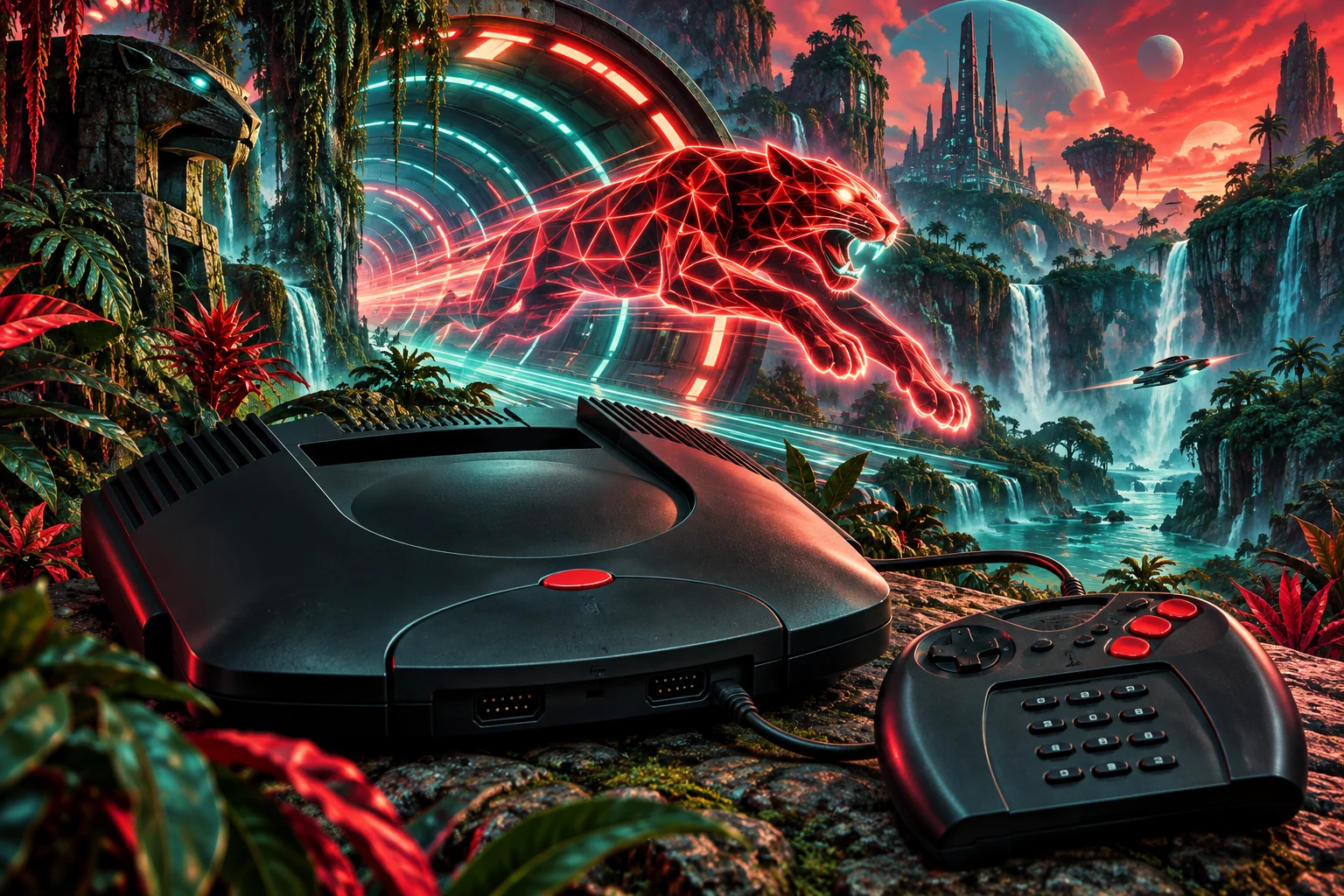
A 64-bit machine with a 68000 at its center
The Atari Jaguar’s modding history begins with a hardware description that still causes arguments decades later. Atari sold the console as a 64-bit system, and that label was not invented by later fans trying to rescue the machine’s reputation. The Jaguar’s 64-bit claim referred chiefly to its wide external memory path, phrase-oriented graphics transfers and the memory organization intended to sustain them—not to a 64-bit general-purpose CPU or a universally 64-bit cartridge interface. Its Object Processor and Blitter handled wide “phrases” of data, and its memory system was designed to move large amounts of information quickly. Yet the console’s main supervisory processor was a Motorola 68000, a 16/32-bit CPU whose programming model was familiar from the Amiga, Atari ST and Sega Mega Drive. Calling the Jaguar simply a 64-bit computer is therefore misleading; calling the claim wholly fraudulent is just as careless.
The more accurate picture is a heterogeneous multiprocessor system. The 68000 initialized the machine, coordinated software and performed much of the ordinary game logic. Tom contained the programmable GPU, Object Processor and Blitter, while Jerry contained a programmable digital signal processor and the console’s sound and input functions. The GPU and DSP were RISC processors with 32-bit registers and data paths, using a shared 16-bit instruction set and their own local resources. They were not two halves of a single 64-bit general-purpose processor. Atari’s engineering advantage lay in parallel work: one processor could organize the game while specialized engines assembled display lists, moved graphics data or generated audio.
Why the architecture shaped every later modification
That division of labor was powerful on paper and demanding in practice. A Jaguar program had to decide which tasks belonged on the 68000 and which justified moving into Tom’s GPU or Jerry’s DSP. The Object Processor did not behave like a conventional sprite chip waiting for simple commands. It read an object list containing bitmap, scaled-bitmap, GPU, branch and stop objects, with fields governing position, scaling, transparency, palette use and read-modify-write behavior. Shading effects could result from those read-modify-write operations or from the Blitter; shading was not a basic Object Processor object type. The Blitter moved and combined pixel data in phrase-sized operations. The GPU could execute code close to the graphics data, but it also had to share the machine’s memory resources with the other processors.
For a commercial developer, this created a difficult relationship between hardware capability and development time. The Jaguar offered bandwidth and specialized engines, but its programmers had to understand scheduling, memory placement, object-list construction and the behavior of several processors that could access shared resources. A game that left most work on the 68000 might be easier to develop but fail to exploit the machine. A game that pushed Tom and Jerry aggressively could look impressive while becoming harder to debug and more sensitive to timing. These trade-offs later mattered to hobbyists because the first unofficial development systems did not simplify the architecture; they merely made it possible to reach the architecture without Atari’s complete commercial toolchain.
The console’s unusual design also explains why a successful development board could not be judged only by whether it stored a large binary. A useful system needed to place code and data where the Jaguar’s processors expected them, start execution in a controlled way, and offer a means of inspecting failures. The difference between a writable cartridge, a development instrument and a modified boot environment would become central to the scene. Long before consumer flash cartridges, Jaguar experimentation was tied to the problem of replacing a tightly managed commercial startup path.
For cartridge-oriented experimentation, the cartridge connector was the most accessible bridge into the machine, but cartridge-port hardware alone did not reproduce the complete commercial boot or professional development environment. Alpine and Stubulator, BJL, later loading boards and retail cartridges each occupied different positions in that chain.
The retail boot path was not an open invitation
In its commercial form, the Jaguar treated a cartridge as more than passive memory. Atari’s developer materials described cartridge software in the system memory map, but the retail console also carried out a startup validation process before handing control to the game. Later reverse-engineering work and emulator implementations document a cartridge protection check and a validation result associated with the value 03D0DEAD. Those sources help establish observable behavior, but they should not be mistaken for a complete, original Atari explanation of the cryptographic design.
The safest historical description is that Jaguar cartridge software passed through a protected boot process involving validation data and computation performed with help from the console’s custom hardware. Atari supplied licensed developers with production tools for creating acceptable software, while an ordinary retail cartridge was expected to contain material that the console would recognize. The surviving record does not justify confidently reducing this to one neat public-key formula, a precise digest sequence or a universally agreed account of every key and signature. Those details belong to later reverse engineering and recovered development material, and some popular explanations combine evidence from different sources.
This distinction matters because “protected” did not mean “unbreakable,” while a later workaround did not mean the retail system had never been protected. Official development equipment, modified boot ROMs, writable memory boards and software loaders each created different routes around the ordinary cartridge-production process. A system could bypass the retail validation environment for development without reproducing Atari’s manufacturing pipeline. Conversely, a device that loaded a program through an unofficial path did not automatically authenticate or manufacture a standard commercial cartridge.
The protection also had a practical commercial purpose. Atari controlled the transition from a developer’s finished build to a cartridge that could boot on retail consoles. That control supported licensing, production approval and platform management at a time when console makers treated the cartridge as both software package and access point. The Jaguar’s later community would inherit not just an unusual processor architecture but the consequences of a publishing system designed around proprietary tools.
The Jaguar CD added another boundary
The Jaguar CD made the distinction between formats even sharper. Its optical drive was not simply a larger cartridge attached to the side of the console. Atari’s developer documentation describes a nonstandard raw-sector and data layout, including 2352-byte sectors, with the drive and Butch interface delivering data through Jerry’s data path under the control of the CD BIOS. The system also supported audio playback, streamed material and the Memory Track save cartridge. A disc image can preserve sector and filesystem data without, by itself, reproducing the complete physical drive, BIOS, timing, save-media and validation environment of an original Jaguar CD system.
The add-on also had its own protection and validation history. Atari archival material identifies separate Jaguar CD encryption and binary files, while later technical investigations describe protected disc data that ordinary copying procedures would not reproduce as a bootable Jaguar CD. The available evidence supports saying that the CD system used a distinct validation arrangement mediated by the CD BIOS. It does not support casually describing the process as the cartridge check transferred onto an optical disc. Cartridge verification and CD validation belonged to separate parts of the platform, and the public Atari manuals do not by themselves establish every stage of the later-reconstructed sequence.
That separation became important to preservation. A cartridge dump, a Jaguar CD image and a BIOS are different classes of material with different relationships to the original hardware. When later researchers reconstructed Jaguar CD behavior in emulators, they were preserving a system rather than merely copying a collection of files. The same principle applies to hardware modification: a cartridge-side development board cannot automatically stand in for the Jaguar CD’s drive and BIOS environment.
For early experimenters, however, the cartridge remained the more accessible point of development. The console’s cartridge connector exposed the machine’s principal memory and boot relationship in a way the proprietary optical subsystem did not. That made cartridge-port development boards the natural bridge between Atari’s professional workflow and independent investigation.
Alpine: Atari’s official answer to iteration
Atari’s Alpine development board shows what professional Jaguar experimentation looked like before the hobbyist scene built cheaper alternatives. Alpine plugged into a production-style Jaguar and presented writable memory in the place where a retail cartridge would normally provide read-only software. Host-computer interfaces allowed a programmer to download a build and inspect or modify memory. Documentation describes SRAM, programmable logic, configuration controls and support circuitry rather than a simple collection of flash memory chips.
Its relationship with the Jaguar’s development or “Stubulator” ROM made the difference. Documentation for the Alpine/Stubulator combination describes host transfers, memory inspection and modification, tracing, and breakpoint management. Reset and halt control depended on particular board provisions or documented modifications, and the documented debugging facilities belong to that board-and-ROM combination; they should not be generalized to every surviving Alpine board or revision. Alpine therefore offered more than a way to boot an unapproved binary. It formed part of a professional development system in which code could be transferred, tested and revised on actual Tom, Jerry and 68000 hardware.
The surviving documentation distinguishes 2 MB boards from later higher-capacity arrangements. A November 2000 upgrade document records a community modification that expanded a 2 MB Alpine to 4 MB. That is evidence for a documented aftermarket modification, not proof that every Alpine shipped as a 4 MB Atari production board. Nor should Alpine be described as equivalent to a later consumer flash cartridge. It was an official instrument intended for licensed development, integrated with Atari’s tools and assumptions.
Alpine also clarifies why access to development hardware mattered more than the protection algorithm alone. If a studio could download and debug code through an official board, it did not need to manufacture a new encrypted cartridge after every edit. The board moved development outside the retail validation environment while preserving the behavior of the real console. When Alpine systems became scarce or unaffordable, independent developers had to solve the same practical problem with different hardware and less documentation.
Several unofficial routes into the machine
The earliest independent experiments should not be reduced to a single inventor or a clean “first hack.” The surviving record points to several overlapping projects, and the evidence does not establish an uncontested priority claim for one person or one title. What can be documented is a progression from studying the Jaguar’s hardware and boot behavior toward building alternate development paths.
One example was Jaguar Server, associated with Roine Stenberg and Istari Software. Its documentation describes an external development arrangement connecting an Atari computer to the Jaguar’s cartridge interface. This approach treated the console as the target machine while moving the development and transfer process outside Atari’s official environment. It was not the same as Alpine: the hardware, software and debugging capabilities differed, and it did not become an Atari-authorized replacement for the professional kit. Its significance was more basic. It demonstrated that independent programmers could build a workable connection to the Jaguar without waiting for the original manufacturer to supply one.
Another path was BJL, the unofficial project developed by Lars Baumstark and Bastian Schick. The surviving project material records revisions beginning in 1997 and documents a modified or replacement boot ROM together with host transfer software. Instead of asking the retail boot environment to accept a normally produced cartridge, it changed the console’s startup circumstances so that programs could be sent from a computer and run on real Jaguar hardware. BJL was therefore a development-path modification, not a universal declaration that Jaguar security had vanished.
Robert Jung’s Jaguar FAQ records JUGS—the Jaguar Unmodified Game Server—as a transfer route requiring BattleSphere, a JagLink interface and a PC serial connection. This is a community record of a specific loading arrangement, not an Atari development-kit specification.
Those differences matter because all three systems could be described loosely as ways to “load code.” The phrase hides the important questions: Was the retail BIOS retained? Was the cartridge bus supplemented or replaced? Did the system provide debugging, or only transfer? Did it require an altered console, an external board or a special program? Early Jaguar modding developed through those distinctions, not around a single bypass that solved every problem.
When homebrew became visible
Some of the earliest documented public hobbyist programs emerged alongside these unofficial development routes, but their exact priority is less certain than later retellings suggest. JSTetris is frequently cited as one of the earliest visible Jaguar homebrew games, yet the available evidence does not justify presenting it as an uncontested first without a dated artifact, reliable provenance and a contemporary announcement. A careful history can say that it is commonly associated with the early homebrew period while avoiding the invention of a definitive first hacker or first release.
What matters more than the title of the earliest experiment is the change in the development loop. A programmer could write code on a general-purpose computer, assemble or compile it, transfer a build and observe the result on an original Jaguar. Each cycle exposed the realities that an emulator or a hardware diagram could conceal: object-list mistakes, memory placement errors, sound timing, processor contention and the difference between a program that merely started and one that behaved reliably.
This was the beginning of a new relationship with the console. Atari had designed the Jaguar as a controlled commercial platform whose specialized architecture demanded professional investment. Independent developers treated the same architecture as an object of investigation. They learned Tom and Jerry by measurement, documentation and repeated failure, then built tools that made the next experiment less expensive. The resulting scene did not begin with a clean public release of the entire platform; it began with partial access, imperfect knowledge and hardware that had to be persuaded to reveal what Atari’s commercial system had kept behind its development pipeline.
A platform released from commercial supervision
The Jaguar’s independent era gained a formal opening on May 14, 1999, when Hasbro Interactive announced that it had released “all rights that it may have” to the Jaguar hardware platform. The announcement mattered less as a business revival than as a change in permission. Developers no longer needed to obtain a platform-development licence from Hasbro merely to create and publish new Jaguar software. At the same time, Hasbro drew a clear branding boundary: independent projects could not use the Atari name or logo, or imply that Hasbro had approved them.
The qualification is important. Hasbro released the rights it may have held in the hardware platform; it did not declare the Jaguar’s games, firmware, characters, soundtracks or third-party properties public domain. The announcement addressed platform development. A programmer could target the 68000, Tom, Jerry, the object processor and the cartridge bus without entering the platform-licensing system that had once stood between an idea and a finished Jaguar project.
The timing was significant. Atari had discontinued the Jaguar and was no longer operating a normal Jaguar hardware business, while Hasbro’s attention was directed toward other software and platforms. The announcement therefore removed a gate that the owner no longer considered worth maintaining. It did not supply updated compilers, documentation, testing laboratories or manufacturing support. Those responsibilities moved outward to enthusiasts, small teams and preservation projects. The Jaguar became more approachable as a technical target while its official infrastructure was disappearing.
The announcement also did not authorize redistribution of existing commercial software or firmware. A new Jaguar game could be independent without being Atari-authorized, while a port, prototype or re-release could raise separate copyright, trademark and licensing questions. That narrow distinction—an opened hardware target rather than an ownerless software library—became the legal and technical foundation of the Jaguar’s afterlife.
Communities built the missing middle layer
The early unofficial loaders and development arrangements had demonstrated that code could reach a real Jaguar, but a sustainable scene required more than a transfer trick. Developers needed assemblers and compilers, libraries, emulators, debugger-like tools, hardware schematics, tested examples and somewhere to exchange discoveries. Jaguar communities gradually assembled that middle layer through specialist websites, mailing lists, forums, demonstrations and shared source code.
This was a different form of technical progress from the commercial race of the 1990s. Atari’s engineers had integrated several specialized processors to gain bandwidth and parallelism. Hobbyists instead made the architecture legible. A programmer who did not want to write every object-list routine from scratch could reuse an example. Someone investigating sound could compare a DSP routine with another developer’s implementation. A new project could start from a known memory map rather than rediscovering the location and behavior of every register.
The social structure mattered because Jaguar knowledge was unusually difficult to infer from playing commercial games. The console’s visible output did not reveal how a title divided work between the 68000 and Tom, how much data was copied into local memory, or whether the DSP was generating music, effects or general-purpose calculations. Documentation and experimentation had to supply that missing information. Community archives became practical engineering references as much as historical collections.
The result was cumulative rather than centrally managed. One project might improve a loader, another might document the object processor, and a third might turn those discoveries into a reusable library. Developers did not all use the same tools or make identical assumptions about the target. That variety explains why “Jaguar homebrew” covers a broad range of work, from tiny demonstrations and ports to games with their own production pipelines and physical releases.
Why transferring a program was only the beginning
A Jaguar development setup still had to respect the machine’s memory model. The retail cartridge appeared in the console’s address space, but a development board, modified boot environment or flash device could present memory differently. A transferred build might be placed in writable memory for testing, while a manufactured or flash-based cartridge would normally expose code and assets from cartridge space. The same source project could therefore need different build targets and startup assumptions.
This distinction became especially important as projects grew. Assets left in cartridge memory did not consume the same writable RAM as assets copied during boot, but they also had different access characteristics. Frequently used graphics, sound data and tables had to be placed with the object processor, blitter, GPU and 68000’s competing needs in mind. A program that fit comfortably as a development binary could still require restructuring before it behaved like a conventional cartridge release.
The custom processors imposed further constraints. Tom’s GPU had local memory and specialized instructions, but moving code into that environment meant deciding what the 68000 would stop doing. Jerry’s DSP could handle audio work and other calculations, yet sound data, mixing routines and timing all competed for limited resources. The object processor reduced the need for a conventional sprite engine, but it demanded carefully formed display lists. A title’s apparent graphical complexity was therefore only one measure of difficulty; the cost of coordinating the machine could be greater than the number of visible objects.
The JagStudio Reference Manual version 1.11, updated February 10, 2023, describes these choices, including the distinction between ROM-resident assets from data intended for RAM, while libraries supplied routines for graphics, input, sound and timing. That convenience changed the entry point, not the underlying hardware. Developers still had to discover when an abstraction was too slow, when an asset exceeded available memory, or when an emulator’s forgiving behavior concealed a problem on a physical console.
Skunkboard turned the cartridge slot into a test bench
The Skunkboard marked an important middle-era breakthrough because it made the development cycle feel less like a specialist laboratory. Its hardware and software, later archived with source material and the CPLD bus-manager description, were designed around writable cartridge-side memory and host transfer. A developer could build a program on a contemporary computer, send it to the board and run it through an original Jaguar without producing a new commercial cartridge for every revision.
That function made Skunkboard different from a normal aftermarket game cartridge. It was not merely a storage accessory and not an emulator. The target remained the Jaguar’s actual processors, bus behavior, video output and controller hardware. Its value was the shortened distance between edit and observation. Bugs that depended on real memory arbitration, display timing or peripheral behavior could be investigated on the machine for which the code was intended.
It also differed from the earlier official Alpine system. Alpine belonged to Atari’s professional development environment and supplied a broader set of development-oriented facilities. Skunkboard was a community-era tool aimed at making practical experimentation attainable outside that environment. The two boards occupied related positions in the development cycle, but they were not interchangeable products and should not be treated as though one were simply a later retail version of the other.
The board’s limitations became part of the culture. A project that ran from Skunkboard did not automatically behave like a manufactured cartridge, and save support could depend on the target hardware. Developers therefore learned to describe the execution medium alongside the software. “Runs on Jaguar” was increasingly incomplete without asking whether the test involved original cartridge hardware, a Skunkboard, an emulator or another loading device.
Reusable libraries changed who could attempt a game
The most consequential change in Jaguar development has not been a single cartridge. It has been the rise of reusable software libraries that hide some of the machine’s difficult low-level work without pretending that the hardware is ordinary. The available JagStudio reference manual, version 1.11, updated February 10, 2023, later organized these capabilities around BASIC, C and assembly projects. The date matters: these are documented features of that reference version, not a claim that every detail remains current on September 16, 2026.
RAPTOR and its Raptor Basic+ lineage supplied reusable routines for common Jaguar tasks, while JagStudio organized those capabilities around structured projects. This lowered the amount of low-level code required to produce a visible result. A newcomer could call library functions for drawing, sound, input or timing instead of beginning with a blank file and the full register map.
That change was more consequential than a simple increase in convenience. Libraries captured community knowledge. They embodied decisions about object lists, memory use and processor responsibilities that had previously been scattered across personal experiments and old technical notes. A beginner could therefore encounter the Jaguar through a structured framework, while an experienced programmer could bypass the framework when a particular optimization demanded direct control.
The high-level syntax did not make the Jaguar a generic target. The generated program still had to fit the console’s memory, use its display system and cope with the performance of Tom, Jerry and the 68000. The documented JagStudio workflow distinguished emulator builds, Skunkboard transfers and GameDrive outputs. The toolchain gave developers choices, but each choice described a different relationship with the hardware.
This shared infrastructure broadened the kinds of projects the community could finish. A small game such as HMS RaptoR was presented by Reboot as an example project demonstrating library functions, not as proof that the Jaguar had become effortless. Raiding Rivers was described as a short development exercise using RAPTOR, showing how a compact project could be completed quickly within a prepared framework. These examples mattered because they made the platform teachable. The scene no longer depended exclusively on a few specialists who understood every subsystem at machine-code level.
From experiments to identifiable releases
As tools improved, homebrew became easier to distinguish from private technical demonstrations. Reboot’s catalogue included free games, demos, digital editions and physical cartridges, creating a visible publishing culture around a platform that no longer had an ordinary commercial publisher. The releases varied substantially in ambition. Some were compact demonstrations of a technique or library; others were designed as complete games with menus, sound, save behavior and packaging.
That range is important when assessing claims about Jaguar capability. A technical demo may show a rendering effect without proving that a full game can sustain it alongside audio, collision logic and input. A title using a flash cartridge may rely on storage or save features unavailable to a conventional cartridge. A port may inherit design assumptions from another computer or console. A new game written specifically for Jaguar may be optimized around Tom and Jerry from its first line of code. These are different achievements, even when they appear on the same screen.
Jumping at Shadows provides a documented example of the execution-target problem. Its release information identified Skunkboard, RetroHQ’s GameDrive and BigPEmu as supported environments, while warning that saving might not function on Skunkboard. The qualification was not an embarrassment; it was useful technical reporting. It acknowledged that a game’s features could depend on the memory and storage facilities provided by the device running it.
BattleSphere belongs to an earlier and more demanding part of this independent tradition. Its developers described years of optimization, substantial work on the DSP sound engine and an ambition that included networked play. The project demonstrated what sustained specialization could extract from the Jaguar, but it did not establish that every team had the time, expertise or memory budget to reproduce the result. Later libraries and loading hardware addressed some barriers; they did not erase the production effort involved in a large game.
Flash cartridges separated access from authorship
The Jaguar GameDrive represented a further change in how software reached the console. Its manufacturer’s published instructions describe a cartridge-side device using removable storage, with compatibility specified for unprotected Jaguar games. The same documentation excludes JagLink network play and the Jaguar CD add-on, and does not promise support for protected cartridge software. GameDrive therefore made cartridge software more accessible, not every Jaguar format interchangeable.
For a player, the device could reduce handling of scarce original cartridges and provide a convenient way to run compatible, unprotected homebrew. For a developer, it supplied another target for testing compatible builds. The available JagStudio reference manual—version 1.11, updated February 10, 2023—documents a GameDrive build target and detection of three cases: no flash cartridge, a Skunkboard or a Jaguar GameDrive. Those named cases are narrower than a promise of future-proof detection of every flash device.
What modern homebrew actually looks like
New projects also vary in their relationship to the original library. A game written specifically for Jaguar hardware is not the same kind of work as a port from another computer, a fan patch for a commercial title, an unfinished prototype recovered from a studio archive or a newly manufactured edition of an older release. They may share a cartridge connector and a flash device, but their creative and legal histories are different.
JagRacer illustrates the continuing attraction of the platform as a technical target: its project presents an independent, unofficial textured 3D racing game developed around original Jaguar hardware. The project should be credited to its creators, not folded into Atari’s commercial catalogue. JagJam 2026, running from May 1, 2026 through October 31, 2026, shows that a public Jaguar development invitation was active on September 16, 2026. It does not by itself establish completed submissions, scene size or the output of the event.
These projects do not prove that the Jaguar has become easy or that every ambitious game is practical. They show something more interesting. A platform once constrained by expensive official tools can support a range of independent work when libraries, examples, transfer hardware and community knowledge are available. The machine’s limitations become design conditions rather than an absolute prohibition.
Emulators, compatibility and the problem of proof
Emulation has become both a preservation tool and a development instrument. The available JagStudio reference manual, version 1.11, updated February 10, 2023, documents Virtual Jaguar and BigPEmu targets alongside Skunkboard and GameDrive builds. Its separation of those targets is significant: passing one emulator’s test does not certify every other emulator or an original console. The manual is evidence of the documented toolchain at that date, not proof that every feature remains current in September 2026.
The documented Virtual Jaguar emulator-core feature set includes Jaguar CD images, Memory Track behavior, audio-CD playback and the Virtual Light Machine, with additional peripheral-related features described in the same context. Those capabilities make emulation valuable for research, but they should not be converted into a claim of perfect compatibility. A title may boot while exhibiting differences in timing, audio, peripheral behavior or save handling. Conversely, a physical console may fail for reasons unrelated to the software, including aging memory, connectors or optical hardware.
A difficult platform with a second life
In 2026, the Jaguar is therefore neither merely a failed 1990s console nor simply a piracy target. It is a living case study in how a proprietary platform can outlast its business: official tools can become community archives, a cartridge slot can become a laboratory, and a difficult architecture can become a creative constraint. Its second life is credible because developers and preservationists continue to distinguish the hardware target, the execution medium and the software running on them.
Explore more modding histories
Compare these experiments with our original PlayStation modding history, original Xbox modchip and homebrew history and Dreamcast boot discs and homebrew story. Find more long reads in Editorial Spotlight and explore our game walkthrough library.