A Cartridge Computer with Few Secrets to Hide
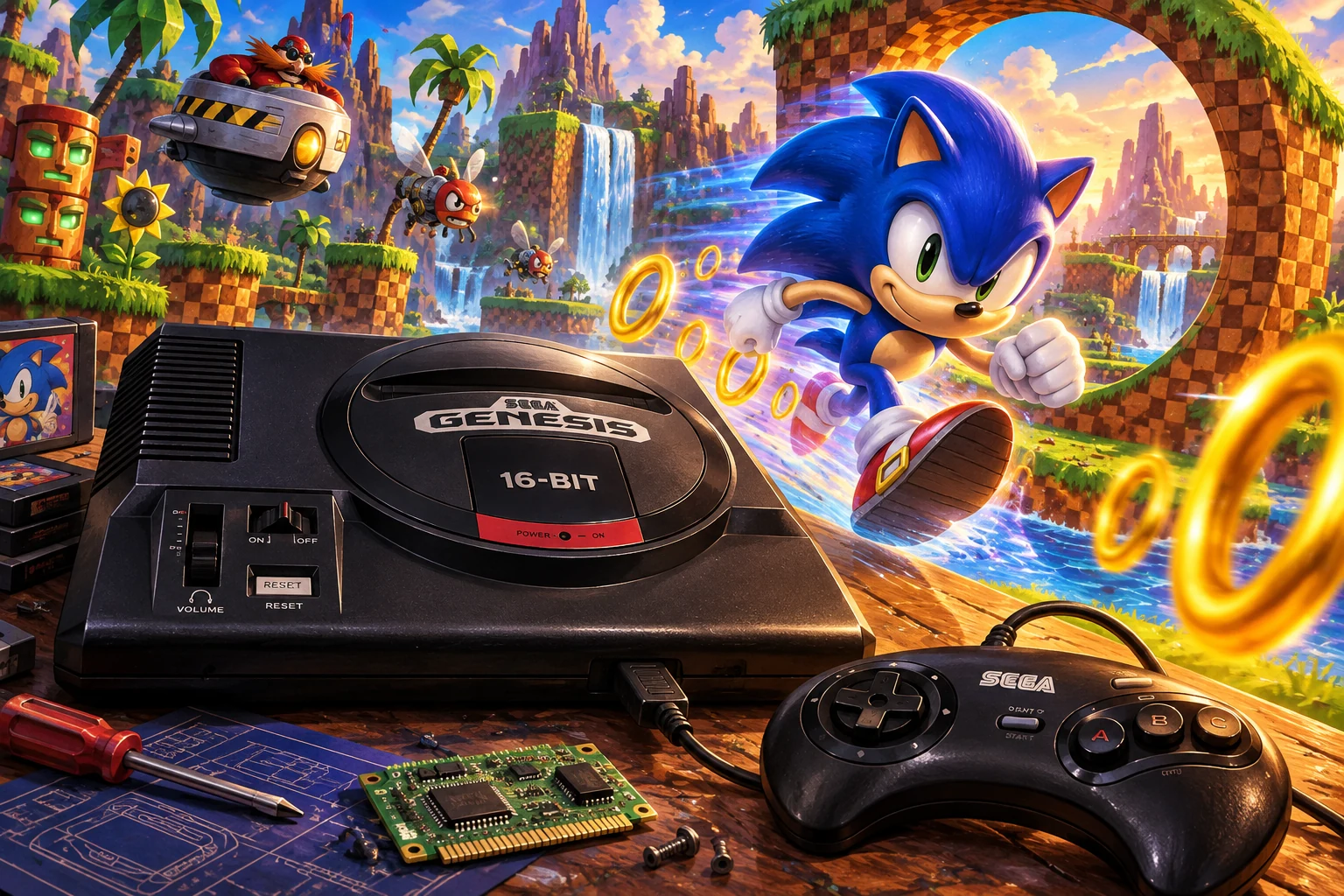
The Genesis, or Mega Drive outside North America, did not begin life as a locked vault. It was a cartridge computer whose important boundaries were visible on its bus: a Motorola 68000 handled the principal game workload, a Zilog Z80 provided a second processing environment, and the cartridge supplied the program and, in some cases, extra memory or logic. That arrangement shaped every later modification. The earliest experiments were less about defeating sophisticated encryption than about understanding which signals reached the cartridge, which processor could see which device, and how regional hardware changed the machine’s assumptions.
Sega’s own development documentation makes the architecture unusually legible. The 68000 addressed cartridge ROM, work RAM, the video display processor, and system input hardware. The Z80 was a secondary eight-bit processor with its own RAM and access to the Yamaha YM2612 FM synthesizer, the programmable sound generator, and shared resources through the Genesis bus-arbitration design. Commercial software commonly used it for sound-related work, but software was not restricted to one fixed division of labor: programmers could assign it other tasks when timing, memory access, and coordination made that practical. It was not a second, interchangeable game CPU, however, and ordinary commercial game execution centered on the 68000.
That distinction is important when describing the Genesis as approachable hardware. A person investigating the system did not have to discover one mysterious processor hidden behind a unified security layer. They had to map a collection of buses, registers, clocks, interrupts, and ownership rules. Sega’s manuals documented the relationships well enough for licensed developers to build software, while service documents exposed the physical components and board-level variations. The result was a machine that invited study even when commercial policy discouraged unlicensed use.
The First Fault Lines Were Regional
Some of the earliest practical modifications addressed geography rather than software copying. A Japanese Mega Drive, a North American Genesis, and a PAL European Mega Drive were related machines, but their compatibility was not determined by a single label on the cartridge. The console’s physical slot could differ, the system could present different territory information, and the video hardware operated at different standards. NTSC machines generally produced 60 Hz timing; PAL machines generally produced 50 Hz timing. That affected frame cadence, game speed, screen timing, and the visible vertical field.
The development and service manuals treat video standard selection as hardware. The video display processor exposes an NTSC/PAL selection input, while the clock arrangements and surrounding circuitry differ between regional versions. A game could therefore encounter several kinds of import problem. It might inspect a territory signal, assume a particular refresh rate, or simply fail to fit through a differently shaped cartridge opening. Even when the program ran, software written around 60 Hz timing could behave differently at 50 Hz. “Region free” was never a universal description of what the original hardware could do.
This explains the appeal of passthrough adapters sold under overlapping names such as Mega Key and Super Key. These devices accepted an original cartridge in an adapter and used switches or related circuitry to alter the territory and, in some variants, the PAL/NTSC condition presented to the game. They were not cartridge copiers. They did not need a floppy drive or a large RAM buffer to run the original cartridge, and their presence did not prove that any game had been dumped. They were physical compatibility tools, albeit imperfect ones: changing a signal could not automatically repair every timing assumption, display issue, peripheral problem, or board-level difference.
The surviving records are not strong enough to identify one inventor, manufacturer, or exact first release date for this product family. Several names appear to have been used by different makers or resellers, and “Mega Key,” “Super Key,” and similar labels should not be treated as a single, neatly documented product line. What can be stated securely is functional: these adapters belong to the early history of Genesis modification because they exploited the console’s regional inputs while leaving the original cartridge as the source of the program.
Why the Cartridge Bus Mattered
The cartridge connector was more than a socket for read-only memory. Sega’s software-development material describes cartridge identification fields and the possibility of external backup memory, including battery-backed SRAM and serial EEPROM arrangements. It also records the address ranges and device characteristics that software could expect. That flexibility helped licensed developers support saved games, but it also meant that a cartridge could become an active participant in the console rather than a passive block of code.
A cartridge could contain additional RAM, address-decoding logic, or banking hardware that changed which portion of a larger program appeared in the 68000’s address space. This is the beginning of the technical history later associated with flash cartridges and modern homebrew boards. The console supplied a defined address environment, but the cartridge could extend it within limits. A person studying the system thus had to understand both sides of the connection: what the Genesis offered and what a particular board added.
That openness should not be confused with the absence of all control. Sega’s original machines still had reset behavior, cartridge-header conventions, region signals, and hardware differences between revisions. Later systems introduced another layer of concern. But these controls were not encryption. Nothing in Sega’s technical material or the later court record describes Genesis game code being stored as an encrypted executable that the console decrypted with a secret key. The software was presented to the processor through the cartridge bus. The important question was whether the console would initialize and accept the cartridge, not whether it could decode an unreadable cryptographic package.
This distinction also separates genuine compatibility investigation from the mythology of a dramatic “security crack.” The early Genesis scene was built around observation, disassembly, electrical interfaces, and controlled testing. Understanding a register or determining which territory line a game examined could be enough to make an import work. The work was technical, but its object was a comparatively exposed hardware platform.
TMSS Changes the Meaning of “Locked”
By 1991, Sega had added its Trademark Security System, or TMSS, to revised Genesis hardware. The contemporary Accolade litigation calls the affected revision “Genesis III.” That is the court’s terminology for the early-1990s system, not a reference to the much later compact Genesis 3. Sega’s security patent describes comparison of a cartridge-supplied code with an expected value, using SEGA as its example, and relates that result to startup control. The practical result was a new compatibility requirement for unlicensed cartridge makers.
Those facts should not be compressed into a claim that one comparison directly generated the on-screen trademark message. The code comparison concerned whether the system would proceed with execution; the initialization sequence also caused the Sega Message to appear during startup. They were connected parts of the TMSS arrangement, but they are analytically distinct: authentication or lockout, processor startup behavior, and trademark-screen display.
TMSS is best understood as boot-time access control, not encryption. The primary sources do not describe Genesis game code as cryptographically transformed, nor do they describe a secret-key decryption process before the 68000 could execute it. The cartridge program remained readable through the console’s normal address space. The security question was whether the machine would complete its initialization when the expected code and sequence were present.
TMSS did not replace the cartridge bus with an encrypted channel. Once the startup requirements were satisfied, the game still ran as a program for the familiar processor and video hardware. That makes the system very different from a later console whose executable files carry cryptographic signatures. An independent developer needed to understand initialization, while a developer targeting a modern signed-code platform may need an entirely different chain of permissions before a program can start.
Sega’s legal and technical interests met in this design. Company officials characterized the system as groundwork for action against counterfeit cartridges and as a barrier to unlicensed software. Because the required initialization sequence used Sega’s own name, a functional compatibility requirement also produced a trademark-screen question. That combination—not a modern cryptographic crack—made TMSS a distinctive chapter in the console’s history.
Accolade and the Boundary of Compatibility Work
Accolade’s Genesis investigation became the clearest early demonstration that software compatibility could require reverse engineering. The company purchased a Genesis and three Sega cartridges, disassembled their object code, studied the results, and produced documentation describing the functional requirements for compatible software. This was not a hardware modification and not an attempt to reproduce complete Sega games. It was an investigation of what a new program had to do to communicate with the console.
The Ninth Circuit’s 1992 opinion, amended in 1993, held on the preliminary-injunction record that Accolade’s disassembly could qualify as fair use when it was the only practical way to access unprotected functional elements and the purpose was legitimate compatibility. The court did not grant a general right to copy Sega’s games. Its reasoning distinguished studying platform requirements from distributing a finished product that infringed protected expression.
The TMSS issue sharpened that distinction. Accolade’s software had to use the initialization code expected by the Genesis III. The resulting Sega Message was produced by Sega’s functional startup system, rather than being a freely chosen claim that Accolade’s game came from Sega. The court reversed the preliminary injunction on Sega’s copyright and trademark claims on the record before it and remanded the case. That was an interlocutory ruling about preliminary relief, not a final merits judgment declaring every reverse-engineering project lawful.
Historically, the case is valuable because it shows what Genesis compatibility work actually looked like. Investigators bought retail hardware and software, converted machine code into a more readable form, tested behavior, and documented functional requirements. There was no browser script that single-handedly defeated a modern cryptographic barrier. The work sat between software development and hardware study, distinct from a region adapter and distinct from copying a complete commercial library.
From Interface Study to Cartridge Copiers
The same cartridge architecture could also be repurposed in a very different direction. The 1994 findings in Sega v. Maphia document advertising, sales, and distribution of Super Magic Drive-type copiers in the MAPHIA bulletin-board network. The 1996 permanent-injunction order gives the more detailed hardware description: a console connector, cartridge receptacle, RAM, and floppy-disk drive, with programs loaded from disk or copied from cartridge to disk. These opinions establish the documented function and legal context without proving a unique first manufacturer, a single international launch date, or one lineage for every product sold under a similar name.
In the documented Super Magic Drive design, RAM and floppy storage allowed game data to be loaded through the adapter; the final description of that data appearing to the console through the cartridge connection is an explanatory account of the documented function, not a complete electrical schematic for every copier model. That distinction matters because the court’s functional description is broader than a board-level diagram, and different regional products may not have been electrically identical.
The court documents place the copier in a recognizable setting: a computer, a modem, a bulletin-board service, floppy disks and a cartridge console. Data moved between systems that had never been designed as a single consumer network. A cartridge supplied a game image, a computer supplied storage and communications, and a copier supplied the bridge back to the console. That workflow explains why a floppy-drive attachment belongs in a history of a cartridge machine. It also explains why studying its hardware tells only part of the story; the surrounding distribution network determined how the equipment was used.
Maphia matters as much for the surrounding conduct as for the box itself. The 1994 findings connected the copier to a bulletin-board operation through which unauthorized Sega programs were uploaded and downloaded. The 1996 order permanently enjoined the copying activities of Chad Scherman, also identified in the proceedings as Chad Sherman, and resolved the infringement claims against him. The case therefore records a networked copying practice built around physical cartridge technology. It also shows why compatibility investigation, region adaptation, and unauthorized copying must remain separate historical categories even when they touched the same bus.
The Hardware Family Refuses to Stand Still
Even before later homebrew tools and flash cartridges, Genesis modification had to contend with revisions. Sega service documentation for Model 1 and Model 2 systems records changes involving the 68000, Z80, bus-arbitration logic, video encoder, regulator, amplifier, connectors, and integrated circuitry. PAL and NTSC boards also carried different timing concerns. Those changes could affect what a cartridge saw and what a television or amplifier received, even when the game software addressed familiar VDP and sound registers.
This is why the phrase “works on a Genesis” has always needed qualification. It might mean that a program executes on an early North American Model 1, that an import adapter allows a cartridge to start on a PAL machine, or that a copier can load a file on one board revision. It does not automatically establish identical behavior on a Model 2, a Genesis III, a Nomad, or a regional Mega Drive. The console’s architecture was open enough to study, but the family’s variations made universal claims hazardous.
The first generation of modification history therefore formed around practical boundaries: the shape of the cartridge slot, the territory and video signals, the address map, the behavior of the reset sequence, and the capabilities added by the cartridge board. Those boundaries were visible and negotiable, but they were never all solved by one switch, one adapter, or one interpretation of the word “security.”
A New Kind of Genesis Workshop
By the middle era of Genesis and Mega Drive modification, the central question had changed. Earlier work had asked how the machine recognized a cartridge, how regional signals affected imports, and how the bus could be repurposed. The next generation asked what could be made for that bus without Sega’s licensing pipeline. The answer emerged through programmer documentation, development tools, cartridge-board experimentation, and projects that treated the console less as a sealed appliance than as a small, unusually well-defined computer.
That change did not make development easy. The 68000 offered a powerful instruction set for its period, but the console’s working memory was limited, the video display processor had strict rules about tiles, planes, sprites, and transfers, and the cartridge was not an infinite storage device. Programmers had to think about where every table, image, sound sample, and routine lived. A modern tool could simplify compilation without removing those constraints. The machine still expected software to cooperate with its VDP, its interrupts, its controller ports, and its separate sound processor.
The surviving development tools and project documentation show a culture of incremental testing: programmers worked from register descriptions, resource converters, sample code, and test builds while comparing emulator output with original hardware. SGDK’s documented toolchain illustrates that process, but the surviving evidence does not justify assigning every such practice to one organized community or identifying a single origin point. A test ROM could answer a narrow question about video operations, controller reads, timing, or cartridge addresses without constituting a dramatic security exploit.
This distinction keeps the history precise. SGDK and similar tools made the doorway wider; they did not turn the Genesis into a modern development platform or remove the need for hardware-specific testing. The technical work remained incremental, and its results were often useful precisely because they documented one behavior on one class of machine rather than claiming to solve the entire Genesis family.
The Toolchain Becomes the Breakthrough
The most important middle-era breakthrough was not a new console modification but a reduction in the cost of writing software. Stephane Dallongeville’s SGDK gave contemporary programmers a GCC-based toolchain aimed at the Mega Drive’s Motorola 68000, with C libraries, resource-conversion utilities, examples, templates, and support for assembly work on both the 68000 and Z80 sides of the system. Its project documentation describes the output plainly: a ROM image that can be tested in an emulator or put on a flash cartridge.
That boundary matters. SGDK is a development kit, not an emulator, copier, or security bypass. It helps produce software for the original architecture; it does not transform a general computer into a Genesis, nor does it add memory to the console. The programmer remains responsible for the assumptions embedded in the resulting program. A build that runs in an emulator still needs a suitable way to reach original hardware, and successful execution on one console revision does not by itself establish universal compatibility.
The attraction of C was accessibility, not freedom from machine-level detail. A developer could describe game logic, data structures, and object behavior in a higher-level language instead of writing every routine in 68000 assembly. Yet the performance-critical portions still led naturally toward assembly or carefully designed C. Rendering required awareness of the VDP’s name tables, pattern data, sprite attribute table, palette memory, and video-RAM transfers. Sound work required coordination with the Z80 environment and the YM2612 or programmable sound generator. The language made the doorway wider; it did not enlarge the room.
SGDK’s continuing revisions show where the real difficulties lay. Its release history records work involving sound drivers, sprites, DMA transfers, bank switching, SRAM defaults, PAL behavior, interrupt handling, and compiler support. These are not cosmetic refinements. Direct memory access, or DMA, lets the VDP receive data without the 68000 manually writing every unit, but it still competes with the console’s limited transfer opportunities. Interrupts must be handled without disrupting game timing. PAL operation changes the number of refreshes available to a game each second. A library can provide safer defaults and useful abstractions, but it cannot repeal the original video budget.
The project also helped turn scattered technical knowledge into a reproducible workflow. A newcomer could begin with a template, convert graphics and sound into formats suited to the console, compile a ROM, test it in an emulator, and then move to a flash cartridge. That sequence did not erase the value of hardware testing. It made iteration affordable enough that more people could discover the places where emulation and physical machines diverged.
The Cartridge Is Part of the Program
Modern homebrew also exposed a misconception inherited from simple ROM images: a cartridge is not necessarily just a storage container. Sega’s development documentation defines header fields for external memory, including whether a cartridge uses volatile or nonvolatile storage, SRAM or EEPROM, the bus width, and the address range. The manual gives examples of backup-RAM arrangements and warns that newly shipped memory may contain undefined data. Those details become practical design constraints for anyone building a new cartridge.
A game with battery-backed SRAM expects the cartridge to respond at particular addresses and preserve its contents when power is removed. A serial EEPROM may require a different communication protocol and wiring arrangement. A larger game may need bank-switching logic so that different portions of its program appear within the 68000’s address space. A homebrew developer therefore has to choose more than a file format. The board, memory device, decoding logic, save behavior, and expected console signals all form part of the product.
This is why modern flash cartridges vary so substantially. A basic flash cartridge can present a selected image and provide some form of save memory. More elaborate products add programmable logic to imitate mapper arrangements or supply features that were never part of the original cartridge. The underlying idea is historically continuous with the earlier cartridge bus, but the purpose has changed from copying commercial software to making the old interface useful for new software and preservation.
A normal game save contains the progress data chosen by the game itself: a level, inventory, score or other small record. The program writes that record through its cartridge’s saving protocol. An aftermarket save state instead tries to retain enough running-machine information to resume at a chosen moment. That is a different engineering problem, and the available capture can be incomplete. The player may experience both as “saving,” but a title that never supported saving can gain a save-state feature without acquiring an original-style battery-backed save system.
Flash Cartridges Grow Beyond Loading
The Mega EverDrive family illustrates how the category diversified, but its documentation must be read model by model. Krikzz’s Mega EverDrive v2 manual describes PSRAM, a maximum ROM size, battery RAM, ordinary battery-backed saves, snapshot saves, support for Genesis and Mega Drive software, Master System and 32X functions, and additional CD-related capabilities. The X3 documentation describes a smaller design with a lower maximum ROM size and does not present the same snapshot feature set. “Mega EverDrive” is therefore not one fixed specification.
Krikzz’s Core documentation describes in-game menus, save states, an IPS patcher, CD BIOS loading, CD-RAM-cart behavior, and MD+ support. MD+ is an aftermarket format that pairs a patched cartridge image with additional CD-quality audio data. It should not be confused with the original cartridge’s YM2612 soundtrack or with an authorized Sega peripheral. The cartridge is adding a new delivery and playback arrangement around the original console rather than restoring an official feature that every retail game possessed.
The same Core manual documents host limitations. Nomad and Genesis 3 systems lack cartridge-audio inputs, so a feature depending on that path cannot be assumed to work there. Master System games do not work through an attached 32X. The manual’s One-Chip Genesis restriction specifically concerns the in-game menu while running Master System games: that configuration does not expose controller state to the cartridge as the menu requires. These are warnings in Krikzz’s product documentation, not independently verified properties of every Genesis-family console. They demonstrate why a flash cartridge’s feature list describes an interaction among cartridge logic, host revision, attached hardware, and software.
Save states require a precise qualification. Unlike a game’s battery-backed SRAM or serial EEPROM, an aftermarket save state attempts to preserve enough captured machine information to resume a title later. It is not a complete reproduction of the console’s condition: Krikzz’s Core manual says the Genesis audio subsystem cannot be reliably saved, that audio initialization is ignored, and that some restores may produce glitches or hangs. Save states are therefore approximate, model-specific aftermarket conveniences rather than equivalents of original cartridge save hardware.
Terraonion’s MegaSD belongs to a broader category. Terraonion describes it as an FPGA-based cartridge and Mega-CD/Sega CD optical-disc emulator, alongside manufacturer claims concerning Genesis/Mega Drive, Master System, 32X, cartridge mappers, saves, and save states. FPGA logic—programmable circuitry configured to reproduce digital hardware behavior—allows the product to do more than select a conventional flash image. The historical distinction remains essential: cartridge flash loading, mapper recreation, save-state capture, and optical-disc emulation are separate functions combined in one aftermarket device. Terraonion’s claims do not establish comprehensive reproduction of every original Mega-CD hardware behavior.
Homebrew Learns to Ship
The maturity of the scene became visible when developers stopped treating new Mega Drive software as a technical demonstration and began shipping it as a product. Tanglewood, developed by Big Evil Corporation and released for Mega Drive in August 2018, is a clear example of a new title designed for original-hardware use rather than only for an emulator. Its platforming and puzzle systems, hand-drawn presentation, animation, and time-of-day cycle show that homebrew could be conceived as a full commercial-style production.
A physical release makes the hardware commitment tangible. The buyer expects a cartridge that starts consistently, a game that responds properly to the controller, and packaging that explains what system is required. Those expectations are more demanding than a video of a prototype running in an emulator. They reconnect independent development with the old console’s original use: switching on a machine, inserting a finished game and playing it on real hardware.
Xeno Crisis offers a different but complementary case. Bitmap Bureau’s own product material identifies a boxed physical cartridge edition for Mega Drive and Genesis, describes compatibility claims across versions I, II, and III and PAL, NTSC, and NTSC-J variants, and labels the game unofficial and unlicensed rather than implying Sega authorization. Its YM2612 soundtrack places the work within the console’s actual sound architecture, while the cartridge packaging turns a modern independent game into an object that participates in the old hardware ecosystem.
An interview with Mike Tucker describes Xeno Crisis as growing from a 2016 Global Game Jam prototype, followed by PC prototyping and a Kickstarter campaign launched in December 2017 before the Mega Drive porting work. Tucker also discussed limits involving color, resolution, file size, controls, and the 4:3 display. Those constraints explain why a modern game made for the Genesis is not simply a contemporary game with a retro filter applied. The design has to negotiate the machine’s display vocabulary and input assumptions. SGDK’s own project documentation separately lists Xeno Crisis among SGDK-based projects, supporting that attribution while not revealing every internal tool or cartridge component used by the developers.
Physical homebrew also changed the relationship between programmer and audience. A ROM made for personal testing can tolerate rough edges, emulator-specific assumptions, or a narrow hardware target. A boxed cartridge invites expectations associated with a commercial release: documented compatibility, stable saving, reliable manufacturing, and support for real televisions and controllers. The community’s technical culture increasingly had to account for those expectations without pretending that an original console was as uniform as a modern development platform.
Compatibility Is a Testing Question
Compatibility is not established by a product label alone. It is a set of separate tests: does the 68000 execute the program, does the cartridge-side memory respond at the expected addresses, does saving persist correctly, do interrupts and video transfers behave on schedule, and does the resulting signal reach the intended display and audio equipment? A device can pass one test while failing another. That is why an emulator, a flash cartridge, an original cartridge, and a modified console each reveal different parts of the system.
Emulator testing is valuable for rapid iteration. It can expose incorrect instruction use, bad assumptions about the VDP, controller logic, memory mapping, or sound-driver behavior before a developer spends time manufacturing hardware. It is not, by itself, evidence that a program behaves identically on every original console. Emulators may abstract analogue filtering, cartridge electrical behavior, refresh-rate differences, bus contention, unusual save devices, or revision-specific quirks.
A flash cartridge on original hardware supplies a closer test of the cartridge connection and host timing, but it can still conceal differences between a modern programmable board and a historical retail cartridge. Its mapper may be implemented differently; its save area may not use the same chip or protocol; and its menu or convenience functions may alter the conditions under which software runs. Conversely, an original cartridge remains a useful reference when the research question concerns a particular board, save device, startup sequence, or accessory interaction.
Preservation work therefore benefits from comparing categories rather than searching for one definitive setup. Software behavior can be checked in an emulator, cartridge access on several representative console revisions, and audiovisual output through the relevant analogue paths. Documentation should identify the tested model, video standard, attached hardware, cartridge board, and save method. Manufacturer claims from Krikzz or Terraonion can be reported as claims, while independent reproduction should be described separately. This methodology adds something different from a list of product limitations: it explains how to keep modern convenience from being mistaken for original hardware behavior.
The Analog Machine Behind the Digital Program
A Genesis or Mega Drive program addresses the same broad digital subsystems on many revisions, but the signal leaving the console is shaped by the particular board. Sega’s service documentation records changes among Model 1 and Model 2 designs involving the 68000, Z80, bus-arbitration logic, video encoder, regulator, amplifier, connectors, and integrated circuitry. Those changes are not merely cosmetic. They alter the analogue path through which the VDP’s video and the sound chips’ output reach a television, monitor, or amplifier.
This creates a useful three-way distinction. First is the digital behavior expected by software: instruction execution, VDP registers, DMA, interrupts, controller reads, and sound-chip commands. Second is the host’s analogue implementation: encoder choice, filtering, amplification, connector wiring, clock-related behavior, and other board-level decisions. Third is an aftermarket modification, such as an RGB or audio bypass, that changes the output path without changing the software platform. A modified Model 2 remains a Model 2 for compatibility purposes, even if its picture or sound is presented differently.
The distinction matters to preservation and homebrew testing. A flash cartridge can provide a program and cartridge-side logic, but it cannot make every console revision produce identical analogue video or audio. An emulator can reproduce intended register behavior while omitting the electrical characteristics of a particular encoder or amplifier. Conversely, an original cartridge can preserve a historically specific board while still being played through a console whose output circuitry differs from the one used for an earlier review or advertisement.
The available documentation supports describing component and circuit changes, but not a universal ranking of “best” or “worst” revisions. Enthusiast listening tests and modification guides may be valuable evidence for perceived differences, yet they should not be silently attributed to Sega or treated as a complete engineering survey. The important historical point is narrower: the cartridge computer was never a single electrically identical object, and modern claims about compatibility or preservation should identify which layer they actually test.
The Systems Around the Cartridge Are Separate Histories
The cartridge did not define the whole Mega Drive ecosystem. Sega’s 32X and Mega-CD, known as Sega CD in North America, expanded the platform through separate hardware. They introduced additional processors, memory, buses, software expectations, and—especially in the case of Mega-CD—an optical-disc subsystem. A base Genesis cartridge, a 32X-enhanced setup, and a Mega-CD system therefore present different preservation targets. They are related layers of one commercial family, not interchangeable forms of cartridge modification.
The distinction is architectural as well as historical. A base Genesis program can assume the 68000, Z80, VDP, sound hardware, controller interface, and cartridge address space. Software built around an attached 32X or Mega-CD has additional assumptions that an ordinary cartridge console cannot satisfy. Expansion support cannot be inferred from the size of a cartridge image or from the presence of removable storage. It depends on the processors, memory, buses, video paths, and software protocols supplied by the relevant accessory.
Modern products may combine several forms of reproduction across those layers, but each claim needs its proper scope. Krikzz’s manuals describe particular CD BIOS, CD-RAM-cart, Master System, 32X, audio-input, and controller-menu behaviors for particular Mega EverDrive models. Terraonion claims broader Mega-CD, mapper, save, and 32X functionality for MegaSD. Those statements document manufacturer-designed or advertised functions; they do not prove comprehensive reproduction of every original expansion circuit or every obscure software combination.
The historical lesson is that expansion support is not simply a larger version of cartridge loading. A copier’s floppy and RAM arrangement, a flash cartridge’s programmable mapper, a Mega-CD optical-disc emulator, and 32X support may all meet at the console’s connectors, but they address different machines and different purposes. Keeping those layers separate prevents the Genesis story from becoming a generic account of removable storage and makes clear what each modern device is actually attempting to reproduce.
A Platform Reopened, Not Simply Unlocked
The Mega Drive’s modding history is less a story of one lock being broken than a sequence of distinct technical developments. Regional adapters negotiated territory and refresh-rate differences. Compatibility investigators studied functional requirements. Copiers repurposed the cartridge bus for unauthorized distribution. Later development tools made new software practical, while independent publishers treated the original console as a production target.
Those developments intersected around the same exposed interfaces, but they should not be collapsed into one technology. SGDK is a build environment, not a copier. TMSS is boot-time access control, not encrypted game media. A region adapter is not evidence that a cartridge was dumped. A save state is not original save RAM. An unlicensed homebrew cartridge is not an authorized Sega peripheral. Precision is more revealing than the broad label “hack.”
The lasting achievement of the modern scene is therefore not that it discovered a hidden master key. It made the machine’s layers useful again: the documented 68000 and Z80 architecture, the VDP and sound interfaces, cartridge-side memory arrangements, and the differences among host revisions. Developers can write new software for those constraints, and preservationists can choose tools suited to the particular behavior they want to retain.
That layered view explains why the Genesis and Mega Drive remain productive objects of study. Their architecture is legible enough for contemporary developers to target, varied enough to punish careless compatibility claims, and flexible enough to support new cartridge hardware without becoming a different console. The platform was reopened through documentation, testing, and engineering—not transformed by one universal unlocking event.
Explore more modding histories
Compare these experiments with our original PlayStation modding history, original Xbox modchip and homebrew history and Dreamcast boot discs and homebrew story. Find more long reads in Editorial Spotlight and explore our game walkthrough library.