A Small Cartridge With Several Machines Inside
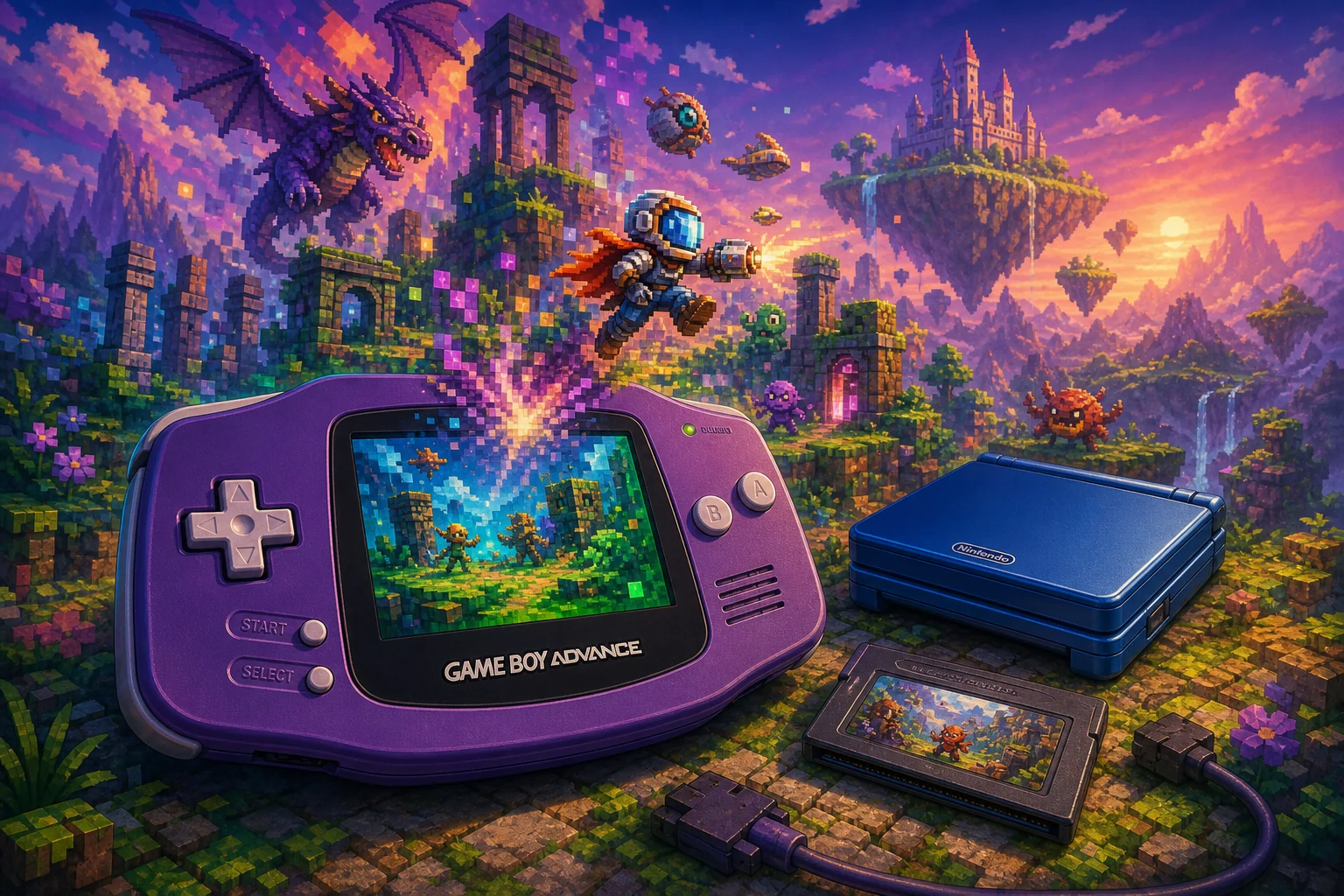
The Game Boy Advance looked familiar enough to invite the wrong assumptions. It still accepted a removable Game Pak, still had a directional pad and still fit into a pocket, but its native software ran on a 32-bit ARM processor rather than the older Game Boy family’s 8-bit architecture. That change made the GBA a more capable development target—and a more complicated object to modify. Its cartridge was not merely a plastic container for a program. It was a participant in the machine’s startup sequence, memory map, save system and, in some games, timekeeping or motion hardware.
The GBA’s early modification history therefore began with several different projects that are often flattened into one story: Nintendo’s own development and communication features; small programs sent through the link port; aftermarket writable cartridges; and copier products designed around reproducing commercial software. They could all place unfamiliar code near a GBA, but they did not use the same route. Understanding those routes means starting with the console’s architecture, because the hardware explains why the first tools were impressive, awkward and frequently incompatible.
An ARM Machine Behind a Familiar Interface
Nintendo described the GBA as using a 32-bit ARM processor with embedded memory. More precisely, its native software environment was built around an ARM7TDMI-class core, an implementation of the ARM architecture that could execute both full-width ARM instructions and compact Thumb instructions. Thumb code used shorter instruction forms, allowing programmers to reduce the size of parts of a program while retaining the same processor family. The distinction mattered on a handheld with limited memory and a cartridge bus that was not designed like a modern storage device.
The ARM core had no memory-management unit—the hardware found in larger computers that remaps and protects virtual memory. A GBA program instead worked with a fixed physical address map. Internal work RAM occupied one region, video memory another, and cartridge ROM appeared in a broad address range beginning at 08000000 in hexadecimal notation. Hexadecimal is simply a compact way to write binary-oriented addresses; developers used it constantly because the machine’s registers and memory regions were defined in those terms.
The cartridge ROM connection was effectively 16 bits wide. Parallel cartridge SRAM and flash-style save memory used an 8-bit data path, while EEPROM used a serial interface with its own access procedure. That difference had practical consequences. A writable cartridge had to behave like a cartridge electrically, answer reads and writes at the expected addresses, respect the console’s timing, and supply storage for both the program and its saves. A PC file copied onto a memory chip was not, by itself, a functioning GBA cartridge. The adapter between computer and handheld had to translate between two very different environments.
The original GBA also retained a separate path for older Game Boy software. In its backward-compatible modes, the system did not simply run an old game as though it were a slow ARM program. The hardware switched into an older cartridge and processor environment. That separation explains why native GBA development and Game Boy compatibility became distinct engineering problems. It also explains why the later Game Boy Micro could remain a GBA machine while dropping compatibility with original Game Boy and Game Boy Color software altogether.
The SP Changed the Shell, Not the Basic Software Target
The Game Boy Advance SP preserved the native GBA architecture while changing the physical experience. Its folding shell, rechargeable lithium-ion battery and integrated front light made it more convenient to carry and use, but it remained compatible with the same broad families of Game Paks: original Game Boy cartridges, Game Boy Color software and native GBA cartridges. Nintendo’s documentation also warned that some older games might exhibit display or sound problems, an important qualification to the phrase “backward compatible.” Compatibility meant that the hardware could enter the relevant mode, not that every title would behave perfectly.
This distinction became useful to the aftermarket. A cartridge accessory advertised as GBA-compatible was primarily promising that it could run native GBA software. Its behavior with older Game Boy software, its use of the link port and its power requirements could be separate matters. The original SP and later screen revisions should likewise not be treated as one undifferentiated machine. The early front-lit model documented in Nintendo’s consumer material is not evidence for every later display revision sold under the SP name.
The Game Boy Micro makes the architectural boundary especially clear. It retained the GBA’s ARM-based software path but played only GBA games. It was therefore not a reduced-power version of every GBA feature; it omitted the older Game Boy-compatible hardware. This mattered for linkers and cartridges whose advertisements used broad language such as “GBA compatible.” Native execution, old-cartridge support and accessory behavior were different claims, even when the same small console logo appeared on the packaging.
A Startup Contract, Not a Locked File Cabinet
Before a native program could run, the console expected the cartridge to present a recognizable structure. The cartridge header included an entry point, a Nintendo logo region, a title, identifying codes and checksums. The internal boot program initialized enough hardware to begin execution, inspected the cartridge data and then transferred control to the program. In practical terms, the header was a startup contract: the cartridge had to introduce itself in the form the console expected.
This process is often described as encryption, but that word obscures more than it explains. Available technical records describe validation involving boot code, logo data and checksums. They do not establish that ordinary GBA game programs were encrypted with a modern secret-key system and decrypted at startup. The important barrier was instead that a cartridge with an invalid or incomplete startup presentation could fail before its own code was reached.
A United States Customs ruling from 2001 is useful historical evidence because it recorded Nintendo’s position and a laboratory description of an early Flash Advance device. The ruling said that the GBA boot code expected unlocking data from the cartridge, displayed the Nintendo logo and would not operate without the required information. It also treated the boot code and logo data as copyrighted works in the context of an import decision. That record supports calling the mechanism an access-control and authenticity check. It does not justify calling the entire game image encrypted.
For developers, the effect was straightforward. A perfectly valid ARM program could still appear dead if its entry point, header fields, logo data or checksum were wrong. Development utilities consequently needed to create or preserve a compliant header. The surviving documentation does not securely identify one inventor or one first header-generation tool, and the history should not assign that credit without a dated original release. What can be said confidently is that homebrew authors and linker makers had to work within Nintendo’s cartridge format rather than treating the cartridge as an anonymous memory card.
Multiboot: A Legitimate Shortcut Through the Link Port
Nintendo provided a different route for getting small programs onto a GBA without a rewritable cartridge. Multiboot used the link connection to send a payload from one system—or from suitable development equipment—to another. The receiving console placed the program in external work RAM and executed it there. This was an official capability of the platform, not the same thing as an aftermarket flash cartridge and not a general-purpose method for rewriting a Game Pak.
The receiving program occupied the region beginning at 02000000 in hexadecimal notation. The client GBA has 256 KiB of external work RAM, so conventional multiboot images can occupy at most 256 KiB, including the required cartridge-like header and multiboot-specific payload structure. That is a memory ceiling, not a promise that every arbitrary 256-kilobyte file will satisfy the protocol. Header fields, minimum structure, handshake requirements and implementation details still matter. Nor does the limit mean that GBA programs or commercial cartridges were limited to 256 KiB; ordinary Game Paks could hold many megabytes of ROM.
The link cable also was not a USB cable in disguise. It was a console communication accessory. A multiboot host had to establish a session, exchange handshake information, send header and transfer data, and check that the receiving machine had accepted the payload before execution began. Later community projects reconstructed portions of this behavior through observation and testing, including the BIOS call associated with multiboot. Those projects are valuable technical evidence, but they should not be mistaken for Nintendo’s complete public protocol specification.
Multiboot gave programmers an important, legitimate escape from cartridge manufacturing. A developer could test a small program, a local multiplayer experiment or a demonstration with a GBA and a link connection rather than first obtaining a writable Game Pak. Its limitations were equally important: the program disappeared when power was lost, the client memory was small, and persistent saves or a larger game required another solution. Those limitations clarify what flash cartridges added: persistent storage, larger programs and a stand-alone cartridge workflow. That is an engineering contrast, not proof that multiboot alone created market demand.
Claims about the first multiboot cable are especially unstable. “First” might mean first built, first documented, first sold, or first that worked with a particular computer interface. The surviving evidence establishes Nintendo’s link capability and later commercial and community implementations, but not a defensible single winner.
The Parallel-Port Frontier
The earliest well-documented commercial GBA flash ecosystem grew around parallel-port linkers and rewritable cartridge-sized cards. Contemporary reports from 2001 described the Flash Advance Linker, a printer-port connection and cards advertised in capacities such as 64 megabits. The linker connected a desktop computer to the console-facing cartridge hardware, allowing software to prepare a program image and transfer it to rewritable memory. It could also read or manage save data, making it more than a simple cable.
The period is revealing because a printer port was an ordinary PC interface at the time, but it was never an elegant handheld development connection. Desktop computers still commonly exposed the DB-25 connector, yet port modes varied and transfer software had to account for the host computer’s configuration. The linker became an active bridge between incompatible worlds: PC software handled image preparation, writing and save management, while the cartridge adapter had to present the right electrical behavior to the GBA.
Prices reported during 2001 varied by publication and seller. One contemporary account listed approximately 35 dollars for a linker and approximately 109 dollars for a 64-megabit card; another later review gave a lower card price. Those figures are useful evidence of the commercial landscape, not universal prices. Bundles, regions and dates could change the total, and the records do not establish a single worldwide launch price.
The same products occupied an uncomfortable line between development and copying. Their writable memory made homebrew experimentation possible, but their advertised ability to duplicate commercial cartridges placed them within the copier economy that Nintendo challenged. The technical device and the user’s purpose were not identical questions. A linker could be used to test an original program, preserve a save, or reproduce commercial software without authorization. A responsible history keeps those uses separate rather than labeling every development cartridge as piracy hardware or every copier as a neutral development board.
Many Families, No Secure First Place
Flash Advance products were followed or accompanied by several other families, including Flash2Advance, EZ-Flash, XG-Flash and EFA hardware. Their surviving manuals describe different cards, writers and software packages rather than one interchangeable standard. Some later designs moved toward USB connections and larger capacities; others retained older interfaces or appeared in multiple revisions. The broad chronology is clear enough—parallel-port products were visible in 2001, while USB-oriented and higher-capacity designs became more prominent afterward—but the precise priority among individual families is not securely documented.
A manual preserved for the Flash2Advance line describes both USB and printer-port variants, but its surviving form does not establish a reliable single release date or prove that every product sold under the name used one continuous design. EZ-Flash documentation advertises a USB writer, cards described in 128-megabit and 256-megabit capacities, and support for multiple save modes. XG-Flash and EFA documents provide their own capacities, linkers and software arrangements. These are firm product-feature claims where the manuals state them, not evidence that one manufacturer invented the whole category.
That caution matters because later community retellings often turn product succession into a neat race. The available records do not securely establish the first GBA flash cartridge, the first USB linker or the first product to support a particular save technology. Nor do they establish, without board-level evidence or contemporary statements, that one family was a clone of another. The more accurate picture is an overlapping market in which manufacturers solved similar problems with partially compatible hardware and changing software.
The real technical contest was not simply storage capacity. Each product had to make its memory look sufficiently like a GBA cartridge, preserve a bootable header, write data through a limited PC interface and reproduce the save behavior expected by the selected program. A card could appear successful when a game started and still fail later when the player tried to save, use a clock or access special cartridge hardware.
Why Saving Was Harder Than Running
GBA cartridges did not have one universal save technology. SRAM, flash memory and EEPROM could all store persistent game data, but they did so through different electrical and software procedures. SRAM was directly accessible and often depended on a battery to retain its contents after power-off. Flash was nonvolatile but required command sequences, erase operations and appropriate timing. EEPROM communicated serially and came in different capacities and access patterns.
This meant that “the game runs” proved very little about a flash cartridge’s compatibility. A cartridge could present the program ROM correctly while failing to emulate the selected game’s save device. Early manuals openly describe separate save modes and limitations, which explains reports of one title saving correctly while another lost progress or produced a corrupt file. The GBA header did not offer a universal, simple save-type label that solved detection automatically; later tools relied on known game behavior, identifying strings, observed access patterns, databases and heuristics.
The phrase “flash save” also needs care. An original commercial cartridge might use mask ROM for its program and a small flash chip for saves. An aftermarket flash cartridge could use rewritable memory for the entire selected program while providing SRAM, flash or another device to represent saves. Both arrangements involved flash technology, but they were not the same hardware problem.
Once linkers became practical, a save stopped being an invisible consequence of running a game and became an object users could manage. A title might boot, display correctly and accept input while silently failing when it attempted to write its chosen memory device. Users could back up saves, convert them between tools, restore them after a battery replacement and keep them separate from the program image.
That separation was particularly valuable for preservation. Copying data from an original cartridge before a battery failed could protect a long-running game, while restoring the result to rewritable hardware offered continued access without repeatedly exposing aging original media to use. The same procedures could also be used with unauthorized copies, so the hardware did not determine the user’s purpose. A responsible history distinguishes archival save management from the copying of commercial software.
A homebrew author faced a different problem from a player preserving an existing game. The author could choose a save design and build the program around it. A commercial title had already been written with a particular memory device in mind, so the aftermarket writer had to recognize or accommodate that expectation. This is why databases, patches, configurable modes and later firmware updates became part of the user experience.
Save data also could not stand in for cartridge peripherals. A file could preserve progress in Pokémon Ruby, Sapphire or Emerald, but it could not by itself create the live clock circuit those games expected. Nor could it reproduce Boktai’s solar sensor or WarioWare: Twisted!’s motion hardware. The archival object was therefore only one layer of the original cartridge experience.
Clocks, Sensors and the Cartridge’s Hidden Periphery
Some GBA software expected more than ROM and save memory. A real-time clock was generally a cartridge-side peripheral rather than a standard feature of the console. Pokémon Ruby, Sapphire and Emerald are familiar examples: their time-based systems depended on clock hardware and a battery-backed circuit, even though the save memory itself need not have been battery-backed SRAM. Battery presence therefore does not automatically identify the save technology.
Boktai went further by placing a light-sensitive solar sensor and clock-related hardware in the cartridge. WarioWare: Twisted! used motion-related hardware, with cartridge documentation also identifying rumble and sensor arrangements among the platform’s unusual peripherals. These designs connected game software to physical components through cartridge I/O, including GPIO—general-purpose input and output lines that allowed the program to communicate with hardware beyond ordinary memory.
A flash cartridge could reproduce a program and a conventional save while lacking the sensor, wiring or timing behavior the original cartridge supplied. That is why a special peripheral game was a much harder compatibility test than a conventional role-playing game. It also explains why later preservation hardware and software often document RTC registers, sensor types and cartridge identification separately from ROM and save extraction.
The early commercial manuals do not establish uniform real-time-clock support across the Flash Advance, Flash2Advance, EZ-Flash, XG-Flash and EFA families. Support must be attributed to a specific product and revision when the evidence exists. Treating every writable cartridge as a complete substitute for every original Game Pak erases the most interesting part of the engineering: the GBA’s cartridge was a small expansion bus, not just a read-only shelf for code.
When the Linker Became a Development Environment
By the middle of the GBA’s life, the aftermarket scene had moved beyond the novelty of putting a writable cartridge into a retail console. The important change was organizational. A linker, its cartridge, the PC software that prepared images, and the save-management utility increasingly formed one development environment. Users were no longer dealing with a single transfer device so much as a chain of tools, each responsible for a different part of the console’s expectations.
The shift from parallel ports toward USB made that chain easier to use, although it did not make the underlying problem simple. A USB linker still had to translate between a computer’s file system and the GBA’s cartridge bus. It had to write the selected memory, preserve a valid startup structure, identify or configure a save method, and communicate with software that might support several hardware revisions. The interface became more convenient while the cartridge emulation problem remained.
Flash2Advance, EZ-Flash, XG-Flash and EFA products occupied overlapping portions of this transition, but they were not one standardized platform. Their manuals describe different writers, card formats, capacities and software packages. A USB logo on the box did not guarantee that a card from one family could be written by another family’s utility. Even within a product line, later revisions could require different firmware or a revised writer.
This was also the period when capacity stopped being the only persuasive specification. Larger cards made room for bigger commercial images and collections of homebrew, but users also wanted reliable saves, shorter transfer times, compatibility with the folding SP and support for the increasingly common Nintendo DS hardware. The best-selling feature depended on the audience. A hobbyist writing a small demo valued an inexpensive, repeatable workflow; a player carrying several games valued storage and save persistence; a preservation-minded user needed dependable extraction rather than merely fast loading.
The surviving manuals document advertised features, but not a complete chronology of every regional revision. It is therefore safer to describe the middle-era market as a succession of overlapping solutions than as a clean race from one winning product to the next. The historical change lies in the maturation of the workflow: writing a cartridge became a routine operation, and the people using these tools increasingly treated the GBA as an open development target rather than only a closed commercial console.
Homebrew Outgrew the Demonstration
As writable cartridges became more accessible, GBA homebrew developed beyond short proof-of-concept programs. The platform remained demanding: programmers worked with limited RAM, fixed video hardware, a cartridge-oriented startup format and an ARM processor whose compact Thumb instruction set rewarded careful code and data layout. Yet those limitations also gave the scene a recognizable style. Developers learned to treat memory, palettes, tile data and timing as design materials rather than invisible resources supplied by an operating system.
The early route was close to the hardware. A programmer assembled or compiled ARM and Thumb code, supplied startup support, wrote directly to video and sound registers, and used the BIOS for selected system services. There was no general desktop-style runtime standing between the game and the machine. Libraries could make the work more manageable, but they did not remove the need to understand the display’s tiled backgrounds, sprites, interrupts or DMA transfers. Direct Memory Access, or DMA, allowed the hardware to move blocks of data without burdening the processor with every individual transfer; using it well was one of the differences between a convincing game and a sluggish experiment.
The Tonc tutorial became an important expression of this register-level culture. Rather than presenting the GBA as an abstract game-making platform, it explained the machine through its graphics modes, memory regions, sprites, interrupts and assembly-aware programming model. Its value was partly technical and partly social: it organized scattered knowledge into a route that newcomers could follow. The project’s continued preservation and community maintenance show that GBA development history was not only written by commercial tool vendors. It was also assembled by hobbyists documenting one another’s discoveries.
libgba represents another stage in that development. Its openly developed C library, with project documentation dating its license agreement to 2004, supplied reusable headers, definitions and support code for programmers who did not want every project to begin with the same low-level scaffolding. It was not an operating system and did not turn the GBA into a conventional desktop target. Instead, it reduced repeated setup work while leaving the programmer close to the hardware.
That combination mattered. A small library could provide declarations and wrappers, but the author still had to decide how many backgrounds to use, where assets would live, how animation data would fit in memory and how a game would respond to the console’s timing. Homebrew therefore became more ambitious without becoming detached from the machine. The cartridge scene supplied a practical way to run the results; community documentation supplied the knowledge needed to make them.
Small Programs, Real Communities
The middle-era GBA scene also blurred the line between a development sample and a finished independent release. Demos circulated as compact binaries, often designed to show a graphical trick, a sound routine or a familiar console effect. Others became games with menus, save systems and enough content to be played rather than merely inspected. A writable cartridge gave these projects a physical presence: a programmer could hand someone a card and ask them to test a build on the same kind of hardware used by commercial players.
That physical loop changed feedback. An emulator could accelerate testing and make screenshots easy, but a real GBA revealed problems involving screen readability, button timing, cartridge loading and power behavior. A program that looked correct on a computer monitor could feel poorly balanced on the original display. Conversely, a routine designed around the GBA’s actual limits could seem more impressive when experienced on the small screen for which it was intended.
The community’s vocabulary reflected this mixture of engineering and play. A “demo” might be a technical showcase, a prototype might be a nearly complete game, and a development cartridge might be used for both. These categories were not legally or technically interchangeable, but they shared a distribution channel. Homebrew authors could circulate original code without reproducing Nintendo’s commercial software, while users could learn how a program behaved by examining its source, documentation or build notes when those were provided.
The open nature of the tooling also created uneven documentation. Some projects preserved source and build instructions; others survived only as binaries on old community pages. Attribution can consequently be difficult. The available evidence does not establish one first GBA homebrew author, one first independent game or one inventor responsible for the whole scene. Naming a project where its repository or contemporary documentation supports the connection is safer than attaching a sweeping origin story to an individual.
Nintendo’s Peripheral Ideas Became New Targets
Nintendo’s official accessories gave the GBA an important characteristic that aftermarket cartridge histories can obscure: the platform was not defined by ordinary ROM and save memory alone. The e-Reader paired GBA software with printed cards carrying optical dot-code data. A player interacted with the game through a physical reading process, creating a distribution and input path distinct from loading a conventional Game Pak.
The e-Reader demonstrated that a GBA title could depend on an accessory and a physical format as well as on its cartridge program. It therefore became an especially revealing target for later development and preservation work. The detailed modern projects built around its data formats, software-side handling and alternative transfer methods belong in the dedicated e-Reader discussion later in the article.
The Legal Pressure Around Copying Hardware
Nintendo’s reaction to the early copier market was not an abstract argument about every unofficial program. It focused on devices and practices associated with reproducing commercial software and, in the GBA’s case, with copying protected boot material. That distinction matters because the same period also contained legitimate development functions, original homebrew and technical research.
The 1999 Bung Enterprises litigation produced a permanent injunction concerning the Doctor GB Xchanger and related devices. When United States Customs later considered the GBA Flash Advance Linker, its December 2001 ruling referred to that earlier outcome and concluded that the device violated the cited provision of the Digital Millennium Copyright Act and would be subject to seizure if imported. The ruling’s analysis emphasized the linker’s copying or reproduction of GBA boot code and logo data.
This was an administrative import decision, not a universal judicial ruling that every flash cartridge, emulator or development tool had the same legal status. It is also not evidence that the GBA startup process used modern encryption. Its historical value is narrower and more precise: it shows how Nintendo and Customs characterized the boot sequence and why an early commercial linker attracted enforcement attention.
The outcome shaped the public identity of the hardware. Commercial reports could describe a device as useful for programmers while also discussing its ability to copy retail cartridges. Those descriptions were not necessarily contradictory. A writable cartridge was technically capable of original development, but a product marketed around duplication invited a different industry response from a tool presented as an authorized development system.
For homebrew authors, the practical lesson was that technical capability and commercial positioning mattered. A programmer could write an original game for the GBA without making a copy of a Nintendo program. A copier vendor could offer hardware capable of running that homebrew while also enabling unauthorized reproduction. The legal history therefore belongs beside the engineering history, not as a substitute for it.
A Platform Held Together by Workarounds
By the middle of the 2000s, the GBA scene had acquired several layers that did not share a single purpose. USB linkers made rewritable cartridges less dependent on aging desktop ports. Save tools treated persistent data as something that could be extracted and managed independently. Tonc and libgba helped programmers move from isolated experiments toward reusable code. e-Reader research showed that the platform’s accessories could become subjects of preservation and new development.
None of these changes erased the GBA’s original constraints. The machine still expected a particular cartridge startup structure. Its processor still shared a small physical memory map with video and working data. Its games still encountered several save protocols, and unusual cartridges still carried hardware that could not be replaced by a file alone. The scene’s progress came from recognizing those constraints and building tools around them.
That is why the historical middle period is better understood as an accumulation of bridges. Linkers bridged desktop computers and cartridge buses. Libraries bridged low-level hardware knowledge and playable software. Save managers bridged original cartridges and rewritable media. Preservation projects bridged accessories and new forms of distribution. Each bridge solved one problem while leaving other parts of the original machine visible.
The result was a console that could support commercial cartridges, original homebrew, small link-delivered programs and accessory experiments without making them technically identical. The GBA’s modification history became richer precisely because no single replacement absorbed every function. A writable card could make development practical, but it could not explain the whole platform; the people who programmed, documented and preserved the system had to supply the missing pieces.
The Toolchain Finally Became the Platform
The earlier GBA scene had already established why writable cartridges mattered. The modern scene changed the question from “How do I get a program onto the machine?” to “How do I build, inspect, preserve and distribute an entire project?” That shift is visible in the software surrounding the hardware. Contemporary GBA development is no longer dependent on one linker utility or a single low-level code example. It is a layered toolchain in which compilers, libraries, asset converters, debuggers, emulators and physical targets each do different work.
At the foundation is devkitARM, the ARM cross-compilation toolchain commonly used for GBA development. It supplies the compiler and build environment, but it is not itself a complete game engine or hardware abstraction layer. Libraries such as libgba and libtonc sit above it, providing declarations, startup support, register definitions, BIOS wrappers and reusable functions. That distinction is easy to lose when modern discussions refer casually to “the devkit.” The compiler, the GBA support library and the tutorial or examples built around them are separate parts of the development stack.
libtonc represents the classic route into the system: close enough to the hardware that a programmer can learn how backgrounds, sprites, interrupts and video registers actually work. Its continuing examples preserve a style of programming in which memory layout and timing remain visible design concerns. libgba offers another route, with an openly developed C library that reduces repeated setup without pretending that the GBA has a conventional operating system. Neither library removes the need to understand the target. They make the machine more approachable while leaving its constraints intact.
Butano shows how far the modern scene has moved beyond isolated register demonstrations. It is a C++ engine with abstractions for sprites, backgrounds, text and raster effects, alongside asset-import tools, examples, profiling and debugging support. Its repository includes complete games such as Butano Fighter and Varooom 3D, making the project more than a collection of utility headers. The important historical change is organizational: larger projects can now be structured around reusable resources and higher-level systems while still producing software for original GBA hardware. That does not make the target modern; it makes modern development habits usable on an old target.
The Emulator Became a Laboratory
mGBA occupies a different place in this ecosystem. It is an emulator, but its value to developers goes well beyond playing software on a computer. Its command-line debugger, ARM and Thumb breakpoints, watchpoints, Lua scripting and GDB support turn it into a laboratory for examining code behavior. A programmer can stop execution, inspect registers, watch a memory location change and compare the result against an expected video or input state without repeatedly transferring a build to a handheld.
That convenience is especially valuable on a machine with no desktop operating system to provide ordinary debugging services. A crash may otherwise look like a frozen image or an unresponsive set of buttons. In a debugger, the same failure can become an invalid address, an unexpected interrupt, a bad pointer or a mistaken assumption about memory timing. The emulator also makes repeatable experiments practical: scripts can automate tests, while logging and breakpoints can expose behavior that would be difficult to observe through the handheld’s screen alone.
Yet mGBA is not a replacement for original hardware. An emulator models the platform, and even a highly accurate model remains an interpretation of the platform. Timing-sensitive code, unusual cartridge peripherals, display characteristics and power behavior may produce different results on a real GBA or on a particular aftermarket cartridge. The sensible modern workflow is therefore complementary. Use the emulator for rapid iteration and inspection, then validate important behavior on the intended physical target.
This distinction also gives preservation work a more rigorous vocabulary. An emulator preserves an executable environment; it does not automatically preserve the electrical behavior of a cartridge, the feel of a screen or the operation of an accessory. A debugger can reveal how a program expects to communicate with a peripheral, but it does not recreate the sensor or connector that supplied that peripheral in the first place.
The E-Reader Is an Accessory, a Format and a Preservation Problem
The e-Reader makes the layers of GBA preservation unusually clear. Nintendo’s accessory used an optical reader to interpret printed dot-code cards, allowing data and additional content to enter the GBA through a physical process that was neither ordinary cartridge loading nor a conventional link transfer. Preserving it therefore means preserving more than a program file: researchers must consider the card’s encoded data, the reader’s loading behavior and the software waiting for the transferred material.
The e-reader-dev project treats that chain as a development subject. Its examples and conversion utilities support turning custom GBA programs into dot-code data for distribution through the accessory’s original concept. That is narrower than a claim that any GBA software can be converted indiscriminately. The project also documents the relationship between the accessory’s optical input and software-side handling, while mGBA provides an environment in which e-Reader-related behavior can be tested and debugged.
The 4-e project demonstrates a different preservation strategy. A 4-e program sends decoded e-Reader card data to a running Super Mario Advance 4 session on a target-specific implementation: real GBA hardware, Analogue Pocket hardware or an mGBA multiplayer window. These are separate target paths, not one undifferentiated class of GBA programs. In each case, the original optical scan is replaced by a software-mediated transfer, while the receiving SMA4 session remains the destination for the card data.
That replacement is not the same experience as scanning a physical card. It does, however, make the boundary between preserved function and simulated hardware easier to see. A project can preserve the relationship between encoded card data and a receiving game without recreating the original reader, printed surface or electrical path.
The distinction also matters when discussing copyrighted commercial card data. Preservation projects can document formats, create original test material and reproduce interoperability without turning a historical account into a directory of commercial card files. The e-Reader’s modern life is therefore not simply a story about extracting content. It is a case study in how an unusual accessory can remain understandable after its original distribution system has disappeared.
When the GBA Runs Somewhere Else
Modern software has also made it possible to experience GBA software on hardware that is not a GBA. GBARunner2’s project documentation calls it a GBA hypervisor for Nintendo DS, DSi and 3DS systems running in DS mode. It should not be described as a hardware modification to an original GBA or as native execution on the handheld. As an explanatory description, it uses the DS family’s available processors, memory and display hardware to reproduce enough of the GBA environment for GBA programs to run; it should not be treated as a conventional full-system emulator or assumed to derive all compatibility from one uniform mechanism.
That distinction changes how compatibility results should be interpreted. A title that runs under GBARunner2 has succeeded within a DS-family implementation, not necessarily on original GBA hardware, a modern flash cartridge or a cartridge containing an unusual sensor. Different builds may target different DS-family systems and use hardware available only on those systems. The result belongs to the history of platform translation, even though its purpose is to make GBA software playable.
The Game Boy Player creates a related but separate comparison. Nintendo’s Game Boy Player combined an attached Game Boy-side hardware unit with a required GameCube Start-up Disc that launched the official software. Game Boy Interface, by contrast, is third-party GameCube software that replaces the official startup software’s role and changes how the Player hardware is driven. A GBA displayed through the Game Boy Player with Nintendo’s software, the same hardware driven by GBI and a DS running GBARunner2 may look similar to a casual observer, but they represent three different technical paths.
That separation is important for preservation claims. One path preserves original cartridge-facing hardware, another alters the software driving an authorized accessory, and another recreates the platform on a different handheld. None should be used as evidence that the others behave identically.
Modern Flash Cartridges Are Convenience Machines
Current flash cartridges are more sophisticated than the early linker-and-card combinations, but they remain aftermarket cartridge hardware rather than development kits or emulators in the same category as mGBA. Krikzz lists, for the EverDrive GBA Mini, a direct GBA cartridge workflow, multiple save types, real-time-clock support, low power consumption, fast loading, 256-megabit PSRAM, 1-megabit SRAM, FAT32 support and GameCube Player compatibility. Its documentation separately identifies NES, Game Boy and Game Boy Color operation as emulation modes. These are manufacturer-listed specifications and claims, not independent verification of every title, console revision or accessory.
EZ-Flash lists a broader feature set for the Omega Definitive Edition, including PSRAM, NOR flash, a real-time clock, save states, cheats, sleep support, hotkeys, firmware and kernel updates, rumble support, FRAM-based saves and functions related to Nintendo DS Slot-2 hardware. Its documentation also identifies emulation for older Game Boy-family and NES software. These are manufacturer-documented specifications and claimed capabilities, not independent verification of every title, console revision or accessory.
The useful comparison is not a universal ranking. Krikzz’s documentation emphasizes a relatively direct GBA experience and power-conscious operation, while EZ-Flash emphasizes extra features and multiple working modes. In either case, a listed save type does not prove identical behavior in every title, and a stated accessory feature does not guarantee that every revision of every console will respond the same way. Compatibility can depend on the game, cartridge firmware, console revision and peripheral involved.
Neither product should be confused with an authorized Nintendo development system. Nor does a flash cartridge make commercial software distribution lawful. Its historical significance lies elsewhere: it turns a fragile, discontinued cartridge workflow into something more convenient for development, preservation and personal use, while still exposing the limits imposed by clocks, sensors, unusual cartridge hardware and software-specific behavior.
A New Generation of GBA Games
Modern homebrew proves that the GBA is more than a platform being kept alive by nostalgia. The GBA Jam 2021 archive, created for the system’s twentieth anniversary, links entries to released builds and, where available, source repositories. Its entries include projects such as Varooom 3D and Inheritors of the Oubliette. Butano’s own project identifies Varooom 3D among its complete example games, offering a visible connection between a modern development framework and a finished GBA title.
The importance of these projects is not that they imitate commercial games perfectly. They show that the platform’s restrictions can become a shared creative language. Developers work within a fixed display, limited memory and a familiar control layout, but they can now use source control, modern build systems, asset pipelines, automated testing and contemporary collaboration practices. The old machine remains constrained; the surrounding production culture no longer has to be.
Goodboy Galaxy offers a different kind of evidence. Its creators have released GBA and PC versions, with an Evercade version also identified on the official site and additional ports announced separately; the Nintendo Switch version is announced for October 30, 2026. This distinction matters: a listed or announced platform is not necessarily an available release. The project’s official site should therefore be read as a dated record of availability and plans rather than as proof that every platform version has shipped.
Community databases help map this expanding catalogue, but they should be treated as indexes rather than final authorities. Individual repositories and creator pages remain stronger evidence for authorship, licensing, release dates and dependencies. A freely downloadable binary may coexist with separately licensed music, art or source code. Modern preservation is therefore partly technical and partly documentary: keeping a game playable also means recording who made it and under what terms.
Changing the Screen Without Changing the History
Physical restoration forms another modern branch of GBA modification. IPS and ITA replacement displays, new shells and replacement batteries address aging hardware rather than expanding the software library. Current aftermarket catalogs document GBA SP IPS kits, laminated LCD assemblies, ITA-related parts and replacement batteries. They do not, by themselves, establish universal fit, installation difficulty, battery life or compatibility with every motherboard revision.
The conceptual tradeoff is straightforward even when the practical installation is not. A brighter modern display may improve visibility and contrast while changing power consumption, pixel appearance and the visual character of the original screen. An ITA-style replacement may aim for a presentation closer to the original pixel structure, but that does not make it identical to an aging Nintendo panel. Shell fit, ribbon-cable routing, brightness controls and board revision can all affect the final result.
Battery restoration has its own boundary. Replacing a degraded cell can recover useful operating time, but a replacement battery is not an upgrade in the same historical sense as a new screen technology. It restores the handheld’s ability to operate independently of a charger, while a display swap changes the visual relationship between software and hardware. Both are valid preservation choices, but they preserve different qualities of the original object.
These modifications also demonstrate why “original hardware” is not always a simple yes-or-no category. A GBA with a new battery remains close to the original electrical design. A GBA with a replacement display retains the motherboard and cartridge interface but presents the software through a substantially newer panel. A flash cartridge adds another layer without changing the console at all. Good preservation writing identifies which layer has been retained, replaced or simulated instead of treating every restored handheld as equivalent.
What the GBA Preserved
The modern GBA scene is best understood as a set of overlapping preservation choices. Original cartridges preserve Nintendo’s software and its intended cartridge interface. The e-Reader preserves an accessory-driven format in which printed optical data became part of the game experience. mGBA preserves executable behavior while adding a powerful development and debugging environment. GBARunner2 preserves access through another Nintendo platform, but not through original GBA hardware. Game Boy Interface changes how an authorized Game Boy Player is driven. Flash cartridges preserve convenient access to selected software while adding their own memory, firmware and compatibility decisions. Screen and battery replacements preserve a usable physical object, though not always its original display or power characteristics.
Homebrew gives the platform a future rather than merely extending its past. Toolchains such as devkitARM, libgba, libtonc and Butano allow new authors to choose how close they want to work to the registers. Debuggers and emulators make difficult experiments repeatable. Preservation projects show that an accessory, save format or hardware behavior can be studied without reducing the entire experience to a downloadable image.
That variety is the GBA’s most durable legacy. It survived not because one modern device replaced every original function, but because different communities preserved different layers: the code, the cartridge bus, the accessory, the display, the development knowledge and the social practice of making new software for an old machine. The result is not one perfect substitute for a 2001 handheld. It is a living archive in which original hardware, aftermarket electronics, emulation and homebrew remain distinct—and become more meaningful because they are not mistaken for one another.
Explore more modding histories
Compare these experiments with our original PlayStation modding history, original Xbox modchip and homebrew history and Dreamcast boot discs and homebrew story. Find more long reads in Editorial Spotlight and explore our game walkthrough library.