The Handheld With Two Ways In
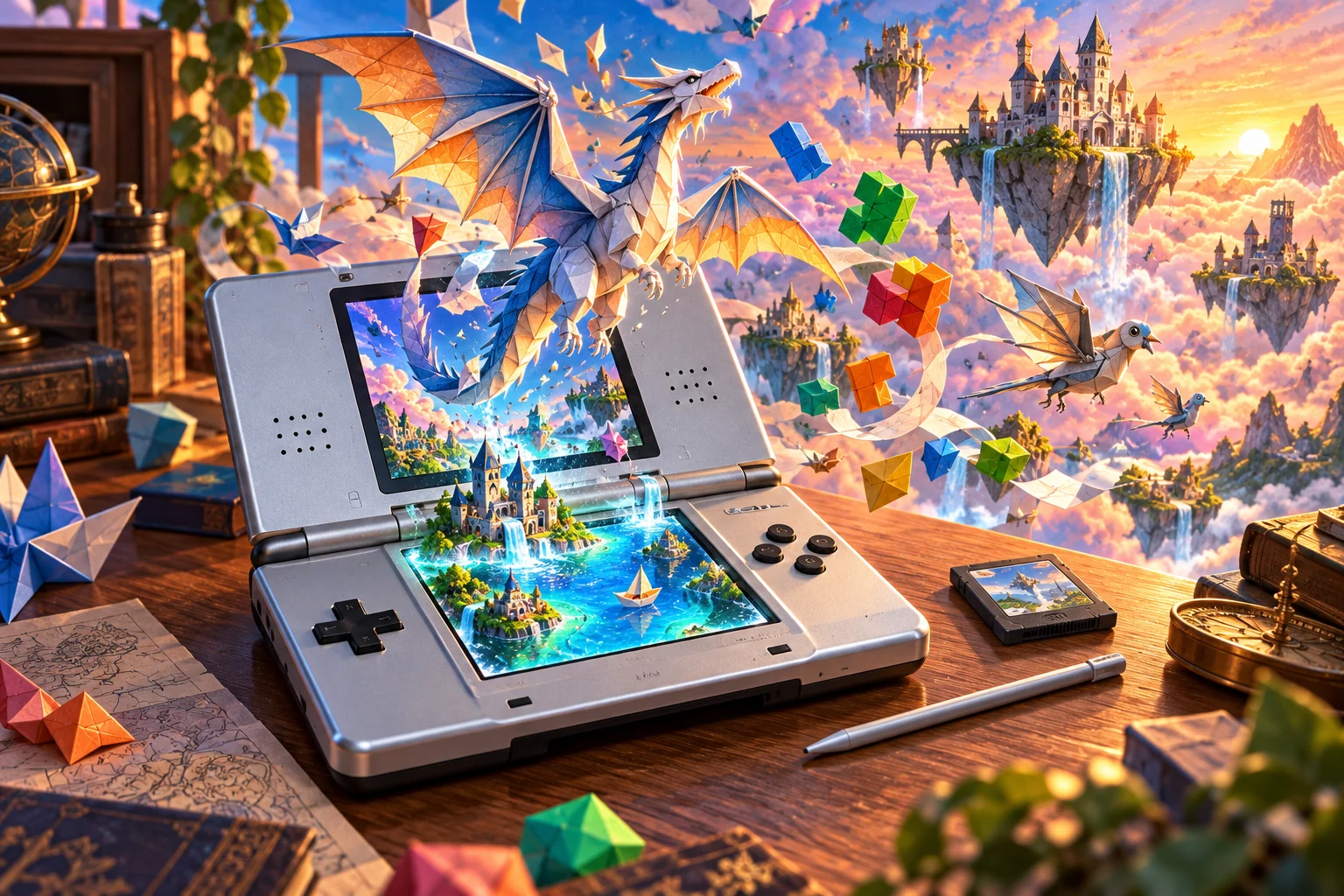
The Nintendo DS did not begin life as an especially inviting computer. It was a game console with two screens, a stylus, a microphone and a wireless radio, wrapped around software that Nintendo expected to arrive on proprietary Game Cards. Yet its first modding history was shaped by a peculiarity visible before anyone opened the case: the machine had two cartridge slots and two processors. Those decisions, made for compatibility and flexibility, created several separate boundaries for curious developers to test.
The original DS and DS Lite used a Slot-1 connector for DS Game Cards and retained a Slot-2 connector for Game Boy Advance cartridges and accessories. Internally, an ARM9 processor handled much of the demanding game logic and 3D work, while an ARM7 processor handled or assisted with sound, microphone, wireless and selected system or input/output duties. That division should not be read as a rigid assignment of every input function to ARM7: the two processors shared responsibilities through system libraries and interprocessor communication. “ARM” here refers to a processor architecture, not a single chip design; the distinction matters because the DS was effectively a small two-processor system whose components had to cooperate rather than behave like two independent computers.
That division became visible in the homebrew software that followed. A program could have an ARM9 component for its principal application and graphics, alongside an ARM7 component responsible for services such as audio or wireless communication. The processors exchanged messages and shared carefully arranged memory rather than behaving like two independent computers. Later open development libraries made this arrangement easier to use, but they did not create it. The hardware had always been organized this way, and early experiments had to respect those boundaries long before polished menus hid them from users.
A Cartridge Was More Than Storage
Nintendo’s public descriptions of the DS emphasized a new semiconductor Game Card format, but a Game Card was not merely a removable memory chip. At startup, the console expected identifying information and Nintendo-specific data from the card. Later court records concerning commercial game-copying devices described logo data, scrambling and shared-key encryption as parts of the authentication process. That evidence supports a careful explanation of the boot check, although it does not disclose every detail of Nintendo’s original boot ROM or cryptographic implementation.
The practical consequence was simple: a program on an ordinary writable cartridge could not necessarily present itself as a legitimate DS game. The console wanted to begin with a card that looked authentic, while researchers wanted to make it execute code that Nintendo had not signed or supplied. The early scene therefore did not “break the DS” in one event. It looked for ways to borrow, redirect or relocate the information used during startup.
This is why the first solutions were awkward by later standards. A developer might need an authentic DS game to provide the identity the console expected, a Slot-2 flash cartridge to hold experimental software, and an additional device or altered firmware to redirect the machine after its initial checks. The result was less like replacing a console operating system than persuading a guarded loader to accept one source of identity and another source of executable code.
The separation between authentication and execution also explains why early DS homebrew should not be described as piracy by definition. The same redirection path could launch a programmer’s test, a graphics demonstration, a utility, an emulator or a copied commercial game. The technical opening and the material placed behind it were different questions. Some later products were explicitly promoted for commercial ROM files, but that later use should not be projected backward onto every experiment that established unsigned-code execution.
Borrowing Trust From Slot 1
PassMe was the clearest early expression of this compromise. It was not itself a normal flash cartridge and did not simply store a program for the DS to find. Instead, it worked with a genuine DS game and a compatible Slot-2 device, using the authentic cartridge as an anchor while redirecting execution toward code supplied elsewhere. The name became associated with a family of related approaches, but the underlying idea is more useful than any simplified claim about a single universal device: let Nintendo’s cartridge satisfy enough of the startup process, then change where the machine goes next.
The arrangement reflected the DS’s physical design. A Slot-2 flash cartridge came from the older Game Boy Advance development tradition and could contain writable storage, removable media or GBA-oriented software. In GBA mode, it behaved as an aftermarket cartridge for that system. In DS mode, however, it could not simply act as a complete replacement for the DS Game Card. It needed the boot redirection supplied by PassMe or a comparable method.
Nintendo’s firmware revisions complicated that approach. Archived technical records distinguish earlier revisions that worked with original passthrough methods from later revisions that required updated approaches, including PassMe2. The broad progression is well documented, but surviving scene archives do not justify confidently naming one person as the first discoverer or assigning a universally accepted first-publication date to each technique. Those details belong among the unresolved parts of the story, not in a neat but unsupported chronology.
PassMe’s importance was therefore conceptual as much as practical. It established that the console’s trust decision could be separated from the location of the code eventually executed. That distinction would reappear in increasingly integrated products, but the early setup made the compromise visible: genuine cartridge data on one side, experimental software on the other, and a small piece of hardware in between trying to make the two agree.
The Wireless Detour
WiFiMe explored a different route through the DS’s architecture. Rather than relying primarily on a physical passthrough device, it used the console’s Download Play pathway to deliver a program wirelessly, with the transmission staged from a computer equipped with suitable wireless hardware. Download Play was designed for ordinary multiplayer and demonstration scenarios, not as a general homebrew loader, so WiFiMe depended heavily on the behavior of the DS’s wireless software and the firmware revision running on the console.
Its limitations are historically important. Early documentation distinguishes between Nintendo-signed Download Play material and unsigned code, noting that firmware did not treat every payload alike. WiFiMe could support homebrew launched with the help of a GBA flash cartridge, but it was not a complete commercial-game solution by itself. Describing it as a universal wireless jailbreak erases the engineering problem it actually solved: delivering selected code through a narrow, purpose-built communication channel with strict assumptions about what the receiving system would accept.
The experiment nevertheless broadened the scene’s understanding of the DS. The wireless radio was not just a feature for multiplayer; it was another boundary between system software, hardware and user-supplied data. Researchers could study how the handheld received and validated Download Play content, while homebrew authors gained another route into the machine. The route was fragile and specialized, but it demonstrated that the cartridge slot was not the only place where the DS made consequential decisions about code.
WiFiMe also reinforces the need to separate delivery from capability. A wireless transmission path could start a demonstration without providing the storage, memory arrangement or privileges needed by a larger application. A technique that launched a small homebrew program was not automatically capable of running a complete commercial title, and a method that worked on one firmware revision did not become a property of every DS or DS Lite.
Moving the Workaround Into Firmware
FlashMe took the next logical step by modifying the DS or DS Lite’s internal firmware. Its central historical function was to let the console boot DS-mode software from compatible Slot-2 media without requiring a PassMe or PassCard on every start, once the firmware modification had been installed. Some versions also had Download Play-related behavior. It was therefore a persistent convenience layer for a particular boot arrangement, not a universal launcher for every form of unsigned software from every storage location.
That distinction matters. PassMe borrowed authenticity each time the system started through the appropriate hardware arrangement. FlashMe changed the console’s startup behavior so compatible DS-mode code on Slot-2 media could be reached more directly. It was not the same exploit, not merely a new brand of passthrough cartridge, and not a guarantee that every program would work once the firmware had changed. Storage, memory, processor coordination and application-specific assumptions remained separate problems.
The surviving documentation supports FlashMe’s role as an alternative to repeated passthrough hardware, but not a clean discovery narrative. The precise first release day, first author and sequence linking individual early experiments are not securely established by the available primary record. A responsible history can describe what the software did without turning incomplete scene folklore into a named origin story.
This period also established a vocabulary that would become increasingly necessary. “Unsigned” meant code that had not passed Nintendo’s normal authorization process; it did not specify whether that code was a game, a utility, a development test or an infringing copy. “Firmware” meant software closely tied to the console’s startup behavior, not a universal label for every menu or file stored on a flash cartridge. Those distinctions prevented a technically diverse scene from being reduced to one supposed hack.
The Slot-2 Inheritance
SuperCard and M3 illustrate why the DS story cannot begin with the later Slot-1 cards that looked almost like ordinary Game Cards. Their earlier products inherited the design assumptions of GBA flash cartridges: a cartridge-shaped device in Slot 2, storage or media functions that varied by model, and host-side software that prepared files for the device’s particular memory controller. Different products used CompactFlash, SD, MiniSD or other media, so “the Slot-2 flash cart” was never a single standardized machine.
These devices had two identities depending on the mode in which the DS used them. In GBA mode, some Slot-2 products supported GBA software from writable or expandable cartridge-style storage, although patching requirements and compatibility varied considerably by model. Other products functioned primarily as media adapters or DS homebrew storage devices. In DS mode, a Slot-2 device was a source of data that still needed the console’s DS boot process to be redirected or assisted. Calling this emulation would be misleading: the cartridge was not pretending to be a complete GBA console inside the DS, nor was it emulating GBA hardware through the ARM9.
The associated software was correspondingly complicated. Files could be patched into a format expected by a particular product, with separate save or metadata files and different handling for GBA and DS software. Those conversions were not Nintendo’s own Game Card format, and the need for them varied by device and program. Contemporary manuals document the existence of these workflows, but they do not justify reconstructing universal compatibility tables decades later without dated manufacturer evidence or repeatable testing.
M3 occupied a transitional position. Its older products belonged to the Slot-2 lineage, while M3 DS Simply presented a later Slot-1 form with microSD storage, a menu and multimedia support through Moonshell. That shift was more than a change in cartridge shape. It reduced the number of separate pieces required to start software and moved storage, selection and boot assistance toward a single device in the DS Game Card slot.
The Flash Cart Becomes a Game Card
Slot-1 products integrated the pieces that early users had to assemble. A card such as the original R4 Revolution for DS combined a DS-shaped interface, removable storage, a menu and enough of the Slot-1 cartridge protocol and authentication exchange to pass the console’s startup checks without a donor game. That does not establish that every Slot-1 product used the same implementation. The precise circuitry and software varied by product and revision, even when the user experience looked similar.
The original R4 manual documents microSD storage, FAT16 and FAT32 support, homebrew and Moonshell compatibility, a media-size limitation and the absence of native GBA execution. Those details belong to that product family, not to every later card wearing an R4 logo. Over time, manufacturers and sellers reused the name across boards with different controllers, firmware arrangements, storage support and compatibility claims. A later R4 could require a different kernel, reject the original software or add features that the first card never possessed.
CycloDS Evolution followed its own design lineage. Its manual describes a preloaded operating system, a menu separating games and homebrew from media functions and settings, and direct browsing of files on microSD storage. Acekard likewise developed a distinct hardware and software family, with factory releases and later community environments such as AKAIO occupying different places in the chain. A community kernel was not automatically the manufacturer’s firmware, and a loader update was not necessarily an update to the cartridge’s internal controller.
The word “kernel” in this scene usually meant the menu and supporting software stored on the removable card, not the operating-system kernel of a desktop computer. A flash cart might also contain internal boot code, a game-specific loader and a host-side patching utility. Those layers could be updated independently. This is why a file archive listing several kernels cannot, by itself, prove that two branded cards used identical hardware.
By the mature Slot-1 period, the execution boundary had moved again. PassMe had borrowed trust from a genuine cartridge; WiFiMe had tested Download Play; FlashMe had placed a narrower workaround in the console; Slot-2 products had supplied inherited storage and expansion hardware; and Slot-1 cards had folded much of that machinery into a single aftermarket cartridge. The DS had not become architecturally simple. Its complexity had merely become easier to conceal behind a menu.
The Middle Scene Learned to Build for the Machine
Once Slot-1 hardware made unsigned code easier to launch, the DS homebrew scene began shifting from boot research toward software development. The important change was cultural as much as technical. Early experiments had concentrated on persuading the console to start foreign code; the next generation had to make that code useful on a handheld with two processors, two screens, a touch panel, limited memory and a wireless interface designed around Nintendo’s own protocols.
The development environment that emerged around devkitPro and devkitARM gave programmers a practical way to target the DS without writing every hardware routine from scratch. Libraries such as libnds exposed video modes, sprites, touch input, timers, interrupts, sound and filesystem functions. They did not turn the DS into a conventional single-processor computer. A typical application still had to account for an ARM9 program and an ARM7 companion, with communication between them and carefully chosen memory regions.
That division shaped the kinds of mistakes developers made. A graphics-heavy application could appear to work while its audio or wireless component stalled because the ARM7 side had not been configured correctly. A program might read files successfully from one flash-card storage system but fail on another because the storage interface was not presented identically. Homebrew development therefore involved more than compiling a binary: it required understanding which processor owned a service, how the two sides exchanged messages and how an aftermarket cartridge exposed its filesystem.
A documented 2006 stable release of libnds marks one important stage in the move toward reusable development infrastructure. Once common libraries handled routine jobs, programmers could spend more time on games, utilities and experiments rather than duplicating the same initialization code. The result was an ecosystem in which a flash cart became less interesting as a hack and more interesting as a distribution medium for software made by people who were not Nintendo licensees. Nintendo’s official development hardware and SDK materials remained a separate, authorized ecosystem; devkitARM, libnds and aftermarket flash carts were community or commercial alternatives, not interchangeable versions of Nintendo’s development system.
DLDI Made Storage a Software Problem
One of the period’s most consequential ideas was DLDI, the Dynamically Linked Device Interface. Its purpose was to separate a homebrew application’s filesystem code from the peculiar storage controller in the cartridge used to launch it. A homebrew binary normally contained a patchable device-driver area, which could be filled with the driver appropriate to the user’s hardware before launch.
This solved an awkward problem created by the commercial market’s lack of standardization. R4, M3, Acekard, SuperCard and CycloDS products might all accept removable storage, but their controllers did not necessarily respond to the same commands or expose the same addresses. From the user’s perspective, each card showed files in a menu. From a programmer’s perspective, “open this file” could require device-specific code.
DLDI did not make the cards interchangeable, and it did not create a runtime-pluggable driver system in the general operating-system sense. It established a narrower contract: an application could ask for filesystem operations through a known interface, while the card-specific driver supplied the hardware details. That distinction is why DLDI-patched homebrew became associated with the mature Slot-1 period. It was an adaptation layer, not a universal firmware and not an emulator.
The concept also changed preservation. A surviving homebrew binary without its appropriate driver might be difficult to run on the hardware for which it was written, while a source archive could preserve the assumptions needed to rebuild it. Conversely, a later community archive might contain a patched binary whose original build environment was no longer obvious. The DS scene was already developing software layers on top of hardware layers, and each layer could become part of the historical record.
Menus Turned a Research Device Into a Platform
The polished menus of mid-period flash carts concealed the work that came before them. A user selected a file with the stylus, but the cartridge had to initialize removable storage, identify the file type, load a program into the expected memory arrangement and provide save behavior that differed from Nintendo’s own Game Cards. The menu was therefore part launcher, part filesystem browser and part compatibility environment.
M3 DS Simply, the original R4, Acekard products and CycloDS Evolution all occupied this broad category without being the same implementation. Some relied heavily on files stored on the microSD card; some carried more logic in the cartridge controller; some used different patching or loading systems. The distinction between an internal firmware update and a menu update remained important. A new menu could change the interface or loader files without changing the cartridge’s electrical behavior, while an internal update could address how the card presented itself to the console.
Community software complicated the chain further. AKAIO, associated with Acekard hardware, demonstrated how a third-party operating environment could become historically significant without being the manufacturer’s original firmware. The same general pattern appeared elsewhere: users discussed kernels, loaders, drivers and patches as separate objects, even when retail packaging called the entire experience a single “flash cart.” The vocabulary was often loose, but the underlying architecture was not.
This was also when branding became a particularly unreliable guide. “R4” could identify the original R4 Revolution for DS or a later product using the same name on a different board. Storage limits, required directory structures and kernel compatibility could change between products. A contemporary manual can establish what one identified device supported; it cannot establish that every later card with the same logo behaved likewise. That caution matters because many surviving accounts flatten a changing commercial market into one imagined R4 platform.
Homebrew Became More Than a Loader Demonstration
The software that circulated through this infrastructure revealed what users wanted from Nintendo’s hardware. Moonshell, associated with the developer known as Moonlight, turned the DS into a portable media and document player. It handled music, images, text and converted video, making practical use of the two screens, touch input and removable storage. Its video support also exposed the machine’s limits: desktop media could not simply be played unchanged, so files generally had to be prepared for the DS’s processing and memory constraints.
Moonshell’s importance was not that it replaced Nintendo’s game software. It demonstrated that the DS could serve as a small general-purpose appliance when developers worked within its limitations. A game console became a music player, image viewer or reading device through software written outside Nintendo’s official publishing pipeline. Historical claims about exact versions and final releases should remain cautious because the original distribution record is fragmented, but its place in the middle-era homebrew culture is well documented by contemporary references and demonstrations.
DSOrganize, created by DragonMinded, pursued a different idea: the DS as a personal organizer. Its feature set combined notes, calendar and contact-style information with file browsing, text and image viewing, audio playback, homebrew launching and network functions. The stylus was no longer merely an unusual game controller. It became a practical way to write, browse lists and interact with a small graphical interface.
Projects like these changed the meaning of compatibility. A flash cart did not merely need to launch a commercial game image; it had to support an application’s directory layout, filesystem calls, sound routines, wireless expectations and save behavior. A media player might need sustained reads from storage. An organizer might expect a particular configuration file. Homebrew made the differences between cartridge families visible in ways a short game demo did not.
Wireless Was Both Feature and Research Target
The DS wireless hardware attracted developers for reasons beyond multiplayer. Early researchers studied Download Play and wireless delivery, while later homebrew authors explored local communication, file transfer and Internet applications. The ARM9 generally handled the application’s main interface while an ARM7 component supplied or assisted with wireless services, so a network program depended on both the application binary and the correct companion runtime.
Wireless programming remained constrained by the host. Original DS-mode networking was designed around the older radio and security assumptions, including 2.4 GHz 802.11b-era conditions and limited support for contemporary protected networks. A DSi-enhanced title, DSiWare application and ordinary DS-mode program could therefore have different wireless capabilities even when they ran on closely related hardware.
Modern development has widened that boundary without erasing it. As of September 2026, BlocksDS documents DSi-mode DSWiFi work with WPA2 support, while maintaining a separate backwards-compatible DS path. That is a feature of the contemporary SDK and DSi-mode driver, not a capability automatically inherited by unchanged DS software or by the original DS hardware. Rebuilding an old application against a newer library may also require changes to its APIs, memory assumptions and ARM7 component.
Wireless preservation has a second meaning: restoring selected online functions in old commercial games after Nintendo’s official services disappeared. Projects such as Wiimmfi and AltWFC/WFCZwei replace portions of the remote infrastructure expected by particular titles. They can preserve selected multiplayer or online uses without reproducing every original service, account system or server-side behavior. Their supported games and operating conditions can change, so they are independent preservation projects rather than permanent extensions of Nintendo’s network.
This is preservation through substitution. The original console, client software and radio remain part of the historical experience, while the remote service is new. A working match can preserve a social use of an old game without making the DS a general contemporary Internet device.
Nintendo Responded to a Commercial Category
By the middle of the DS’s life, the aftermarket had become difficult to describe as a small circle of experimental hardware. Retail products such as R4 DS, M3 DS, SuperCard DS One, Acekard, CycloDS Evolution and DSTT were identified separately in contemporary legal evidence. Their manuals and menus often grouped homebrew with commercial ROM files, making the commercial context impossible to ignore even though the underlying devices could launch other software too.
Nintendo’s response was not based on the proposition that every program launched through a flash cart had the same legal status. The company and software publishers pursued particular sellers, importers and manufacturers, arguing that the devices were designed and marketed to defeat the DS’s authentication checks and enable copied games. Courts examined the devices’ circuitry, software, data and commercial presentation, while also encountering evidence that they could run homebrew or other non-infringing material.
The 2010 High Court decision in Nintendo Company Ltd v Playables Ltd was a summary-judgment ruling in an action concerning identified imported devices, with an unusual procedural posture that included partial settlement and defendants who did not appear. The court accepted the evidentiary basis for Nintendo’s claims concerning devices that could enable copied DS games, but the decision should not be presented as a universal technical finding or worldwide legal rule. It was an outcome in that proceeding, not a final trial ruling establishing conclusions about every flash cart or every possible use.
France supplied a different stage of the story. An earlier Paris criminal-court decision favored the defendants. On September 26, 2011, the Paris Court of Appeal reversed that result in part. It convicted several defendants on specified copyright, technical-protection and trademark/import allegations, while acquitting or releasing defendants on particular counts and treating identified products differently. The judgment recorded fines and damages. The outcome therefore varied by defendant, product and allegation rather than declaring every device identical.
The R4 Cases Put Names on the Dispute
Japan’s litigation produced the clearest long chronology. Nintendo and software companies including Capcom announced a 2009 Tokyo District Court action against importers and sellers of R4 devices under the Unfair Competition Prevention Act. The case concerned identified commercial conduct and identified products, not every form of homebrew activity on the DS.
Nintendo later reported that the Tokyo District Court ruled in its favor in July 2013, that the Intellectual Property High Court rejected the defendants’ appeal in June 2014 and that the Supreme Court rejected a further challenge on January 12, 2016. Those successive outcomes show how the commercial flash-cart market was treated as an industry issue rather than merely a technical curiosity. They also provide firmer historical anchors than scene stories claiming that one unnamed researcher “broke” the console on a particular day.
The legal pressure and the technical evolution were related but not identical. A product could change its hardware identity, update its internal code or alter its menu, yet still belong to the same broader commercial category in the eyes of observers. Conversely, a homebrew developer using a library or an open toolchain was not necessarily participating in the business model targeted by those cases. Nintendo’s authorized development systems and SDKs were separate from the unlicensed Slot-1 and Slot-2 products sold in the aftermarket.
That tension shaped public descriptions of the scene. Nintendo emphasized circumvention and copied games; developers emphasized experimentation, independent software and the DS’s unusually accessible physical interfaces; retailers often blurred those purposes by advertising one device as a solution for everything. A careful history has to retain all three perspectives without treating a court’s ruling as a technical specification or a homebrew project as evidence that a commercial product was harmless.
The DSi Changes the Hardware Conversation
Nintendo’s DSi announcement in 2008 marked a structural break inside the DS family. The new system removed the GBA slot, added two cameras, internal system memory and an SD-card slot, and expanded the role of downloadable software and built-in applications. Those changes were not cosmetic revisions to the original DS. They removed the physical expansion path that had supported the Slot-2 lineage while creating a larger software environment with persistent system data and updateable system software.
For the original DS and DS Lite, the central aftermarket question had been how to reach DS-mode code through the Game Card boot process. The DSi added another question: how should software interact with a system whose internal storage, SD interface, built-in applications and launch contexts were governed by revised system software? The privilege distinctions described by later reverse-engineering and project documentation were not spelled out in Nintendo’s launch announcement, so they should be attributed to those later technical records rather than projected onto the announcement itself.
The change also made model distinctions essential. A DS Lite could use a Slot-2 accessory and had no Nintendo-provided SD application environment. A DSi could use SD storage and DSi software but was not simply an original DS with a camera attached. A DSi-enhanced title, a standard DS cartridge and downloadable DSi software belonged to different software categories, even when their packaging or branding suggested continuity.
The later access history followed directly from this revised environment, but it produced two different kinds of doorway. Memory Pit used the stock DSi Camera application’s handling of album metadata on an SD card as an application-level entry point. Unlaunch used a weakness in the launcher’s title-metadata handling to establish persistent boot-level control. Neither was a universal cartridge exploit, and neither erased the distinction between DS mode, DSi mode, DSiWare and ordinary system applications.
A Modern Menu for an Aging Handheld
The later DS scene shifted from finding another entry point toward making an aging software ecosystem convenient to use. TWiLight Menu++ became a visible part of that change: an open-source interface for choosing software across several supported DS-family and later Nintendo hosts.
As documented in September 2026, the menu selects different launch paths according to the hardware, storage and available privileges. DS-family titles use native DS or DSi execution where supported; selected older systems use separate emulators. A common interface makes the collection easier to navigate, while the underlying loader still has to meet each program's expectations.
nds-bootstrap Preserves a Compatibility Contract
nds-bootstrap supplies the loader layer that allows DS-family software to use files stored on modern media while expecting a cartridge-like environment. It patches or redirects selected cartridge-access behavior rather than presenting a transparent virtual Game Card. Compatibility can therefore depend on card-read timing, memory settings, anti-piracy behavior, DSi-mode privileges and per-title assumptions.
The project documentation available in September 2026 lists compatibility exceptions and per-title settings. Execution from a DSi or 3DS path is not identical to B4DS operation on a DS-mode host or flashcard, and some software expects memory-expansion hardware or DSi-specific features. Card-read DMA, asynchronous reads, VRAM choices and processor-speed settings can improve one title while introducing timing differences for another.
That is a preservation bargain rather than a defect in wording. SD storage is easier to organize and less dependent on aging cartridge hardware, while native DS or DSi execution retains the original instruction set, screens and much of the hardware model. It can still alter loading timing, save handling or cartridge-specific behavior. A preserved program is consequently more than a file that starts: its launch mode, storage assumptions and known exceptions are part of what must be recorded.
The DSi’s Storage Privileges Still Matter
The DSi’s software architecture makes launch context important. Selected DSi system applications and particular DSiWare paths may receive access to the DSi’s SD environment, while ordinary Slot-1 DS software does not automatically gain that privilege. Unlaunch can change the boot context, but a menu, loader or application still has its own assumptions.
DS cartridges, DSi-enhanced cartridges, DSiWare and DSi homebrew consequently belong to different software categories. A DSi-enhanced title may contain code for cameras, faster processing or improved wireless while retaining compatibility with older DS systems. DSiWare belongs to the downloadable-software environment, and ordinary DS software does not become DSiWare merely because it is launched from an SD card.
Preserving Homebrew as Software History
Preserving DS homebrew requires more than retaining a binary. A surviving application may depend on its original directory layout, a DLDI-compatible storage layer, a matching ARM7 component, particular filesystem assumptions or a media-conversion utility that is no longer easy to locate. The launch environment is part of the artifact.
Source code, compiled releases, configuration files, screenshots, manuals and contemporary discussions preserve different parts of a project. A maintained repository may preserve a project’s continuing source without being an untouched original distribution. Conversely, an old binary may preserve a historically important release while omitting the build tools and data files needed to understand it.
An archive also needs the less glamorous supporting material. A media converter can be essential to a player application, while a filesystem layout may explain why a program works from one card and not another. Retaining those dependencies makes an old release understandable instead of leaving only a binary whose opening screen can no longer be reached.
This approach also distinguishes software preservation from launcher preservation. TWiLight Menu++ and nds-bootstrap may provide a current route to an old binary, but they are not part of that binary’s original release. Recording both layers—what the application was built to expect and how a modern system starts it—makes the historical relationship between program and platform intelligible.
What the DS Modding Story Leaves Behind
The DS homebrew scene made unusually imaginative use of the handheld's design. Two screens, touch input, a microphone and wireless communication invited projects that did not resemble a conventional console game. Hardware work opened the route, but applications gave people reasons to keep using it.
Its legacy now lives in both original machines and the tools that help their software survive. A flash cartridge, an open SDK and a replacement online service contribute in different ways. Together they let new developers approach the DS as a place to create, rather than only a library to remember.
Explore more modding histories
Compare these experiments with our original PlayStation modding history, original Xbox modchip and homebrew history and Dreamcast boot discs and homebrew story. Find more long reads in Editorial Spotlight and explore our game walkthrough library.