The Console That Was Meant to Be More Than One Console
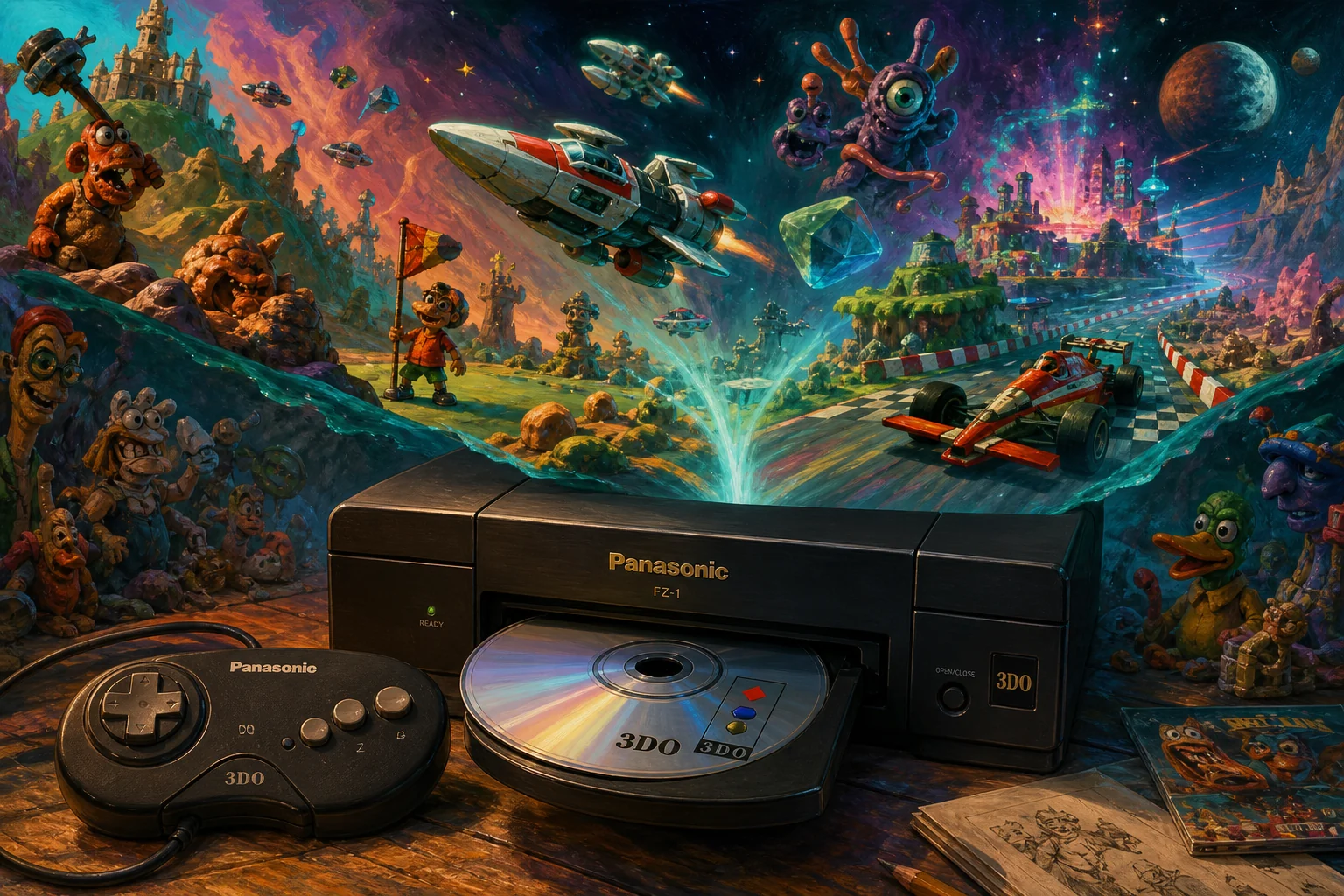
The Panasonic 3DO arrived looking like a machine, but historically it was closer to a negotiated standard. Its broad, dark front-loading case suggested a conventional living-room console: insert a disc, connect a controller, and play. Behind that familiar arrangement was a more unusual business and engineering proposition. The 3DO Company designed a platform that other companies could license and implement under the company’s platform specification. Panasonic’s FZ-1 was the first major retail 3DO model, not the sole 3DO and not the complete definition of its hardware.
The distinction matters because later discussions often treat “the 3DO” as though every unit shared one board, one drive, and one set of behaviors. Panasonic, GoldStar, Sanyo and other licensees were expected to produce compatible Interactive Multiplayer systems, but compatibility was an operating-system and software agreement rather than a promise of electrical identity. The FZ-1, FZ-10 and GoldStar machines could share the same broad software world while differing in memory arrangements, optical mechanisms, firmware, video circuits and regional details. The platform’s apparent simplicity therefore concealed a problem that would define both its commercial life and its afterlife: how do you make different machines feel like one system?
The 3DO Company’s answer was to separate responsibilities. It controlled the platform specification, the Portfolio operating-system environment, licensing and software-production procedures. Hardware partners built and sold the players. Developers targeted the common software environment and submitted production material through the company’s mastering process. Panasonic was a major strategic partner and the first important manufacturer, but calling the 3DO a Panasonic creation erases the structure that made the project distinctive in the first place.
Panasonic’s early 3DO was introduced at a premium price that was later reduced in 1994. The machine was marketed as a new generation of multimedia hardware, but its cost made it unlike the mass-market cartridge systems it hoped to challenge. The machine’s ambition was visible in its architecture; its business model depended on enough licensees and software developers making that ambition worthwhile.
An ARM Processor Inside a Custom Graphics System
At the center of the FZ-1 was an ARM60 running at 12.5 MHz. The ARM processor used a reduced instruction set, meaning that it favored a relatively small collection of simple instructions that could be executed efficiently. That design helped the 3DO perform substantial work with modest hardware, but the ARM60 was not the 3DO’s custom chip. The distinction is essential. The processor handled general computation; the platform’s characteristic graphics and system functions depended on custom silicon surrounding it.
The principal early custom chips were MADAM and CLIO. MADAM handled address generation, direct memory access, the cel and pixel engines, and matrix-related operations. Direct memory access, usually shortened to DMA, allows hardware to move data between memory and devices without making the main processor copy every byte itself. That left the ARM60 available for game logic, operating-system tasks and other computation while MADAM moved and transformed graphical data. CLIO handled display generation, audio-related digital signal processing and additional system duties. In later revisions, important functions were changed or integrated through Anvil-family silicon, which is one reason a late machine cannot be assumed to behave exactly like an early FZ-1.
The FZ-1 technical documentation describes a memory arrangement built around 2 MB of main dynamic RAM and 1 MB of dual-port video RAM, alongside 1 MB of ROM and battery-backed static RAM. Dual-port memory can be accessed by more than one system function, making it useful when the processor and graphics hardware need to share data without serializing every operation. Battery-backed RAM supplied a persistent area for system information and saves. Those figures describe the documented FZ-1 configuration; they should not be casually projected onto every licensee model or later revision.
This division of labor shaped the 3DO’s visual identity. Instead of treating the machine as a conventional frame-buffer console whose processor prepared a complete image one line at a time, software could feed specialized graphics hardware with objects and data structures. The “cel” in 3DO terminology was a graphical element that could be transformed, scaled and composited. The result was not magic and did not eliminate the need for careful programming, but it gave developers a distinctive route to textured surfaces, video-like imagery and layered scenes. The machine’s most interesting software was therefore written for an ARM-and-MADAM environment, not merely ported to an interchangeable CD-ROM box.
Portfolio: The Contract Between Different Machines
The software bridge between licensees was Portfolio. It was a high-level operating system, not a nickname for the console and not a generic term for all 3DO software. Portfolio supplied multitasking, message passing, semaphores, signals, filesystem services and hardware “folios.” A folio was a shared system component that exposed services to applications, somewhat like a dynamically loaded library, although Portfolio’s privileged system structure gave the concept deeper access to hardware and operating-system functions.
Portfolio’s importance was practical as well as philosophical. The 3DO development documentation explicitly presents the operating system as a way for substantially different hardware implementations—including Panasonic’s player and the Creative 3DO Blaster—to run the same software. Developers could call operating-system and graphics services rather than addressing every piece of hardware directly. That abstraction did not make the machines identical. It established a common vocabulary that let software survive controlled differences between them.
The arrangement resembles a contract with limits. A program written for Portfolio could expect certain services, memory resources and device behavior, but it could still encounter differences in video timing, available ROM, drive implementation or later system revisions. An abstraction layer hides hardware details only when the underlying implementations honor the same assumptions. When a game depended on a timing quirk, a particular character set, or an undocumented register behavior, the promise of compatibility became less secure.
The custom filesystem reinforced that identity. A 3DO disc used ordinary compact-disc physical conventions and could contain CD-DA, CD-ROM Mode 1, Mode 2, Mode 2/XA, CD-WO and hybrid material. Yet the software structure was not simply an ordinary ISO 9660 volume treated as a complete console format. Portfolio’s filesystem used its own organization, including “avatars,” optimized file placement and Catapult layouts intended to reduce the painfully long seek times of early CD-ROM drives. The boot structure placed application material under a designated layout, with a launchme executable telling the system what to start. The optical disc was conventional at the physical level and highly specific at the software level.
The FZ-1 Was a Platform Statement in Plastic
Panasonic’s FZ-1 made the platform’s contradictions visible. It was a large, front-loading machine with a full-size mechanism and a design that looked more like a premium multimedia component than a toy. The price and the disc drive announced that this was an expensive bet on interactive media, while the system’s memory architecture and specialized chips were trying to make that media respond like a game console.
The later FZ-10 replaced the FZ-1's front-loading arrangement with a slimmer, top-loading design. Its operating instructions document its storage-management and peripheral functions, while its construction presents a different physical target for modern repairs and modifications. The badge on the lid identifies a shared software platform; the model underneath determines which replacement parts and interfaces fit.
The same caution applies to GoldStar’s machines. GDO-101, GDO-202 and GDO-203 are distinct models, not interchangeable labels for one Korean-made 3DO. Current reverse-engineering documentation identifies model-specific behavior around CD-R detection: GDO-202 and GDO-203 are reported to reject recordable discs, while other systems may read them depending on their optical condition, firmware and media. That is evidence of model-specific hardware or firmware behavior, not proof of a universal anti-copy mechanism built into every 3DO.
Sanyo belonged to the same licensing structure but should not be folded into Panasonic’s Japanese product history. Surviving evidence confirms separate Sanyo machines and model-specific drive and regional differences, while the chronology and worldwide availability of every model remain incompletely documented. Announced or demonstrated hardware from Samsung, Toshiba and AT&T likewise cannot automatically be counted as retail consoles. In a platform designed to multiply manufacturers, a press announcement, prototype or development unit does not by itself establish a commercial release.
The Disc Check Was in the Software
The 3DO's commercial software passed through a production cryptographic process. Original mastering documentation refers to submitting prepared title material to The 3DO Company for encryption, while reverse-engineering documentation describes RSA-related verification in the retail boot path. Encryption and signature verification serve different purposes, so those terms cannot be used interchangeably. The important historical point is that a retail console expected production-prepared boot software rather than accepting any newly compiled program.
The pressed disc remained ordinary optical media with Portfolio's 3DO filesystem and production-processed boot or executable material. Its software layout and authorization were separate from the optical surface. Development instructions organized application material in a /takeme folder and named the main executable launchme before the image was prepared.
Dedicated development hardware provided a different environment for testing programs. Development-oriented ROM configurations, including NORSA variants documented today, can omit checks needed by the retail boot path. That distinction explains why an executable working on a development system does not prove that the same unsigned image will start on an unmodified consumer player.
Recordable discs were consequently useful without being a universal consumer medium. CD-R dye is less reflective than a pressed disc, and readability depends on the disc, writing process, laser condition, calibration and firmware. A console that reads commercial games perfectly can fail with a recordable disc for purely optical reasons. Model-specific behavior complicates the picture further. The reported GDO-202 and GDO-203 rejection of CD-R demonstrates that “reads CD-R” and “has no security” are not equivalent claims.
The Developer Machine Behind the Retail Player
The 3DO’s most important middle-period story happened away from shop shelves. Once Panasonic’s FZ-1 had established the platform, The 3DO Company had to persuade publishers that a licensed hardware family could behave like a dependable development target. That required more than a fast processor and a CD-ROM drive. It required tools, documentation, test hardware and a production pipeline capable of turning software built on one manufacturer’s machine into a disc that would boot on another licensee’s player.
The company had to serve several roles at once: standards designer, operating-system developer, publisher partner and coordinator of a production process shared by hardware manufacturers. Keeping those participants aligned was part of the platform's engineering challenge, not merely a matter of putting the same logo on different cases.
That division of labor helps explain why the period’s development literature can seem more like workstation documentation than a console programming manual. A studio was not merely learning controller input and sprite routines. It was learning Portfolio’s process model, its message-passing conventions, its memory-management rules, its graphics and audio folios, and the peculiarities of organizing software for a slow optical medium. The platform’s promise was that these services would reduce dependence on any one licensee’s circuit board. The practical burden was that developers had to understand a substantial software environment before they could exploit the hardware beneath it.
Portfolio Became a Production Environment
Portfolio’s multitasking model was especially significant in a period when console software was usually built around a single tightly controlled execution loop. Portfolio divided work among tasks and processes, with messages, signals and semaphores coordinating activity. In plain terms, a game could treat sound, input, streaming data and gameplay as cooperating jobs rather than as one enormous routine that manually polled every subsystem. That did not make programming effortless. It imposed its own rules about ownership, synchronization and resource tracking, but it gave the 3DO a software identity closer to a small multimedia computer than to a conventional cartridge console.
The operating system’s folios provided another layer of discipline. Graphics, audio, filesystem and device services could be loaded and called through defined interfaces. A developer could use Lib3DO, a collection of higher-level routines intended to make common 3DO tasks less cumbersome, while still reaching lower-level Portfolio facilities when a project needed more control. This separation mattered to licensees because it gave a publisher a chance to reuse code across Panasonic, GoldStar and Sanyo hardware instead of rewriting every subsystem for each board.
The CD was part of that environment, not just its container. Portfolio’s filesystem treated seek time as a programming problem. Files could be arranged in optimized layouts, with avatars and Catapult-generated structures helping the system find related assets without repeatedly dragging the optical pickup across the disc. A game that streamed animation, speech or music had to consider physical disc geography alongside memory usage. The best 3DO software consequently involved an unusual collaboration between programmers, artists, sound designers and mastering personnel: an attractive asset that was placed in the wrong part of the disc could become a performance liability.
This workflow also changed how teams tested software. Programmers could exercise individual tasks and folios, artists could review assets in the formats the machine expected, and mastering personnel could evaluate whether the final arrangement behaved acceptably on slow optical hardware. The practical challenge was not simply making a program boot; it was coordinating memory allocation, disc placement, asynchronous loading and display timing so that the system remained responsive while the drive moved through a large multimedia package.
Why Middle-Era Games Looked Different
As studios learned the system, the 3DO’s most distinctive software stopped looking like a collection of early demonstrations and began reflecting the compromises of its architecture. MADAM’s cel engine was not simply a faster sprite drawer. It could manipulate graphical objects through scaling, positioning, blending and texture-related operations, while the ARM60 coordinated game logic and operating-system work. Developers who understood that division could build scenes from many independently managed elements rather than first composing every image on the CPU.
The result was visible in software that treated the CD as a reservoir of animation, speech and music while using the custom graphics hardware to assemble interactive scenes. Full-motion video was an obvious selling point, but it was also an easy way to expose the machine’s limitations. Video assets consumed disc bandwidth and memory, and a title that merely played clips did not necessarily demonstrate the strengths of MADAM or Portfolio. More ambitious projects mixed streamed material with real-time cel graphics, although the quality of that combination depended heavily on compression, loading schedules and the amount of working memory left for gameplay.
Audio followed a similarly hybrid path. The platform could play CD audio, but interactive software also used system audio services and compressed assets arranged for the 3DO environment. The distinction between a music disc and a game’s sound pipeline was therefore important. A soundtrack could be delivered as ordinary disc audio, while effects, speech and interactive music depended on data and code managed by the operating system. Developers had to decide which material deserved continuous streaming and which needed to be immediately available in memory.
The 3DO versions of cross-platform games show why “same title” did not mean “same port.” Another World, for example, used ARMv3-targeted code, RGB555 true-color assets, AIFF music using SDX2 compression, and signed 16-bit AIFF sound in its 3DO implementation, along with a modified bytecode engine. Those choices were not cosmetic conversions from the DOS or Amiga package. They reflected the target machine’s processor, color handling, audio formats and filesystem. Similar work occurred across the library as teams learned that a successful port required translating assumptions about memory, timing and media rather than merely recompiling source.
The Platform’s Industry Reception Hardened
By the middle of the 1990s, the industry reaction to 3DO had become more measured than the launch-era promise of a universal multimedia future. Trade coverage continued to treat the licensing model as unusual, and the existence of multiple manufacturers remained attractive to commentators who disliked the idea that one company had to absorb all hardware costs. Yet the same structure made the platform difficult to explain to consumers. A Panasonic player, a GoldStar player and a proposed Sanyo player could all carry the 3DO name while differing in price, appearance and behavior.
The company’s price reduction in 1994 acknowledged part of that problem. Lowering Panasonic’s suggested price from $699.95 to $499.95 made the hardware less forbidding, but it also revealed how far the first machine had been positioned above the mainstream console market. A cheaper player could expand the audience only if software publishers believed that enough compatible machines would exist. Publishers, in turn, wanted evidence that the audience was large enough to justify the cost of learning Portfolio and producing CD-based assets. The platform’s license structure solved manufacturing scale more readily than it solved consumer momentum.
The appearance of the Creative 3DO Blaster sharpened the distinction between a console and a specification. Portfolio documentation treated the Blaster as another hardware implementation capable of running the same software environment, even though its computer-expansion context differed from Panasonic’s living-room player. That flexibility was technically impressive, but it made the 3DO harder to categorize in advertisements and retail conversations. Was it a console, a multimedia player, a computer accessory or a software standard? The answer depended on which licensee was selling it.
Hardware revisions added another layer of caution. Early systems centered on separate MADAM and CLIO devices, while later Anvil-family revisions integrated or altered important functions. The operating system was meant to absorb such change, but a program that relied on undocumented registers, timing behavior or a particular video path could expose differences. The platform’s official compatibility promise was strongest when developers stayed within documented services. The more closely a title reached into the machine, the more its success depended on the exact revision being tested.
Professional Tools Before the Hobbyist Revival
The boundary between official development material and homebrew became blurred in later retellings. Panasonic demonstration discs, sampler discs, developer samples and arcade-oriented software were not automatically independent experiments. Many were authorized projects produced within the commercial ecosystem, even when they were distributed outside ordinary retail channels. A disc’s rarity or unusual content does not make it homebrew, and a program that ran on development hardware does not prove that an ordinary owner had access to the same route.
The original Toolkit combined compilers, assemblers, libraries, graphics and audio utilities, debugging facilities, DataStreamer tools and disc-layout software. Its ARM development environment used Norcroft-era conventions and professional production tools. Later hobbyists inherited the challenge of making that older environment understandable and usable on newer computers.
One Platform, Different Regional Machines
Nor did the absence of a universal region lock create universal compatibility. NTSC and PAL timing, Japanese kanji-ROM requirements, operating-system revisions and game-specific assumptions could all affect whether software behaved correctly. This was a technical consequence of a platform family assembled from different implementations, not a single court-defined regional-security system. The same principle applied to unusual video modes: a timing variation could affect game speed or display behavior without being a hidden authentication mechanism.
By the end of the commercial era, 3DO’s central experiment had produced a platform that was simultaneously standardized and fragmented. Portfolio, the ARM development environment and the mastering pipeline supplied a coherent software culture. Licensee hardware, changing custom silicon, optical mechanisms and regional implementations made the physical machines less uniform than the logo suggested. That tension shaped the projects and preservation efforts that followed, but it was already present when the middle-era developers were still learning how to make one operating system speak through several different machines.
Preservation Became a Layered Engineering Problem
The 3DO’s common software environment made the platform coherent, while its licensee hardware ensured that no single preservation solution could stand in for every machine. Modern work has therefore split into three related disciplines. Emulation replaces the original hardware with software; development projects reconstruct enough of the programming environment to create new software; and console modifications preserve original processors, custom chips and controllers while substituting vulnerable subsystems.
That distinction matters because “modding” can otherwise become a catch-all word. An emulator does not preserve the electrical behavior of a Panasonic FZ-1. An optical-drive emulator does not reproduce every peculiarity of the original laser mechanism. A video modification does not make an Anvil-based board equivalent to an earlier MADAM-and-CLIO configuration. Each project preserves a different layer, and each introduces its own compatibility decisions.
Emulation Is Now Part of the Development Cycle
FreeDO occupies the beginning of the documented modern emulation lineage. Its partially released source appeared in 2010, but the surviving material is not demonstrably the complete FreeDO 2.x codebase. That qualification prevents a common shortcut: treating every later 3DO emulator as a direct continuation of one transparent project. Phoenix is a separate, closed-source option, and its precise relationship to FreeDO 2.x remains uncertain. It is best discussed by its own releases and platform support, not by an assumed genealogy.
The more clearly documented open branch runs from FreeDO through 4DO and libfreedo into Opera. Opera is an active community project descended from that open 4DO/libfreedo branch and maintained as a more independent project after 4DO became inactive. It is useful not only because it can run preserved software, but because current developers can invoke it from the 3DO development kit to test newly built images. That has changed the economics of experimentation. A developer no longer needs a working optical mechanism for every edit-compile-test cycle, and a preservationist can compare image behavior without repeatedly stressing aging drives.
Emulation is not a perfect oracle, however. Doom Redux documented an emulator-side controller-state problem involving a MADAM register and used a patched Opera core for development. The example is important precisely because it is unglamorous: a project can be correct in its software assumptions and still encounter an emulator discrepancy. Conversely, an image that runs in Opera may depend on an implementation shortcut absent from original hardware. Modern testing is therefore strongest when emulator results are treated as one reference point alongside real consoles, not as an automatic definition of compatibility.
Phoenix remains useful in this history as a parallel preservation route, with released builds for Windows, Linux and macOS, but its closed source limits what researchers can confidently say about its internal accuracy or lineage. The evidence supports describing project status cautiously rather than ranking emulators by unsupported claims of fidelity.
Rebuilding a Lost Toolchain
The current 3DO development revival is more substantial than a compiler archive. The community 3DO development kit packages recovered libraries and compilers alongside recreated tools, build scripts, examples and reworked utilities such as modbin. It also provides scripts for using Opera as a test target. This is a bridge between historical software production and modern preservation, but it remains a bridge made from old materials: the resulting programs still reflect ARMv3-era object formats and conventions rather than a normal contemporary GCC console workflow.
That constraint is not merely an inconvenience. It reveals how deeply the original platform’s software identity depended on its development environment. New code must accommodate legacy executable formats, library interfaces, memory expectations and the Portfolio way of organizing system services. Modern wrappers make those requirements easier to approach, but they do not erase them. The result is a hybrid toolchain in which new documentation and build automation surround recovered compilers and libraries.
Recovered operating-system material has also become a form of systems research. The hosted Portfolio source tree is a historical snapshot, not a clean, fully reconstructed upstream project. Its value lies in exposing how processes, shared libraries, device drivers, resource tracking and asynchronous I/O were organized. The example folio project demonstrates how a dynamically loaded collection of services could expose ordinary and privileged functions, while the graphics-folio recreation isolates one important part of the original API rather than claiming to replace the entire operating system.
The recovered projects give new developers several places to begin: operating-system code, graphics services, example programs and build packaging. A small example can expose one interface at a time, while a larger port tests how those interfaces cooperate. That makes the development revival an ongoing reconstruction rather than a single archive download.
Demos, Doom and New Work for Old Hardware
The 2021 demoscene release 3DentrO offers a concrete example of contemporary authorship on the platform. A demo is a creative technical production in its own right, using the machine to combine graphics, sound and presentation. It belongs to a different tradition from an authorized retail sampler or an old commercial game's source release.
Other projects illuminate different kinds of preservation. Rebecca Heineman’s DOOM 3DO source release makes a historically important commercial implementation available for study. Star Fighter’s published source and resources likewise preserve the work of its original creators with permission. These are not new homebrew games in the same sense as an independently authored modern title, but they are invaluable because they expose decisions that would otherwise survive only as machine behavior.
3DO Doom Redux occupies another category: a modern project that revisits and extends the platform’s Doom implementation. Ports such as OpenLara and REAL 3DO Tetris demonstrate that the reconstructed toolchain can support new or substantially adapted software, while the devkit’s examples show how developers can approach graphics, device drivers and system services without pretending that the original SDK was designed for today’s workflows.
Replacing the Optical Path Without Erasing the Console
Optical-drive emulators became central because the original drive is a collection of aging mechanical dependencies, not one generic failure point. The FZ-1’s front-loading mechanism, the FZ-10’s top-loading assembly and the drive families used by GoldStar and Sanyo present different combinations of lasers, motors, switches, gears, ribbon cables and board components. A symptom that resembles a failed laser may instead come from tray detection, traverse gearing or a damaged cable. Capacitor aging is a separate maintenance concern and cannot explain every drive fault.
A drive-replacement ODE changes that equation by replacing or bypassing the disc subsystem while normally retaining the original processor, custom logic, controller bus and video path. It provides an interface between the console and a new source of disc data. The particular board, firmware and supported host model determine how that interface behaves.
MNEMO's drive-replacement products became a recognizable part of the 3DO aftermarket. Their significance was practical: owners could move beyond dependence on an aging original mechanism. Like other ODE families, the name covers products whose exact supported models and features must be considered individually rather than treating every installation as the same device.
Fixel's official firmware repository separates the FZ-1 ODE and XPort ODE, with distinct firmware files and shared menu material. That separation is useful: one firmware family does not imply one universal physical board. A drive replacement is still designed around the interface and electrical requirements of its target console.
FCare's SataTo3DO offers an open alternative aimed at the NTSC FZ-1. Its documented design uses an RP2040 module, supports USB flash storage formatted with FAT32 or exFAT, and has its own menu-ordering behavior. The source and hardware design make the project studyable as well as usable. Its specific target matters more than the broad label of 3DO ODE.
NVRAM Turns Save Data Into an Archive
Save preservation adds a quieter reason to care about modern hardware work. NVRAM is a distinct persistent memory resource, and its contents are not simply another copy of the game disc. Console software, operating-system facilities and model-specific management tools can determine how that data is created and handled. A replacement optical path may keep a game playable while leaving save preservation entirely unaddressed.
Save-export features, where provided by a particular replacement menu, address a separate job from launching a disc image. An external copy can protect progress, but it is not automatic synchronization and does not explain the internal format used by every game. Keeping the game software alive and keeping a player's history alive are related responsibilities with different data behind them.
The supervisor-memory device-driver project makes the underlying issue visible to researchers. It demonstrates controlled access to DRAM, VRAM, NVRAM, ROM and memory-mapped hardware, including MADAM and CLIO. That is a development and investigation technique, not a consumer feature, but it gives preservationists a way to study the resources on which software depends. External copies can protect a fragile archive; they cannot by themselves explain every game’s save structure or guarantee that a restored image will behave identically across revisions.
Video Mods Follow the Board Revision
The 3DO’s video afterlife has developed along two different paths. 3DORGB is an RGB modification project intended for most 3DO consoles, while PixelFX’s Retro GEM 3DO is an internal digital HDMI system. They serve different display environments and should not be presented as competing versions of one generic upgrade.
Retro GEM’s installation documentation is a separate primary project source and gives model-specific guidance for FZ-1, FZ-10 and GoldStar systems. It excludes late mainboards carrying the Anvil IC and describes an internal installation involving a flex connection, a 3.3-volt power board and a mini-HDMI output arrangement around the RF-port area. Some Japanese consoles lack the relevant opening, and an existing RGB modification may need to be reversed before installation. It is therefore a digital replacement video path, not an external converter that can be applied indiscriminately.
The preservation tradeoff is straightforward but not trivial. An RGB modification can retain a direct relationship with an analog display chain, while HDMI offers a practical route to modern displays and digital scaling. Neither approach restores every original display behavior, and neither is compatible with every board. The most reliable modern descriptions therefore name documented project limits instead of promising that any Panasonic 3DO can accept any video solution.
The Chain of Controllers Is Still a Hardware Feature
Modern preservation often focuses on discs and video, but the original controller architecture remains one of the 3DO’s less replaceable characteristics. The system used one control-port socket with additional peripherals connected through the preceding controller, forming a chain rather than relying on a later-style multiport hub. Panasonic’s documentation describes arrangements involving pads, mice, keyboards, glasses and other peripherals, with as many as eight control pads in the documented configuration.
That topology affects modern compatibility. A specialty controller may depend on pass-through behavior, signal routing or a position in the chain that a standard pad provides. A third-party adapter that merely exposes more sockets is not automatically equivalent to the original bus arrangement. Conversely, an accessory that works in one position may fail when placed directly at the console. Such claims belong to the documentation or testing for the specific device; the general historical point is that chaining was an authorized part of the platform, not a later hack.
The controller bus also explains why emulation and hardware testing can diverge. An emulator may represent input as abstract controller states, while a real chain includes timing and pass-through behavior. A modern port can therefore appear correct when tested with a simple pad yet expose a problem with a mouse, light gun, flightstick or downstream accessory. Preserving the 3DO means preserving these relationships, not merely reproducing the buttons a contemporary game happens to use.
Keeping the 3DO’s Character Alive
The most revealing preservation limits are often physical. A replacement drive may eliminate the sound and pauses of a seeking mechanism. A digital video path may produce a clean image while losing the character of an old analog display. A modern controller interface may reproduce buttons without reproducing every relationship in the original peripheral chain.
Those differences do not make the modern projects failures. They explain why a working original system, an emulator, recovered source code and a new hardware design remain useful alongside one another. The 3DO survives through documented continuities rather than one perfect replacement, with each project keeping a different part of its ambitious experiment within reach.
Explore more modding histories
Compare these experiments with our original PlayStation modding history, original Xbox modchip and homebrew history and Dreamcast boot discs and homebrew story. Find more long reads in Editorial Spotlight and explore our game walkthrough library.