The add-on that arrived between generations
Before the Sega 32X became a curiosity for collectors, it was an attempt to stretch an existing console into a new technical category without replacing the machine already in millions of homes. Sega’s own later history describes a hurried design intended to extend the commercially important Genesis market while Saturn development was under way. That account gives the 32X a nine-month development period, with the North American Genesis 32X arriving in November 1994 and the Japanese Super 32X following in December. The Japanese launch is dated December 3, 1994, but the more precise North American day often repeated in later histories is not necessary here: contemporary primary evidence securely places it in November.
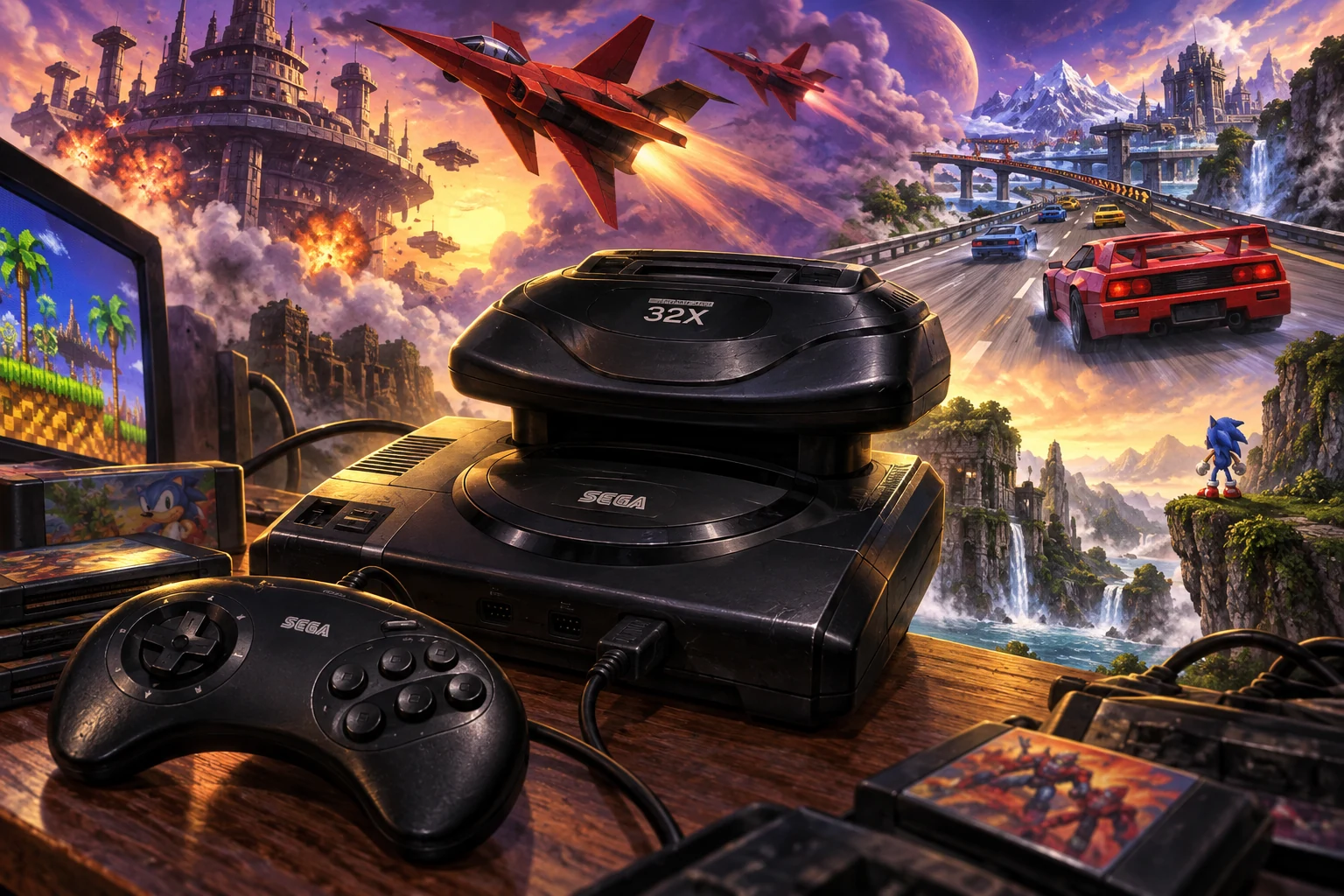
The result was never a self-contained successor. The 32X was a hardware layer inserted between a Genesis or Mega Drive and the television, while its cartridge software still depended on the host console’s processor, video path and physical connections. Sega marketed it as a power-up booster, but that phrase could obscure the engineering reality. The add-on introduced substantial new hardware without erasing the old system. Understanding that arrangement is essential to understanding both its original security questions and the later efforts to develop software for it.
A 32-bit machine with a 16-bit host still inside
At the center of the 32X were two Hitachi SH2 processors running at approximately 23.01 MHz. Each was a 32-bit RISC processor with internal cache, while the expansion supplied its own SDRAM, frame-buffer memory, video circuitry, palette hardware, DMA facilities and PWM audio. Those specifications sounded like a clean generational leap, but the Genesis Motorola 68000 remained an active participant. The SH2 processors did not simply take over the cartridge slot and leave the original console idle. Software had to coordinate the 68000, the two SH2s and the 32X’s new display and memory resources.
That made the 32X a multiprocessor system rather than an ordinary cartridge console with a faster central processor. Sega’s technical documentation describes master-and-slave relationships between the SH2s, communication registers linking the expansion to the 68000, shared bus access, interrupts, FIFO communication and restrictions on simultaneous operations. The processors competed for resources whose timing could affect performance. Cartridge reads, video-register access, frame-buffer work and data transfers all had to be arranged with the hardware’s arbitration rules in mind.
The architecture also explains why the 32X’s video cable was fundamental. The Genesis generated part of the system’s image, and the 32X could generate another layer through its own frame buffers and video processor. The expansion received the Genesis signal, mixed or prioritized the two display paths, and sent the combined output to the television. The cable was therefore not simply an accessory for sound or power. It was part of the normal video architecture, and a missing or incorrectly arranged connection could prevent the machine from behaving as intended.
The consumer hardware added further variables. Sega produced region-specific Genesis and Mega Drive versions, with separate PAL and NTSC specifications, power requirements and accessories. The 32X’s display controls included different timing arrangements for those television standards. A North American unit’s compatibility could therefore depend on more than the shape of a cartridge or a label printed on its box. Host-console region, video standard, expansion hardware and software expectations could all interact.
Security began with recognition and boot validation
The earliest documented security questions around the 32X concerned more than territory. Sega’s hardware manual describes a Boot ROM that validates the expected initial program, uses the cartridge’s user header during startup, and loads initial application data from cartridge ROM into the 32X’s SDRAM. If the initial program is altered or does not begin at the expected address, the documented behavior is to lock access rather than continue normally. That is a real platform security boundary, even though it is unlike the later image of a console protected by a single secret key.
This boot validation belongs beside, not inside, the separate territory-recognition story. Sega’s developer-support archive records a technical bulletin titled “32X ID Data & Territory Lockout,” dated November 29, 1994, alongside a bulletin covering sample code for hardware recognition. Those titles establish that identification and territory behavior were active development concerns close to launch. They do not establish one universal lockout mechanism, nor do they prove a 32X equivalent of every Genesis security feature.
The cartridge therefore had to satisfy a documented startup arrangement before ordinary application execution could proceed. A valid user header and initial program were part of that arrangement, while the Boot ROM controlled the transition into the software supplied by the cartridge. It is reasonable to infer that changing only an identity value would not address every requirement, but the primary evidence securely supports the narrower claim: the initial program had to pass the Boot ROM’s checks and supply the data expected by the expansion.
The regional story remained layered. Sega’s manuals describe PAL and NTSC operation, while consumer documentation warns that particular North American hardware was intended for specified NTSC television markets. A game could also perform software-level checks, and the host Genesis itself had its own regional and compatibility history. The safest description is therefore that the platform combined documented boot validation, hardware and signal-standard differences, territory-recognition work, and software checks whose exact behavior could vary by title and hardware revision.
The contemporary Genesis legal record supplies useful background but not a 32X case. In Sega Enterprises v. Accolade, the Ninth Circuit discussed how Genesis software used initialization code associated with the console’s trademark-security system and how Accolade investigated the functional requirements for compatibility. That opinion belongs to the Genesis interface and reverse-engineering history. It does not rule on 32X territory checks, a 32X modchip dispute or the legality of modifying this particular add-on.
The surviving 32X documents describe recognition routines and boot validation across host and expansion hardware. Sega’s technical bulletins also record differences among development targets. Those are evidence of an evolving development environment. Bus arbitration, cache behavior and processor coordination are execution constraints; their complexity should not be mistaken for a documented anti-copying mechanism.
The cartridge boot path was an experiment in controlled handoff
The 32X cartridge was more than a storage medium attached to the Genesis. Sega’s development documentation describes a special startup arrangement in which cartridge data supplied the initial 32X program image. The expansion used a user header and a boot sequence that brought code and data into its working memory before the SH2 processors began normal operation. The 68000 also remained involved in system initialization and communication. In practical terms, the cartridge was the meeting point where the old console and new expansion agreed to start running together.
That handoff created an important startup and compatibility boundary. The software had to present the information expected by the 32X, initialize the relevant processors and communicate in a way the host system understood. A conventional Genesis cartridge image could not simply be assumed to function as a 32X title, because the expansion expected its own startup information and execution arrangement. Conversely, the 32X could not be treated as independent hardware with no obligations to the Genesis side.
Sega’s documentation also describes cartridge access from both processor domains, while warning that the SH2s could encounter contention when reading through the cartridge bus. Frequently used code and data were better placed in the 32X’s SDRAM, but transferring material there required correct startup and coordination. The platform’s startup and compatibility story was therefore tied to its boot contract, memory layout and bus-arbitration rules as well as to separate territory checks. Those bus rules explain execution constraints; the available documentation does not identify ordinary contention itself as an anti-copying mechanism.
This is why early experiments with 32X software should be understood as hardware-recognition and development work rather than as a straightforward attempt to defeat protection. Sega’s own bulletins addressed how development boards, ROM boards, SRAM boards and target boxes behaved. Their existence shows that engineers were still clarifying the platform’s assumptions during the period when retail software was appearing. It does not reveal a single hidden key or a universal bypass procedure.
Official developers faced a moving target
Sega’s October 1994 Developer Technical Support newsletter lists an unusually broad collection of 32X materials: system overviews, hardware information, a main hardware manual, supplements, technical information, a sample disk and development-equipment menus. The documents carry dated identifiers and revisions from March through September 1994. The sequence is revealing. Sega was not handing developers one timeless specification; it was distributing a growing body of corrections, additions and clarifications as the product approached release.
The later technical-bulletin index fills in the practical detail. Notices addressed VRESET behavior, SRAM and ROM boards, PWM audio, CD precautions, development-board security, internal SH2 input/output cycles, interrupts, stack pointers, hardware recognition and territory data. Several were issued around September, November or December 1994. The index alone cannot show how many studios received every notice or whether each issue affected a retail game, but it does document an environment in which important engineering questions remained active close to launch.
The development problem was not simply that programmers had to learn a new instruction set. They had to decide what belonged on the 68000 and what belonged on the SH2 side, establish communication between them, avoid stale cached data when dealing with hardware registers, manage frame buffers and respect bus ownership. The two SH2 processors also shared resources rather than acting like two isolated chips with unlimited memory bandwidth. Sega’s documentation makes those constraints concrete, replacing the vague claim that the 32X was merely “hard to program” with a picture of the decisions developers actually had to make.
The Hitachi SH7604 documentation helps explain the appeal of the processor family: the SH2 offered a 32-bit RISC core, cache, multiplier, DMA controller, interrupts, timers and external-memory controls. Yet the 32X implementation was not a Saturn-compatible software environment. Sega explicitly distinguished the two products, even though both used SH2 processors. The 32X’s Genesis-dependent video arrangement, startup process and memory map gave it a separate identity. A developer could borrow ideas from the broader SH2 family, but could not assume that Saturn software or Saturn development practices transferred directly.
The first experiments were constrained by the machine’s physical stack
For consumers and engineers alike, the 32X’s physical arrangement made its experimental character visible. The unit had to sit between the console and television path, with its own cartridge slot and connections. Sega’s instructions discussed different setup procedures for original and later Genesis models, shielding plates and the required seating of the expansion between the console’s cartridge-slot shields. These were not cosmetic concerns. They reflected a system in which mechanical fit, signal routing and regional electrical specifications were part of compatibility.
The Sega CD complication added another layer without creating a single hybrid console. Sega advertised the 32X as usable with Mega Drive and Mega-CD hardware, and the Japanese product documentation said conventional cartridges and CD software remained available in the combined configuration. But the stack still consisted of separate machines: a Genesis or Mega Drive host, an optional Sega CD or Mega-CD unit, and the 32X. A CD-based 32X title could require all three, while an ordinary 32X cartridge did not thereby become a CD game.
That distinction also shaped technical experimentation. Developers could investigate cartridge ROM behavior, CD interaction, backup memory and territory recognition as related but separate problems. Sega’s bulletins included precautions for 32X software used with CD hardware, yet the existence of those notices should not be read as proof that the CD unit was required for normal 32X operation. For ordinary 32X cartridge titles, the boot and execution path remained cartridge-based, with the Genesis and 32X sharing responsibility for startup and display. Sega CD 32X software was a separate CD-based configuration and should not be folded into that description.
By the time the 32X reached the market, its technical identity was therefore already a compromise: a new dual-processor subsystem grafted onto a still-essential 16-bit host, connected through a compositing video path, and subject to regional hardware and software recognition. Those conditions shaped every later attempt to preserve, reproduce or extend the platform.
When the commercial bridge became a community project
Once Sega’s official 32X development pipeline disappeared, the platform did not become easy so much as difficult in a different way. The original problem had been access: studios needed Sega’s documentation, target hardware, development boards and changing technical notices. The later problem was reconstruction. Enthusiasts had to preserve manuals, compare revisions, recover examples and build a toolchain that could address the 68000 and both SH-2 processors without pretending they were one ordinary development target.
That transition happened gradually rather than through one clearly documented breakthrough. No single person can be verified as the first modern 32X homebrew developer, and the available project histories do not support naming one. What can be documented is a sequence of community resources: archived Sega technical material, GNU-based cross-compilers, examples shared through development forums, and increasingly reproducible build environments. Together, these turned an obscure commercial platform into a target that an individual programmer could approach without owning Sega’s original professional setup.
The distinction between preservation and modification is important here. This period was not primarily about defeating a mysterious hidden lock or creating a new security chip. It was about learning the machine’s boot contract, memory layout and processor handoffs well enough to produce legitimate software. A modern homebrew ROM still has to satisfy the original hardware’s expectations. Replacing Sega’s proprietary tools with GCC does not replace the 32X’s startup sequence, video compositor or arbitration rules.
Rebuilding the missing development bridge
The original 32X development environment was not one timeless SDK. Sega’s October 1994 Developer Technical Support material lists system overviews, hardware manuals, supplements, technical information, a sample disk and development-equipment menus. Technical bulletins separately addressed VRESET behavior, SRAM and ROM boards, PWM audio, CD precautions, development-board security, SH2 input/output cycles, interrupts, stack pointers, hardware recognition and territory data. The surviving record therefore points to a distributed professional workflow that combined documentation, target hardware, boards, sample code and commercial tools.
One documented commercial route was the PSY-Q Development System from SN Systems and Psygnosis. Its 1995 documentation describes mixed C and assembler development and testing for the 32X. That establishes one third-party route into the platform, not a universal or sole official SDK and not evidence that every publisher used it. The distinction matters because later community projects are often described as if they were recovering one lost master package.
Chilly Willy’s 32XDK provided a public route to contemporary development. Its stated scope covers Mega Drive, Sega CD and 32X targets, with GCC components, binutils, Newlib and the zasm assembler. The multi-target scope should not obscure the architecture: 32X work needs both 68000 and SH2 tools, startup material and code that coordinates separate processor domains. The toolchain makes those components available; it does not make the targets interchangeable.
The release history also records maintenance rather than a single breakthrough. A 2019 release listed GCC 9.1.0, binutils 2.32, Newlib 3.1.0 and zasm 3.0.22. A later 2022 release moved to GCC 12.1.0, binutils 2.38, Newlib 4.2.0 and zasm 4.4. The documentation says that building requires a POSIX-style environment such as Linux, MinGW, Cygwin or Windows Subsystem for Linux. Modern access is therefore easier than Sega’s original professional arrangement, but still involves cross-compilation, linker scripts, startup objects and environment configuration.
The release description says that supplied samples were tested on real 32X hardware and in Fusion 3.64. That is evidence about those samples, not a universal compatibility guarantee for every application built with the devkit. Compilation can succeed while synchronization, timing, controller handling or peripheral behavior remains wrong. The toolchain’s historical importance lies in restoring a practical route to the platform, not in making verification unnecessary.
Marsdev and the separation of execution worlds
Andy Grind’s Marsdev addressed the reproducibility problem around the toolchain rather than replacing the 32X architecture. Its repository presents a cross-platform environment for Mega Drive, Super 32X and Sharp X68000 targets, with separate M68K and SH2 toolchains, examples and SGDK integration. Its documentation explicitly requires the SH toolchain in addition to the M68K toolchain for 32X development.
That separation makes a central fact visible: one 32X project can contain multiple compiled worlds. Conventional Mega Drive development generally centers on the 68000, while a 32X project adds SH2 startup code, linker expectations and communication routines. Marsdev’s `m68k-elf` and `sh-elf` distinction is therefore architectural information, not merely a naming convention. It tells the programmer that the source tree must assign work to different processors and arrange their handoffs.
Marsdev’s contribution was infrastructural. It gathered build targets, environment setup and skeleton projects into a more reproducible form, reducing the need to reconstruct Sega’s host environment before attempting a program. It did not provide coherent shared memory, remove bus arbitration or turn the expansion into a standalone console. The repository’s migration notes also warn that Gendev and Marsdev projects do not automatically interoperate, while an experimental LLVM target was described as untested and lacking skeleton projects.
The public release history shows continuing revision rather than a finished universal replacement. The latest listed release is the `v1.0.0-rc1` tag, which is a release-candidate tag rather than a final 1.0 release. Its notes describe an updated GCC 13.1.0 environment, separated M68K and SH2 toolchain repositories, thinner SGDK integration and possible breakage for existing project paths. That tag describes a particular release, rather than the status of every component in the repository.
Doom32X Resurrection makes the architecture visible
Doom32X Resurrection, Victor Luchits’s modern Doom project for the 32X, is a substantial public demonstration of the rebuilt development route. Its repository describes a code base drawing on the original Jaguar Doom source release, with substantial code from Calico Doom. Its stated aims include preservation, education, correction of original-game limitations and improved performance. The project matters historically because its source exposes the division between the Genesis-side processor and the SH2 side instead of presenting the machine as an abstract 32-bit target.
The repository’s feature list claims use of both SH2 processors in threaded rendering, multiple resolutions, distance lighting, stereo panning, SRAM-backed checkpoints and options, Sega Mouse support, DMAPINFO support and a reduced-complexity “potato” mode. For expanded content it identifies MAP20 from the 24 Level Expansion ROM hack. These are repository-documented features, not an independently verified test matrix for every Genesis model, 32X revision, flash cartridge, display chain or emulator.
Its source layout includes MD-side material, SH2-oriented code, startup assembly, communication structures, rendering routines, sound support and save handling. That arrangement is consistent with Sega’s documented hardware division: a 32X application has to coordinate the host processor, the two SH2 processors and the expansion’s display resources. A source tree with those components is evidence of an ambitious implementation, but it does not by itself establish that every source revision produces a universally playable binary on original hardware.
The project credits Luchits and Chilly Willy as programmers, Matt B and TrekkiesUnite118 as testers, and Spoony Bard for VGM music. It credits Calico Doom contributors including James Haley, Samuel Villarreal and Rebecca Heineman, while acknowledging John Carmack and id Software for the original Jaguar Doom source lineage. These are project-provided attributions and should remain limited to the contributions the repository identifies.
The repository’s licensing statement says that original code and code derived from the 3DO source are MIT-licensed, while Jaguar Doom-derived files remain under the original id Software license described by the project. Its build description expects the IWAD separately from the source tree. That distinction is technically and historically important: a public engine repository is not automatically a redistribution of the copyrighted data associated with a commercial game, and a source tree is not the same thing as a packaged playable release.
What modern software still has to solve
A modern compiler can automate compilation, but it cannot provide a general-purpose operating system, coherent shared memory or automatic synchronization. A 32X project still needs startup code that satisfies the expansion’s expected header and boot arrangement. It must establish communication between the Genesis-side processor and the SH2 side, decide how the two SH2s divide work, and ensure that data is visible to the processor that needs it.
Sega’s technical documentation remains relevant because the difficult cases occur at boundaries. Hardware registers cannot be treated like ordinary cached variables. Cartridge reads can contend with 68000 activity. Frame buffers, palette memory and the VDP have access restrictions. DMA and interrupts must be sequenced rather than assumed to happen in a frictionless background. These rules help explain why compilation alone cannot establish hardware compatibility, and why emulator behavior may not expose every timing or arbitration assumption.
Doom32X Resurrection’s source-facing structure offers one response: keep processor roles explicit and build communication mechanisms into the engine. Its MD-side routines, SH2-oriented rendering files and ring-buffer material suggest a design in which work is prepared, transferred and consumed according to known ownership rather than casual shared-state access. That is an interpretation of the source organization and Sega’s documentation, not a quotation of the developers’ private reasoning.
The same constraints explain the value of smaller teaching projects. The barebones32xproject repository describes itself as a basic Mega Drive/32X shell with Doom-specific material removed, using Doom32X Resurrection’s structure as a starting point. Its value is pedagogical: a learner can study the minimum arrangement needed to bring up a dual-processor application before confronting a complete engine. It makes the architecture more approachable without making the hardware simple.
The result is closer to embedded multiprocessor programming than to writing a conventional PC port. C and C++ improve source-level accessibility, but they do not supply automatic synchronization, memory coherency or a modern operating system. The community has reduced the barrier to entry while leaving the original machine’s ownership rules, memory limits and boot protocol intact.
Why the 32X’s commercial window mattered to its technical afterlife
The 32X’s short commercial life helps explain why its modern development story depends so heavily on archival work. Sega’s official retrospective places the North American Genesis 32X in November 1994 and the Japanese Super 32X in December, with the Japanese release dated December 3. The same account describes a nine-month design period and says that Sega’s development push consolidated around Saturn during 1995. Those dates do not prove that the hardware lacked merit; they show that documentation, tools and software support had to mature inside a narrow window.
Sega’s official software list records 32X releases continuing through 1995, including Virtua Racing Deluxe, Tempo, Chaotix, Stellar Assault and Virtua Fighter. Retail software therefore continued after launch even as the company’s strategic emphasis shifted. That distinction matters for modding history: the surviving manuals and bulletins belong to a platform that was still receiving technical attention, but not to one with the long support runway enjoyed by Genesis or Saturn.
The timing also shaped the platform’s identity. Consumers were asked to understand an add-on that required an existing Genesis or Mega Drive, used a video loopback cable, varied by PAL or NTSC configuration, had its own cartridge library and could be stacked with Sega CD hardware. Developers had to target a host-and-expansion arrangement while Saturn was already defining Sega’s next-generation message in Japan. The 32X’s technical capabilities were real, but its commercial position was transitional.
That history gives modern preservation a specific task. A community developer is not simply reviving an old console with a clean public SDK. They are reconstructing a bridge that Sega built quickly, documented in revisions and bulletins, and then left behind as the company concentrated elsewhere. The modern toolchains and projects matter because they preserve the practical knowledge that would otherwise be scattered across a short-lived commercial ecosystem.
Explore more modding histories
Compare these experiments with our original PlayStation modding history, original Xbox modchip and homebrew history and Dreamcast boot discs and homebrew story. Find more long reads in Editorial Spotlight and explore our game walkthrough library.