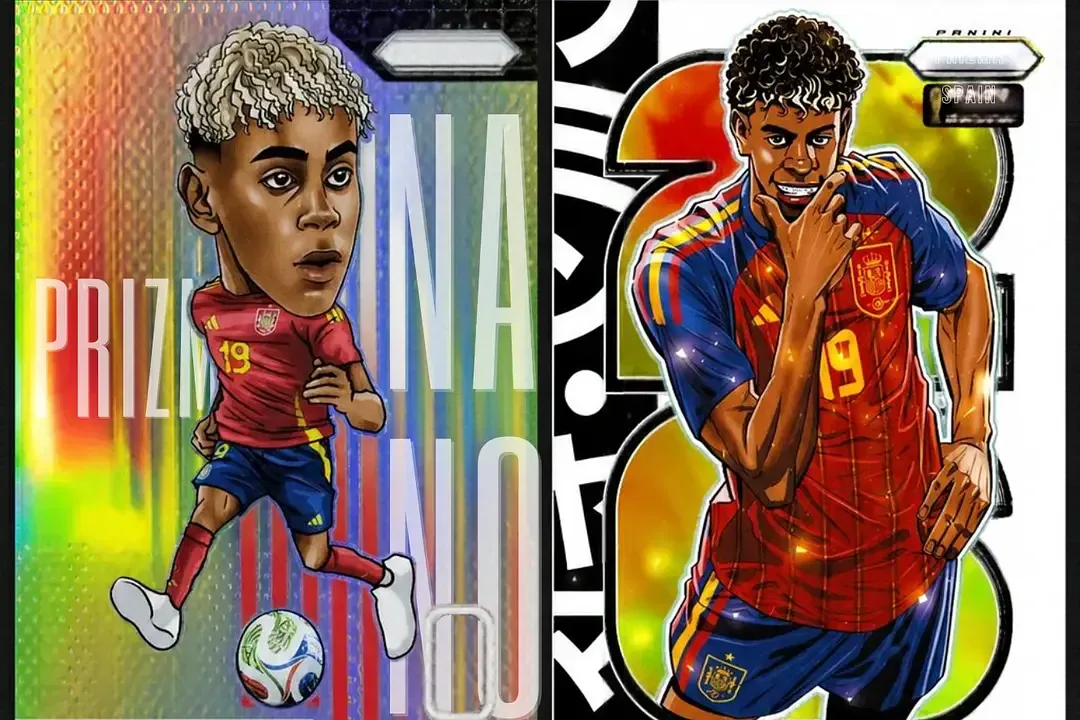
Two chase inserts from Panini’s 2026 World Cup Prizm release are producing dramatically different results on the secondary market. Completed sales recorded from June 16 through October 11 show Manga far ahead of Prizmania in both activity and total transaction value—even where the two inserts feature the same player.
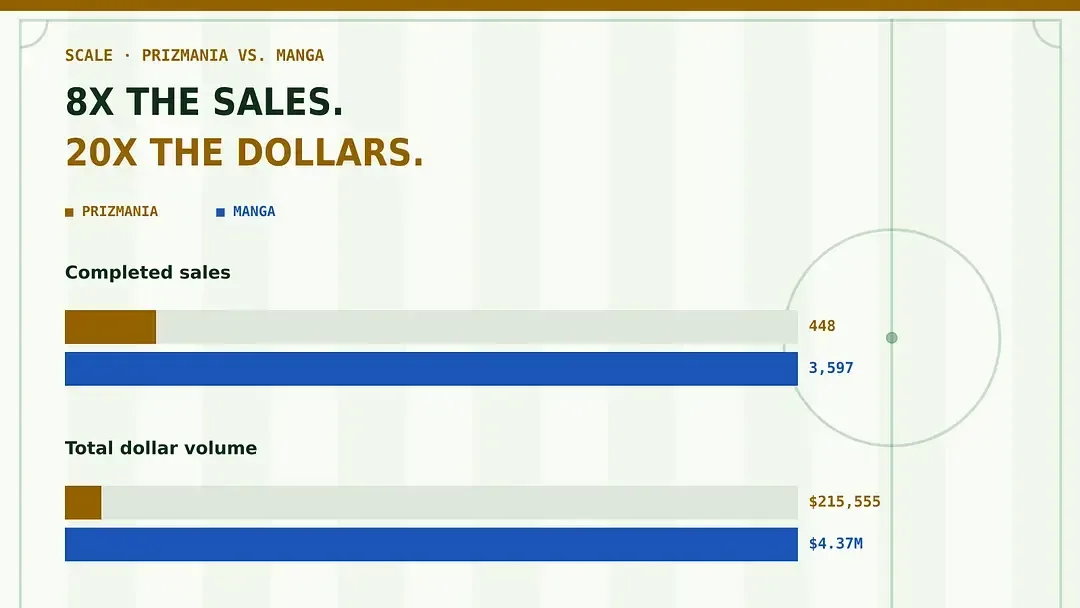
Manga logged 3,597 completed sales worth about $4.37 million during that span. Prizmania recorded 448 sales totaling $215,555. Put simply, Manga generated around eight times as many sales and roughly 20 times the dollar volume.
That result does not, by itself, establish that one insert is rarer than the other. It does establish something important for collectors: the market is assigning substantially more attention and money to Manga, and the difference cannot be explained solely by a few extra low-end sales.
Volume is only the start of the story
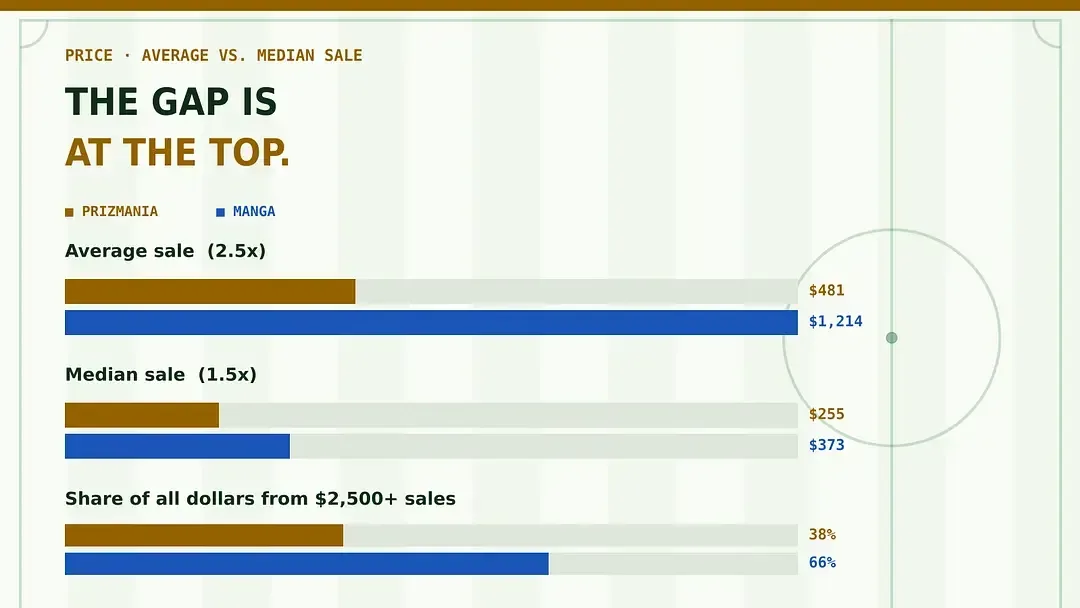
Prizmania’s average completed sale was $481, while Manga’s was $1,214. An average is found by adding all sale prices and dividing by the number of sales, so it can be heavily influenced by a relatively small number of very expensive cards. Manga’s average was about 2.5 times Prizmania’s.
For more context, explore Coi Leray Calls Herself Single as Justin LaBoy’s Meme Keeps Relationship Status Unclear.
The median comparison paints a more restrained, but still significant, picture. The median is the middle sale when all prices are ranked from lowest to highest. It is often useful in card-market discussions because a handful of blockbuster results cannot pull it upward as easily. Manga’s median sale was $373, compared with $255 for Prizmania—about 1.5 times higher.
The fact that Manga’s average premium is larger than its median premium points toward the upper end of the market. Expensive Manga cards are doing considerable work in lifting the category’s total value. Sales of $2,500 or more accounted for 66% of Manga’s total dollar volume, versus 38% for Prizmania.
That is a major distinction. Manga is not merely selling more cards at slightly higher prices. Its biggest transactions occupy a much larger share of the market. For a collector trying to understand headline sale figures, that means the category’s extraordinary total should be separated into two ideas: broad demand across many sales, and very strong demand for the most expensive examples.
Related coverage includes 2026 World Cup Prizm Market Watch: Why Manga Is Crushing Prizmania in Sales and Value.
Same-player comparisons make the gap clearer
The strongest comparison is not Manga versus Prizmania as broad categories. It is Manga versus Prizmania for the same athlete. Both inserts include Lionel Messi, Lamine Yamal, Cristiano Ronaldo and Diego Maradona, allowing the player variable to be held relatively steady while the insert changes.
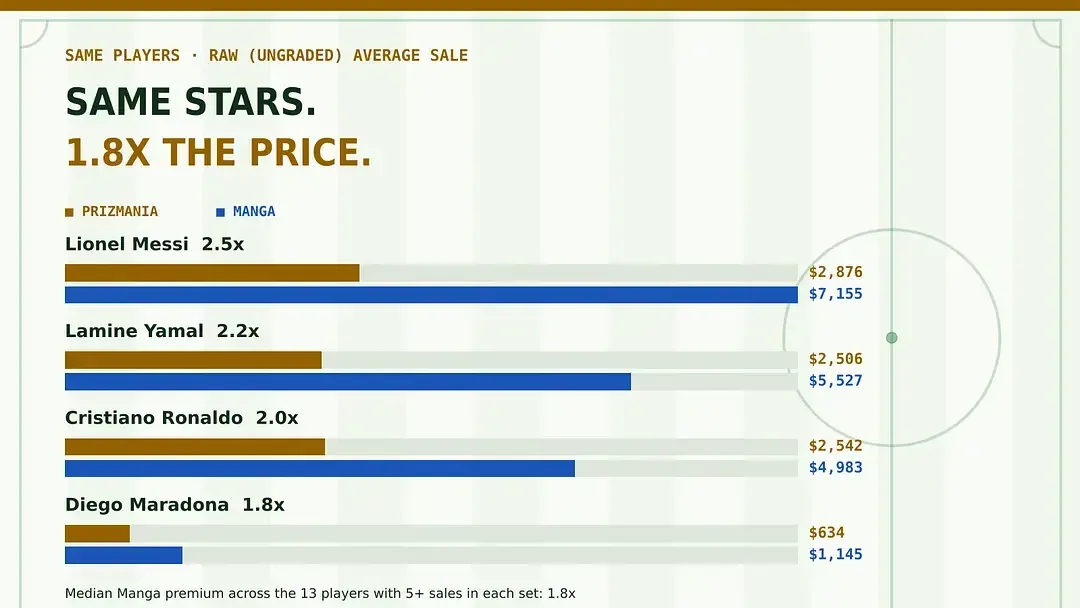
On ungraded, or raw, average sales, Manga led each of those examples:
- Lionel Messi: $7,155 for Manga, compared with $2,876 for Prizmania, a 2.5-times multiple.
- Lamine Yamal: $5,527 for Manga, compared with $2,506 for Prizmania, a 2.2-times multiple.
- Cristiano Ronaldo: $4,983 for Manga, compared with $2,542 for Prizmania, a 2.0-times multiple.
- Diego Maradona: $1,145 for Manga, compared with $634 for Prizmania, a 1.8-times multiple.
The wider sample followed the same direction. Among 13 players with at least five sales in each insert, the median Manga premium was 1.8 times the price of the corresponding Prizmania card.
Those figures matter because they narrow the question. Messi, Yamal, Ronaldo and Maradona each carry their own collecting appeal, and a player’s popularity can otherwise overwhelm an insert-level comparison. Yet when the player and tournament remain the same, the Manga version still commands a large premium. The available data therefore indicates that the market preference is connected to the Manga insert itself, rather than being only a result of its checklist.
What the market seems to be rewarding
Case hits are generally chase cards—rare inserts intended to be difficult to pull compared with standard cards in a product. But “case hit” is a product description, not a complete explanation of price. Design, collector familiarity, visual appeal, the ease of finding buyers and grading behavior can all affect what people pay after cards enter the market.
The data supports the view that Manga has stronger buyer demand. It appears in far more completed transactions, and its lead persists in head-to-head player comparisons. Its dollars are also more concentrated in high-end sales. This is consistent with a market where collectors place a notable premium on the insert’s artwork and identity.
That does not mean Prizmania has no following or that it must be a weaker collectible. It means it is currently priced and traded differently. A collector who values Prizmania’s look may see less competition when shopping for comparable stars. A collector pursuing the most established market preference, meanwhile, has clear evidence that Manga attracts more spending.
Neither conclusion should be confused with a guarantee about future value. Completed sales describe what buyers paid during a defined period. They do not predict where either insert will trade next month or next year.
Grading is another dividing line
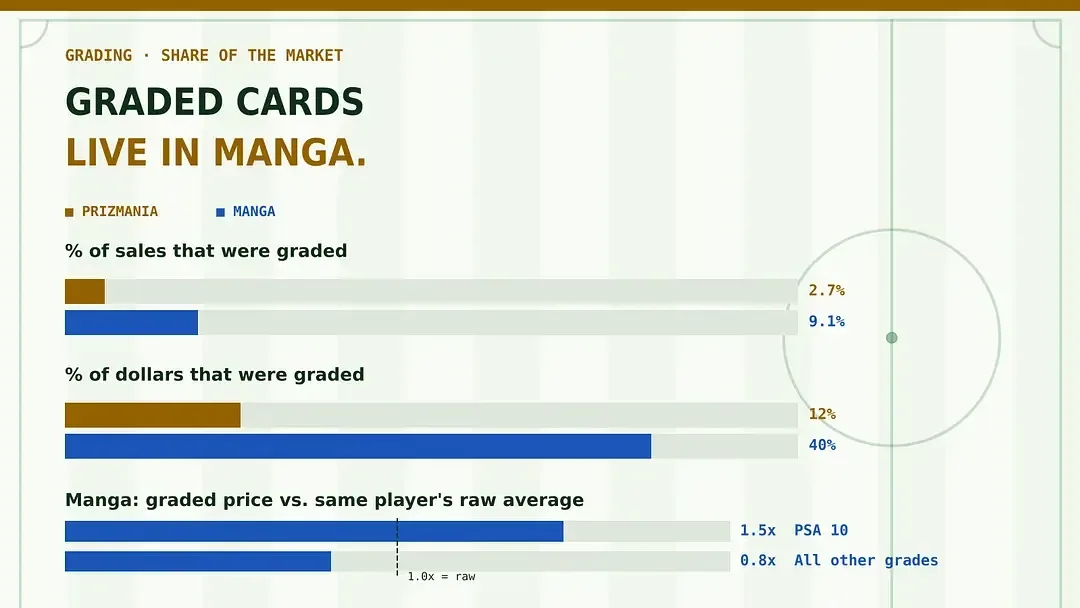
The grading data adds another layer to the split. Only 2.7% of Prizmania sales in the period were graded, compared with 9.1% of Manga sales. A graded card has been evaluated and encapsulated by a third-party grading service; a raw card has not been assigned such a grade.
The value contribution was even more uneven. Graded Manga accounted for 40% of Manga’s total sales dollars, while graded Prizmania represented 12% of Prizmania’s total dollars. In practical terms, the highest-value portion of Manga’s market is much more closely tied to graded copies.
The reported grade-level comparison also urges caution against treating every slab as an automatic premium. A Manga graded PSA 10 sold for about 1.5 times the same player’s raw average, while Manga examples in other grades sold for around 0.8 times that raw average. PSA 10 refers to a gem-mint grade from Professional Sports Authenticator. The contrast illustrates a familiar but essential point: grading can change a card’s buyer pool and presentation, but the specific grade remains crucial.
For collectors considering submission, the available results do not support a blanket assumption that encapsulation alone adds value. The premium is associated with the top grade in this comparison; other grades traded below the relevant raw averages. Raw averages are not perfect one-to-one substitutes for identical-condition cards, but the directional warning is clear.
More sales do not prove more supply
Manga’s 3,597 completed sales versus Prizmania’s 448 might tempt collectors to declare Manga the more plentiful card. That would go beyond what these numbers can prove.
Sales volume measures transactions, not total copies produced, pulled, submitted for grading or held in private collections. A card can sell frequently because there are more copies available, but it can also sell frequently because more collectors want it, more sellers choose to list it, or a more liquid market makes owners more willing to move copies. Liquidity here means the relative ease of buying or selling an item because active buyers and sellers are present.
So the sale counts are a meaningful signal of market activity, not population data. They show Manga is changing hands much more often. They cannot, on their own, settle the question of print scarcity between Manga and Prizmania.
What collectors can take from the comparison
For someone choosing between the two inserts, the data offers a useful framework rather than a command. Manga has the stronger record of completed-sale volume, total dollars and same-player raw pricing. It also has a larger graded presence, especially at the high-value end. Anyone buying Manga should recognize that its present premium is substantial and is not confined to Messi or another single star.
Prizmania is the lower-priced option in the matching-player comparisons supplied here. That may appeal to collectors who prefer the card’s design or want a different route to stars such as Messi, Yamal, Ronaldo and Maradona. The smaller number of sales also means it is sensible to avoid drawing broad conclusions from a single result; individual card condition, grade and timing can matter more when fewer transactions are available.
Most importantly, scarcity and popularity are separate questions. Prizmania may be less frequently sold, but the figures do not prove why. Manga may be the more actively traded and more expensive insert, but its sales count does not reveal its full supply. Treating those questions separately is the clearest way to read a market where two cards from the same release can have very different audiences—and very different price tags.