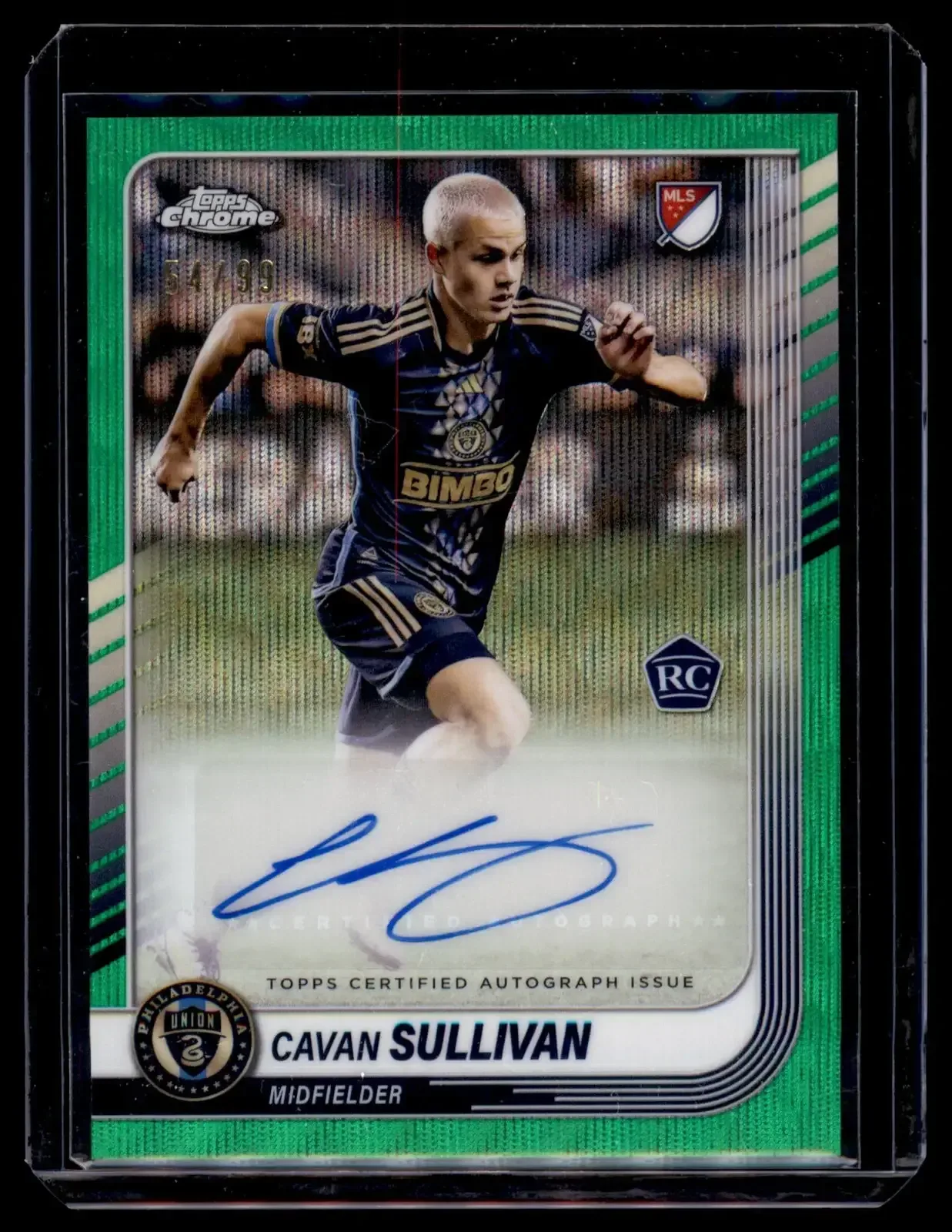
A youth-focused US men’s national team window has created a clear, rapid reaction in the soccer-card market. Cavan Sullivan, Julian Hall and Justin Ellis each emerged from four wins over Chile, Peru, Mexico and Canada with more attention on their national-team cases—and recent sales of their cards moved substantially higher.
That does not mean every increase establishes a permanent new price level. Modern prospect cards can move quickly when a player receives a call-up, produces decisive moments or appears closer to a bigger role. Still, the available sales show that collectors responded to this particular window with conviction, especially around scarce autographs.
The three players occupy different positions in the market. Sullivan already carried significant prospect momentum and added a national-team record. Hall paired a three-goal, one-assist spell with a strong domestic season. Ellis saw a lower-established market accelerate after showing he could provide both central-forward and wing options. Their results offer a useful snapshot of what collectors are paying for: not merely goals, but a plausible route to future USMNT involvement and career progression.
Cavan Sullivan’s record adds to an already rising market
Sullivan’s latest jump came after he became the youngest scorer in US men’s national team history, finding the net in a 3-0 victory over Mexico. His Green Wave autograph numbered to 99 sold for $1,100 on October 6, compared with $575 on September 20, before the international break.
For more context, explore Night of the Idle Horde Demo Is Live on Steam Ahead of November 16 Launch.
That is a striking change even by the reactive standards of prospect collecting. The same card had reportedly sold as low as $95 and commonly changed hands in roughly the $120-to-$150 range as recently as early May. A numbered autograph, often shortened by collectors to an “auto,” is a card carrying the player’s signature; “/99” denotes a print run capped at 99 copies. Low serial numbering does not guarantee value, but it restricts supply at precisely the moment a player’s profile is attracting new demand.
Sullivan was already one of the most closely watched young American players. He was included in The Guardian’s “Next Generation” group of 60 international names to watch. The Mexico goal gives collectors something especially valuable in a prospect market: a concrete senior-international milestone rather than a projection alone.
There are still important reasons not to treat one sale as a straight-line forecast. A $1,100 transaction is evidence of what one buyer paid for one particular copy at one moment. It is not automatically a universal market price for every Sullivan card, even identical numbered versions. Condition, auction timing, buyer competition and the visibility of the sale can all influence the result. The speed of the move also underlines how sensitive the market remains to attention.
Related coverage includes USMNT Youth Breakout Sends Cavan Sullivan, Julian Hall and Justin Ellis Cards Higher.
The longer-term case rests on continued USMNT opportunities and the development path ahead. Sullivan cannot move until winter 2028. A prospective move to Manchester City has also been described as potentially vulnerable should serious punishment be imposed, though the outcome remains unresolved. For collectors, that uncertainty matters: a player’s club situation can shape exposure, playing time and the number of headline-making performances that feed a card market.
Julian Hall’s international production sparks the biggest percentage leap
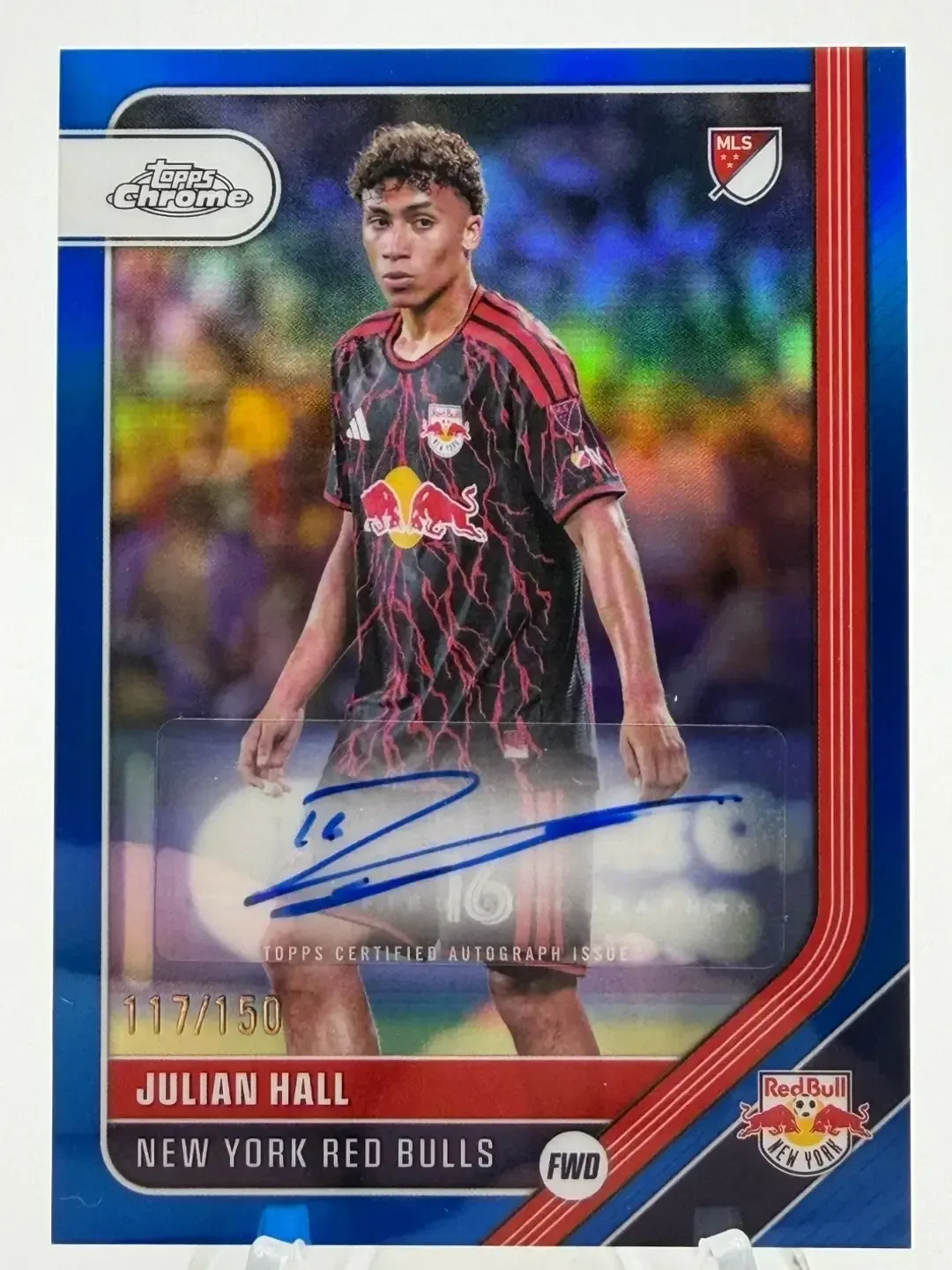
Hall’s international output was difficult to ignore. The 18-year-old forward recorded three goals and one assist during the window, strengthening the argument that he belongs among the options behind Folarin Balogun. His 2026 Topps Chrome MLS Blue autograph numbered to 150 sold for $149.99 on October 6, after a $31 sale on September 23.
In percentage terms, that is the sharpest leap of the three highlighted examples. It also demonstrates why collectors often watch international breaks closely. A short run of matches can introduce an MLS player to a substantially larger audience, while goals and assists create simple, shareable evidence for buyers who may not have followed the player’s club season.
Hall’s card is from 2026 Topps Chrome MLS, a branded MLS card product. “Blue” identifies a parallel, meaning a variation of a card design distinct from the standard version, while the “/150” print limit signals that 150 copies were produced. Parallels give collectors a clearer scarcity ladder than a base card, although demand still depends on the player rather than the color alone.
The national-team burst followed a productive start with the New York Red Bulls. Hall has 10 goals and three assists in the 2026 season, though only one of those goals came after the World Cup break began in late May. He scored in the final match before this international period, then carried that renewed form into the USMNT matches.
His immediate club backdrop is more complicated than the international statistics. The Red Bulls are outside the MLS playoff places, and a player’s team results can affect how much sustained attention he receives. Hall may also be a candidate for a European move this winter after the MLS season ends. That next destination could become a major market catalyst, but it is still prospective, not settled.
For now, Hall’s appeal is rooted in the combination of age, production and role. A forward who has already scored repeatedly for the national team at 18 offers collectors an easily understood upside case. The risk is that a small sample can create unusually high expectations. Continued goals for New York and repeat call-ups would provide stronger support for the new interest than a single international window can on its own.
Justin Ellis turns a lower starting point into a fast-rising one
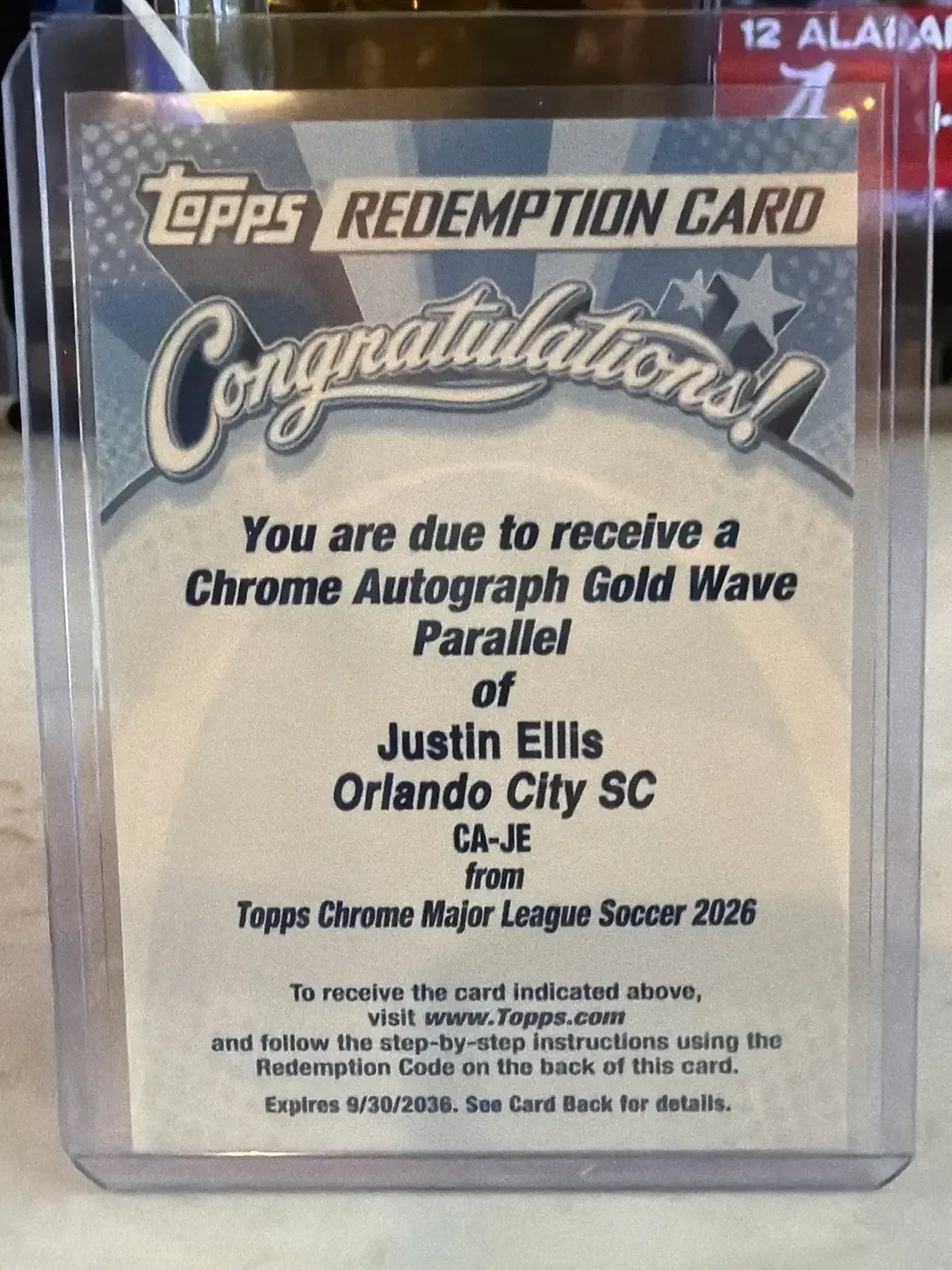
Ellis also left the break with a far more visible market. A 2026 Topps Chrome MLS redemption autograph numbered to 50 last sold for $300 on October 3. Before the international matches, a sale on September 20 landed at $103.50.
A redemption card represents an unfulfilled autograph or other promised hit: the buyer typically redeems a code with the card company rather than receiving the signed card in the pack. That status can be relevant when comparing listings and completed sales. An actual fulfilled card and a redemption for the same intended card are related, but collectors may value them differently depending on timing and confidence in eventual fulfillment.
Ellis’s rise went beyond individual card sales. In group breaks—events where participants purchase rights to a team or player’s cards from unopened product—his position reportedly moved from being bundled into an “Orlando Others” slot to a separate $30-to-$40 slot, then to a price above $100. That is a practical sign of demand because breakers adjust their allocations as buyers show interest.
The increase should nevertheless be read carefully. Break prices are not the same as completed single-card transactions. A break slot is a wager on what might emerge from unopened boxes, with outcomes depending on the product, the checklist and luck. It can reflect hobby heat, but it is not a guaranteed floor for an Ellis autograph or any other individual card.
On the field, Ellis helped establish himself as another attacking option behind Balogun and has the positional flexibility to play wide as well as through the middle. He is the oldest of the three players covered here but is also described as the least experienced, having made significant strides since the World Cup break. That combination leaves more uncertainty around his ceiling, yet it may also explain why collectors saw room for growth from a comparatively lower starting base.
A possible European move next summer is part of the upside discussion, but it is not a certainty. As with Hall, the next club situation would matter greatly. A move can create visibility and excitement, but the developmental value for a player—and the lasting impact on cards—depends on opportunities after the move, not the transfer headline alone.
What the sales actually say about the market
The common thread is not that every young USMNT player is suddenly a safe investment. Rather, this window gave collectors three separate narratives that were easy to recognize: Sullivan’s record-setting goal, Hall’s repeated scoring and playmaking, and Ellis’s emergence as a flexible attacking option. Each narrative was reinforced by limited autograph cards, where available supply is explicitly constrained.
Collectors considering these results should separate attention from liquidity. Attention is the buzz created by performances, social conversation and roster momentum. Liquidity is the depth of actual buying demand when it is time to sell. A headline sale can demonstrate attention; a consistent run of comparable sales is more useful for judging liquidity. The supplied results show meaningful movement, but they are individual reference points rather than a complete sales history.
- Check the precise card: A Green Wave /99, Blue /150 and redemption auto /50 are distinct items with different scarcity and collector appeal.
- Use completed sales, not asking prices: Listings can signal ambition; completed transactions show where a buyer and seller actually met.
- Watch the next opportunity: Further USMNT minutes, club goals and any confirmed career move could influence demand for all three.
- Remember the downside: Prospect markets can cool as rapidly as they rise if production, playing time or transfer expectations change.
The most durable takeaway from the four-match stretch may be the way the USMNT youth pipeline has become a direct catalyst for MLS card demand. Sullivan remains the most established headline prospect of the group, Hall owns the most explosive recent on-field international line, and Ellis has made the strongest case as the developing market with room to define itself. Their next matches and club decisions will determine whether these October sales become brief spikes or the early markers of deeper collector support.