Christian Pulisic’s summer on the biggest international stage did not produce the moment that collectors, supporters or the player himself wanted. The United States attacker played 45 minutes against Paraguay in the World Cup opener before a calf injury interrupted his tournament. He returned against Turkiye and Bosnia and Herzegovina, then had to leave the knockout-round loss to Belgium through injury. He recorded no goals or assists after the opening match.
That sequence matters in sports cards because the market often reacts to visibility as much as long-term résumé. A World Cup can concentrate attention, new buyers and emotional spending into a short stretch. Pulisic’s tournament instead put an abrupt ceiling on an opportunity to build fresh momentum on home soil.
There are signs that the first part of a recovery may already be underway. Pulisic has scored in three of his past four Serie A appearances, including against Genoa, and he has been selected for the 25-player United States Men’s National Team squad set to play Haiti twice in the CONCACAF Nations League quarterfinals. If he plays, it will be his first international action since the World Cup.
For collectors, though, the important distinction is between an encouraging bounce and a confirmed market reversal. Recent transactions for two notable Pulisic cards show improvement from their lows, but neither has returned to its World Cup peak. That makes the next club and international appearances relevant—not as guarantees of price appreciation, but as the next tests of whether buyer interest can persist.
For more context, explore iPadOS 27.3 Beta Adds a Siri Camera Tab for Visual Intelligence, Including Apple Pencil Selection.
One USMNT PSA 10 has already moved higher
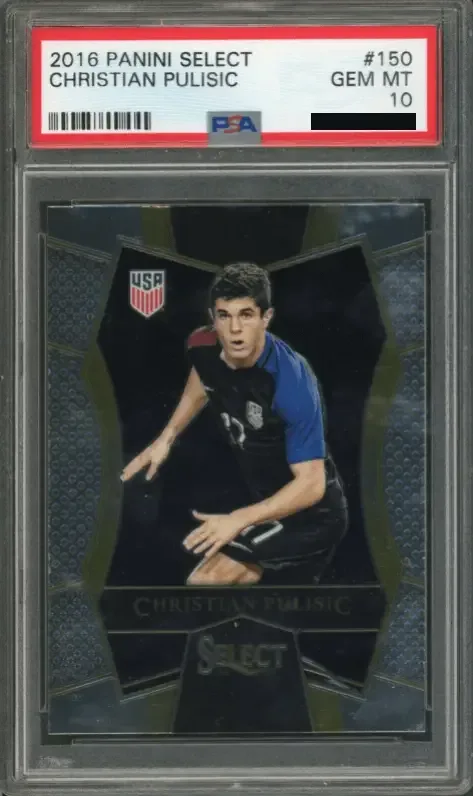
The clearest recent change involves Pulisic’s 2016 Panini Select base card showing him in a USMNT kit. Multiple PSA 10 copies sold for $50 last month. Sales rose to $70 last week after his national-team selection, based on Card Ladder sales data. That is a meaningful percentage increase at this price level, even if it does not yet indicate that the card has recovered its earlier highs.
During the 2026 World Cup, the same PSA 10 card reached a sale of $230. The more recent $70 level is therefore well below that high-water mark. It is also a useful reminder that a peak sale during a major event can be a poor stand-in for the everyday market. Peak transactions can occur when attention is unusually intense and buyers are responding to a live storyline. A card’s ability to sustain several sales at a new range is generally more informative than one exceptional result.
PSA 10 refers to a card graded Gem Mint 10 by Professional Sports Authenticator. Grading evaluates condition, and the numerical grade helps separate a high-condition copy from the broader raw-card population. It does not make every PSA 10 equally liquid or ensure that a given sale can be replicated quickly. Demand, the number of available copies and the particular card all still matter.
The $50-to-$70 movement is best viewed as an early reaction to renewed relevance. Pulisic’s call-up gives collectors a near-term catalyst, while his recent Serie A goals add a positive club-form narrative. The next question is whether those two storylines become performances that are memorable enough to broaden demand beyond buyers who were already watching his market.
The club rookie card has improved, but not yet accelerated
Pulisic’s 2016 Panini Donruss card from his Borussia Dortmund period is commonly treated as his true rookie card. A PSA 10 copy most recently sold for $100 on November 1. That was above the year’s low sale of $89 in October, but still substantially beneath its World Cup high of $289.
The difference between this card and the Panini Select USMNT issue is worth watching. The national-team card responded promptly after the squad announcement, while the Donruss rookie-card market had not shown the same modest uplift. That does not establish that one is better than the other. It does suggest that buyers may currently be responding most directly to the national-team narrative rather than repricing Pulisic’s entire card catalog.
True rookie card is collector terminology, not a universal designation that automatically settles value. In practical terms, it is usually used for a player’s first mainstream card associated with their professional breakthrough. Collectors should identify the exact set, year, player image and grade before comparing sales. Similar-looking Pulisic cards can represent different products, parallel levels or grading populations, and their prices should not be treated as interchangeable.
For a buyer considering either card, the most useful comparison is not simply World Cup high versus current sale. Look at several recent confirmed sales for the same card and grade, then separate base cards from parallels, autographs and serial-numbered editions. A base card is the standard version of an issue; a parallel is a variation that may have a different finish, color or scarcity. Their supply-and-demand dynamics can be dramatically different.
Collectors also need to decide what they are buying. Someone collecting Pulisic because of his role in modern American soccer may reasonably see current prices as part of a longer personal collection. Someone buying strictly on the expectation of a quick increase is making a different, more time-sensitive bet—one exposed to the results of a small number of matches and to future injury news.
Why the upcoming USMNT matches matter—and why they do not settle anything
The two Haiti matches in the Nations League quarterfinals create a straightforward opportunity for Pulisic to return to the international conversation. A productive return could extend the attention created by his selection and recent club scoring. Conversely, another injury or underwhelming performances could stop the momentum before it develops further.
The injury risk is not abstract in this case. Pulisic’s World Cup was shaped by a calf issue in the opener and another forced exit against Belgium. That recent history means health will remain part of the market conversation alongside goals, assists and team results. Sports cards do not price an athlete’s performance in a clean, mechanical way, but availability affects opportunity: a player who is on the field has a chance to create the moments that renew attention.
It is equally important not to overstate what a single international window can do. A few strong games may produce a burst of listings, bids or completed sales. They cannot erase the World Cup disappointment by themselves, and they do not ensure lasting demand. The stronger evidence would be continuing club contributions, sustained national-team involvement and a sequence of sales that holds rather than immediately falling back.
Pulisic himself struck a subdued but appreciative tone after the Belgium loss, thanking those who believed in the group while acknowledging that the team’s result was not good enough. That response reinforces the central point for the market: the World Cup did not create a clean triumph narrative for collectors to chase. Any rebound will likely have to be assembled from form, fitness and renewed relevance over time.
Cavan Sullivan shows how quickly attention can move
Pulisic is only 28, but he is operating in a national-team environment with a rising group of younger players. Mauricio Pochettino called up numerous young players for the first international break after the World Cup. That group won all four friendlies in September and October, including victories over Mexico and Canada.
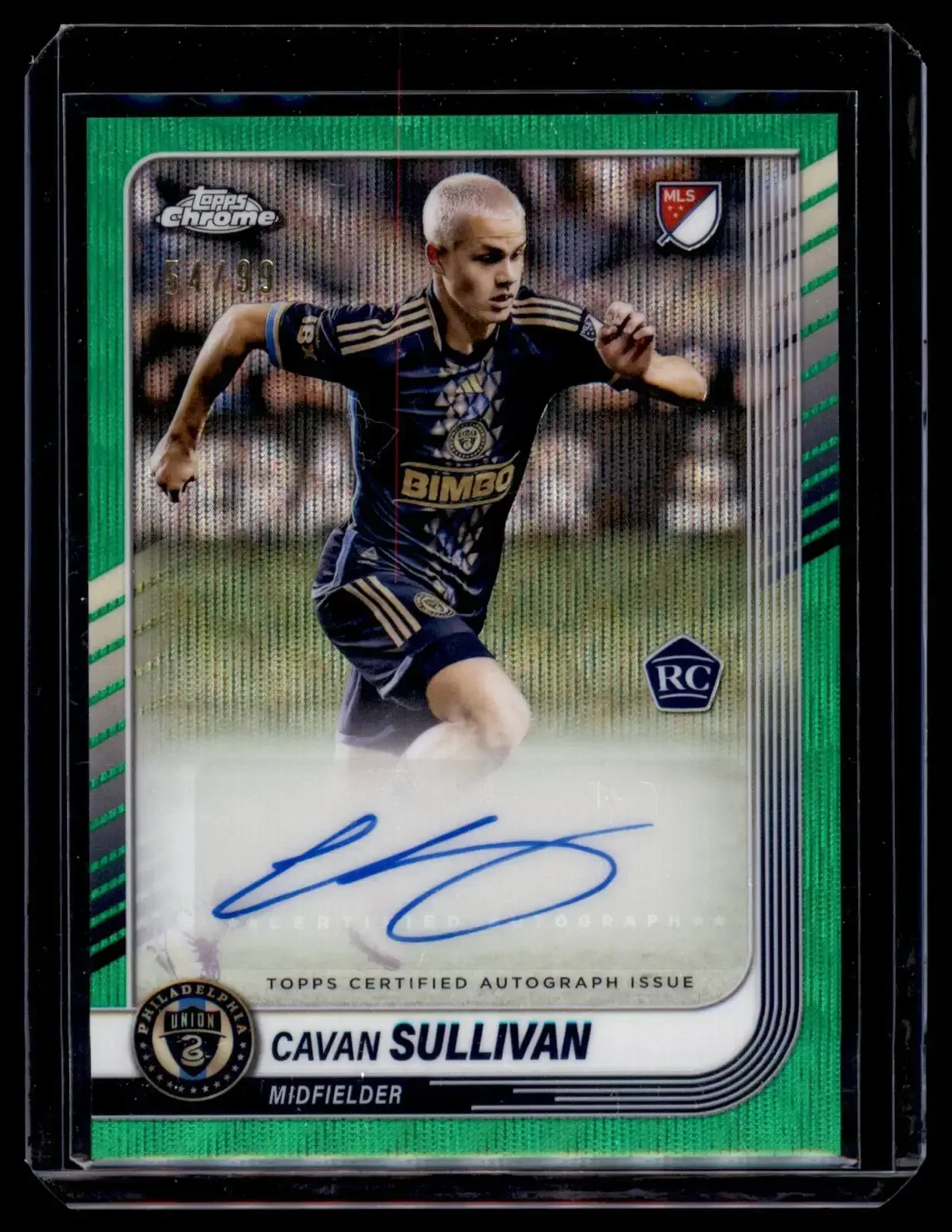
Cavan Sullivan was the most prominent name from that call-up. The 16-year-old has been producing in Major League Soccer ahead of an eventual move to Manchester City, and he scored his first international goal against Mexico. With many regulars now back in the squad, his role in this window will be a point of interest.
In card-market terms, Sullivan has already attracted an extraordinary level of premium demand. His MLS rookie debut patch card sold for $324,000 in September, the highest sale cited for a Sullivan card. Pulisic’s highest cited sale is $113,460 for a 2016-17 Panini Select Signatures Black Prizm 1/1 graded BGS 9.5, sold in June.
Those figures should not be used to declare a simple winner between the players. They describe very different cards. Sullivan’s result was for a rookie debut patch card, while Pulisic’s was a signed, one-of-one Black Prizm. One-of-one, often written as 1/1, means the manufacturer designated that specific version as the sole copy of its kind. BGS 9.5 is a high grade assigned by Beckett Grading Services. Both rarity and grade can make headline sales poor direct comparisons with standard base cards.
What the numbers do demonstrate is the market’s willingness to pay heavily for a new American soccer prospect with a powerful future-facing story. That is a competitive factor for Pulisic, even if collectors can value both players for different reasons. Prospect markets often thrive on possibility; established-player markets can be more immediately tied to production, health and big-game legacy.
How collectors can read the Pulisic market without chasing a headline
The available sales point to a market that is responsive but unresolved. The Select PSA 10 has moved from $50 to $70 after the USMNT call-up. The Donruss PSA 10 last sold at $100, up from an October low of $89 but well under its $289 World Cup high. Those are not identical trends, and they argue for specificity rather than broad claims that “Pulisic cards are up” or “Pulisic cards are down.”
- Match the exact card: Compare the same year, set, version and grade. A base card is not a parallel, and a PSA 10 should not be priced as if it were a raw copy.
- Use more than one transaction: A single sale can be notable, especially for scarce cards, without representing a stable market level.
- Separate event spikes from sustained demand: World Cup highs capture a particular moment. A sustained rebound would show repeated sales after the event-driven attention fades.
- Watch the relevant catalysts: Club goals, national-team minutes and fitness are the immediate variables supplied by Pulisic’s current situation.
- Respect the prospect premium elsewhere: Sullivan’s headline patch sale illustrates how much capital can shift toward emerging talent, particularly around rare cards.
The upside case for Pulisic is easy to understand: recent Serie A form, a return to the USMNT and the possibility that a disappointing World Cup becomes a temporary interruption rather than the defining story. The caution case is just as clear: the injury backdrop remains fresh, current prices are far below tournament peaks, and a younger generation is drawing major collecting interest.
For now, Pulisic’s card market looks less like a completed comeback than a player returning to the field after a difficult stretch. There is movement, there are identifiable catalysts, and there is substantial distance between present sales and the heights reached during the World Cup. Collectors looking for further context on that developing card-market conversation can read this recent Pulisic market update.