Manchester City’s financial-regulation case has moved from a long-running cloud over the club to a potentially consequential issue for soccer-card collectors. The Premier League has confirmed findings of financial-rule breaches covering 2009 through 2018, centered on allegations that revenue was overstated and costs were reduced through contracts that did not reflect the underlying arrangements. The figure cited is £900 million, or about $1.2 billion.
City continues to deny wrongdoing and may appeal. That uncertainty is essential for the hobby: relegation, exclusion from European competition, fines and points deductions are possible outcomes discussed around the case, not settled consequences. Until the appeal process and any sanctions are resolved, a collector should treat almost every market implication as a scenario rather than a certainty.
Still, the case raises a useful collecting question. What happens to a player’s cards when the club on the front of the card could lose access to the competitions and licenses that help generate major releases? For Manchester City collectors, the answer is not simply that cards would become “rare.” Supply, player visibility, team performance, product licensing and buyer confidence can all move in different directions.
The key distinction: existing cards versus future cards
First, a potential sporting penalty would not make existing Manchester City cards disappear. Cards already printed for Erling Haaland, Jérémy Doku and other City players would remain in collections, sealed products and dealer inventory. Their population would not suddenly shrink merely because the club’s competitive status changed.
What could change is the future flow of officially licensed cards. If City were relegated from the Premier League, the club would no longer be part of the next season’s Premier League card releases in the way it is while in the top division. That could remove City-branded cards from Topps Premier League products for that period. A longer stay outside the top flight would extend the gap.
This is where collectors should distinguish scarcity from desirability. Scarcity describes how limited an item is; desirability reflects whether buyers actually want it. Fewer new City cards could make a particular period of the player’s collecting history more distinctive, but a loss of top-flight exposure could also reduce demand from collectors who value current form, major-match visibility and regular promotional presence in premium products.
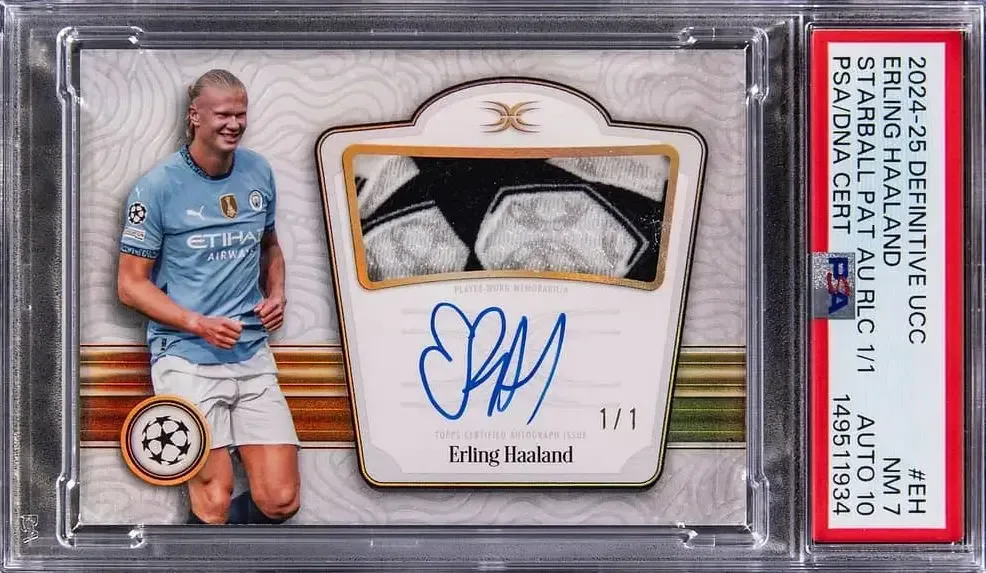
Haaland provides a clear example of why the two ideas should not be treated as interchangeable. One of his Manchester City cards sold for $115,900 earlier this year. That result demonstrates that elite, high-end examples can attract significant money. It does not establish that every later Haaland card would rise if City’s product footprint narrowed. Card markets are highly segmented by player, set, rarity, condition, autograph or memorabilia content, and the individual buyer pool.
Why Premier League and European releases matter
Manchester City’s current collecting ecosystem benefits from two major lanes of visibility: the Premier League and UEFA club competition. A relegation would threaten the first. A major points deduction, even if City remained in the Premier League, could damage the club’s chance of qualifying for European competition and therefore affect the second.
City has appeared in the Champions League every season since 2011-12, which has made the club a regular presence in UEFA-focused products including Topps Chrome UCC. UCC, short for UEFA Club Competitions, refers to card products built around UEFA’s club tournaments rather than one domestic league. Such releases can matter because they place players alongside the sport’s other prominent clubs and attach them to the stakes and visibility of European matches.
If City were absent from both Premier League-focused and European-competition products, collectors could have fewer newly issued mainstream options featuring players in City colors. That does not mean there would be no cards at all. An EFL Championship spell could still leave a route into Panini’s EFL products. But the cited market view is that those releases generally do not carry the same standing as large Premier League releases.
That difference is practical, not merely cosmetic. A player with annual representation across multiple flagship and chrome-style products gives collectors many entry points: base cards, parallels, inserts, autographs and numbered variations. A smaller product footprint can mean fewer choices, fewer new chase cards and less frequent attention around the player’s club identity.
It can also complicate set collecting. A collector building a season-by-season City run may face a gap in familiar Premier League issues. A player collector may need to decide whether a Championship card, a national-team card or a prior City issue best represents that period. Those are collecting choices, not automatic value judgments.
Player movement is the market’s biggest unknown
Team sanctions do not necessarily dictate where individual players will play. The material available on the case notes that many City players may not have relegation clauses in their contracts. If that proves relevant, some prominent players could remain with the club through a demotion rather than immediately move to another top-flight side.
For player-focused collectors, that possibility creates a tension. Staying at City could reduce the number of high-profile club releases available in the near term. Moving elsewhere could preserve—or even expand—a player’s place in flagship domestic and European products, but it would also shift the visual identity collectors associate with that player.
That is especially important for collectors who buy cards because they want a particular club-player combination. A Haaland collector might value Manchester City cards differently from cards issued after a transfer, even if the athlete’s broader market remains strong. Conversely, collectors who are primarily betting on the athlete’s global profile may care more about elite competition and visibility than shirt color.
In market language, this is player demand versus team demand. Player demand follows the individual’s reputation, performances and collecting base. Team demand comes from supporters and from collectors pursuing club sets. The two often overlap, but they can separate during a crisis. A major player can remain highly collectible while cards tied to a troubled club become more complicated for some buyers.
Cavan Sullivan illustrates the prospect-card complication
The uncertainty is sharper for prospects than for established stars. Cavan Sullivan, the 17-year-old American player, is expected to join Manchester City when he turns 18. His MLS debut patch card reportedly sold for a record $324,000 last month, placing considerable hobby attention on his next steps.
A debut patch card is generally a card incorporating a piece of player-worn or game-used material and tied to an early or debut appearance. These cards are often treated differently from conventional base cards because the patch component, limited production and player milestone can make each copy more distinctive. The reported Sullivan result is therefore meaningful as evidence of demand for a premium early-career item, though it should not be used as a direct price guide for every future card.
For Sullivan collectors, City’s situation creates multiple paths rather than one forecast. If he joins City as planned and the club lacks Premier League or European access, the first cards depicting him with City could have a narrower mainstream release environment. That could limit supply in the most familiar products. It could also limit the match-driven momentum that often helps young players attract attention.
There is another possibility: Barcelona and Real Madrid have reportedly asked about Sullivan in light of the situation. No move is established by that report, and collectors should not buy as though a transfer has happened. But the interest illustrates why prospect values are frequently tied to projected destination as well as talent. A player’s next club affects likely product exposure, supporter base and the kind of rookie-era narrative collectors build around.
What collectors can sensibly watch
The case is a reminder that a sports card is not only an image of a player. It sits within a chain of league participation, tournament qualification, licensing, team circumstances and collector sentiment. That does not mean every legal or sporting development requires a trade. It does mean collectors should identify what they actually own and why.
- For City team collectors: Keep track of future Premier League participation and European qualification, since those are the clearest factors for continued representation in the major relevant product lines.
- For player collectors: Separate the athlete’s overall appeal from the availability of cards in a particular club uniform. A constrained City release calendar and a weakened player market are not necessarily the same thing.
- For prospect collectors: Treat rumored destination changes as uncertainty, not confirmation. Future card identity depends heavily on where the player ultimately plays.
- For high-end buyers: Review the exact card rather than relying on a headline sale. Serial numbering, condition, card type and the presence of autograph or patch elements are all material.
- For sealed-product buyers: Be wary of assuming reduced future City representation makes all older products more valuable. A product’s full checklist, print run and broader chase structure still matter.
The wider card hobby has plenty of examples of collectors weighing scarcity, release format and narrative, including the very different mechanics behind a blind-bag comic card promotion. Soccer cards add a further variable: a club’s place in domestic and European competition can directly influence where future player cards appear.
For now, Manchester City collectors have more questions than answers. The Premier League’s findings are significant, City contests the case, and the ultimate sporting outcome remains unresolved. The most grounded approach is to avoid treating a possible reduction in future supply as a guaranteed price catalyst. If sanctions materially alter City’s league or European status, the strongest effect may be a reorganization of collecting options—who appears in which products, in which uniform, and how often—rather than a simple across-the-board rise or fall in value.