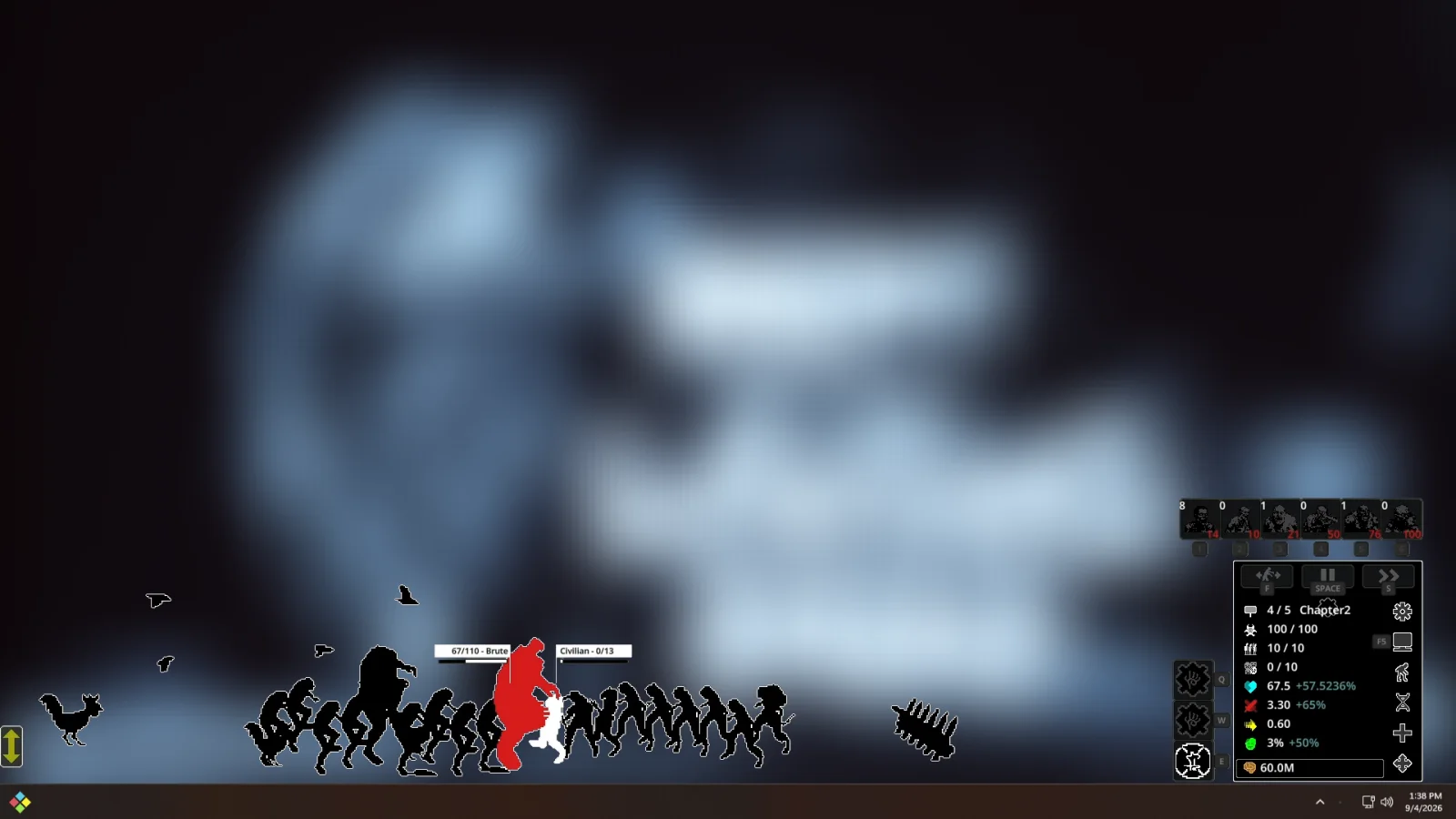
Night of the Idle Horde, a zombie-themed incremental survival horror game from Ten Image Publishing and developer myradann, now has a demo on Steam. The full release is scheduled for November 16, with listed prices of £4.59, $4.99 and €5.19.
The premise turns a familiar survival-horror setup on its head. Rather than trying to outlast an undead swarm, players create one: building a zombie horde, carrying infection into new Regions and developing the permanent abilities that make the outbreak more effective over time. Its stated inspiration is Night of the Living Dead, while its systems point toward an incremental game built around long-term growth, resource flow and decisions about how much direct attention a player wants to give the horde.
The newly available demo is a relatively focused slice of that structure. It includes five zombie types, five automations, 14 mutations, five Sigils and one Region. Those numbers do not establish the full game’s eventual scale, but they should give prospective players a useful opportunity to understand the central loop: make the horde stronger, set up ways to gather resources, and decide when active management is worth the intervention.
An idle game with a moving zombie front line
“Incremental” generally describes games in which progress compounds. Players begin with a limited capacity to produce resources or exert influence, then reinvest the results into upgrades, additional units or automated processes. Growth can be measured in numbers, but the more important design question is whether each new upgrade meaningfully changes how a player approaches the system.
Night of the Idle Horde frames that process around infection and an undead army. The game asks players to spread the infection across Regions, recruit minions for harvesting and upgrade zombie statistics permanently. That makes its horror theme more than surface dressing: the desired outcome is not merely survival, but the expansion of an escalating plague.
Regions are particularly important to this structure because they include Game Changer modifiers. A modifier is a rule alteration that can change the value of existing choices. In practical terms, a Region modifier can require a player to reconsider a previously reliable setup rather than simply repeating the same upgrade order everywhere. Only one Region is present in the demo, so players should treat it as an introduction to the concept rather than proof of every variation planned for the full release.
For more perspective on how the game’s zombie-army premise could fit its incremental design, see Joking Joystick’s Night of the Idle Horde PC design feature.
Permanent zombies or expendable flesh eaters?
One of the clearest strategic tensions described for Night of the Idle Horde is the choice between permanent zombie upgrades and cheaper, expendable flesh eaters. This is a resource-allocation problem, a common but effective foundation for strategy-focused idle games.
Related coverage includes Night of the Idle Horde Demo Opens Its Zombie Survival Loop on Steam.
Permanent upgrades typically matter because their benefit persists. Investing in zombie stats can improve the underlying strength of the player’s operation and potentially make later tasks more efficient. Expendable units, by contrast, imply a lower-cost option intended for immediate use. The trade-off is not simply “good unit versus bad unit”; it is whether a player needs durable growth or a short-term body count at that moment.
That distinction is likely to matter most when the player encounters changing Region conditions or needs to alter the horde’s arrangement quickly. Saving resources for a lasting upgrade can be sensible, but it may leave a player with too little immediate force. Spending freely on cheap units can solve a pressing problem while slowing broader development. The game’s premise gives this familiar economic decision a fittingly grisly presentation.
The developer also lists tactical horde layout and on-the-fly minion movement among the game’s core systems. “On-the-fly” here means adjustments made during play rather than only through a fixed, pre-planned setup. This matters because it suggests the horde is not intended to be a completely hands-off spreadsheet. Even while the larger progression loop runs over time, positioning and moving minions may demand active decisions.
Automation and offline collection explained
Automation is the other half of the game’s identity. Night of the Idle Horde includes rats, crows, bats and chickens as automated resource collectors, with the systems described as supporting offline resource collection. In an idle game, automation means assigning a process to continue producing without requiring repeated manual input. Offline collection extends that idea by allowing resources to accumulate while the player is away from the game.
The appeal is straightforward: players can return to gains that can be reinvested into the horde rather than needing to watch every cycle happen. The design challenge is balance. If automation makes all choices irrelevant, active play loses purpose. If it is too weak, the game may not feel meaningfully idle. Night of the Idle Horde’s stated mix of automated harvesting, Region modifiers, layouts and temporary powers suggests it is aiming for a middle path in which automation maintains momentum while active input handles more tactical moments.
The demo’s five automations should therefore be useful for evaluating the game’s intended rhythm. Players can look at whether those systems feel like distinct tools, whether their resource roles are understandable, and whether their output creates interesting next decisions. Because the demo contains only a subset of the announced systems, it is also worth separating what can be observed in that build from assumptions about the final game’s progression.
Sigils are temporary powers, not permanent upgrades
Night of the Idle Horde calls its temporary special abilities Sigils. These can boost statistics for a limited period or summon allies. Unlike a permanent upgrade, which raises a baseline indefinitely, a temporary ability is about timing. Its value depends on when it is used and what problem it is meant to solve.
That creates a potentially useful counterweight to the calmer cadence of offline harvesting. A player may let automated collection and permanent development handle ordinary progress, then use a Sigil when a Region’s modifier, layout problem or sudden tactical need calls for a burst of help. The demo provides five Sigils, enough to establish how those powers are positioned within the wider loop without revealing what later options may exist.
The same distinction applies to mutations. The demo includes 14 mutations, though no individual effects have been detailed. In an incremental context, mutations usually signal another layer of build shaping: choices that can alter a horde’s capabilities or priorities. Without specifics, it would be premature to describe their exact role. Their inclusion does indicate that progression is intended to involve more than simply increasing a single zombie-stat number.
Desktop Mode is designed for background play
Perhaps the most direct statement of the game’s intended use is its Desktop Mode, which lets Night of the Idle Horde run in a customizable corner of the screen. That feature aligns with the idea of a background idler: a game that can remain visible and accessible while the player does other things, rather than always demanding full-screen attention.
Customization matters because desktop space is personal. A small corner window may suit someone who wants quick check-ins on resources or minion placement, while another player might prefer the game to be less visually prominent. The feature also reinforces the balance myradann is pursuing between passive accumulation and active management. If the game is genuinely useful in a corner of the display, it needs to communicate progress clearly enough for brief interventions.
Myradann described the project as a tribute to B-movie horror and said it changed during development in response to community feedback. The developer also characterized its goal as a balance between a background idler and a more demanding incremental experience. That ambition is visible in the announced components: passive resource gathering and Desktop Mode on one side; tactical positioning, movable minions, temporary Sigils and modifier-driven Regions on the other.
What the Steam demo can establish
The demo is not just an early chance to see a zombie aesthetic. Its limited selection of five zombie types, five automations, 14 mutations, five Sigils and one Region should let players test the more consequential question: whether Night of the Idle Horde makes its multiple layers work together.
- Horde choices: Do permanent upgrades and expendable flesh eaters create clear, worthwhile trade-offs?
- Automation: Does offline resource collection keep the game moving without erasing the reason to engage directly?
- Tactics: Are layout and minion-movement decisions understandable and meaningful in the available Region?
- Temporary power: Do Sigils feel like tools that reward timing rather than buttons pressed whenever available?
- Desktop play: Does the customizable corner-screen mode support quick check-ins cleanly?
Those are practical considerations for anyone interested in the game’s particular blend of horror presentation and incremental design. The full release is due November 16, while the current Steam demo offers the first public opportunity to see how effectively its outbreak-management loop holds together.