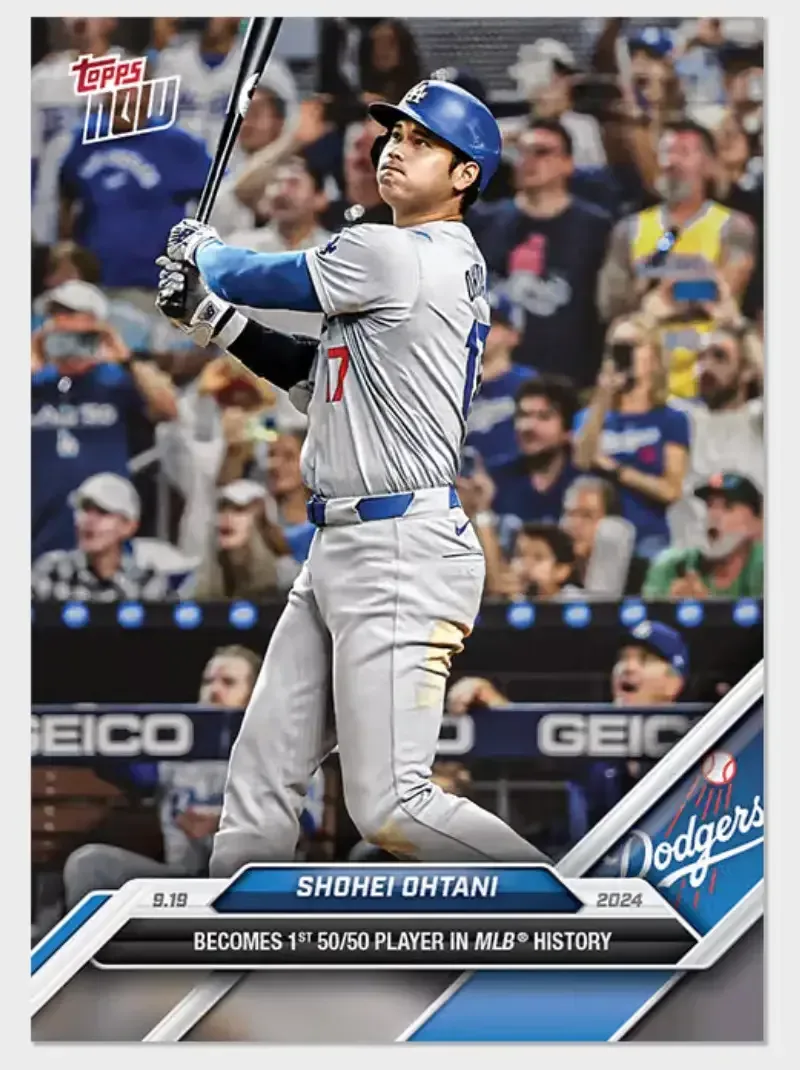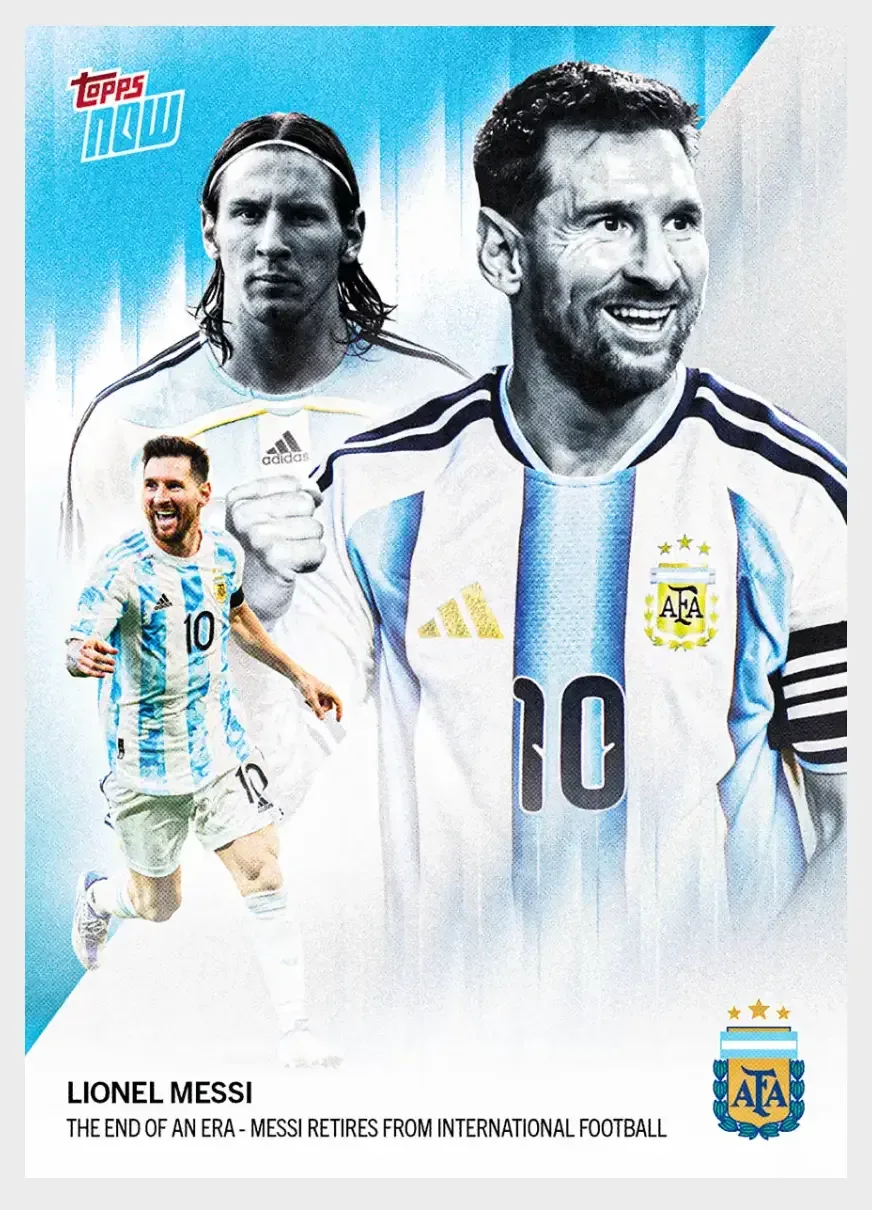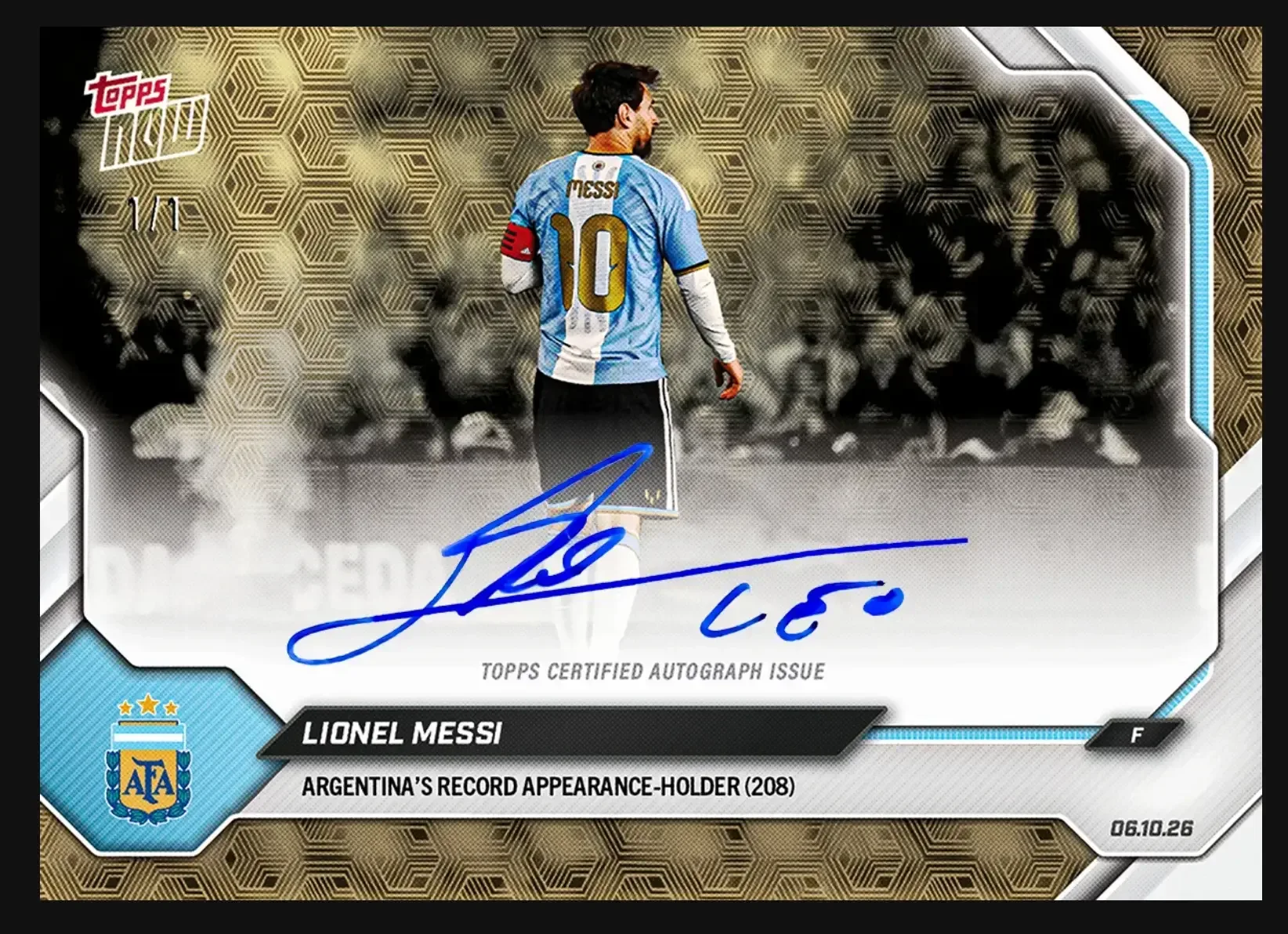
Lionel Messi has added a trading-card milestone to an already remarkable sporting résumé. The 2026 Argentina Topps NOW Final Farewell Pack closed with a print run of 664,325, the largest for any Topps NOW release to date. The total narrowly but decisively moved past the previous leader: Shohei Ohtani’s 50/50 milestone card, which recorded 653,737 copies.
It is a record with an extra wrinkle beyond sheer sales volume. Passing 500,000 copies activated the Topps NOW Chrome program’s highest stated print-run threshold, producing the first 1/1 White OpalFractor Chrome card in the program. One collector will have the possibility of finding that unique Messi parallel when Final Farewell Packs begin shipping in November.
For collectors, this is not simply a story about a high serial number or a famous name selling a great many cards. It is a demonstration of how a time-limited, event-driven card release can turn widespread demand into a new chase-card outcome. Messi’s pack exceeded the White OpalFractor trigger by more than 164,000 copies, so the historic parallel was not unlocked at the last possible moment; it was secured by a substantial margin.
A new high-water mark for Topps NOW
Topps NOW is built around commemorating current events and milestones rather than following the conventional schedule of a season-long card set. The value proposition is immediacy: a sports or cultural moment can be turned into a card offering shortly after it happens, giving fans an opportunity to collect the occasion while it remains fresh.
Messi’s Final Farewell Pack marked an Argentina-related career moment and was sold as a two-card format. Each pack includes a Farewell base card, parallel, or autograph, plus a variation or short print. The release also created a chase for four separate 1/1 Messi autograph cards.
That combination matters. A base card provides the core commemorative piece, while the possibility of parallels, short prints, variations, and autographs gives sealed packs differing outcomes. In hobby terminology, a parallel is a version of a card that shares a design or subject with the base release but differs through finish, color, numbering, or another production treatment. A short print is produced in a smaller quantity than the standard card, making it comparatively harder to pull.
That basic framework is familiar across contemporary cards, and it also appears in adjacent collecting spaces. For instance, the enormous variant-cover count tracked for Absolute Batman #25 illustrates how collectors often navigate multiple versions of a single centerpiece release. The Messi offering is different in format and distribution, but its appeal likewise comes from pairing an accessible central item with scarcer possible pulls.
The final total put Messi ahead of other huge Topps NOW releases. Ohtani’s 50/50 card had held the top position at 653,737. An Olympic basketball card featuring LeBron James, Stephen Curry, and Kevin Durant reached 588,030. Messi now occupies two of the five largest print runs in Topps NOW history: his earlier Argentina retirement announcement card finished at 335,283, while Jack Hughes’ Olympic-goal card reached 332,447.
Related coverage includes Lionel Messi Sets New Topps NOW Sales Record and Unlocks the First 1/1 White OpalFractor.
How the White OpalFractor was unlocked
The standout detail of the release is its connection to Topps NOW’s Chrome milestone structure. Rather than treating every offering identically, the program adds particular Chrome cards after a release hits specified print-run levels. The escalating thresholds create a visible target during an offering’s sales window and make total demand consequential to the product configuration.
- At 50,000, Chrome parallels numbered to 99 and 50 become available.
- At 100,000, more parallels are added, including a 1/1 Superfractor.
- At 250,000, Opal Chrome parallels enter the release.
- At 500,000, the release unlocks one 1/1 White OpalFractor Chrome card.
Numbering is important here. A card labeled 1/1 is a one-of-one: just one copy of that designated version exists within the release. That does not mean it is the only Messi card, or even the only rare Messi card, in the Final Farewell Pack. The four 1/1 autograph chase cards are distinct unique items. But the White OpalFractor is notable because it is the first card of that particular one-of-one Chrome tier produced through the Topps NOW milestone program.
A Superfractor is another name used for a top one-of-one Chrome parallel. The terminology identifies a specific premium treatment and scarcity designation, not a guarantee of a particular resale result. Likewise, an OpalFractor name describes a parallel style; it should not be confused with a condition grade or an appraisal. A card’s ultimate market value can vary based on collector demand, the card’s physical condition, the player’s long-term appeal, and the preferences of buyers at a given time.
The practical point for buyers is straightforward: the 664,325 figure describes how many Final Farewell Packs were printed, not how many White OpalFractors exist. There is only one White OpalFractor Chrome card. The extremely large overall print run instead supplied the condition that allowed the unique card to be included among the potential outcomes.
Why this Messi release reached the threshold
Topps senior vice president of product Clay Luraschi attributed the response to a convergence of Messi’s achievements, his global collector base, the rise of international football, and Topps NOW’s own growing profile. That explanation fits the unusual scale of the result: a card program designed to react to the moment found an athlete with broad international recognition and a milestone that carried emotional weight for supporters.
The number of first-time Topps NOW buyers is another significant part of the story. Luraschi said the release brought a record number of new buyers into the program. That does not establish how many newcomers will become regular collectors, but it does show that a marquee release can work as an entry point. Someone who purchases a pack to commemorate Messi may then encounter the wider collecting vocabulary—base cards, numbered parallels, short prints, and autographs—for the first time.
That dynamic is particularly useful for a product such as Topps NOW. Traditional card products can depend on collectors following a full set, a league, or a release calendar. A moment-based release can meet buyers at a different point: they may be fans of a player or a specific event before they are dedicated card hobbyists. The card becomes both a keepsake and a potential route into the collecting side of the product.
The program’s reach has also moved beyond standard sports-card fare. A card marking the election of Pope Leo XIV sold 133,535 copies, setting a Topps NOW non-sports record. Earlier in the year, LeBron James partnered with Topps around his move to the Philadelphia 76ers. Those examples do not make every current event equally suited to a card release, but they show the program operating across sports, major cultural news, and high-profile personal milestones.
Record print run versus rarity: a useful distinction
It is tempting to read a record-setting release as a simple rarity story, but the Messi Final Farewell Pack is more nuanced. The base component comes from a release with a very large print run. In that respect, it is a heavily produced commemorative item. Scarcity sits elsewhere in the product: in the short prints, variations, autographs, numbered Chrome parallels, and the single White OpalFractor.
That distinction is valuable for collectors deciding what they actually want. A buyer who wants a tangible marker of Messi’s Argentina farewell moment may value the standard card and its connection to the event. A buyer pursuing rarity will be looking at a different part of the checklist, where the odds and supply are more constrained. Neither motivation is inherently better, but they are not the same collecting objective.
It is also why a massive print run can be both a commercial triumph and a deliberately designed part of the chase. In this case, demand did not dilute the White OpalFractor’s stated scarcity; the high total is what caused that one-of-one card to exist. The result makes the release a clear example of threshold-based configuration: collective demand changed the range of cards available in packs.
What happens next
The immediate next step is fulfillment. Final Farewell Packs are expected to begin shipping in November, and the White OpalFractor remains an unclaimed chase at this stage. Until packs are opened, no one knows which collector will pull the inaugural example.
The longer-term question is what Topps NOW does after reaching the 500,000 milestone for the first time. Luraschi indicated that the challenge is now to find additional ways to raise the bar and create future chase cards. No new thresholds or products were detailed, so collectors should separate that ambition from any assumption that a specific follow-up mechanic has already been confirmed.
For now, the facts are unusually clean. Messi’s Final Farewell Pack is Topps NOW’s best-selling release at 664,325. It passed Ohtani’s 653,737-card benchmark, crossed the 500,000-card trigger, and created the program’s first 1/1 White OpalFractor Chrome. In a product designed to package moments quickly, it has become a milestone in its own right.