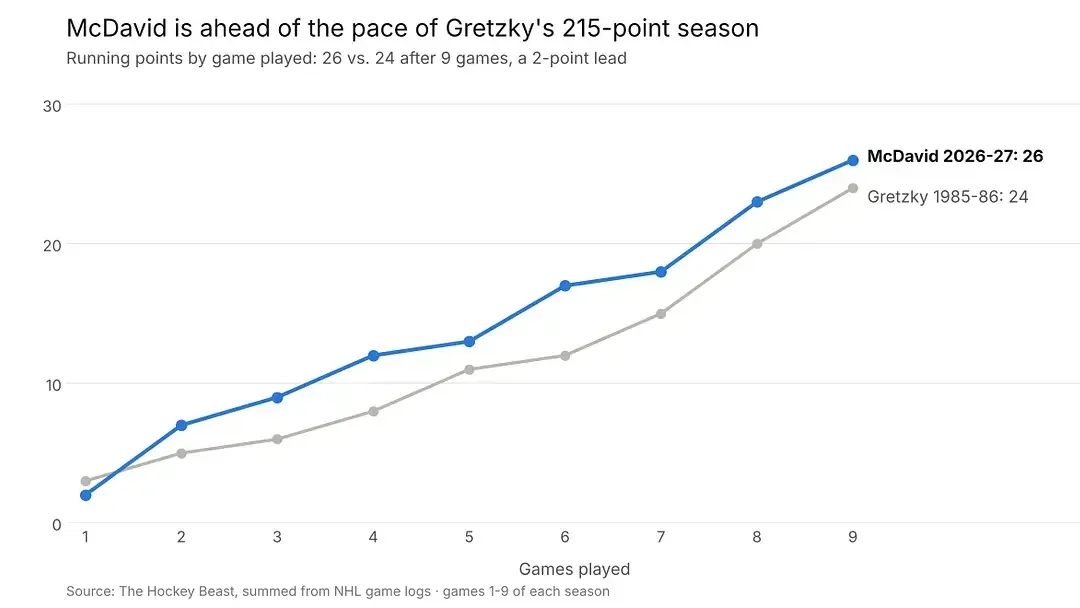
Connor McDavid’s opening nine games have supplied the sort of numbers that force both hockey fans and card collectors to stop refreshing the standings for a minute and look at the stat line. He has 26 points: six goals, 20 assists and a plus-17 rating, while Edmonton has started 7-1-1. At 2.89 points per game, it is the fastest start of his 12-year career.
For the card market, the interesting question is not simply whether McDavid is playing brilliantly. His place at the very top of the current NHL conversation is already reflected in the values attached to his major rookies. Instead, collectors are watching for two possible events with rather different effects: a season-long challenge to Wayne Gretzky’s 215-point benchmark, and the first Stanley Cup that remains absent from McDavid’s résumé.
Neither possibility comes with a guaranteed card-price result. Sports-card markets react to performance, collector sentiment, card scarcity and the number of copies ready to be sold. The available data does, however, provide a useful framework. McDavid’s flagship rookie is widely traded and has a large graded population, while select autograph and patch rookies are limited by numbering. That distinction may matter more than a championship headline alone.
A historic assist pace has changed the short-term conversation
McDavid reached 20 assists in nine games, setting the NHL record for the fastest route to that mark. Wayne Gretzky, Mario Lemieux and Pat LaFontaine had previously shared the record at 10 games. McDavid also sat two points ahead of Gretzky’s 24 through the same stage of Gretzky’s 215-point 1985-86 season.
A simple full-season pace calculation puts McDavid at 243 points if he maintained 2.89 points per game. That would be 28 beyond Gretzky’s 215. It is an eye-catching projection, but it is important to call it what it is: an extrapolation from nine games, not a forecast or a promise. Hockey scoring rates move as schedules, opponents, health and ordinary variance take their turns.
There is still meaningful context even after applying a more cautious lens. McDavid’s best full-season total was 153 points in 2022-23, a 1.87-points-per-game rate. If he played the remainder of this season at that personal-best rate, he would finish near 166 points, another career high. At last season’s rate, he would end up near 152. The 215-point chase remains extraordinarily demanding; sustaining more than 2.5 points per game into February 2027 is presented as the threshold for keeping Gretzky’s record seriously in play.
That potential record pursuit could be a more immediate market catalyst than the Stanley Cup. A points chase produces a rolling sequence of milestones, game after game, and therefore repeated attention. A championship is a single climactic result at the end of a long run. Both can increase interest, but they do not necessarily concentrate buyer activity at the same moment.
Why a Stanley Cup would still be a major collecting story
McDavid is already regarded as the NHL’s best player, but a first championship would answer the career question most often attached to his greatness. If Edmonton won in 2027, he would be 30 and in his 12th season. That timing resembles the longer waits associated with Steve Yzerman and Alex Ovechkin more than the early championships of Gretzky, Lemieux and Sidney Crosby.
Related coverage includes Connor McDavid’s Historic Pace Puts His Card Market in Focus.
Legacy matters in collecting because it changes the story attached to an item. A rookie card does not become a different physical object when a player wins a title. Its grade, set, serial number and condition do not change. What changes is the player’s historical narrative, and a first Cup would be a defining addition to McDavid’s. That can bring new bidders into a market or encourage existing collectors to focus on a player’s most important cards.
Yet a legacy event and a lasting increase in every card’s sale price are not identical outcomes. The practical market lesson from a recent championship example is that buyers may act before and immediately after the news, then lose urgency once the moment has passed.
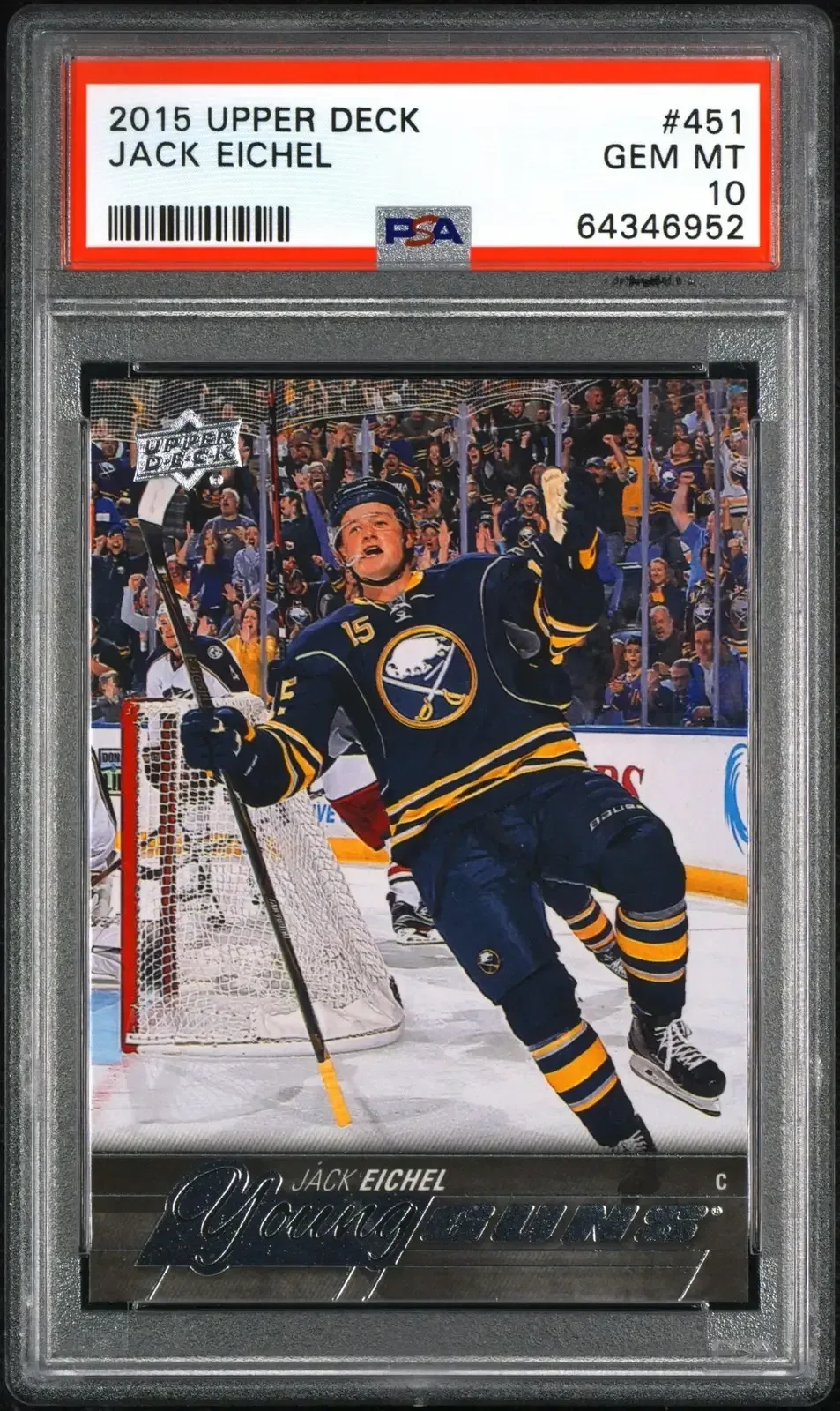
Jack Eichel’s 2015-16 Upper Deck Young Guns rookie in PSA 10 sold from $138 to $185 in the days before Vegas clinched the Stanley Cup. Sales then moved to roughly $225 to $232 after the win. By August of that summer, examples were selling around $107. The sequence illustrates a familiar collector-market phrase: “sell the news.” Anticipation and confirmation can drive a rapid spike, while the post-event market can cool even though the accomplishment remains on the player’s record forever.
It is only one comparison, not a pricing formula for McDavid. McDavid operates at an entirely different value level and has a different market profile. Still, it is a useful warning against treating a Cup victory as an automatic permanent percentage gain for every rookie card.
The flagship benchmark: 2015-16 Young Guns #201
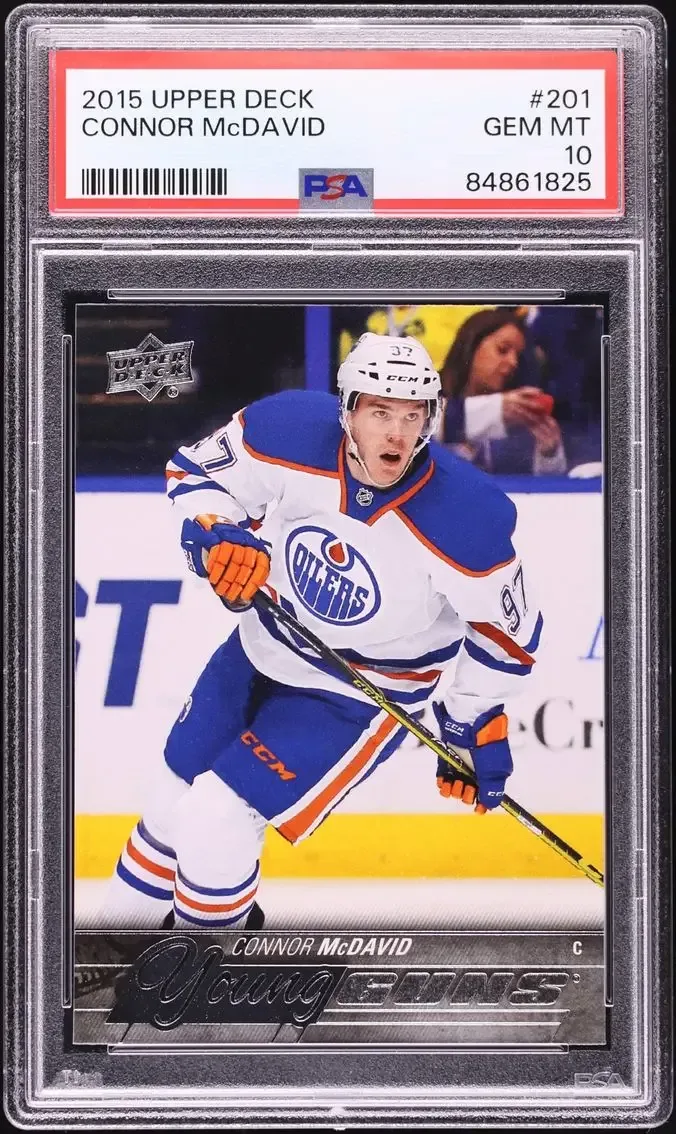
The principal reference point is McDavid’s 2015-16 Upper Deck Young Guns #201 rookie card in PSA 10. “PSA 10” is a Gem Mint grade: a third-party assessment used by collectors to standardize condition and make like-for-like sales comparisons easier. The three-month average was $3,191 across 44 sales, and the most recent reported sale was $3,450 on October 20, a 15% increase.
That is substantial value, meaningful transaction volume and a sign that the card remains a central vehicle for collector interest in McDavid. It is also why the card is especially vulnerable to the basic economics of supply. McDavid has 2.4 times the PSA 10 supply of either Crosby or Ovechkin’s 2005 rookie cards. It traded at nearly twice Ovechkin’s volume and almost three times Crosby’s over the referenced period.
In straightforward terms, many graded copies can come to market when demand rises. The card can still climb sharply if buyers flood in, but thousands of PSA 10s mean potential sellers have ample opportunity to meet those buyers. A championship surge may therefore be powerful and highly visible, yet difficult to sustain once the immediate demand subsides.
The card’s own history reinforces that it is responsive rather than fixed. It sold around $800 in mid-2020, reached roughly $5,600 to $6,332 in 2021, and fell as low as $2,025 during the 2025 playoffs. Those moves show why collectors should avoid reading a single recent sale as a permanent new floor. A last sale can be useful evidence, but it is one completed transaction within a market that has already demonstrated significant swings.
What “comps” and population mean
Collectors often use comps, short for comparable sales, to estimate where a card is currently trading. The most useful comps are recent sales of the same card in the same grade, rather than asking prices that may never lead to a transaction. The $3,191 three-month average and 44-sales sample give a clearer snapshot than one spectacular sale alone, though even that average cannot predict what a future playoff run will do.
Population refers to the number of cards that have received a particular grade from a grading company. It is not necessarily the exact number of copies in collectors’ hands, and it does not tell us how many owners intend to sell. But a large PSA 10 population is a meaningful clue: as prices rise, more owners may decide that now is the time to list.
For anyone considering a purchase or sale, the distinction is practical. A collector focused on owning McDavid’s iconic mainstream rookie may value the Young Guns for its recognizability and liquidity—the relative ease of finding buyers and sellers. Someone expecting scarcity to limit available supply needs to recognize that the flagship PSA 10 has much more potential supply than certain numbered alternatives.
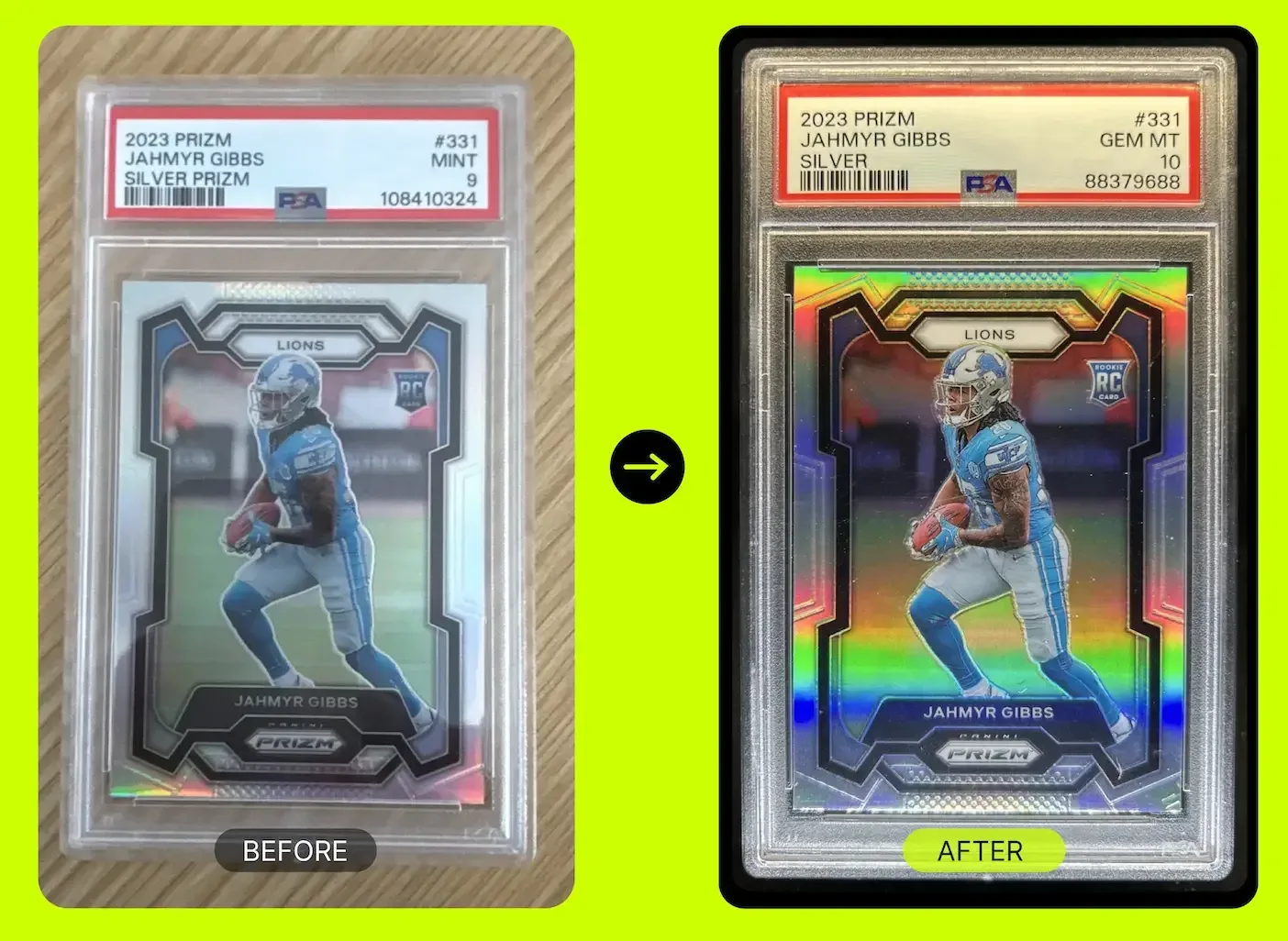
Modern selling tools are also increasingly designed around the work of turning a card into a listing, from photographs and identification through to the listing itself. That workflow matters during a hot streak, when a wave of owners may decide to offer copies at once. Card-selling workflow tools are putting more attention on those preparation steps, which may make market supply react faster when attention peaks.
Scarce autograph and patch rookies may behave differently
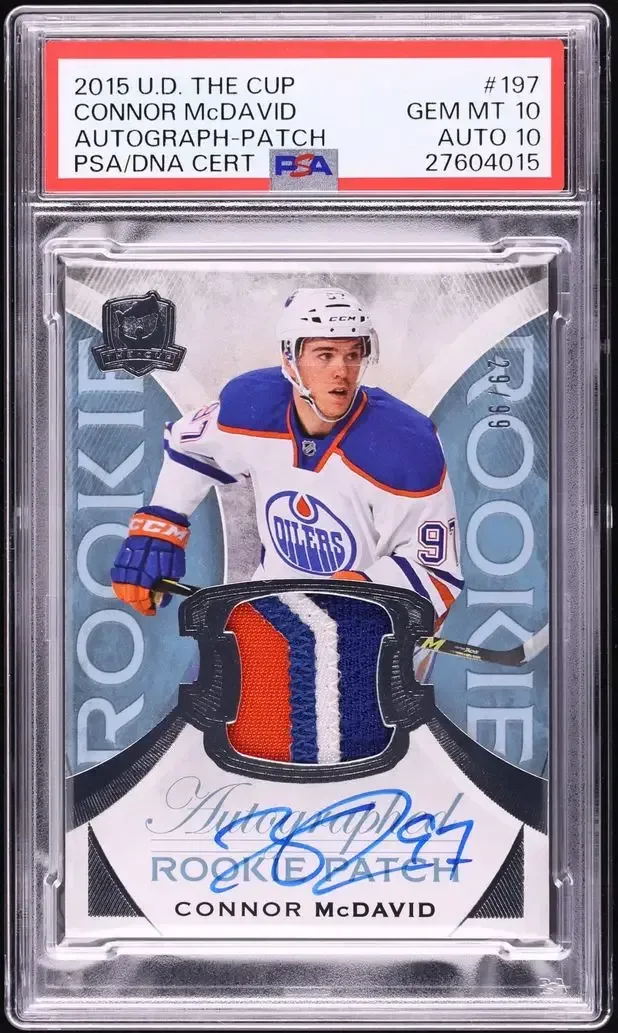
The other major part of the McDavid market consists of cards with explicitly limited production. Two examples are the 2015-16 SP Authentic Future Watch Autograph, numbered to 999, and The Cup Rookie Patch Autograph, numbered to 99. The notation “/999” or “/99” means the card was limited to that stated total. The latter also combines an autograph with a patch element, making it a materially different collectible from a base flagship rookie.
These cards should not be treated as interchangeable with a Young Guns PSA 10. There are far fewer copies, and they do not have thousands of examples ready to appear on a marketplace during a spike in demand. Lower supply does not guarantee a higher price or a sale at any particular moment. It does mean that a small number of committed bidders can have an outsized effect when very few copies are available.
That is why a career-defining accomplishment may have more staying power in rare rookie patch autographs than in a high-population flagship card. The thesis is not that every limited card will rise, nor that a title would make all variations equally desirable. It is that demand created by a legacy event has fewer immediately available copies to absorb it in a low-population segment.
Scarcity also comes with trade-offs. A heavily traded Young Guns has many recent sales for comparison. A rare card may have fewer public transactions, so establishing its current value can be more difficult. Collectors should not assume a gap between two sales represents a smooth upward line; it can just as easily reflect the fact that few examples changed hands.
What collectors can reasonably watch from here
- The scoring pace: McDavid’s present 2.89-points-per-game mark is extraordinary, but his rate through February will say more about whether the Gretzky conversation remains a live short-term driver.
- The broader market: The Young Guns gained 15% over three months even as collectors reported softer pricing across modern hockey cards. That makes it worth separating McDavid-specific momentum from the wider category’s direction.
- Transaction volume and recent completed sales: For the flagship card, a collection of completed PSA 10 sales is more informative than isolated listings.
- Which card segment is moving: A rise in the Young Guns does not prove the same outcome for numbered autograph or patch cards, and a rare-card sale should not automatically be applied to the flagship.
- Timing around major events: The Eichel example suggests that playoff anticipation and immediate post-win demand can be distinct from the market months later.
The clearest read is that McDavid’s cards are already responding to a season that has begun at an historic level. His $3,450 Young Guns PSA 10 sale on October 20 and its 15% three-month rise show that attention is not waiting for June. If he remains near the extraordinary scoring threshold required to sustain a Gretzky chase, that pursuit could dominate the near-term hobby narrative.
A Stanley Cup would still be the central legacy moment. It would complete the achievement collectors most want to see added to McDavid’s résumé. But the available market evidence points to a more nuanced outcome than “Cup equals every card permanently higher”: a well-supplied flagship rookie may surge around the event and later normalize, while lower-population autograph and patch rookies may be better positioned for demand that cannot be met quickly by fresh listings.