Opening a box that contains exactly one card removes every illusion of a leisurely break. There is no stack to sort, no middle stretch of commons, and no prospect of a modest consolation pull a few cards later. With 2025-26 Upper Deck Splendor, the entire experience rests on one encased card.
That is the point of this return. Splendor is due to arrive September 30 as a premium standalone hockey release for the first time in eight years. Every card is limited to 36 copies or fewer, and each comes slabbed in the pack. A QR code on the case is intended to identify what is inside. The 50-player checklist reaches from Wayne Gretzky and Mark Messier to contemporary stars including Connor McDavid, Alex Ovechkin and Auston Matthews, plus selected members of the 2025 rookie class.
The defining promise is straightforward: each card includes an on-card autograph, a game-used jersey patch, or both. The approach makes Splendor very different from a conventional release built around a wide base set and a smaller number of premium inserts. It is a deliberately narrow, high-end chase where scarcity, player selection and memorabilia are doing nearly all of the work.
What the one-card format actually means
A one-card box is exactly what it sounds like: a sealed box containing one trading card rather than a pack or a run of packs. It creates an unusually sharp outcome. A collector can land a signed relic of an all-time great, a limited rookie patch autograph, or a card that does not match their collecting focus. There are no extra cards in the box to soften that result.
For more context, explore Helldivers 2 Ironclad Democracy Warbond brings grenade launcher, missile pistol and anti-tank support.
The same applies to the term parallel. In trading cards, parallels are alternate versions of a design, often differentiated by color, finish, numbering or a combination of those traits. Splendor’s autographed base-card parallels include Black and White versions as well as Red numbered to nine, Green to eight, Gold to five and Black as a one-of-one. The slash-number notation tells collectors the stated production ceiling for that version: /5 means five copies, while /1 means a single copy.
Those figures explain the product’s appeal, but they are not a guarantee of financial performance. Low numbering is a statement about supply, not an automatic verdict on demand. The specific player, the visual appeal of the patch, the signature, card condition and the number of collectors chasing that subject will all matter when a card changes hands.
On-card signatures and game-used material lead the checklist
Splendor puts autographs at the center of its configuration. The base set uses both bordered and borderless signed designs, including the monochrome Black and White Autographs. More elaborate versions pair autographs with multi-color uniform material in the Showpieces Auto Relics line.
An on-card autograph is a signature written directly on the card stock, rather than on a sticker later applied to the card. That distinction is a major point of interest for many autograph collectors because the signature is integrated into the card itself. A patch auto, meanwhile, combines a signature with a swatch of memorabilia. In this release, the cited uniform pieces are game-worn, meaning they came from uniforms used in games.
The Showpieces Auto Pucks cards add another version of that formula by embedding game-used pucks alongside signatures. They are numbered to five or fewer. It is a practical example of how Splendor makes the relic itself part of the card’s visual identity rather than treating memorabilia as a tiny accent.
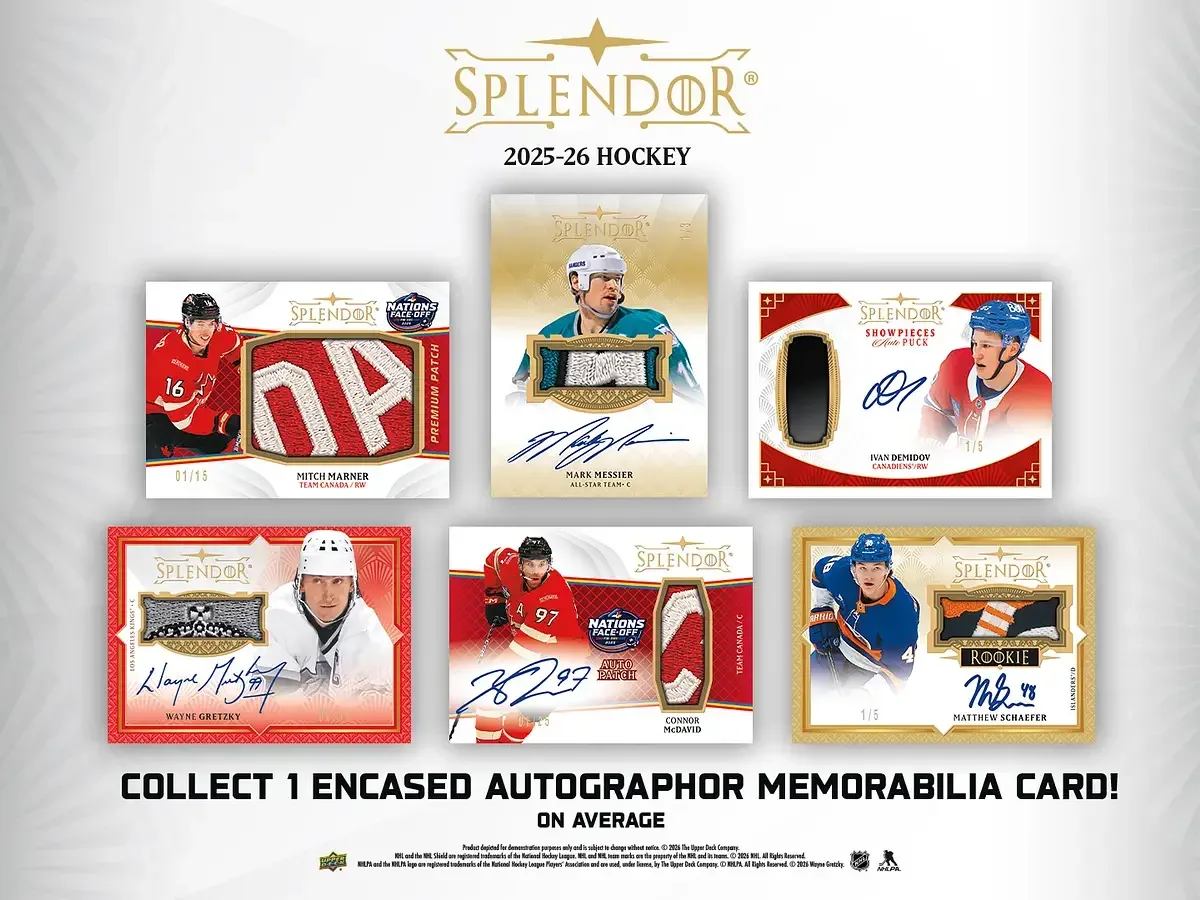
Gretzky provides one of the clearest examples. A highlighted card combines his full-name autograph with a three-color patch from his black-and-silver Los Angeles Kings uniform. For collectors who value a recognizable visual link between player and relic, a multi-color patch can be more evocative than a single-color fabric square. It does not prove that one patch is universally more valuable than another, but it can make the card more distinctive.
Matthews is also among the featured stars, with a Gold patch-auto parallel numbered to five. The star-heavy player mix appears intentional: this is not presented as a deep roster product intended to cover every level of an organization. It concentrates on recognizable names from several generations.
Rookies get the premium treatment
The product includes 10 rookies from the 2025 class through Rookie Autographed Patches, with multiple parallels including one-of-one editions. High-end signed rookie cards occupy a different lane from the widely collected Young Guns cards in Upper Deck’s flagship releases. The latter are generally a familiar entry point for rookie collectors; Splendor’s rookie offerings are lower-numbered, signed and memorabilia-driven alternatives.
Matthew Schaefer heads that group. The 19-year-old was the unanimous Calder Trophy winner, reached 20 goals and 50 points as a defenseman at a record-setting young age, and is featured on a Rookie Patch Auto containing orange-and-white striping from a navy Islanders jersey. The combination is tailored to what premium collectors frequently seek: a rookie designation, a direct autograph, limited production and a visually substantial uniform fragment.
Ivan Demidov is another key rookie inclusion. He led rookies with 62 points, made up of 19 goals and 43 assists, and was a unanimous All-Rookie Team selection. His Splendor cards appear in several autograph and memorabilia insert lines, using material from his red sweater or a puck he handled in a game.
There is an important collecting distinction here. A card’s rookie status does not make it a conventional flagship rookie card, and it does not settle questions about long-term demand. What it does give Splendor is a high-end rookie category for collectors who prefer scarce autographed relics to mass-collected rookie issues. For Schaefer and Demidov collectors, that makes the release a focused option rather than a replacement for every other rookie-card format.
4 Nations memorabilia gives the release a specific event hook
Beyond NHL uniforms, Splendor draws from the 4 Nations Face-Off. Event-used memorabilia gives a card a connection to a defined tournament moment instead of a player’s club identity alone.
Connor McDavid’s Auto Patch card is a prominent example. It uses an oversized red-and-white section containing the “C” from the word Canada on his jersey. McDavid scored the overtime winner that earned Canada the tournament crown, so the item links a marquee player to a memorable competitive moment. That connection is why event memorabilia can carry a different kind of appeal from a standard club-jersey relic: the patch is part of a particular visual story.
The announced 4 Nations Dual Patch Auto concept takes that a step further. A dual auto features signatures from two players on a single card; a dual-patch auto adds memorabilia from both as well. The full checklist had not yet been released, but Matthew and Brady Tkachuk are featured together with jumbo Team USA patches in red, white and navy.
For collectors, a dual card has an obvious practical complication as well as an attraction. It can appeal to fans of either player, collectors of the pair, national-team collectors and people who value a specific tournament theme. At the same time, its desirability will depend heavily on the pairing. The Tkachuk brothers have a ready-made relationship that makes their shared card more coherent than a random two-player combination.
Past sales offer context, not a price guide
Earlier Splendor cards show why the product commands attention in the high-end market. A bordered one-of-one McDavid autograph sold for $7,791 in March 2022. A PSA 10 McDavid three-color patch auto brought $5,000 in September 2024. A Jaromir Jagr base patch auto more recently sold for $1,112, while a black-and-white Ovechkin card signed in gold marker sold at auction for $877.
Gretzky-McDavid dual autographs illustrate the value of player pairing. Twelve signed cards from the 2017 release had reached the market, with raw copies selling between $2,750 and $3,000 and graded examples surpassing $4,000. In card collecting, raw means ungraded, while a graded card has been evaluated and assigned a condition grade by a third-party grading company. PSA 10 denotes the top grade from PSA in the cited McDavid sale.
These are individual historical sales, not a prediction for the 2025-26 product or a fixed benchmark for every comparable card. A one-of-one, a three-color patch, a signature style and a card’s grade can all produce major differences even when the featured player is the same. Auction timing and the availability of comparable cards also affect realized prices.
The useful lesson is narrower: Splendor has previously produced meaningful sales for its highest-profile McDavid, Gretzky, Jagr and Ovechkin cards. The new edition continues the ingredients behind those results—tight serial numbering, direct signatures, game-used material and elite names—while placing the 2025 rookie class and 4 Nations relics alongside established stars.
Who this release is built for
Splendor is best understood as a targeted premium product, not a broad set-building project. A collector who wants the most cards for a budget, a full team checklist, or a large rookie roster will find its one-card design restrictive. Someone seeking a single dramatic display card—especially an autograph-and-relic combination tied to a favorite star, rookie or tournament—will see the appeal more clearly.
The slabbed packaging is another practical feature. Encapsulation gives the card a uniform presentation and a degree of physical protection from immediate handling. It should not be confused with a condition grade: the supplied details say the cards are slabbed in the pack, while grading is a separate assessment process.
With a 50-player checklist and every card capped at 36 copies or fewer, the central question is not whether there will be scarcity. There will. The question for prospective buyers is whether the potential player, relic type and one-card experience align with their own collection. Splendor’s return is built around the highest-end version of that decision: one opening, one card, and a considerable amount riding on it.