Upper Deck’s 2025-26 Stature is scheduled to arrive on October 28, 2026, continuing a premium hockey-card line built around a deliberately compact premise: a 100-card checklist, thick card stock, foil-heavy designs, hard-signed autographs and game-worn patch material.
That restraint is meaningful in a premium-card landscape where a single product can contain a tangle of insert names, mini-subsets and variations. Stature instead puts its principal chase elements at the center of the design. Collectors can pursue established NHL talent, retired stars and rookies through the same visual language, then move upward through numbered color parallels, autograph versions, patch cards and signed patches.
The product does not promise that every box will contain a particular star or rookie. It does, however, specify a five-card, single-pack configuration with a defined high-end component: every box includes one autograph, patch or patch-auto card, alongside two numbered parallels, a base veteran card and a numbered base rookie or legends card. That gives the release a relatively direct box-opening structure while preserving the uncertainty that separates a solid pull from a truly scarce one.
A 100-card checklist with three collecting lanes
Stature’s base set is divided into 50 established NHL players, 15 legends and 35 rookies. Each card uses a shimmering foil border around the player image, maintaining a consistent look rather than splitting the core set into radically different styles.
For more context, explore 2026 Gotham Nominations Put ‘Clarissa,’ ‘The Invite’ and Three More Films in a Four-Way Spotlight.
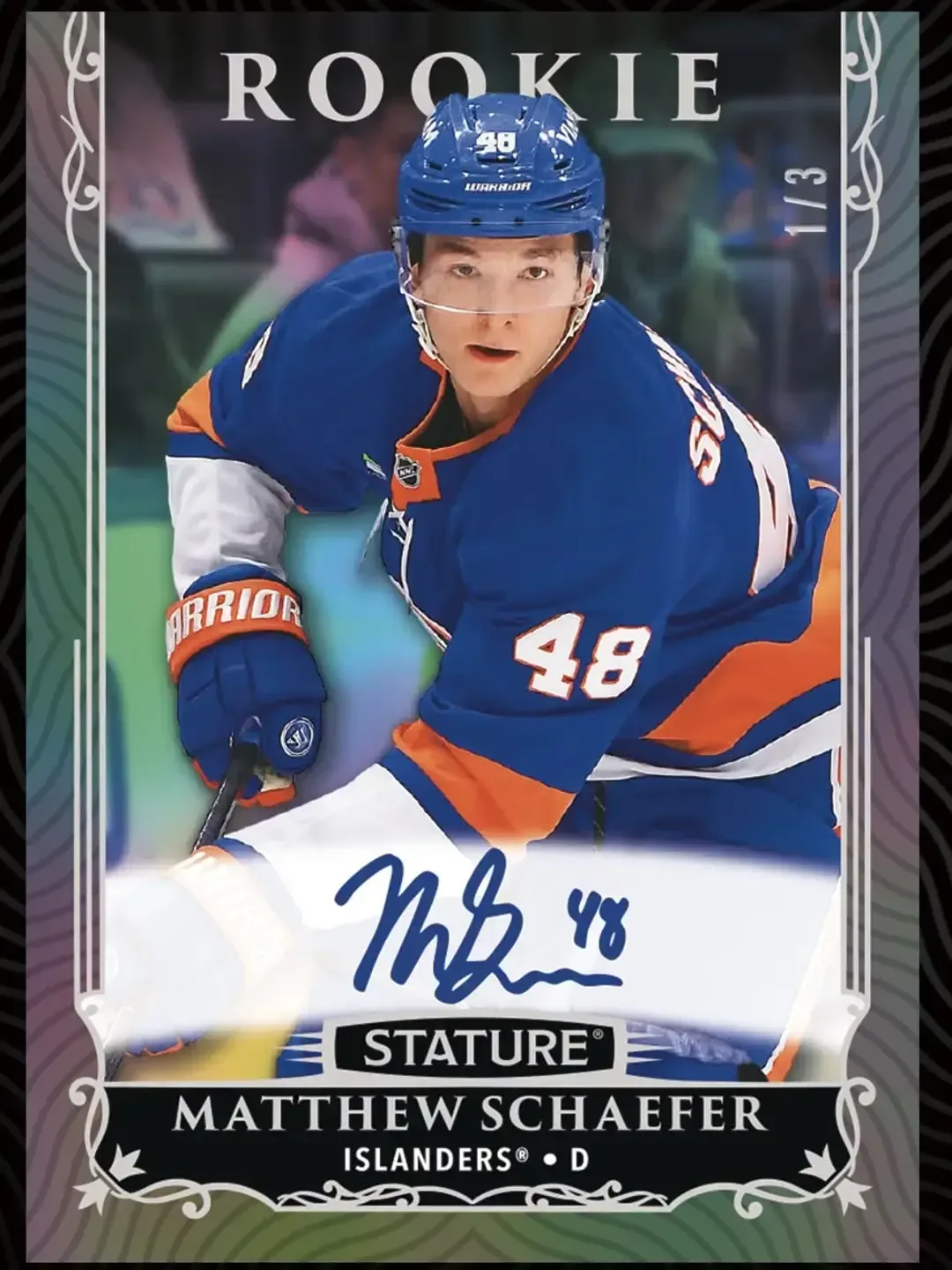
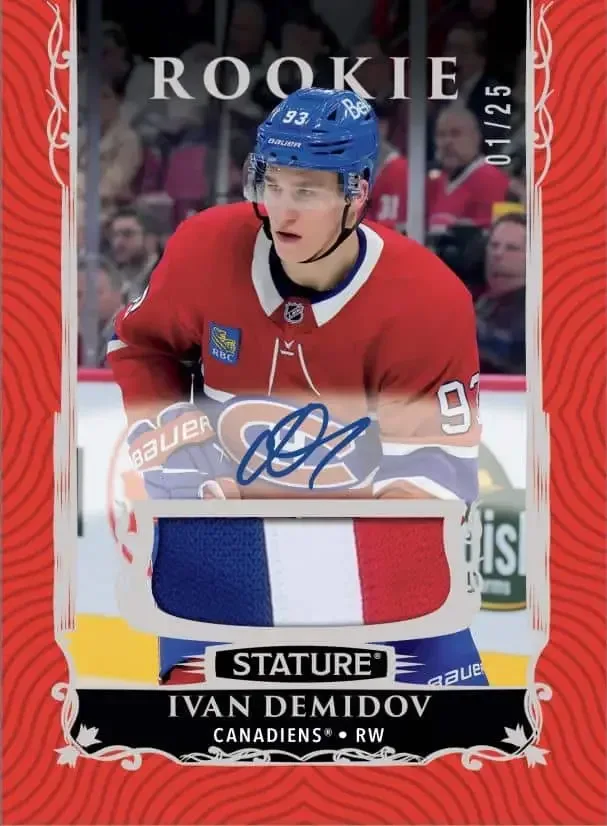
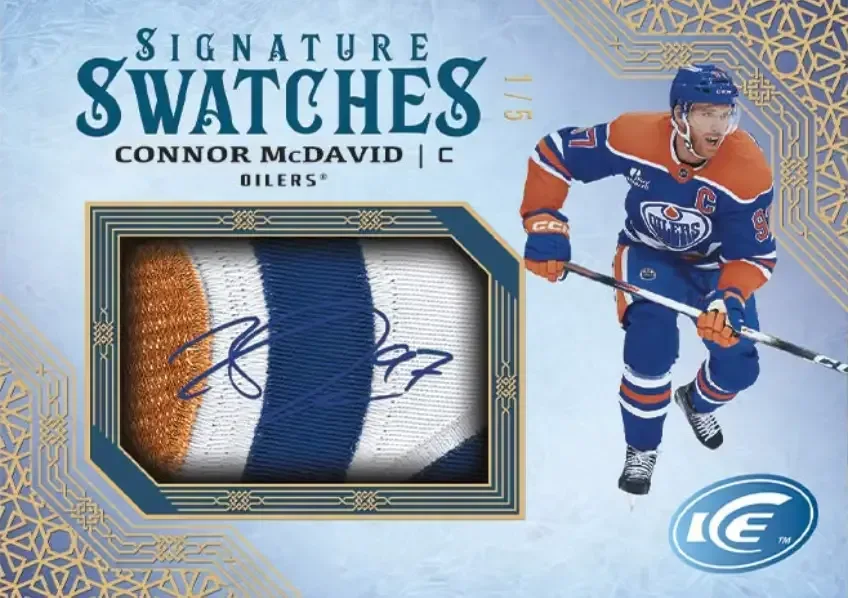
Connor McDavid is among the veteran names, while Mario Lemieux and Joe Sakic are included in the legends group. The legends base cards are numbered to 999. The rookie section is also limited to 999 copies per card and is led by New York Islanders defenseman Matthew Schaefer and Montreal Canadiens winger Ivan Demidov. Demidov led NHL rookies with 62 points, while Schaefer enters the set after a Calder Trophy campaign.
For collectors, a base card numbered to 999 is not the same thing as a rarity guarantee. It is the starting point of a hierarchy. Serial numbering means a card is individually marked with its place in a limited print run, expressed in hobby shorthand as “/999,” “/25” or similar. A card numbered 14/25, for example, is one of 25 copies. That concrete cap is a central part of the appeal for collectors who prefer defined scarcity over an unnumbered parallel with an unknown supply.
The base parallel ladder
The seven base-card color parallels provide the product’s main rainbow-building challenge:
- Green: numbered to 349
- Red: numbered to 249
- Orange: numbered to 199
- Blue: numbered to 99
- Gold: numbered to 50
- Purple: numbered to 25
- Black: numbered to 10
A rainbow is a collector’s term for assembling multiple versions of the same player card across its colors and serial-number tiers. It can be an attainable long-term project at the higher-numbered Green, Red and Orange levels, or a formidable pursuit when the goal expands to Purple and Black copies. The challenge is not merely finding a low-numbered card; it is locating every color for one player, often after cards have spread among different collectors.
That structure lets collectors approach the release in different ways. A fan focused on Beckett Sennecke can aim for a numbered rookie parallel without treating a complete rainbow as mandatory. A Sidney Crosby collector, on the other hand, may see a Black parallel limited to 10 as a major target even without chasing the rest of the colors. Stature’s format makes these collecting decisions easy to understand because the color hierarchy is repeated across the product.
Hard-signed autos keep the base design in view
Stature’s autograph cards are not presented as a visually unrelated detour from the base set. They use the base-card design with signatures added directly to the card. These are hard-signed autographs, meaning the player signed the card itself rather than signing a separate sticker later attached to the surface.
The standard autograph versions are unnumbered. Collectors looking for more limited signed cards can pursue another seven-color ladder:
- Green Auto: numbered to 199
- Red Auto: numbered to 99
- Orange Auto: numbered to 50
- Blue Auto: numbered to 25
- Gold Auto: numbered to 10
- Purple Auto: numbered to 5
- Black Auto: numbered to 3
The distinction between an autograph and a numbered autograph matters. Both offer the signature, but the color parallel creates an additional scarcity layer. A McDavid Purple Auto is limited to five copies, while a Schaefer Black Auto is capped at only three. Those are the kinds of cards that make a focused player collection significantly harder to complete, because demand can come from autograph collectors, player collectors, team collectors and collectors pursuing the full color sequence.
There is also a practical appeal in keeping the autograph subset close to the base design. A collector who likes the look of a particular rookie card does not have to shift to a completely separate insert design to acquire that player’s signed version. The visual continuity helps Stature feel like one product rather than a bundle of unrelated mini-releases.
Game-worn patch cards and the RPA ceiling
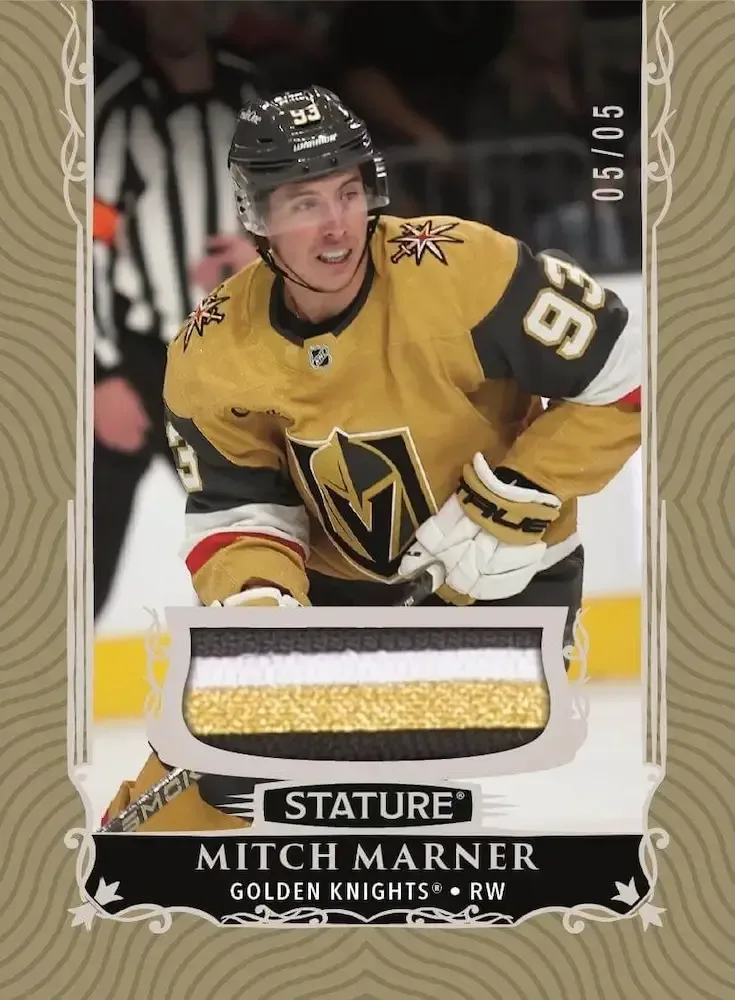
Memorabilia cards are the other major pillar of 2025-26 Stature. The release includes patch cards using game-worn material, including material tied to first-year players. The standard patch cards are numbered to 49, then become more limited through their own parallel sequence:
- Green Patch: numbered to 35
- Red Patch: numbered to 25
- Orange Patch: numbered to 15
- Blue Patch: numbered to 10
- Gold Patch: numbered to 5
- Purple Patch: numbered to 3
- Black Patch: one-of-one
A one-of-one, often written as 1/1, is the sole serial-numbered copy of that specific version. It does not automatically establish a market value, since player demand, card condition, patch appearance and timing all matter. But it does establish a simple fact: another identical Black version cannot be found in the product.
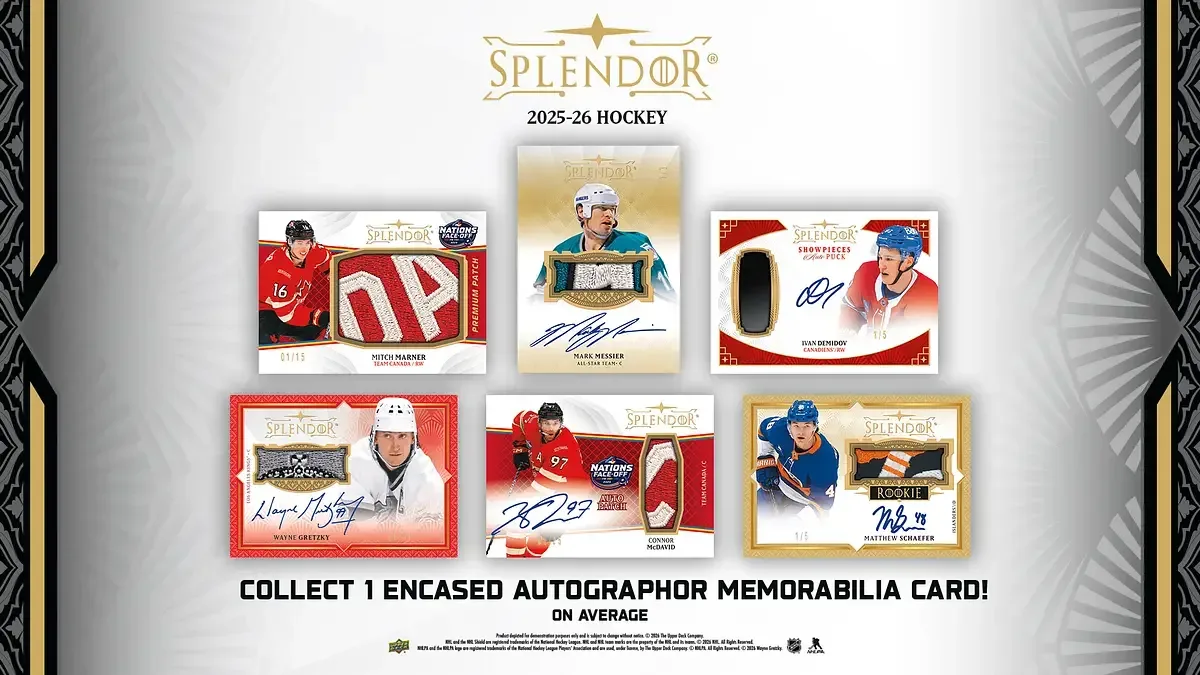
The largest potential pulls are the autograph patch parallels, commonly abbreviated by collectors as RPAs when they feature a rookie. An RPA combines a player signature and a patch swatch on the same card. The format condenses several major hobby interests—rookie status, autograph, memorabilia and low numbering—into one piece.
A Red autograph patch of Demidov, for instance, would be numbered to 25, and its red border visually aligns with the Canadiens’ home colors. This is a small but useful design detail: a parallel can function as both a rarity tier and a color match for a player’s uniform, giving some versions aesthetic appeal beyond the serial number alone.
Recent sales show why the top tier gets attention
Previous Stature results illustrate why collectors will likely pay particular attention to low-numbered rookie patch autos in the new release, while also underscoring that not every card carries that kind of value.
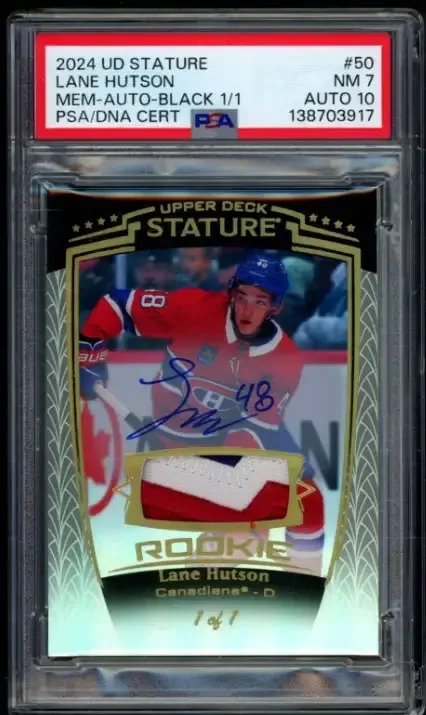
A one-of-one Black RPA of Lane Hutson from the prior Stature release sold for $12,064 in a PSA 7 grade. Connor Bedard’s Update RPA from that release sold for $10,370 at auction in the spring. Macklin Celebrini’s three-color Red RPA, numbered to 25, sold for $7,114 in June, while a Blue version numbered to 10 sold for $6,962.
Those transactions are specific historical sales, not a prediction for the 2025-26 cards. The gap between two Celebrini parallels also offers a useful reminder about card-market interpretation. A smaller print run does not mechanically mean a dramatically higher price every time. Patch quality, the visual presentation of the individual card, buyer competition and the particular moment of sale can all influence an auction result. A three-color patch may also attract attention beyond the number printed on the card.
For collectors deciding what to chase, Stature’s clearest strengths are its defined structure and the availability of several routes through the same checklist. Build a player rainbow. Target legends such as Lemieux or Sakic. Focus on hard-signed autographs. Hunt game-worn patches. Or narrow the search to rookie RPAs of Schaefer, Demidov or another first-year player.
None of those paths eliminates the luck inherent in sealed boxes, and the stated box configuration should not be mistaken for a promise of a particular name, color or card type. Still, the product makes the menu understandable: five cards per box, two numbered parallels, and one autograph, patch or autograph-patch hit. For a high-end release, that clarity is a feature in its own right.