2025-26 Upper Deck ICE Hockey is scheduled to arrive September 23, 2026 with a drastically more concentrated format than prior ICE releases. Instead of a 72-card box, the hobby-exclusive product is built around a single eight-card premium pack. That makes every card carry considerably more weight in the opening experience—and makes a clear understanding of the advertised box makeup more important before collectors commit.
The central attraction is Ice Premieres, the long-running rookie-focused portion of the ICE identity. Each box is expected to contain one Ice Premieres card from either Level 4, numbered to 999, or Level 3, numbered to 499. The remaining cards can include base cards, inserts, autographs, memorabilia pieces and patch-autograph combinations. All autographs in the release are hard-signed, meaning the player’s signature is written directly onto the card rather than applied on a signed sticker.
For a set whose visual character revolves around acetate, crystal-like effects and ice-themed treatments, the new configuration is a major change in how collectors will encounter it. There are fewer cards per box, but a much higher concentration of premium-style card types. That does not make every box equivalent in content or desirability; rather, it creates a product where the specific rookie, serial number, parallel and autograph or memorabilia element are likely to matter enormously.
A premium format built around eight-card outcomes
Every 2025-26 ICE Hockey box contains one pack of eight cards. On average, that pack includes two base cards and one Ice Premieres card from Level 4 or Level 3, leaving five additional slots for the product’s other possible content. Those possible pulls include autographs, inserts, patches and patch-autographs.
“On average” deserves attention here. In card collecting, it signals an expected product-wide distribution, not a promise that every individual pack will follow the same pattern beyond the stated average. The product description identifies the Level 4 or Level 3 Ice Premieres card as the expected rookie component, but it also frames the other five cards as a mix of possible outcomes. A collector hoping for a specific star, low-numbered parallel or autograph should treat those as chase targets, not assumed box contents.
The base set is split evenly between 100 established NHL players and 100 rookies arranged over four tiers. The veteran half includes at least two players from every NHL franchise. This gives the release a conventional 200-card foundation, but the one-pack configuration means ICE is not positioned as a traditional base-set-building box break. It is better understood as a premium hit-oriented opening where base cards establish a floor and the other cards provide the major points of variation.
Acetate is a transparent or semi-transparent plastic card stock, often valued for its clean appearance and distinctive feel. It can be visually striking, especially when paired with foil, layered printing or crystal effects, but collectors may want to handle it carefully to avoid surface marks. ICE’s design language has long leaned into that polished, frozen presentation, and the named insert families continue that approach.
Ice Premieres remains the rookie chase
Ice Premieres is the release’s defining rookie program. Its tier structure gives collectors a direct hierarchy of stated print runs: lower-numbered levels are scarcer than the entry levels, while parallels and autograph or memorabilia versions add further layers.
Related coverage includes 2025-26 Upper Deck ICE Hockey Brings a Premium Format and Big Rookie Appeal.
- Level 4: numbered to 999
- Level 3: numbered to 499
- Level 2: numbered to 249
- Level 1: numbered to 99
- Gold parallel: numbered to 25
- Champagne Gold parallel: one-of-one
- Autograph parallel: numbered to 199 or 299, depending on player
- Gold autograph parallel: numbered to 25
- Jersey parallel: listed at one in three packs
- Patch parallel: numbered to 25
- Autograph jersey parallel: numbered to 35
- Autograph patch parallel: numbered to 10
A parallel is an alternate version of a card, generally distinguished by a different finish, color, serial number, autograph, jersey swatch or patch. A serial number such as “/25” denotes that 25 copies of that particular version were produced. A one-of-one is the sole stated copy of its version. Scarcity is therefore visible in the numbering, but scarcity alone does not settle a card’s appeal: the player, rookie status, signature, memorabilia element and condition can all affect how collectors view it.
The set’s rookie conversation is expected to include Matthew Schaefer, Michael Misa and Ivan Demidov, among others. The product material also identifies Schaefer as a Calder Trophy winner and Demidov as a runner-up. For collectors focused on newer players, Ice Premieres offers several possible paths: a higher-numbered tier for an accessible serial-numbered rookie, a lower-numbered Level 1 or Gold version for greater scarcity, or an autograph and memorabilia variation for a more elaborate card.
The practical distinction is important. A collector who simply wants a numbered rookie of a favorite player may have a much wider target pool than someone specifically pursuing a patch autograph numbered to 10. ICE Premieres spreads the rookie chase across multiple formats rather than concentrating it in a single “best” card. That creates variety, but it also means buyers should decide which version actually fits their collection before opening or pursuing singles.
Five card families worth understanding
1. Ice Premieres autograph and patch versions
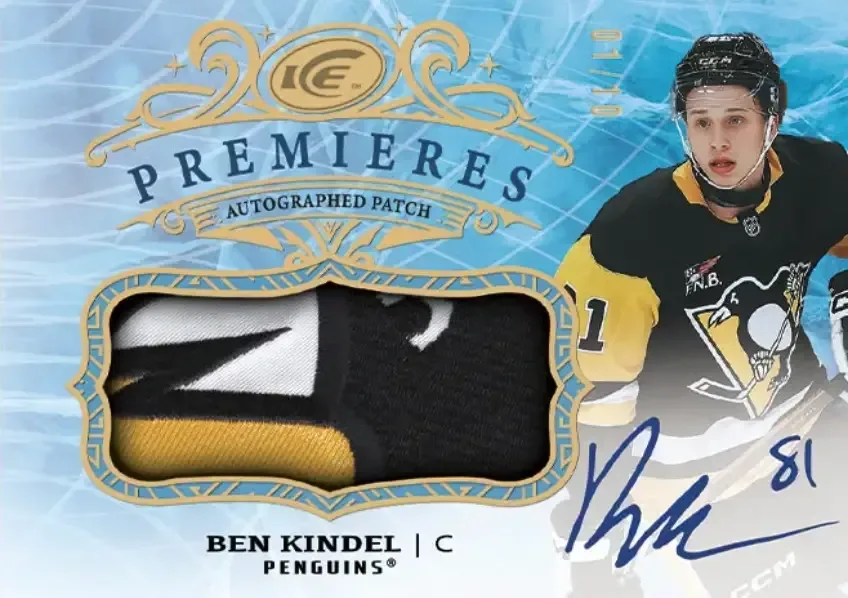
The highest-ceiling Ice Premieres variations combine the rookie format with hard signatures and memorabilia. The autograph patch parallel is numbered to 10, while autograph jersey cards are numbered to 35 and standalone patch parallels are numbered to 25. A Ben Kindel Ice Premieres Auto Patch card numbered to 10 has been previewed as an example of this direction.
These formats bring multiple collecting signals together: rookie designation, a limited print run, a signature and a patch. No individual player’s card is guaranteed to carry the same demand, and the supplied configuration does not establish specific player-by-player odds. Still, the structure makes clear why these cards sit at the top of many collectors’ ICE wish lists.
2. Fire & Ice
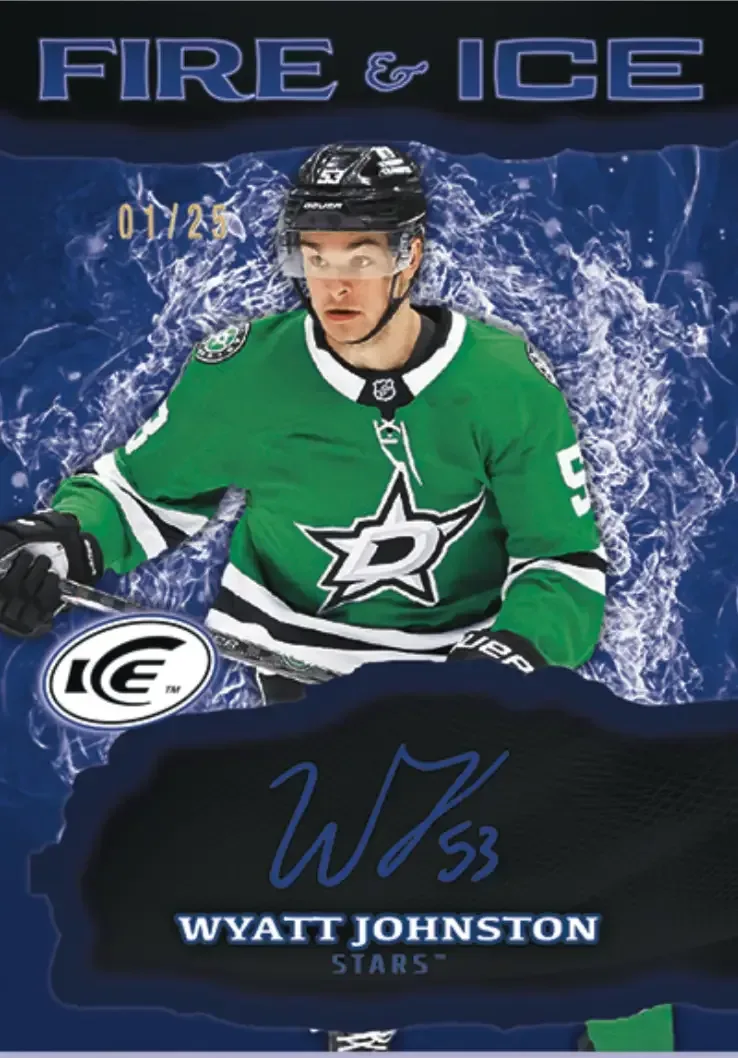
Fire & Ice turns the product theme into a deliberate visual contrast. The line includes icy versions and fire-themed versions, with some players appearing in both and others appearing in only one. Cards in the family are numbered to 25, 99 or 199 depending on the player and version; an autograph example of Wyatt Johnston numbered to 25 has been shown.
This is more than a simple color change. Having two themed variants allows collectors to pursue a preferred aesthetic, while the split player selection means a checklist matters as much as the concept. Anyone chasing a particular athlete should confirm which version or versions that player receives rather than assuming every name exists across both themes.
3. Signature Swatches
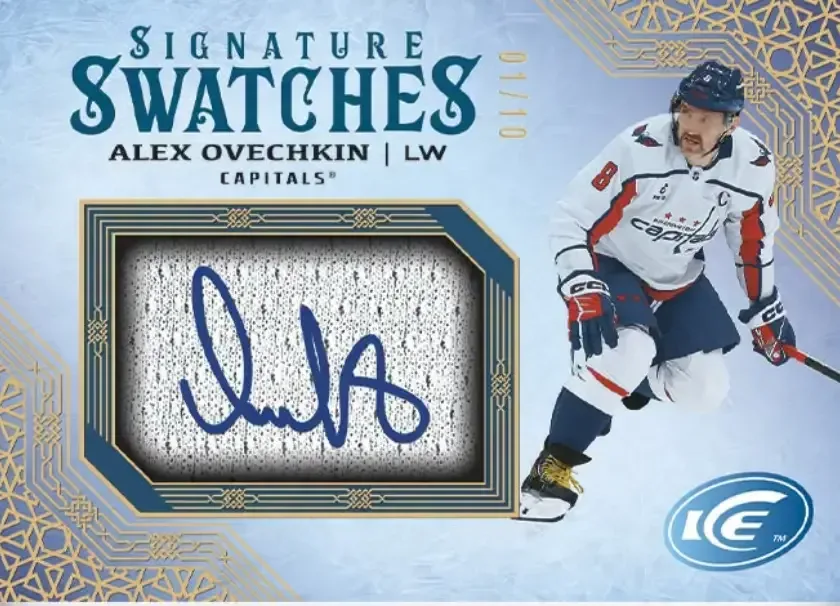
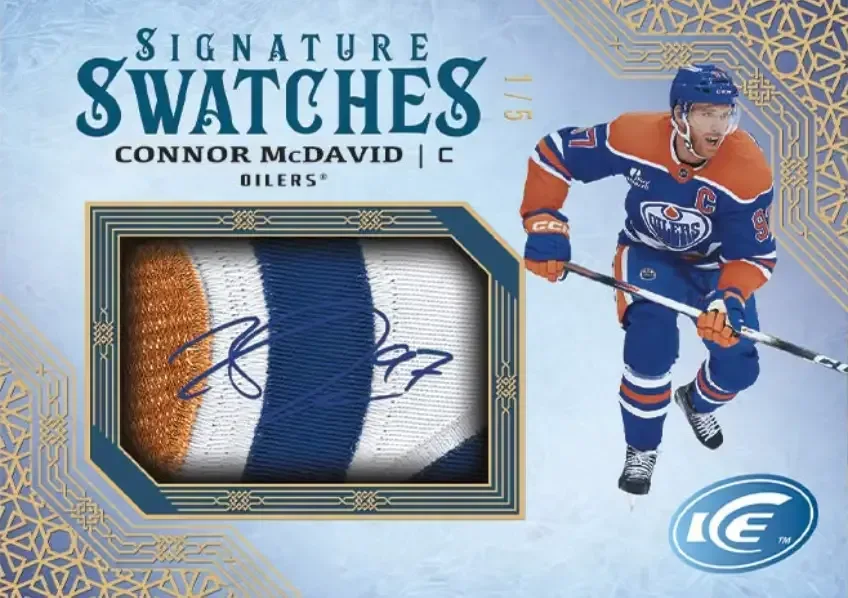
Signature Swatches combines on-card signatures with an action-photo presentation and snowflake-style design elements. Numbering varies by player and parallel, with stated quantities of 5, 10, 15, 25, 49 and 99. Previewed examples include a Connor McDavid autograph numbered to five and an Alex Ovechkin patch autograph numbered to 10.
The checklist reaches across established stars and newer names. McDavid, Ovechkin, Tage Thompson, Connor Hellebuyck and Cutter Gauthier are among the featured players, alongside Schaefer and Demidov. The wide numbering range means “Signature Swatches” is not one uniform level of rarity. The exact suffix—whether /99, /25 or /5—changes the stated supply substantially, so collectors should evaluate the full card description rather than relying only on the insert title.
4. Black Ice
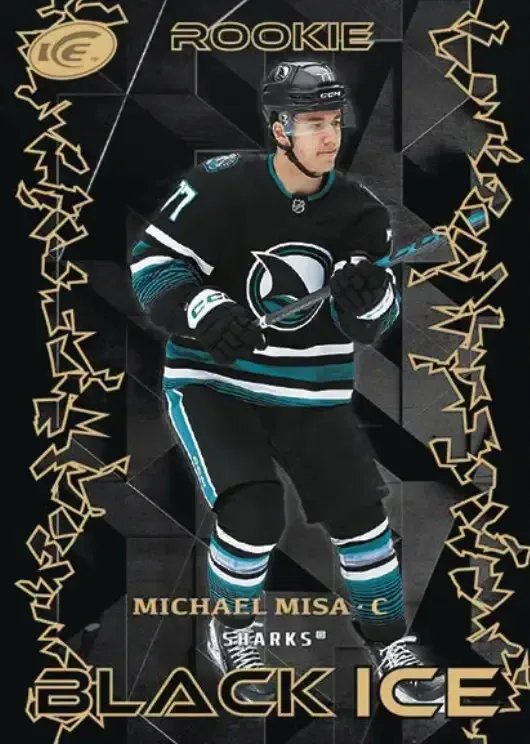
Black Ice is a 60-player insert set divided into 30 veterans and 30 rookies. Veteran Black Ice cards are listed at one per six packs, while rookie versions are listed at one per three packs. Gold Spectrum parallels are numbered to 25. Michael Misa has been previewed on a Black Ice rookie card.
Those separate rates are especially notable in a one-pack box format. The listed rookie Black Ice rate is more frequent than the veteran version, but neither rate says which individual player will appear. The Gold Spectrum parallel adds a clearly defined low-numbered target for collectors who favor the Black Ice design but want a scarcer version.
5. Exquisite Crystal
Exquisite Crystal supplies one of the release’s clearest acetate-driven concepts: players are presented over a crystal-style background. Connor Bedard has been previewed in the set. While the available details establish the design direction, they do not provide print runs or pull rates for Exquisite Crystal, so collectors should avoid assuming a scarcity hierarchy that has not been specified.
That uncertainty does not make the cards less interesting. It simply separates visual appeal from confirmed rarity. For collectors who value the ICE look itself—transparent stock, shine and unusual presentation—Exquisite Crystal may be a design-first chase rather than a numbers-first one.
What the format means for collectors
The shift from 72 cards to eight makes 2025-26 ICE Hockey a notably different proposition from a box designed for volume. A collector can no longer expect a large stack of base cards and a gradual sequence of inserts. Instead, the box is an abbreviated premium opening where a handful of cards determine the entire result.
For player collectors, that makes singles a particularly straightforward option once cards begin circulating: a targeted purchase avoids the uncertainty of trying to land one named rookie or veteran from a single premium pack. For sealed-box collectors, the attraction lies in the possibility of a hard-signed autograph, a patch card or a lower-numbered Ice Premieres variation appearing alongside the expected cards. Neither route guarantees value or a desired card; they simply serve different collecting goals.
Condition also deserves extra consideration with acetate and premium finishes. Transparent edges, reflective surfaces and layered treatments can make flaws more noticeable. Careful handling, appropriate sleeves and rigid protection are sensible from the moment a card is pulled. That is practical preservation rather than a statement about grading outcomes, which depend on the individual card and the standards of a chosen grading company.
For collectors following card releases in other sports and games, the broader hobby calendar also includes products such as the Pokémon World Space Week TCG accessories initiative. ICE, though, is firmly aimed at hockey collectors looking for a compact opening with a pronounced rookie and autograph focus.
The clearest takeaway is that 2025-26 Upper Deck ICE Hockey is built around selective chasing, not bulk accumulation. Ice Premieres provides the release’s deepest ladder of rookie variants; Signature Swatches and Fire & Ice add premium thematic alternatives; Black Ice offers a defined 60-player insert structure; and Exquisite Crystal leans fully into the acetate aesthetic. Collectors who identify a player, tier or insert family before buying will have the most precise way to navigate the product’s much smaller, much more consequential eight-card format.