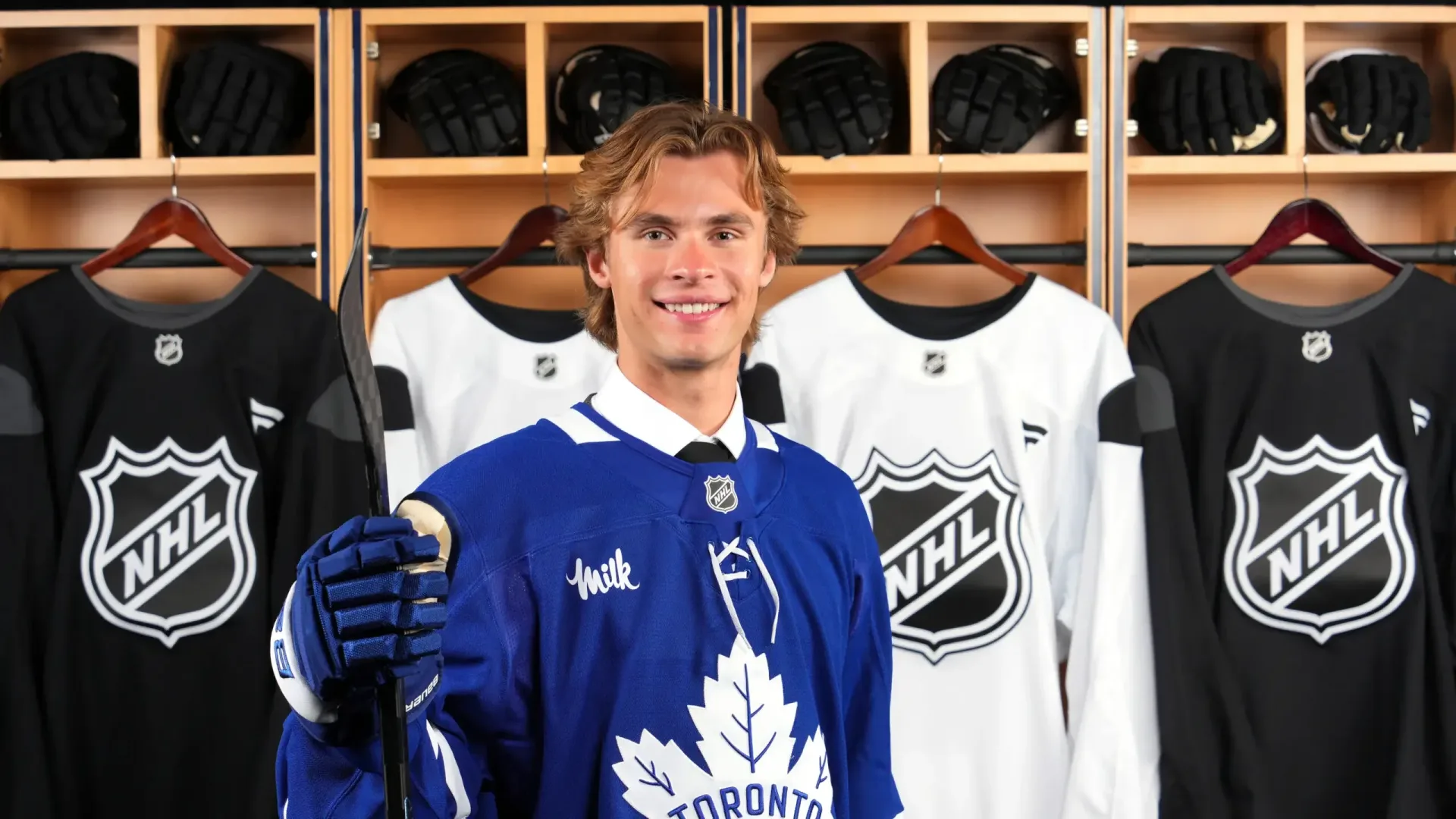
The 2026-27 NHL rookie class gives hockey-card collectors several different kinds of stories to follow. There are recent top draft selections with enormous expectations, players whose first NHL appearances have already provided a useful early checkpoint, and prospects whose existing cards are rooted in college, junior, European or AHL play rather than an NHL uniform.
That distinction matters. “Rookie card” is often used as shorthand for a player’s earliest meaningful pro or major-league collectible, but the available cardboard trail is not identical for every prospect. One player may have a Young Guns card already listed in an upcoming flagship release, another may be making a first pro-card appearance in MVP, while a third is represented for now only by cards from Sweden, Finland, college or Canadian junior hockey.
The practical opportunity is not to treat all 10 names as interchangeable. Collectors who enjoy a draft-to-NHL arc may want to follow newly selected players before their major NHL issues arrive. Those who prefer evidence of immediate NHL readiness have a smaller group to watch, including Anton Frondell, Jacob Fowler and Cole Hutson. And for collectors who simply enjoy building a player timeline, pre-NHL releases can be every bit as important as the eventual flagship rookie.
Recent attention around Connor Bedard and Macklin Celebrini illustrates why the rookie market creates such anticipation. Bedard arrived as Chicago’s first overall pick in 2023, while Celebrini followed as the 2024 first overall selection and a projected cornerstone for San Jose. That interest does not guarantee a comparable outcome for any newer player, but it does explain the intensity around high draft positions, expected Young Guns appearances and the first cards carrying an NHL identity.
For more context, explore Solseed: Journey to Spring Grows Into a 42-Screen ZX Spectrum 128K Quest.
What to watch beyond the headline
Draft position is one useful signal, not a completed scouting report. A first overall selection naturally has visibility, but collectors can also watch production, the league in which that production occurred, NHL games already played, and a player’s projected role. A forward producing at the NCAA level presents a different developmental picture from a defenseman in Finland or a goaltender establishing himself through the AHL.
It is also worth separating availability from upside. A card can be available now because it was issued in a junior, college or overseas set. That does not make it the same thing as a player’s expected NHL rookie release. Conversely, a future product listing creates something for collectors to monitor, not a finished card to assess. Release details described as expected should remain just that: expected, until the product arrives.
For physical collectors, condition and format remain part of the decision. A player can appear across base cards, time-sensitive releases, stickers and sets tied to a previous league or uniform. Rather than chase every issue automatically, it helps to decide whether the goal is a first-card chronology, an NHL-uniform collection, a particular manufacturer’s set, or simply a favorite team’s young core. That focus can make a fast-moving rookie cycle much more manageable.
Related coverage includes 10 NHL Rookies Collectors Should Watch Ahead of the 2026-27 Season.
Collectors interested in the broader mechanics of looking after a physical collection should keep the same simple priority in mind throughout a rookie chase: buy and retain cards because the player, the team connection or the card itself is meaningful to you—not because projected future performance is certain. The on-ice results that make a prospect exciting can change quickly.
The 10 rookie stories to follow
Gavin McKenna, Toronto Maple Leafs
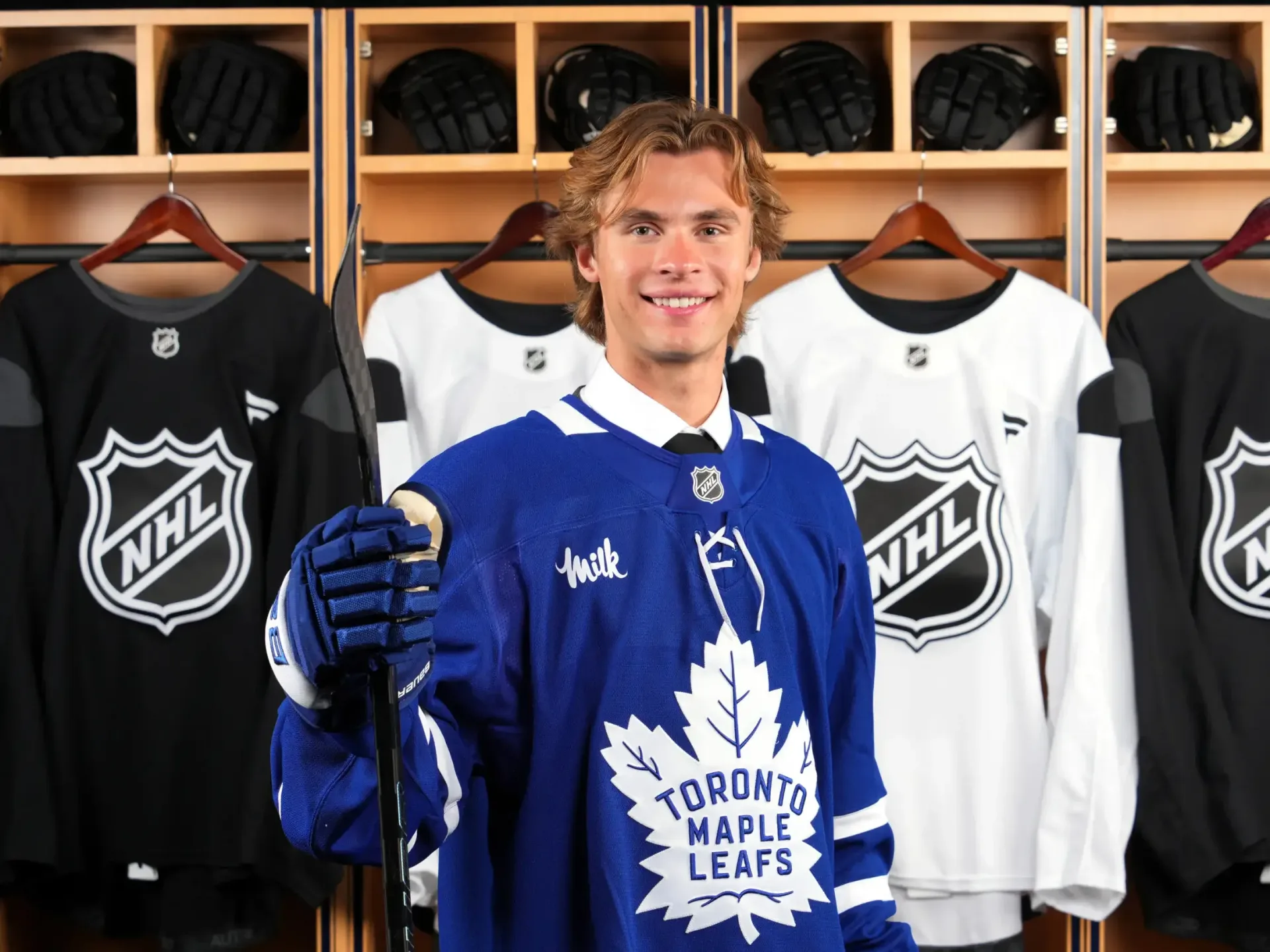
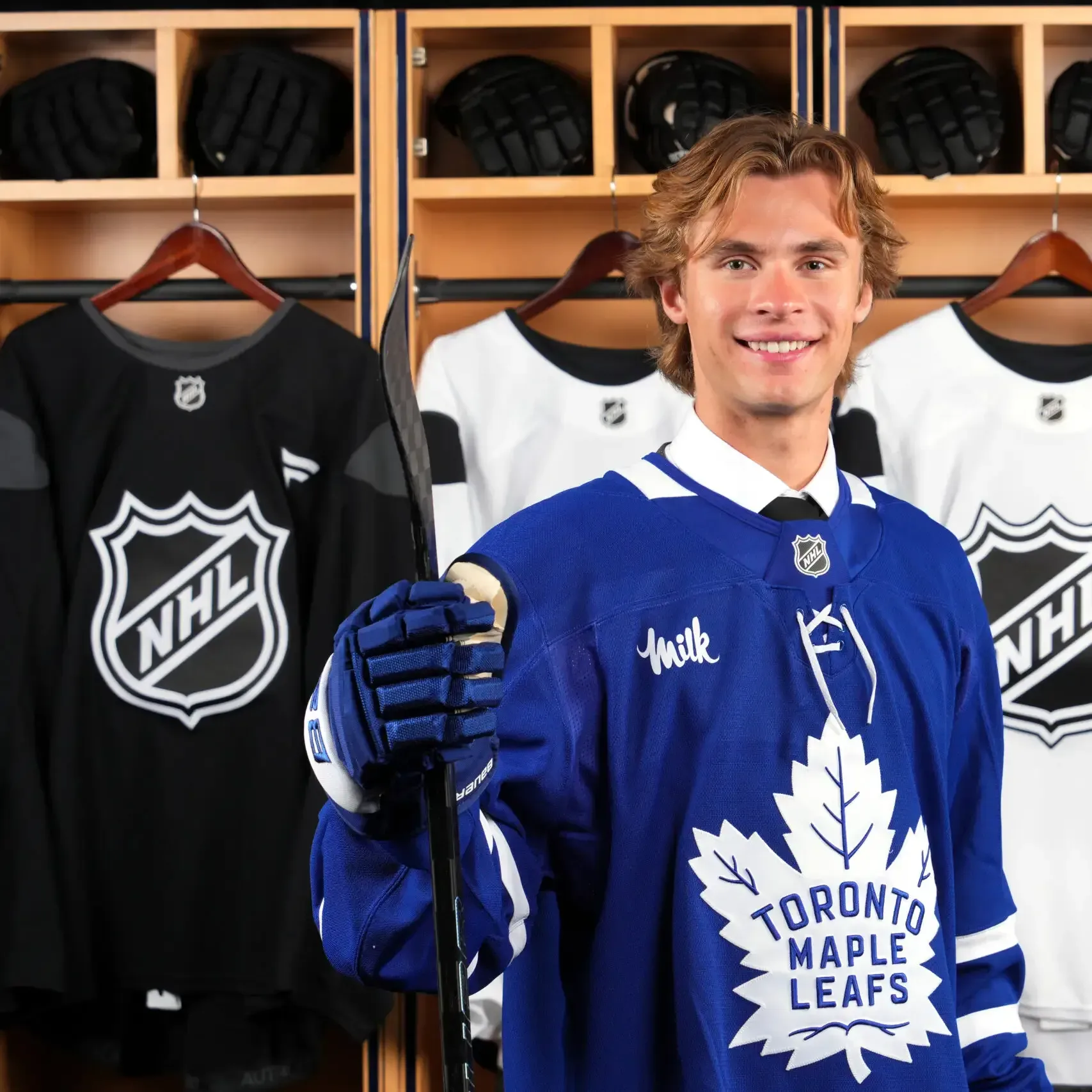
Gavin McKenna enters the season with the clearest spotlight of the group. Toronto selected the 18-year-old winger first overall in the 2026 NHL Draft, and he is regarded as one of hockey’s premier young forwards. His 51 points in 35 games at Penn State last season supply a substantial production marker alongside the attention that follows a No. 1 pick.
McKenna’s appeal is built around playmaking and offensive creativity, qualities that tend to make a young winger easy to follow from game to game. For card collectors, there are two distinct checkpoints. He already has a 2025-26 Bowman U NOW card, while his Young Guns is expected in Upper Deck Series 2 Hockey next year. The former provides an existing collegiate-era option; the latter is the anticipated NHL landmark to keep on a watch list.
Porter Martone, Philadelphia Flyers
Philadelphia selected Porter Martone sixth overall in the 2025 NHL Draft. The big, powerful forward recorded 50 points in 35 games at Michigan State last season, then made an immediate impact during NHL action late in the season. He is expected to carry a major role for the Flyers in 2026-27.
Martone already has several Upper Deck CHL cards, so his collecting history did not begin with Philadelphia. His first pro card is slated to appear in 2026-27 UD MVP Hockey. That makes him a particularly clear example of a player whose cardboard progression spans junior hockey, NCAA production and a first pro issue. Collectors can decide whether the goal is that progression or the more specific milestone of the MVP card.
Ivar Stenberg, San Jose Sharks
San Jose selected Swedish forward Ivar Stenberg second overall in the 2026 draft. He recorded 33 points in 43 Swedish league games last season and has drawn attention for his offensive instincts and skill. Internationally, he also starred for Sweden at both the World Junior Championship and World Championship.
Stenberg has appeared in SHL card sets, providing collectors with an existing avenue connected to his Swedish career. His case is a reminder that NHL teams are not the only source of meaningful prospect cards. For anyone following the Sharks’ next wave, those earlier issues document the period before the player’s anticipated transition to North American professional hockey.
Caleb Malhotra, Vancouver Canucks
Caleb Malhotra, the son of former NHL player Manny Malhotra, went third overall to Vancouver in the 2026 draft after a strong campaign with the OHL’s Brantford Bulldogs. The 6-foot-2 center finished with 84 points in 67 regular-season games.
His profile combines size, playmaking and a two-way game. “Two-way” in hockey describes a player expected to contribute responsibly at both ends of the rink rather than solely in attack. That is not always the flashiest card-market description, but it can be important to a player’s route toward NHL responsibility. Malhotra has cards in Upper Deck CHL sets, giving Canucks collectors a junior-era starting point as they wait to see how his next step develops.
Anton Frondell, Chicago Blackhawks
Anton Frondell has already moved closer to the NHL part of the equation than several recent draftees. Chicago chose the Swedish forward third overall in 2025, and he split last season between Djurgardens in Sweden and the Blackhawks. In 12 NHL games, he scored nine points while showing he could play center in North America.
That small NHL sample should not be mistaken for a full-season verdict, but it is a meaningful early indicator of opportunity. Frondell is also one of the few players here with a specific NHL rookie-card path already identified: he has a Young Guns card in 2026-27 UD Series 1 Hockey. With Chicago continuing to develop a young core, his combination of early production, draft pedigree and a named flagship release will keep him firmly on collector radar.
Konsta Helenius, Buffalo Sabres
Konsta Helenius brings perhaps the most layered recent résumé in the group. The Finnish center led Rochester with 63 points in 63 AHL games last season, then contributed during the NHL playoffs. He also scored the overtime winner for Finland in the 2026 IIHF World Championship gold-medal game.
The AHL is the NHL’s primary developmental league, so Helenius’s point-per-game production there gives a useful pro-level reference point. He has cards in the 2024-25 Upper Deck AHL set. That makes his situation valuable for collectors who prefer a card tied to a player’s professional climb rather than waiting solely for an NHL-specific release. His next objective is translating that momentum into a larger Buffalo role.
Viggo Bjorck, Winnipeg Jets
Winnipeg selected dynamic center Viggo Bjorck eighth overall in the 2026 draft. He is described as a smaller player with tremendous speed, and he has already succeeded against veteran competition in Sweden as well as internationally.
Bjorck has cards in Swedish hockey-card sets. His profile highlights a useful collecting lesson: physical size is only one part of how a prospect is evaluated. Speed and success against older opponents can be meaningful elements of a player’s developmental record. For Jets collectors, the Swedish issues serve as the present entry point while the next stages of his North American path become clearer.
Jacob Fowler, Montreal Canadiens
Jacob Fowler is the lone goaltender on this list, and his path is naturally different from that of the skaters. He posted a 2.23 goals-against average and a .916 save percentage across 27 AHL games last season before appearing in 17 NHL games with Montreal. He is expected to compete for additional playing time in 2026-27.
Goals-against average measures the average number of goals a goalie allows over a full game, while save percentage reflects the share of shots stopped. Neither number alone settles a goaltender’s long-term projection, but together they provide a compact snapshot of Fowler’s AHL season. His current cards appear in ONIT sets showing him in a Boston College uniform. That creates a collegiate collecting chapter for a goalie who has already begun building an NHL one.
Cole Hutson, Washington Capitals
Defenseman Cole Hutson signed with Washington after two standout seasons at Boston University. A second-round pick in 2024, he totaled 80 points in 74 NCAA games and has already appeared in the NHL. His profile centers on vision, puck movement and offensive instinct.
A puck-moving defenseman is generally one trusted to move play forward through passing, skating and decision-making from the back end. Hutson’s collegiate point total underscores why that skill set is intriguing. His Young Guns card is expected in UD Series 2 Hockey, and he has also appeared in Topps Now NHL stickers. The distinction is useful: a sticker appearance gives collectors an existing NHL-branded item, while the expected Young Guns represents a separate card-release milestone.
Alberts Smits, New York Rangers
Alberts Smits rounds out the list as a 6-foot-3 Latvian defenseman selected fifth overall by the Rangers in the 2026 draft. He recorded 13 points in 38 games with Jukurit in Finland last season. New York has been impressed by his size, composure and potential to reach the NHL quickly.
Smits has cards in Finnish sets, another example of overseas issues providing the first documented collecting lane for a newly drafted NHL prospect. His scoring line does not mirror that of the class’s top forwards, but defensemen are evaluated on a wider mix of qualities, including positioning, composure and the ability to handle the jump in level. For Rangers collectors, he is a name to track through that transition rather than reduce to a single stat line.
How to follow the class without losing the plot
This is a group best followed in layers. McKenna, Stenberg, Malhotra, Bjorck and Smits are recent 2026 selections with early cards tied to their pre-NHL environments. Martone and Frondell connect draft pedigree to more immediate NHL opportunity. Helenius has built a strong AHL case, Fowler offers a goalie development story, and Hutson brings significant NCAA production with an expected Young Guns on the horizon.
The most sensible checklist is straightforward:
- Confirm the product and player image: a college, junior, European or NHL uniform can matter to a collection’s focus.
- Keep expected releases separate from released cards: product plans can provide a target, but they are not the same as having the card in hand.
- Track role as well as points: NHL games, AHL usage, playoff contributions and the ability to earn ice time all add context.
- Build around personal collecting goals: team collecting, first-card collecting and flagship rookie collecting are different projects.
There is plenty of upside in this 2026-27 class, but the better reason to follow it is the unfolding story. Each card is a small marker from a player’s development: a Swedish league issue, a CHL card, a Boston College design, an AHL release, a sticker, or the eventual Young Guns collectors have been anticipating. That sequence—not an assumption about future value—is what makes a rookie class worth watching.