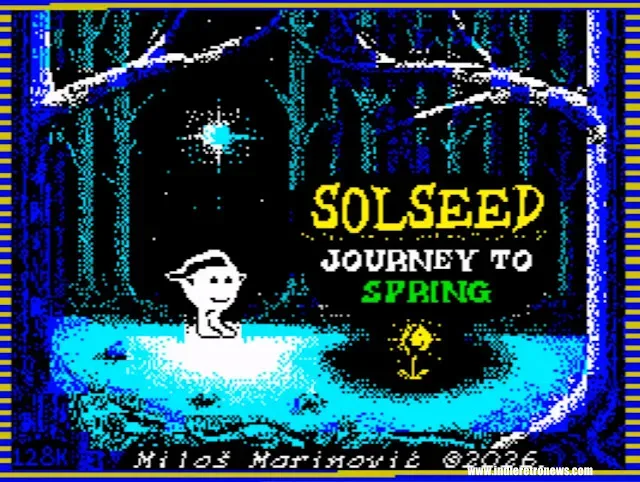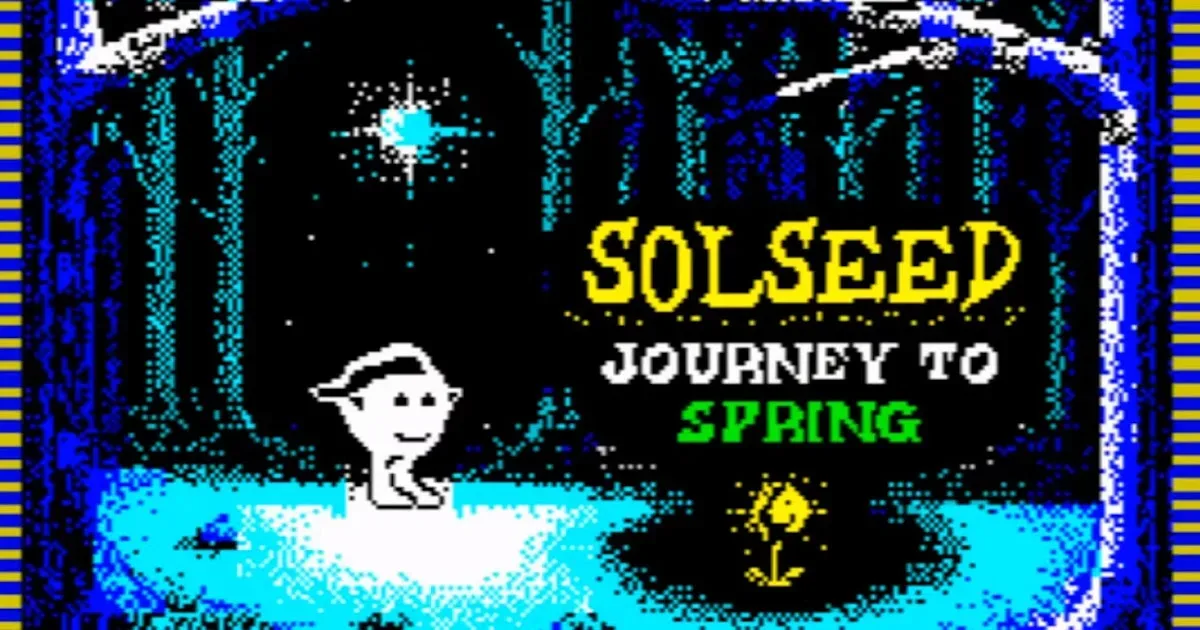
Solseed: Journey to Spring is receiving an expanded ZX Spectrum 128K edition from developer marinovic. Built around a frozen-forest rescue mission, the platform adventure now spans 42 screens, adding 18 screens, rooms, routes and secrets beyond its earlier 48K version.
The premise is pleasingly direct: an Elf wakes from winter hibernation to find that spring has not come. A harsh and unnatural frost has locked the forest in snow and ice, leaving the woodland silent and its old trees frozen in place. The answer lies in 12 magical Solseeds, ancient items the Elf must recover to thaw the land and bring nature back to life.
That makes this an item-driven platform quest rather than a simple dash from left to right. The stated objective is clear, but reaching it means working through a forest of dangers, enemies, hidden details and branching paths. Some routes should move the player toward a needed Solseed; others may be detours that leave them considerably farther from the goal. In a game made from discrete screens rather than a continuously scrolling landscape, knowing where a path leads can be as important as clearing a difficult jump.
A larger winter map for the 128K machine
The central change is scale. Solseed’s 128K edition has 42 screens in total, 18 more than the original 48K release. Those additions are not described merely as extra scenery: they include new rooms, paths and secrets. For a compact retro platformer, that is a meaningful shift in the shape of the game. More screens create more opportunities for wrong turns, discoveries and alternate approaches through the forest.
The world is organised around seasonal and environmental themes. Players will pass through deep winter woodland, a heavily snowbound forest and melting fields. Those locations reinforce the journey’s story: the Elf is not simply escaping a cold place, but gradually pushing toward the restoration of spring. The material does not specify the exact order of those areas, nor whether the new screens belong to particular zones, so the route through the forest remains something for players to uncover.
Every screen can carry its own immediate problem. The game is described as having aggressive enemies, environmental hazards and secrets throughout its rooms. “Environmental hazards” generally means dangers built into the level itself rather than enemies that actively pursue the player: think in terms of spaces and obstacles that demand careful movement. The exact hazards have not been detailed, but the distinction matters. A player must read both the creature in front of them and the terrain around them.
What screen-by-screen platforming changes
Screen-by-screen design divides the game world into individual rooms. Crossing an edge moves the player to the next area instead of smoothly carrying the camera along a larger level. That structure places a premium on memory and observation. A player can form a mental map room by room, remember a suspicious branch or obstacle, and revisit it after learning that a Solseed is still missing.
It also makes branching routes particularly consequential. A fork is not only a visual choice; it can be a commitment to a chain of rooms that may contain hazards, enemies or a secret. Since some paths may take the Elf closer to the objective while others lead further away, the game appears designed to make exploration part of the challenge rather than a decorative extra.
Related coverage includes Solseed: Journey to Spring Expands Its Frozen Spectrum Adventure on ZX Spectrum 128K.
That design philosophy fits a period-flavoured adventure, but it is not simply nostalgia for its own sake. A finite set of 42 screens is a world a player can plausibly learn. The task is to recognise connections, retain information and decide when another route deserves investigation. Players looking for a strongly guided path should expect a different rhythm here. Solseed’s forest wants attention, and it may occasionally reward curiosity with a useful discovery rather than a straightforward advance.
Modern players may recognise a distant cousin of this approach in games that intentionally leave room for navigation and player-led discovery. The desire to get purposefully turned around remains a live design conversation, as explored in this look at a game choosing deliberate disorientation over overt route marking. Solseed’s premise is smaller and its structure is tied to Spectrum-era conventions, but its branching forest similarly treats being lost as part of the adventure’s texture.
Why the 128K label matters here
The ZX Spectrum 128K designation is not just a platform tag attached to this release. Marinovic specifically frames the edition around the extra capabilities of the 128K machine, with the larger game world and AY music among its listed features.
AY music refers here to the soundtrack support associated with the 128K experience. In practical terms, it is presented as a richer musical atmosphere for the journey. That is especially appropriate for a game built around quiet woodland, deep snow and the return of warmth: music can carry mood between rooms even when the player is studying a perilous route or retracing steps through the forest.
The 128K edition also includes redefinable keys. This means players can configure the controls to suit their preferences. It is a small feature with large practical value in a precision-focused platform game. When enemy encounters and hazards can punish a mistimed movement, a control layout that feels natural matters. Players are not locked to one default arrangement; they can make the game fit the keys they use most comfortably.
Neither feature changes the core objective—find all 12 Solseeds and end the eternal winter—but both support the expanded adventure. The soundtrack helps establish the journey’s atmosphere, while configurable inputs can make the moment-to-moment challenge more manageable on an individual basis. The result is an edition that aims to be broader in content without abandoning the concise, room-based identity at the heart of the game.
The 12 Solseeds are the real measure of progress
The Solseeds are more than collectibles in the loose sense. They are the narrative mechanism by which the Elf restores the forest, and collecting all 12 is the stated mission. That gives exploration a concrete purpose: secrets and side routes matter because they may contain—or help lead toward—the items necessary to complete the quest.
Nothing provided so far identifies where each Solseed is placed, whether any require special conditions, or how the game tracks the collection. It would be premature to turn those unanswered questions into a route guide. What is clear is that the added 128K screens broaden the search space. Anyone setting out to finish the game should be prepared to notice alternate exits, remember unexplored branches and revisit earlier parts of the forest if their seed count comes up short.
- Objective: recover 12 magical Solseeds and restore spring.
- Setting: a forest caught in unnatural ice and snow.
- Structure: 42 individual screens with branching routes, dangers and secrets.
- New scale: 18 additional screens, rooms, paths and secrets compared with the 48K version.
- 128K features: AY music and redefinable keys.
A focused expansion rather than a reinvention
Solseed: Journey to Spring’s 128K edition is defined by expansion with a clear purpose. Its additional rooms and routes give the search for 12 seeds more territory, its wintry locations make the central premise readable at a glance, and its technical additions serve atmosphere and control flexibility. The game remains grounded in classic, screen-by-screen platforming, where each room can introduce a fresh threat or a fresh clue about where to head next.
For Spectrum players, the appeal is likely to be the combination of a familiar design language and a substantially larger forest to master. For anyone curious about the game, the key expectation is not speed alone. Progress means navigating carefully, handling hostile rooms and treating the landscape as a puzzle of paths as much as a sequence of jumps. Spring is waiting somewhere beyond the frost; the Elf just has to find all twelve reasons for it to return.