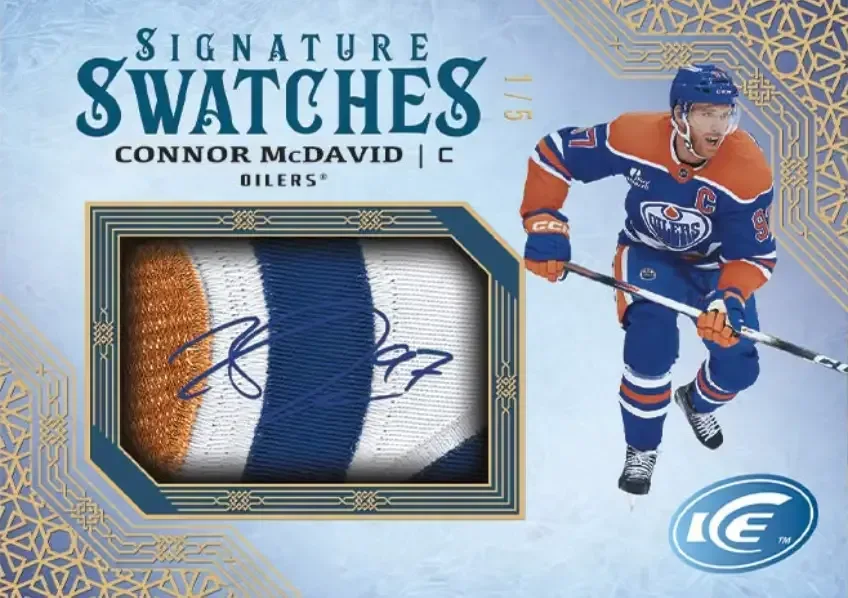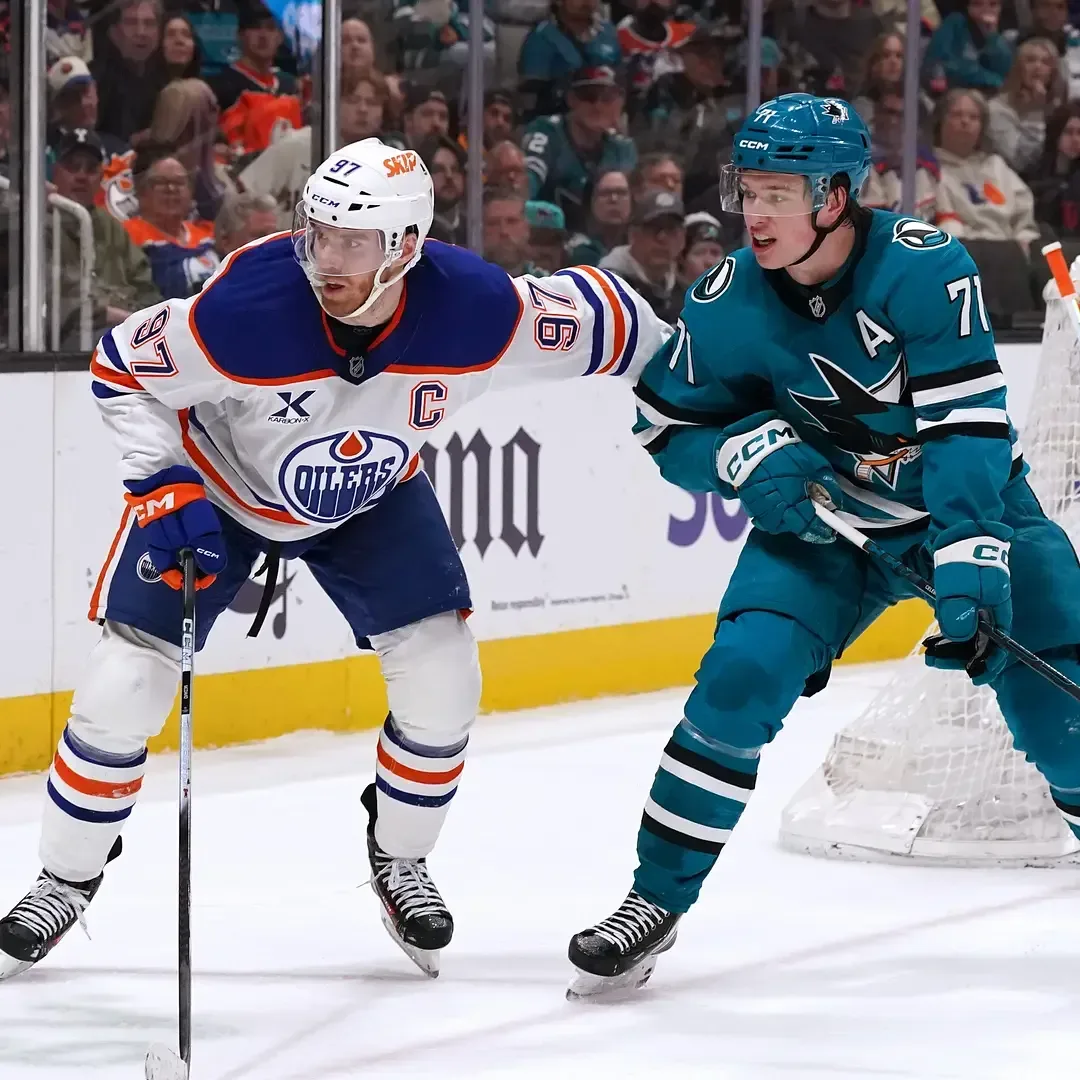
Macklin Celebrini’s first two NHL seasons have created the kind of collecting story that can move from exciting to eye-catching in a hurry. The San Jose Sharks selected the Boston University center first overall in the 2024 draft, and he followed a 63-point rookie campaign with 45 goals and 70 assists in his second season. At 20, he has also become the youngest captain in Sharks history.
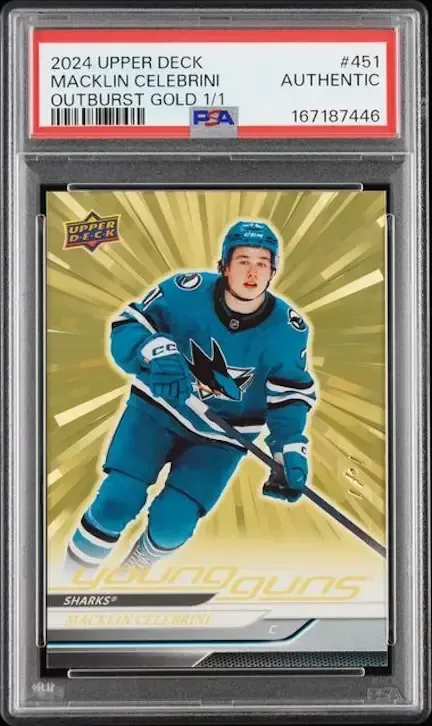
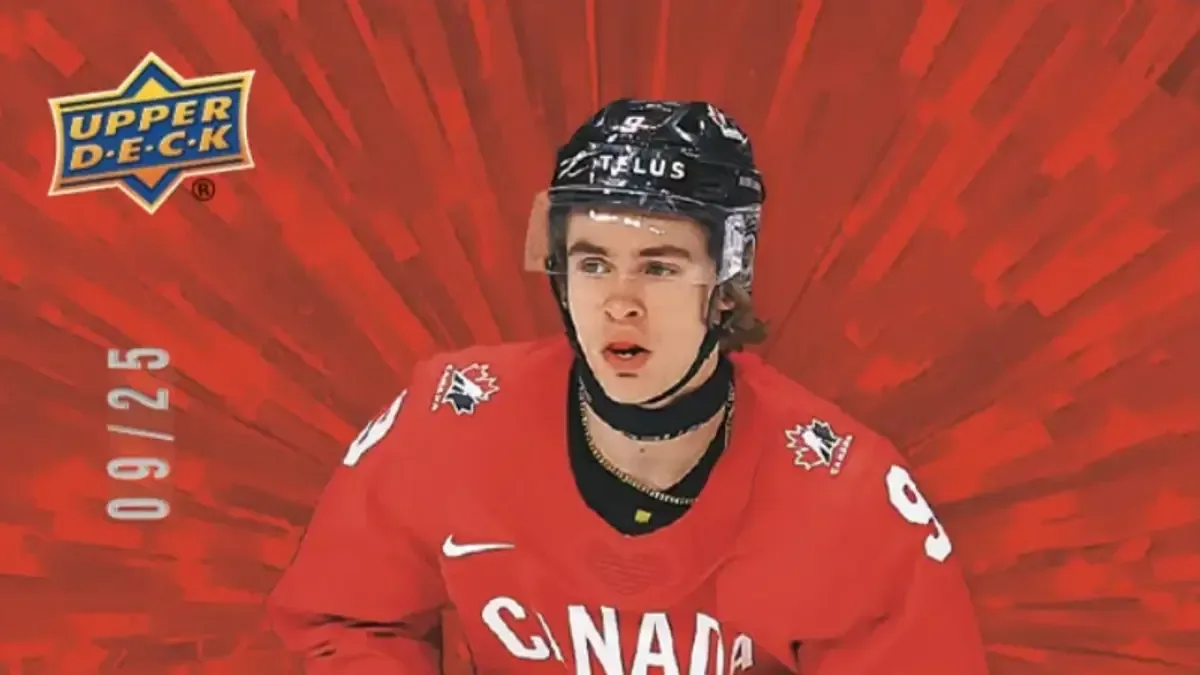
On the card side, the headline number is enormous: Celebrini’s 2024-25 Upper Deck Young Guns Outburst Gold 1/1, authenticated by PSA, sold for $1,281,000 at auction on August 15, 2026. That result is an exceptional marker for a modern hockey rookie card, but it is best understood as a sale for a uniquely scarce card rather than a blanket price tag for every Celebrini rookie.
That distinction matters. A one-of-one, commonly written as 1/1, means the manufacturer designated that card as the only copy of its particular version. The combination of Celebrini’s first-overall-pick status, a flagship rookie-card identity and the Gold parallel’s singular scarcity makes it a markedly different collectible from an unnumbered base card or even a serial-numbered autograph.
Still, the wider group of reported sales offers a clearer picture of the high-end demand developing around his early Upper Deck issues. Rookie patch autographs from The Cup, a logo-heavy booklet limited to six copies, and a dual shield card with Sharks teammate Will Smith have all reached five-figure prices.
The $1.281 million Young Guns Outburst Gold 1/1
Young Guns is Upper Deck’s defining rookie-card line, making it an important starting point for collectors following contemporary NHL prospects and new stars. Its familiarity is part of the appeal: collectors do not need to decode an obscure insert name to recognize why a top prospect’s Young Guns card matters.
Celebrini’s Outburst Gold 1/1 is a parallel of that recognizable rookie format. A parallel is a version of a card that uses a different finish, color treatment or other variation from the standard release; in this case, the Gold version is also limited to one copy. PSA authentication confirms the card is genuine, but “PSA Authentic” should not automatically be read as a numerical condition grade. Authentication and condition grading are related but separate services, and collectors should always read the label rather than assume a card has received a particular numeric grade.
The $1.281 million sale is therefore a powerful signal about the ceiling for Celebrini’s best-known ultra-rare rookie issue. It does not establish that all of his cards should be valued by multiplying or dividing from that one result. Scarcity, card design, serial number, autograph status, patch composition and the specific buyers active on a given sale day can all create major differences between cards of the same player.
The Cup rookie patch autographs show a rising high-end market
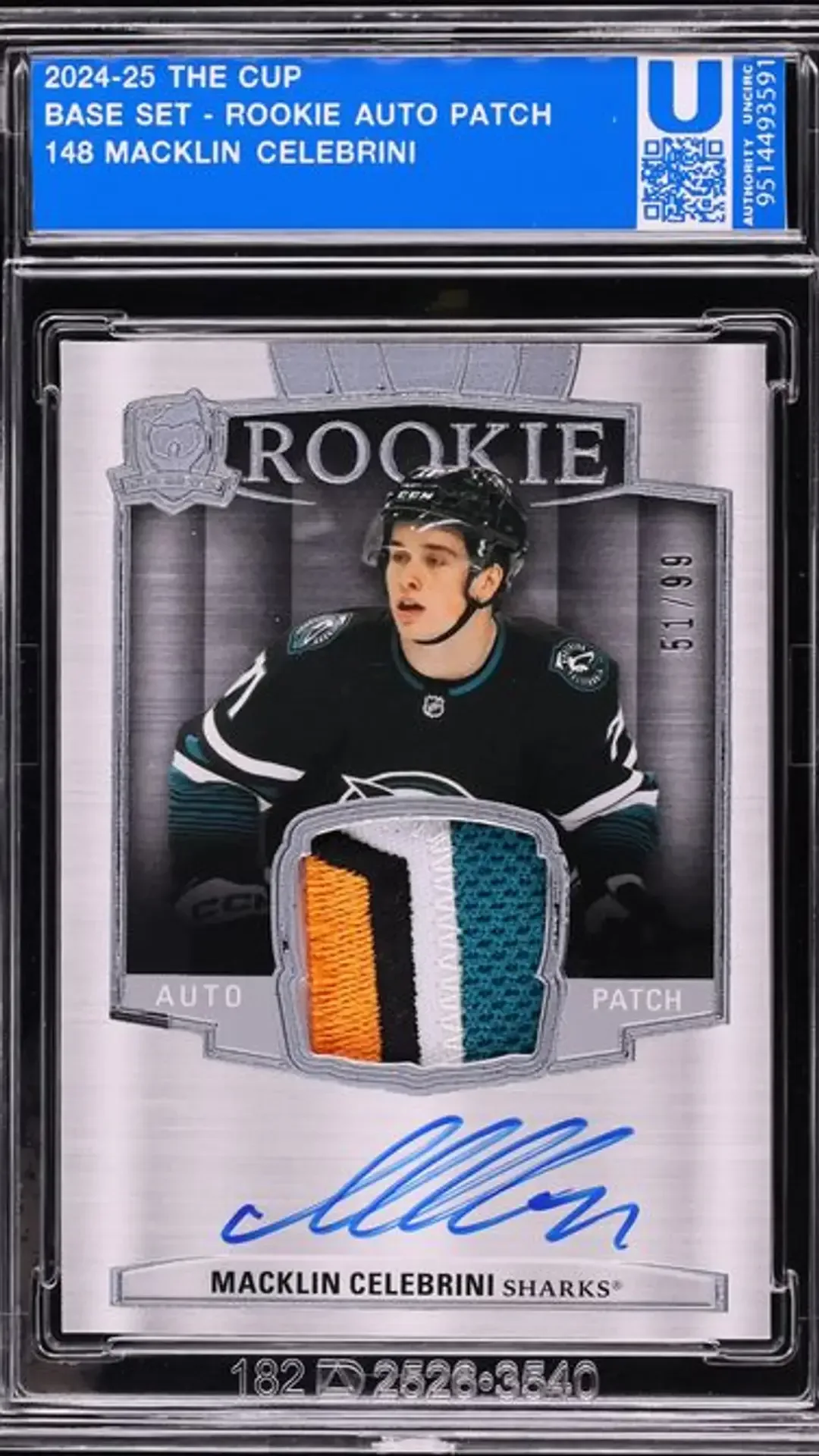
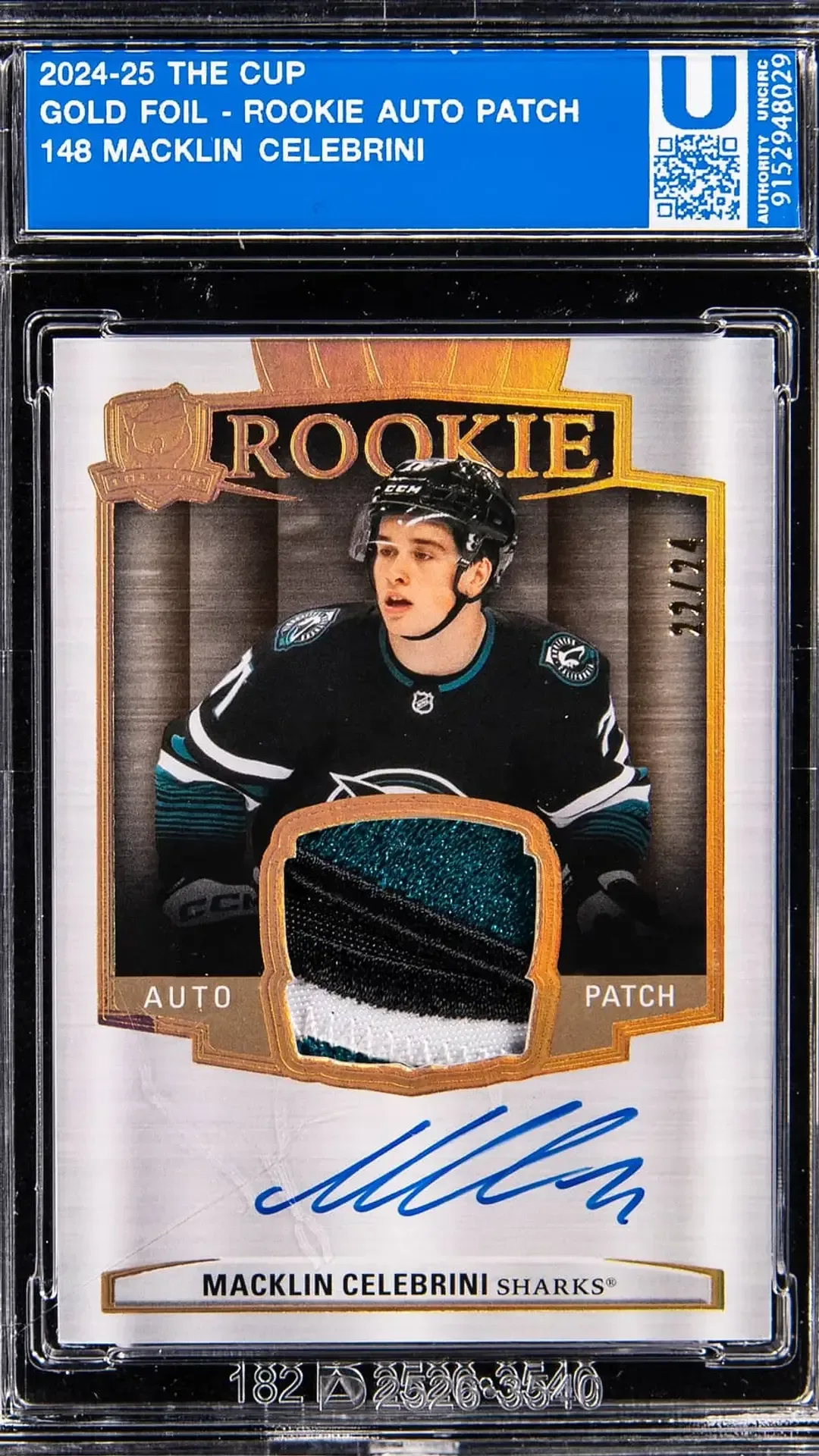
Upper Deck’s The Cup is positioned as a premium product, and Celebrini’s rookie patch autographs—often abbreviated by collectors as RPAs—are among its most significant chase cards. An RPA combines an autograph with a piece of jersey material and is usually serial numbered, meaning the total number produced is stated on the card.
Related coverage includes Macklin Celebrini Card Sales Surge After Historic Sharks Captaincy.
A factory-encased 2024 Upper Deck The Cup Rookie Patch Auto /99, numbered 16/99, sold for $132,000 on September 25, 2026. Another copy from the same /99 run, numbered 51/99, sold for $65,000 in May 2026. Both were described as having similar four-color patches.
The two results demonstrate why collectors should resist treating a print run as a set of interchangeable units. “/99” tells buyers there are 99 numbered copies, but it does not mean every copy contains the same patch, visual appeal or market desirability. A patch is a swatch of player-worn material embedded in the card; multicolor pieces are frequently more visually distinctive than a single-color swatch. Serial-number placement can matter to some collectors as well, although the supplied sales alone cannot isolate exactly why these two copies achieved different prices.
What can be said is that the later $132,000 sale was more than double the earlier $65,000 transaction. That is notable momentum within one parallel, while remaining a small sample. Individual high-end sales are useful reference points, not guarantees of future value or proof that every /99 copy will sell for the same amount.
Celebrini’s still-scarcer The Cup Rookie Patch Auto /24 sold for $85,400 on May 9, 2026. The card was reported as the third-highest sale among Celebrini cards, with a tracked value above $100,000 at the time referenced. A /24 edition is much more limited than a /99 run, but scarcity is only one part of a card’s appeal. The specific patch window, autograph presentation, player trajectory and collector competition can all affect the final result.
A booklet with nearly the full Sharks logo
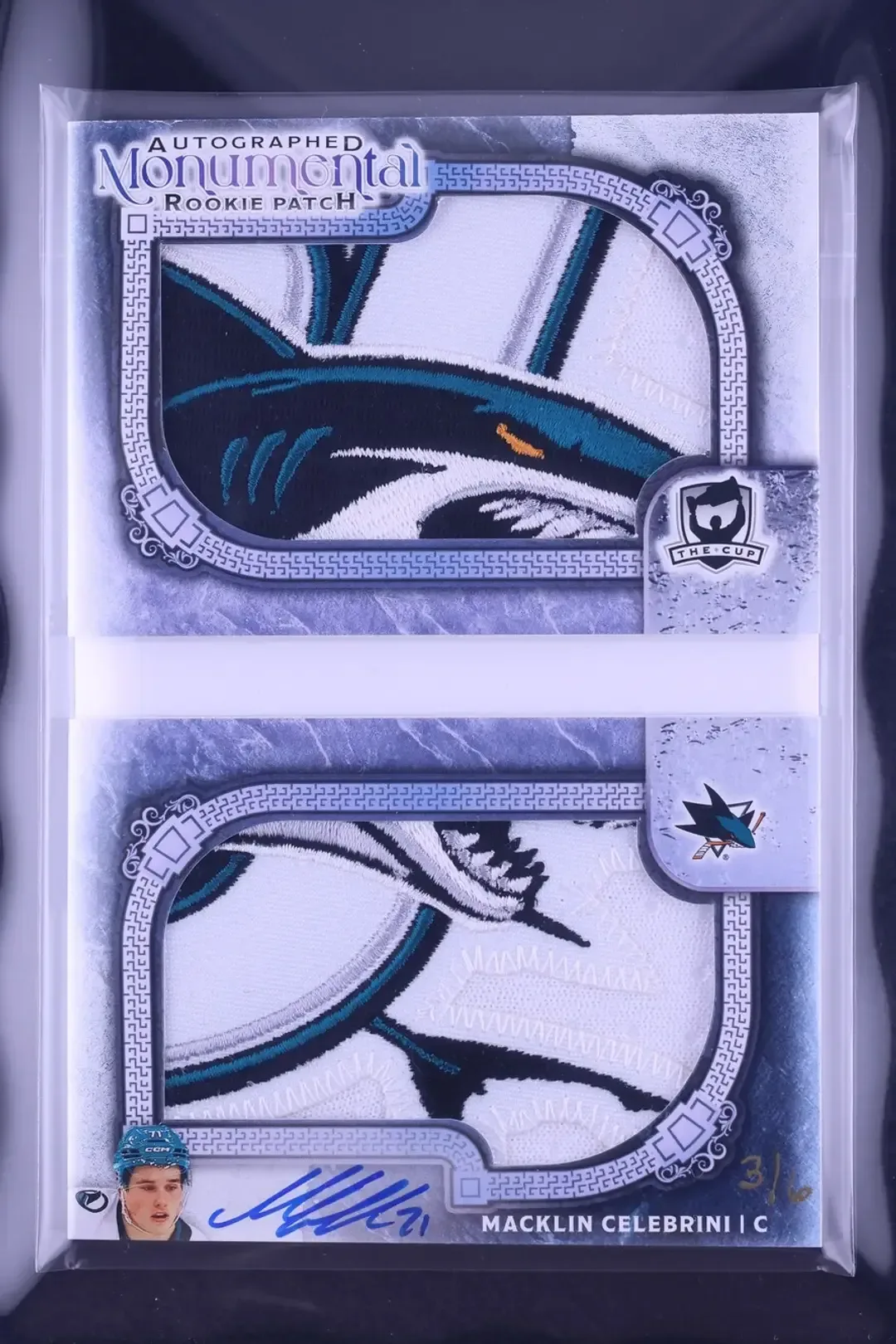
The 2024 Upper Deck The Cup Monumental Booklet Rookie Patch Auto /6 adds another kind of scarcity: a large-format patch that displays nearly the entire Sharks logo. This six-copy rookie booklet sold for $43,200 on February 8, 2026.
Booklet cards fold open rather than following the usual single-card format, allowing manufacturers to include larger memorabilia pieces. In this case, the visual connection to the Sharks identity is central. A large logo patch can be especially compelling because no two memorabilia windows necessarily look alike, even when the cards share the same checklist entry and serial-numbered run.
That makes a reported sale for a particular booklet more informative about that exact copy than about every future logo patch. It is nevertheless an important example of the variety within Celebrini’s early market: collectors are not solely focusing on standard rookie cards, but also on premium autographs and visually distinctive memorabilia cards.
The Will Smith tandem shield card adds the teammate angle
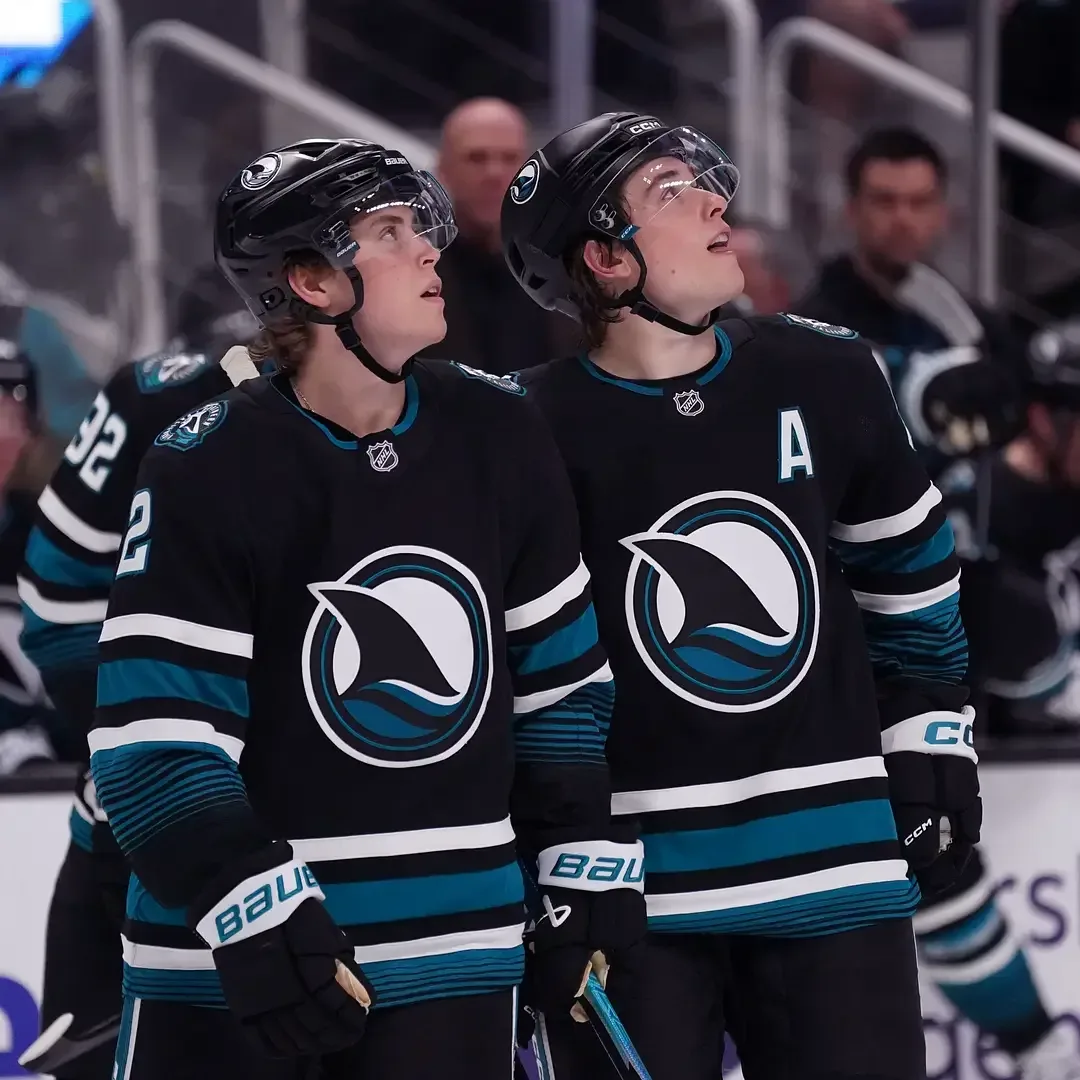
Celebrini is not the only young Sharks center drawing attention. Will Smith recorded 45 points in his rookie season and improved to 59 in his sophomore campaign. San Jose missed the playoffs in 2025-26, but the presence of two young contributors gives collectors a team-building narrative to follow.
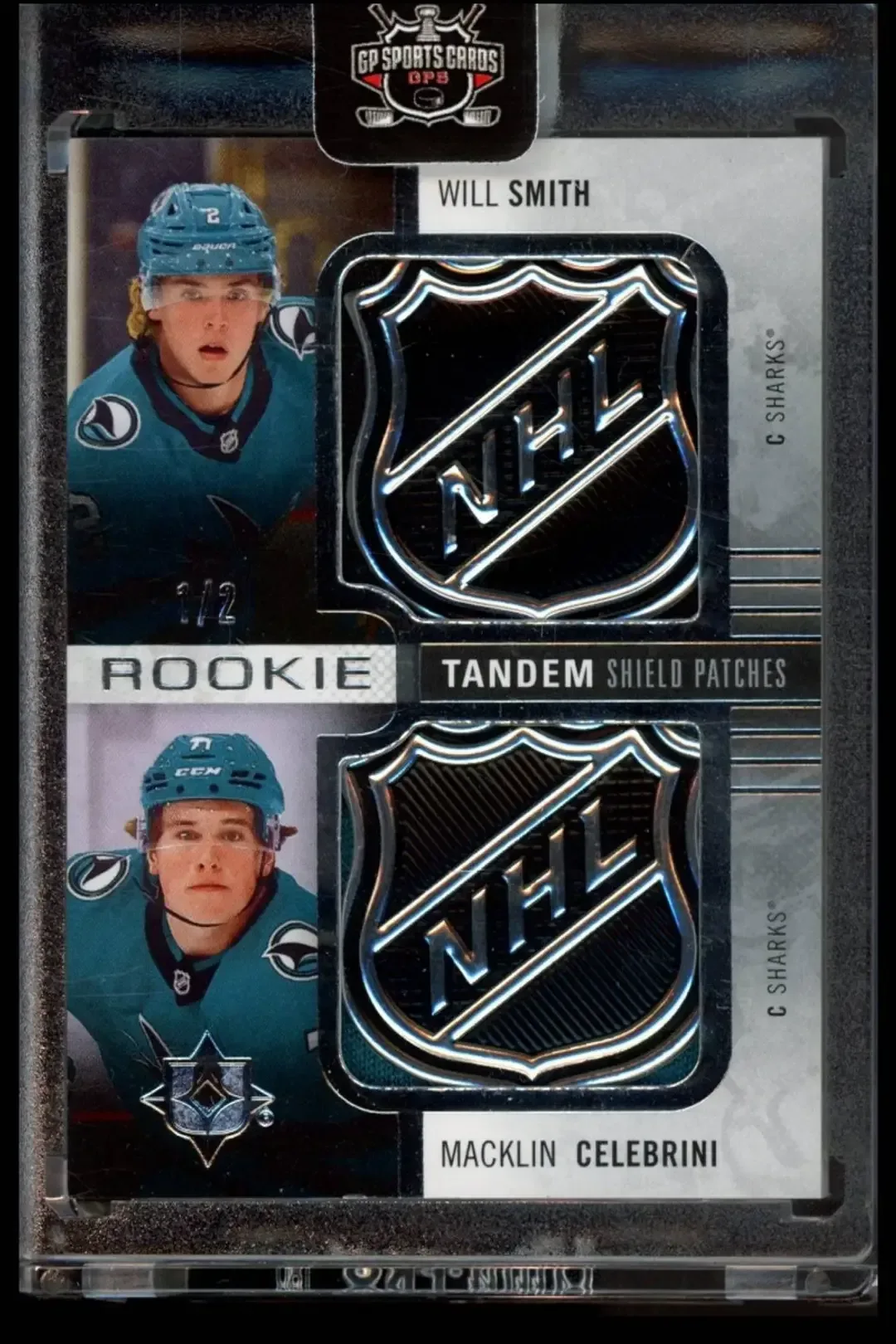
That narrative is built directly into the 2024 UD Ultimate Rookie Tandem Shield Patch /2 featuring Smith and Celebrini. One copy sold for $32,713 on October 23, 2025. The card uses NHL shield patches and is limited to two copies.
UD Ultimate is another premium Upper Deck line that emphasizes autographs and low-numbered cards, with four cards typically included per box. A dual-player card like this creates a different proposition from a solo Celebrini rookie: its desirability depends on both players, the visual strength of the shield patches and the appeal of collecting the pair as a potential core for San Jose.
For collectors, that can be an appealing way to pursue a shared Sharks storyline. It also introduces a broader set of variables. Celebrini’s accomplishments and Smith’s development can each affect interest in a tandem card, so it should not be evaluated exactly like a single-player one-of-one.
How to read these sales without overreading them
The reported results establish that elite Celebrini cards have generated substantial high-end transactions. They do not make card collecting a predictable investment exercise. Auction outcomes can be shaped by card-specific details, the venue, timing, the number of bidders and whether a particular copy has surfaced before.
- Separate the card from the player. Celebrini’s on-ice performance and captaincy provide context, but an individual card’s serial number, autograph, patch and condition are still crucial.
- Use exact comparables. A /99 RPA is a more useful comparison for another /99 RPA than a 1/1 Young Guns is, even if both feature the same player.
- Check labeling carefully. Authentication, numerical grading and factory encasement describe different aspects of an item. None should be assumed from a product name alone.
- Give visual elements their due. The almost-full Sharks logo in the /6 booklet and the NHL shields in the dual /2 illustrate why two cards with similar numbering can command very different attention.
- Remember that reported sales are snapshots. A prior result documents what one buyer paid for one copy at one moment; it is not a promised future price.
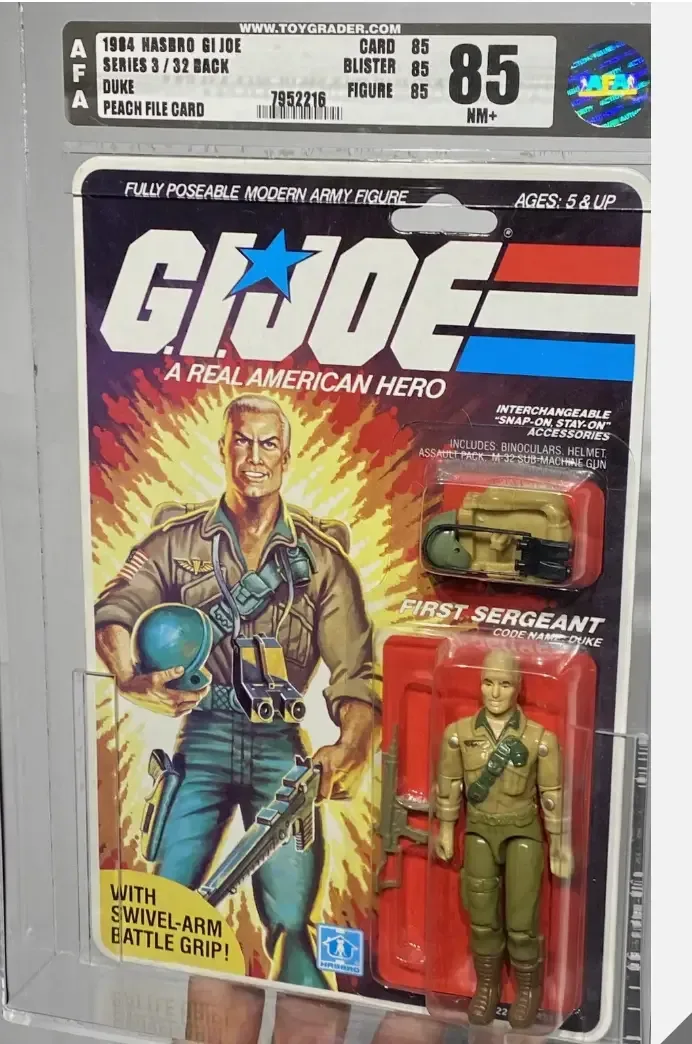
Modern hockey collectors interested in the wider mechanics of condition and presentation may also find value in looking at how high-grade markets develop across non-sports sets, as seen in this examination of 1986 G.I. Joe Action Cards. The players and products differ, but close attention to specific card versions remains fundamental.
Celebrini’s early Upper Deck portfolio now has clear landmarks: a seven-figure 1/1 Young Guns parallel, six-figure The Cup RPA sales, a logo-centric booklet and a limited dual rookie with Smith. His production through two seasons and his historic captaincy make the interest understandable. The more practical lesson for collectors is to keep the focus narrow: identify precisely which Celebrini card is being discussed, how many exist, what is actually on the card, and which prior sale is truly comparable.