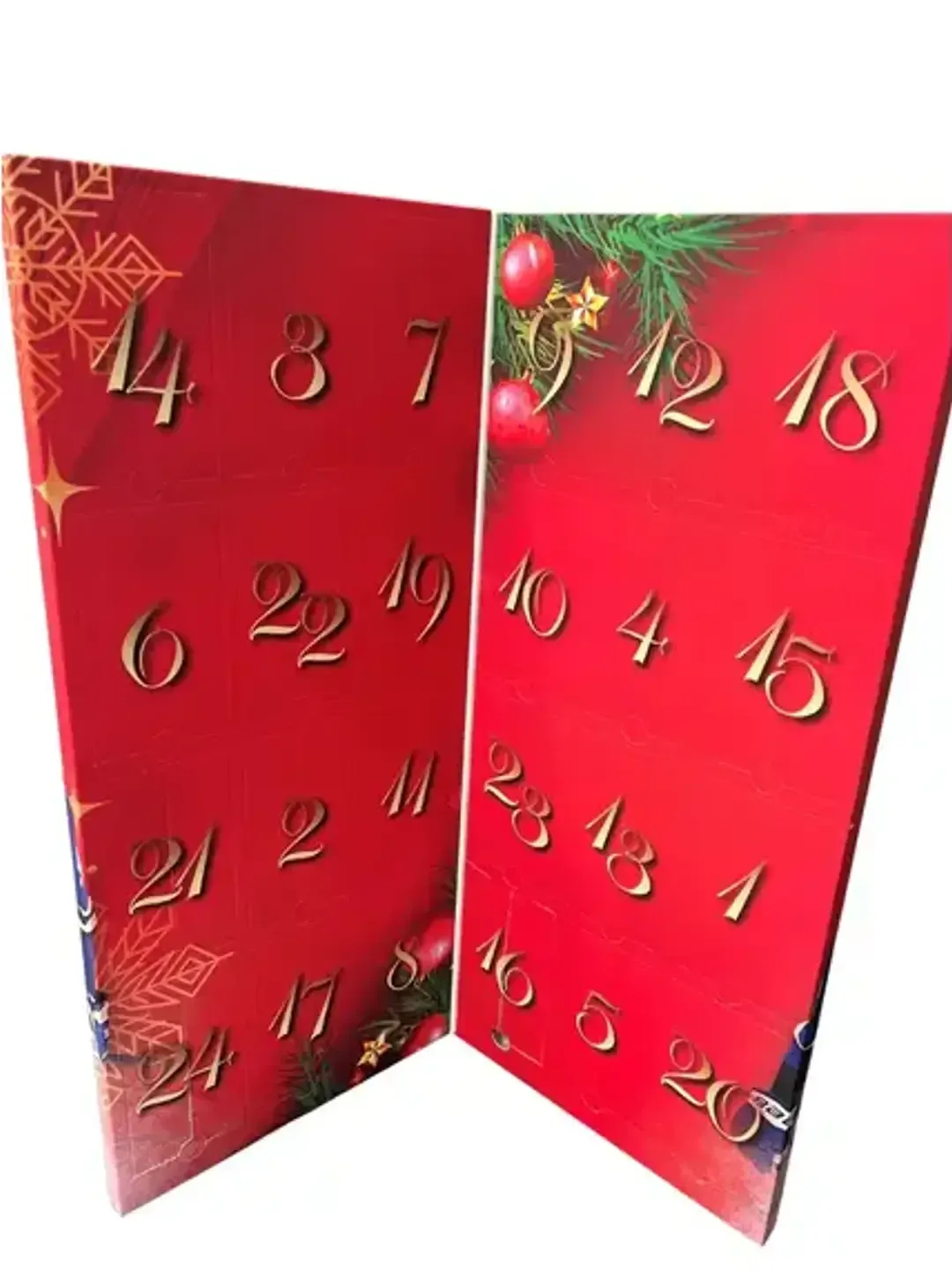
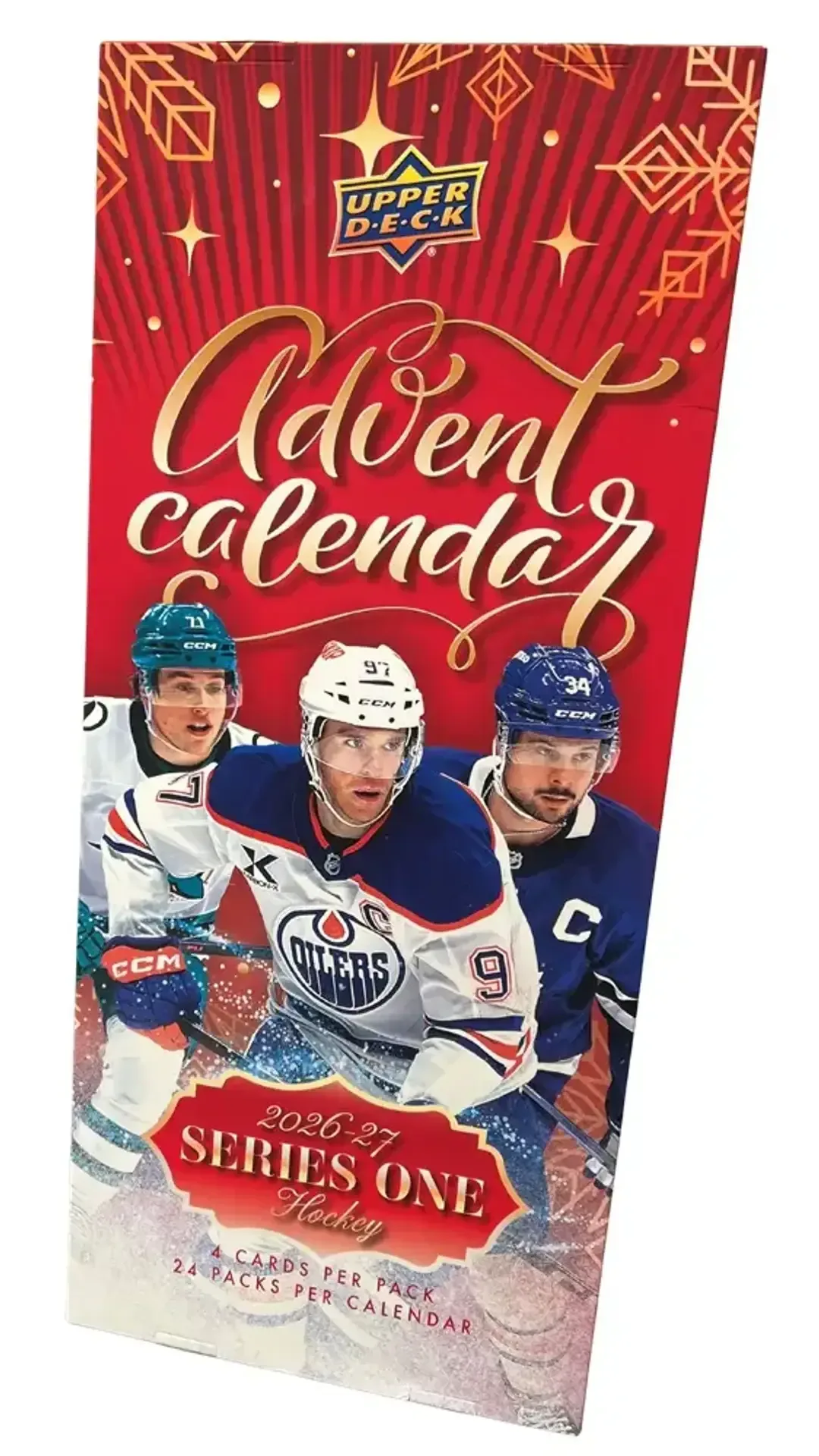
Opening a hockey-card product one day at a time is the central appeal of Upper Deck’s 2026-27 Series 1 Hockey Advent Calendar. Rather than presenting its cards in the usual single-session box format, the holiday package divides its contents among 24 cardboard compartments, each holding one four-card pack. That makes 96 cards across 24 packs, assuming every compartment stays sealed until its designated day.
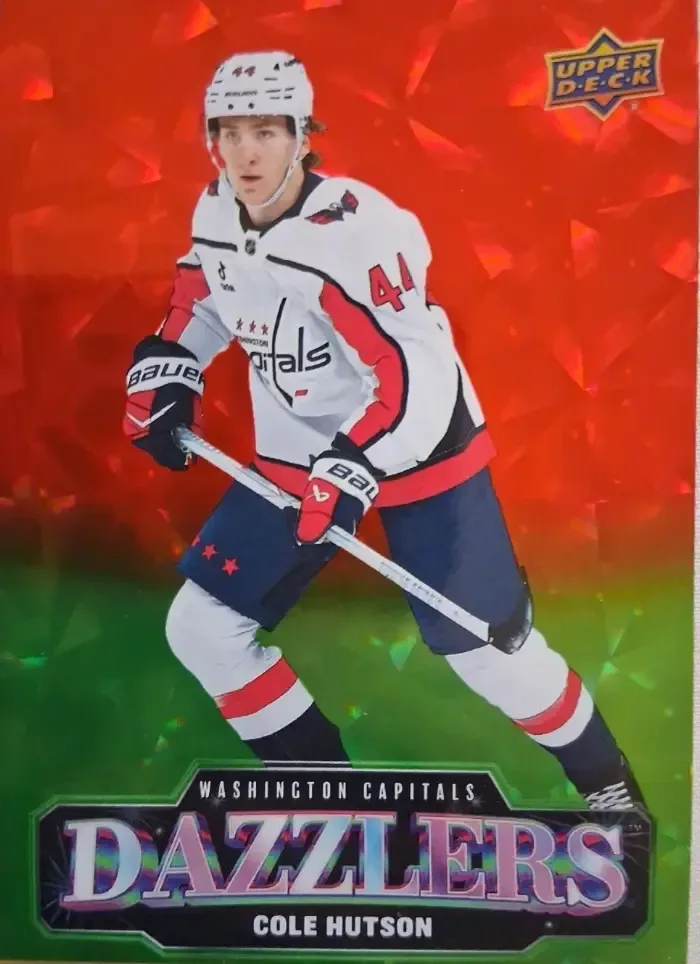
The calendar is built around 2026-27 Series 1 Hockey cards, but it is not simply a repackaging exercise. It has holiday-exclusive parallel treatments intended to give the daily routine a distinct chase: green-foil Young Guns and red-and-green Dazzlers. Published product information lists an average of two of each special insert type per calendar. For collectors, that wording matters. An average is not a promise that every box will contain identical players, the same breakdown, or a specific high-demand rookie.
The early secondary-market sales cited for three rookie-focused cards show where collector attention has settled: James Hagens’ green-foil Young Guns, Porter Martone’s green-foil Young Guns, and Cole Hutson’s red-and-green Dazzlers. Those transactions are useful snapshots of demand, not fixed valuations. A completed sale records what one buyer paid for one card at one moment; condition, timing, listing format and player performance can all affect the next result.
What the Advent Calendar contains
The format is straightforward:
- 24 individual compartments, corresponding to the 24 days before Christmas.
- One hockey-card pack in each compartment.
- Four cards per pack, for 96 cards total.
- Cards based on 2026-27 Upper Deck Series 1 Hockey.
- Holiday-only green Young Guns parallels and red-and-green Dazzlers.
A parallel is a version of a card that is differentiated from its standard counterpart by a changed design treatment, such as foil or a different color scheme. The player and core card identity can remain the same, but the parallel gives collectors a visually distinct variation to chase. Here, the green Young Guns and red-and-green Dazzlers use holiday color palettes and are specific to the Advent Calendar offering.
That distinction is especially important for anyone comparing listings. A standard Young Guns card, a green-foil holiday Young Guns card and a Dazzlers insert are not interchangeable merely because they feature the same rookie. The first comparison should always be the exact card: player, set, insert line and parallel treatment. Only then do sale prices become meaningfully comparable.
The calendars can be ordered directly through Upper Deck and are also available through resellers, with a stated limit of three boxes per customer on the direct store. The combination of an official per-customer cap and a calendar-only parallel helps explain why collectors may watch sealed boxes and individual singles separately. A collector who wants the experience of 24 staged openings may value an unopened calendar differently from someone focused on completing a player-specific parallel run.
The holiday chase: Young Guns and Dazzlers
Young Guns are the rookie-focused cards drawing much of the attention in this release. In the Advent Calendar, their green-foil versions are the seasonal variation. The published average is two green Young Guns per calendar, meaning the format offers repeated chances at rookie content without identifying which rookies will appear in any particular box.
Related coverage includes Upper Deck Series 1 Hockey Advent Calendar Spotlights Hagens, Martone and Hutson.
Dazzlers receive a comparable holiday makeover in red and green. They occupy a different lane from the Young Guns chase: the appeal comes from the themed insert presentation rather than a direct parallel of the rookie-card line. The listed average is two holiday Dazzlers per calendar.
That is a useful practical divide for collectors deciding what they actually want from the product. Someone building a rookie collection may prioritize green Young Guns. Someone attracted to seasonal designs, player collecting or visually distinctive inserts may prefer the Dazzlers. And a collector seeking one particular player should weigh the uncertainty of opening calendars against the option of buying a confirmed single after sales appear.
Average hit rates are not box guarantees
Pack-product language often creates confusion, particularly when an average appears next to a popular insert. “Average” describes the product’s stated overall distribution expectation; it does not guarantee that every calendar has exactly two green Young Guns and exactly two red-and-green Dazzlers, nor does it reserve a particular player for every buyer.
That does not diminish the format’s appeal. It simply frames the purchase correctly. The calendar is built for a sequence of small surprises, while a single-card purchase is built for certainty about the player and variation being acquired. Those are different collecting experiences with different risk and reward profiles.
James Hagens leads the early sales snapshot
Among the reported examples, the 2026-27 Series 1 Young Guns Green Foil Parallel of James Hagens produced the strongest cited completed sale: $120 on eBay on November 10, 2026.
Hagens is 20 and, before an injury, had recorded 12 points in 17 games during the opening months of his NHL season. Those 12 points consisted of six goals and six assists. He was working his way back from the injury at the time of the information provided.
There are two separate reasons a result like $120 can draw notice. First is the player: early rookie-season production can sharpen attention around a young player’s cards. Second is the card’s precise form: this is not merely a Hagens rookie card, but the Advent Calendar’s green-foil Young Guns version. Collectors evaluating it should avoid treating the sale as a universal benchmark for all Hagens cards, or even all copies of this specific variation. It is one completed transaction, useful as a reference point rather than a price guarantee.
In practical terms, condition will be central whenever collectors compare like-for-like copies. Corners, surface, edges and centering can materially change how buyers perceive a modern foil card, while listing photos and whether a card is raw or graded also influence comparison shopping. The reported sale identifies interest in the card, but it does not by itself establish a permanent market level.
Porter Martone’s green Young Guns also lands early attention
Porter Martone’s 2026-27 Series 1 Young Guns Green Foil Parallel had a cited eBay sale of $75 on November 7, 2026. Martone was selected one position ahead of Hagens in the 2025 NHL Entry Draft and is regarded as a high-end prospect with the potential to become an impact player.
The Hagens and Martone examples show how a shared parallel can still produce different individual sale results. Their cards are part of the same Advent Calendar chase, but buyers do not value every rookie identically. Draft placement, perceived upside, on-ice development and the immediate collector narrative surrounding each player can all shape interest.
For player collectors, Martone’s card demonstrates why it is helpful to be specific when setting a target. “Martone Young Guns” is broad. “2026-27 Series 1 Advent Calendar green-foil Young Guns” identifies a much narrower card and avoids accidental purchases of a standard version or another insert. Clear card identification becomes even more important as multiple versions circulate in listings.
Cole Hutson shows the Dazzlers side of the release
The third notable example is not a Young Guns card at all. A 2026-27 Upper Deck Series 1 Red & Green Dazzlers Cole Hutson sold for $46.99 on eBay on November 15, 2026. It is a useful reminder that the calendar’s seasonal chase is broader than the green rookie parallels.
Hutson had 15 points in 18 games for the Washington Capitals in his rookie season at the time referenced. That rate put him on pace for 70 points, compared with Matthew Schaefer’s 59 points in his rookie season the year before. His green-foil Young Guns holiday card had also been selling in an approximately $30 to $60 range.
The Hutson examples make a particularly clear case for distinguishing card type before comparing prices. The $46.99 result was for the red-and-green Dazzlers card. The roughly $30-to-$60 range concerns his green-foil Young Guns holiday card. Both are holiday-themed Hutson cards from the same broader product, but they are separate designs and separate collecting targets. A Dazzlers sale is evidence of demand for that Dazzlers variation; it should not be presented as the going price for the Young Guns parallel.
How to approach the calendar as a collector
The appeal here is partly ritual. Opening a card pack each day gives the product a pace that a conventional box does not have. The special parallels add a defined objective to that ritual, while the Series 1 base provides the wider card-opening backdrop. Collectors can decide how much of the calendar concept they want to preserve: opening day by day, opening all 24 packs at once, holding the calendar sealed, or buying individual holiday cards afterward.
For anyone pursuing specific cards, a measured approach is sensible:
- Identify the exact variation. Confirm whether the target is a standard card, a green-foil Young Guns, or a red-and-green Dazzlers card.
- Use completed sales as reference points, not promises. The Hagens, Martone and Hutson figures are dated transaction snapshots, not an appraisal for every copy.
- Compare condition and presentation. A close look at card condition and listing details is necessary before treating two sales as equivalent.
- Choose certainty or the opening experience. Buying a single can be more direct for a player collection; opening a calendar preserves the surprise and possibility inherent in the product.
The calendar also reinforces a basic truth of modern card collecting: the box configuration, the exclusive parallel and the player are all part of the card’s identity and appeal. A rookie’s name may draw the initial search, but the exact holiday treatment can be what separates one listing from another.
For more card-focused reading beyond this hockey release, browse our trading-card coverage. In the case of the 2026-27 Upper Deck Series 1 Hockey Advent Calendar, the early market story is still compact but clear: Hagens, Martone and Hutson are the names to watch among the reported holiday parallels, while the 24-day format remains the product’s defining feature.