Tom Brady did not merely place on this week’s football-card sales board: he occupied the entire thing. The five largest reported sales all belonged to the former quarterback, spanning rookie-era issues, modern one-of-one cards, an autograph, and a game-used relic. The top result was a 2000 Donruss Elite Status /10 graded PSA 9, which sold for $126,000 on November 5 through ALT.
The clean sweep arrived as Brady was returning to Foxborough, Massachusetts, for the first time as an announcer. That timing is notable context, but the cards themselves offer a more useful snapshot of the market: collectors paid for several distinct versions of scarcity. Some prices were driven by tiny stated print runs; others combined an autograph or relic with a high grade; one was a foundational early-career card whose importance does not depend on being a one-of-one.
The five reported sales
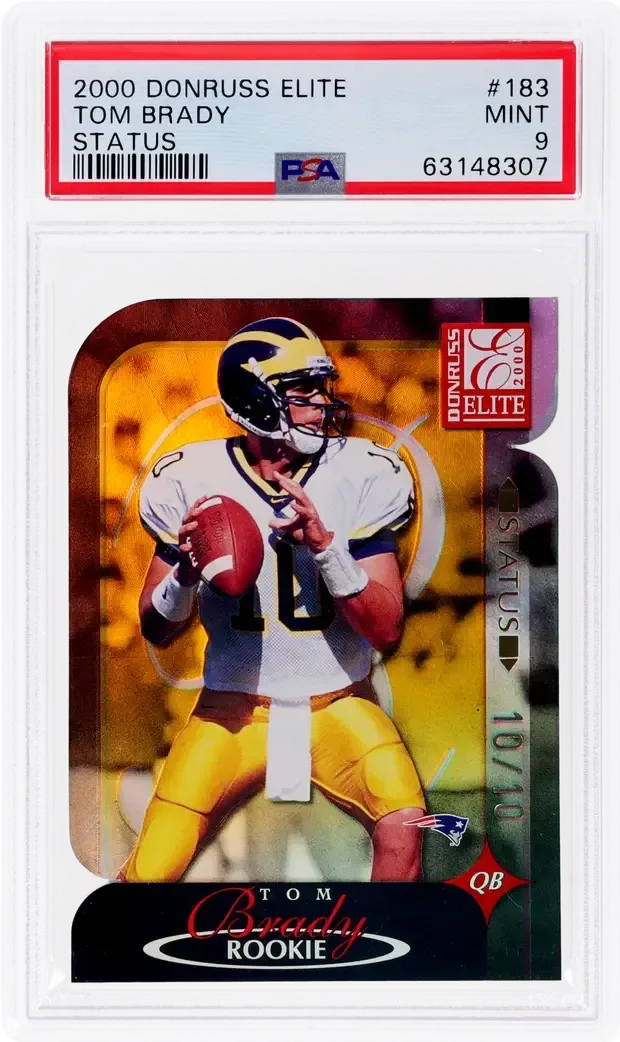
- 2000 Donruss Elite Status /10 Tom Brady, PSA 9 — $126,000 on November 5 via ALT.
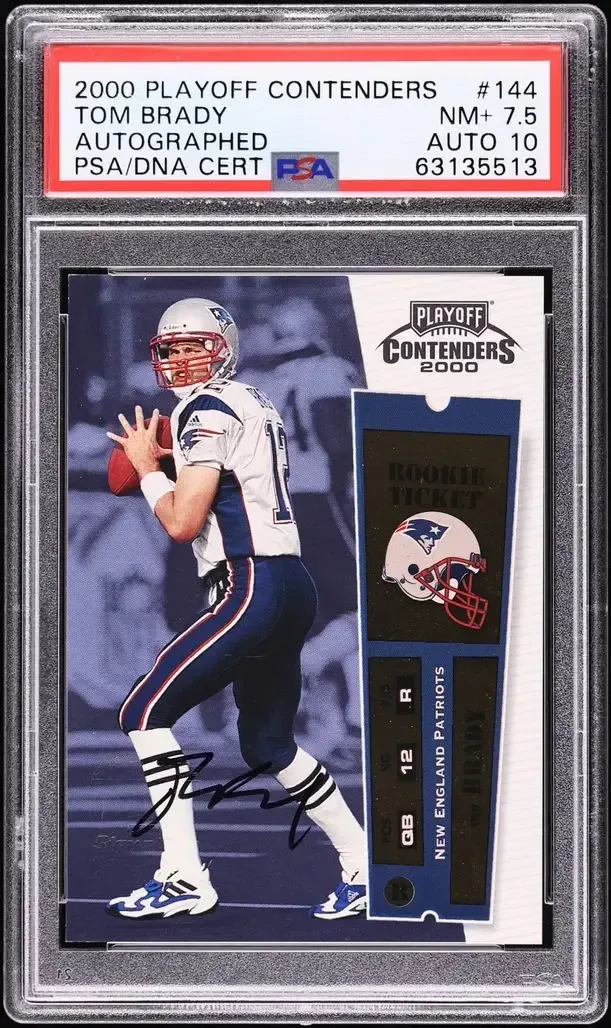
- 2000 Playoff Contenders Tom Brady autograph, PSA 7.5 — $79,750 on November 3 via Fanatics Buy Now.
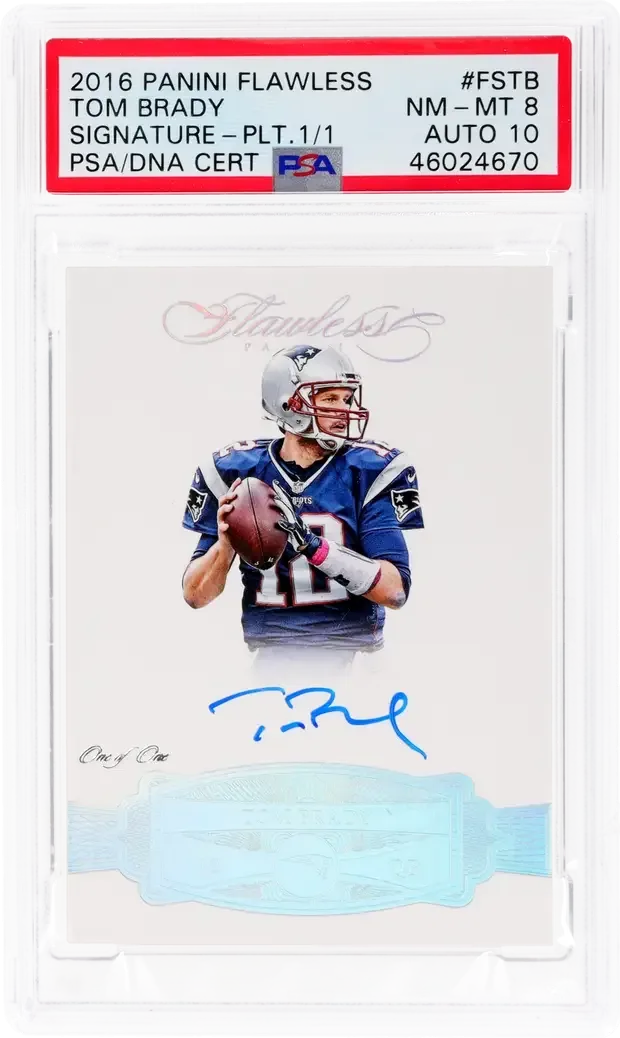
- 2016 Panini Flawless Signature Platinum /1 Tom Brady, PSA 8 / Auto 10 — $66,000 on November 5 through ALT.
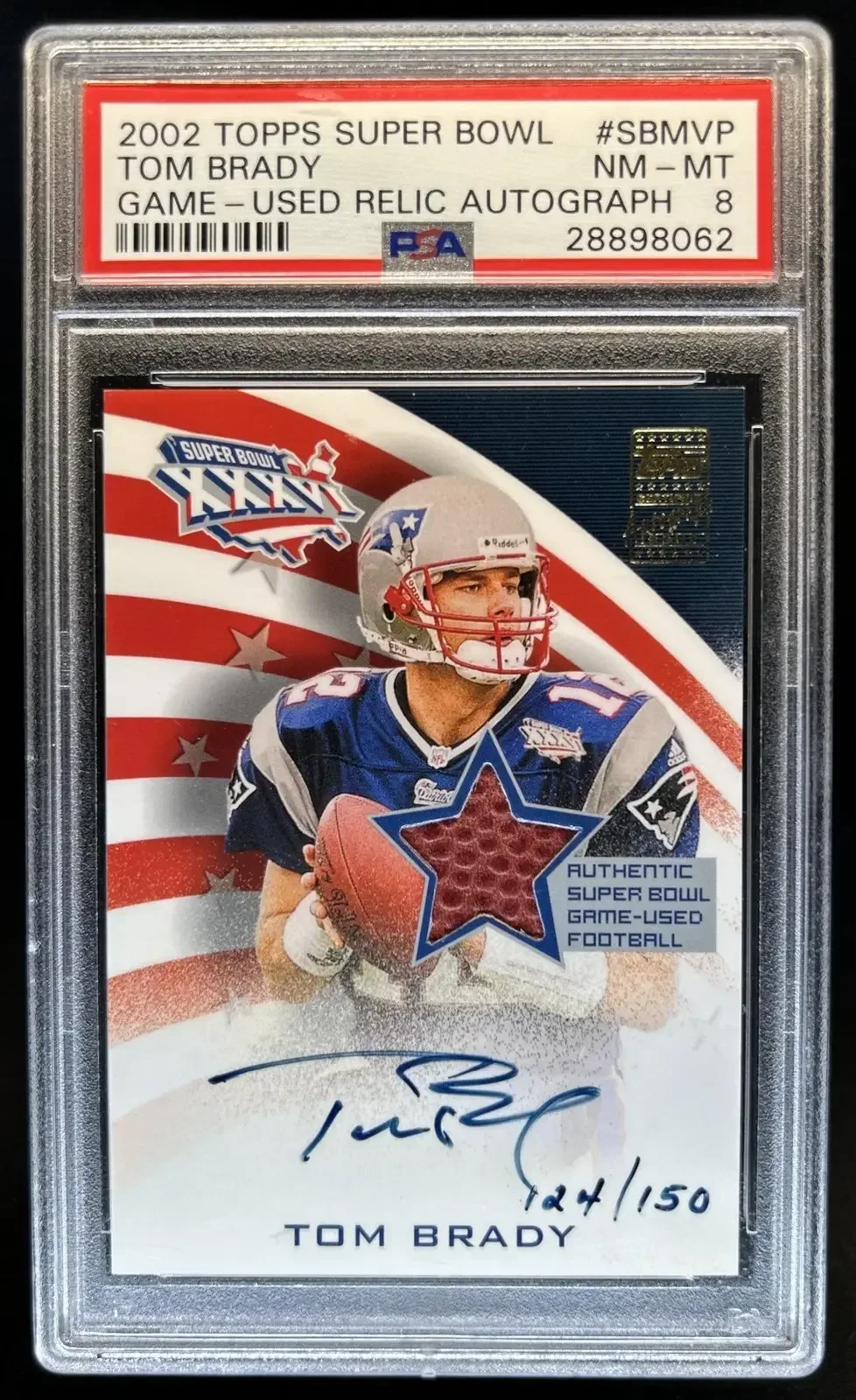
- 2002 Topps Super Bowl Game-Used Relic Auto /150 Tom Brady, PSA 8 — $45,160 on November 7 via eBay.
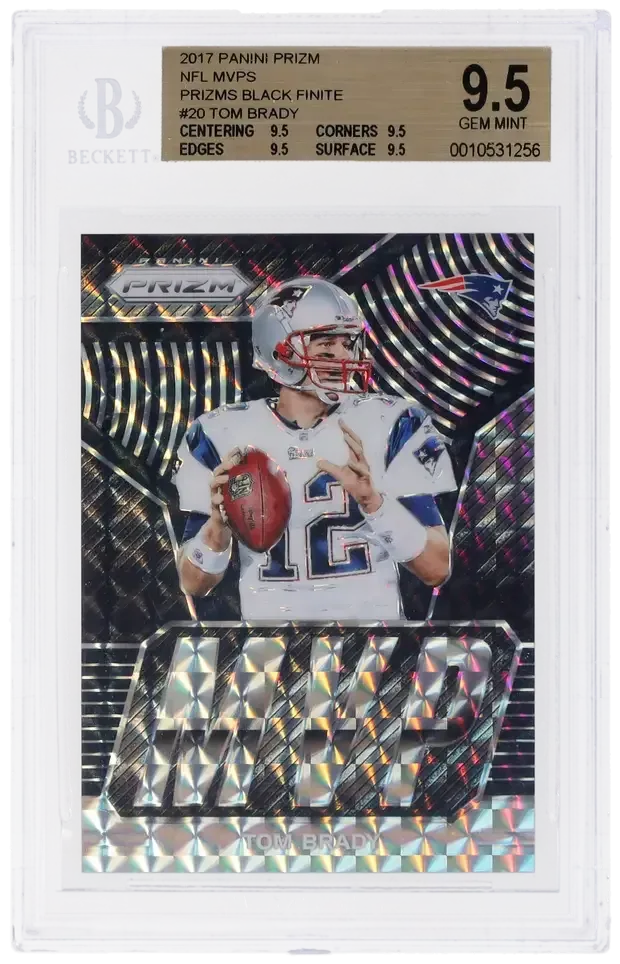
- 2017 Panini Prizm NFL MVP Black Finite Prizm /1 Tom Brady, BGS 9.5 — $33,600 on November 5 through ALT.
In total, those five transactions represent $350,510 in reported sales. That aggregate is not a market-wide Brady valuation, nor does it show the number of bidders or whether individual listings were auctions or fixed-price purchases. It does, however, show demand across several collecting lanes rather than a single hot parallel carrying the week.
1. Donruss Elite Status /10: the $126,000 leader
The leading card was the 2000 Donruss Elite Status /10, a Brady card limited to 10 copies and graded PSA 9. Its $126,000 November 5 result exceeded the next card on the list by $46,250. A PSA 9 is a condition assessment assigned by Professional Sports Authenticator; the grade is separate from the card’s stated scarcity, but both can matter to buyers.
For more context, explore Hot Wax Turns Tetrominoes Into Candles, Asking Players to Burn Through the Board.
This particular copy also has a useful prior public comparison. It previously sold for $137,521 through Lelands on September 25, 2021. The current $126,000 result is therefore $11,521 lower than that earlier reported price. That difference should be handled carefully. It compares one card across two transactions, not every Brady card, every copy of the issue, or the whole football-card market. Still, it gives prospective buyers a concrete reminder that even highly limited, graded cards can change hands at different prices over time.
The card comes from Brady’s 2000 period, after his college career with the Michigan Wolverines. Its serial numbering is especially straightforward: “/10” indicates a stated run of 10. For collectors, that makes it easier to understand the supply side of the card than it is with a more open-ended issue, although actual availability depends on how many copies are known, graded, held privately, or offered for sale.
2. Playoff Contenders: autograph appeal at $79,750
Second place went to a 2000 Playoff Contenders Brady autograph graded PSA 7.5, sold for $79,750 on November 3 via Fanatics Buy Now. It is one of Brady’s most widely recognized rookie-card formats, and its appearance near the top illustrates an important collecting distinction: a card does not need a one-of-one stamp to command a major result.
Related coverage includes Top 3 Tom Brady Football Card Sales of the Week Led by a 2000 Donruss Elite Status /10.
Autographs introduce another layer of desirability beyond the card itself. They also make grading labels more nuanced. A listing may provide a grade for the physical card, while other products can separately report an autograph grade. Here, the reported PSA 7.5 refers to the card listing as presented. Buyers comparing examples should take care not to treat a numerical grade as a universal shorthand for every component of a signed card.
The gap between the top two sales also speaks to the range represented by the list. The Elite Status /10 sold for roughly 58% more than the Contenders autograph. That is not proof that scarcity always outweighs signature appeal. It is simply what these two specific transactions recorded during the week, with different products, grades, and stated supply profiles.
3. Flawless Signature Platinum: one card, two grades
The third-highest sale was a 2016 Panini Flawless Signature Platinum /1, bringing $66,000 through ALT on November 5. It carried a PSA 8 card grade and an Auto 10 autograph grade.
That split label is worth unpacking. The PSA 8 evaluates the physical card’s condition, while the Auto 10 evaluates the quality of the signature. An autograph grade is not an endorsement of the player’s importance or the card’s investment potential; it is a separate evaluation of the ink signature as submitted. A collector interested in eye appeal may care about both pieces of information, while another might prioritize the one-of-one designation above all else.
“Platinum /1” marks this as a one-of-one: a card with a stated production total of one. On a list with two one-of-ones, the Flawless result finished well above the 2017 Black Finite Prizm despite receiving a lower card grade than that BGS 9.5 copy. That comparison demonstrates why a grade alone cannot explain price. Brand, autograph status, design, year, card type, and buyer preferences all differ.
4. A 2002 Super Bowl relic autograph reaches $45,160
The fourth sale was a 2002 Topps Super Bowl Game-Used Relic Auto /150, graded PSA 8, at $45,160 on November 7 via eBay. The card combines three features collectors commonly weigh separately: a stated limit of 150 copies, an autograph, and a game-used football relic tied to Super Bowl XXXVI.
A relic card contains a physical material embedded into the card. In this case, the listing identifies the material as a game-used football patch. That differs from a standard image-and-print card, and it gives the item a tangible connection to the game referenced on the design. It is also why details in the listing matter: collectors should distinguish game-used material from other relic descriptions rather than assuming every embedded swatch has the same provenance.
The reported PSA population figures add another dimension. There are nine PSA 8 examples in the available population data, while a single PSA 10 example is listed. That lone PSA 10 sold for $168,000 through Fanatics Premier on August 28, 2026. The difference between the PSA 8 sale and that PSA 10 sale is $122,840. This is a vivid example of how top-condition scarcity can produce a dramatically different outcome within the same card issue, although it remains a comparison of two reported sales rather than a formula that guarantees future pricing.
5. Black Finite Prizm begins the list at $33,600
The fifth sale was hardly a modest card: a 2017 Panini Prizm NFL MVP Black Finite Prizm /1 graded BGS 9.5 sold for $33,600 through ALT on November 5. BGS refers to Beckett Grading Services, another third-party grading company. Its 9.5 grade should be read within that company’s scale rather than casually converted into a PSA equivalent.
The Black Finite designation identifies a one-of-one parallel. In trading-card language, a parallel is a variation of a card design or release that is distinct from a standard version, often through finish, color, numbering, or other production treatment. The key point here is the stated single-copy production level: this is one Brady card with that specific 2017 Black Finite Prizm configuration.
Available sales information places the $33,600 transaction as the second-highest reported sale for a Brady Black Finite Prizm. The higher comparison is a 2016 Panini Prizm Black Finite Prizm /1, also graded BGS 9.5, which sold for $240,000 through Fanatics Premier on February 20, 2022. The two cards share a player, product family, one-of-one status, and grade company, but they are from different years. That alone is enough reason to avoid reading the older $240,000 result as a direct price guide for the 2017 card.
What this five-card sweep actually says
The most defensible takeaway is breadth. Brady appeared through early-2000s issues and 2010s releases; through a limited serial-numbered card, a recognized rookie-era autograph, a relic auto, and two separate one-of-ones. The weekly ranking therefore did not hinge on one format or a single condition tier.
It also shows why collectors should compare like with like. A one-of-one may be genuinely unique, but it can still differ substantially from another one-of-one based on year, set, autograph status, grading company, and the specifics of the transaction. A PSA 10 may be far rarer in a grading population than a PSA 8, but that does not mean every grade jump will create the same dollar spread. And a card’s earlier sale price is valuable context, not a promise of its next sale.
For collectors tracking Brady cards, this week’s results offer a compact checklist: verify the precise card and year, read the full grade label, distinguish card and autograph grades, understand whether scarcity comes from serial numbering or grading population, and look for prior sales of the exact issue whenever possible. Five Brady cards led the board, but their prices came from five materially different combinations of supply, condition, format, and collector appeal.