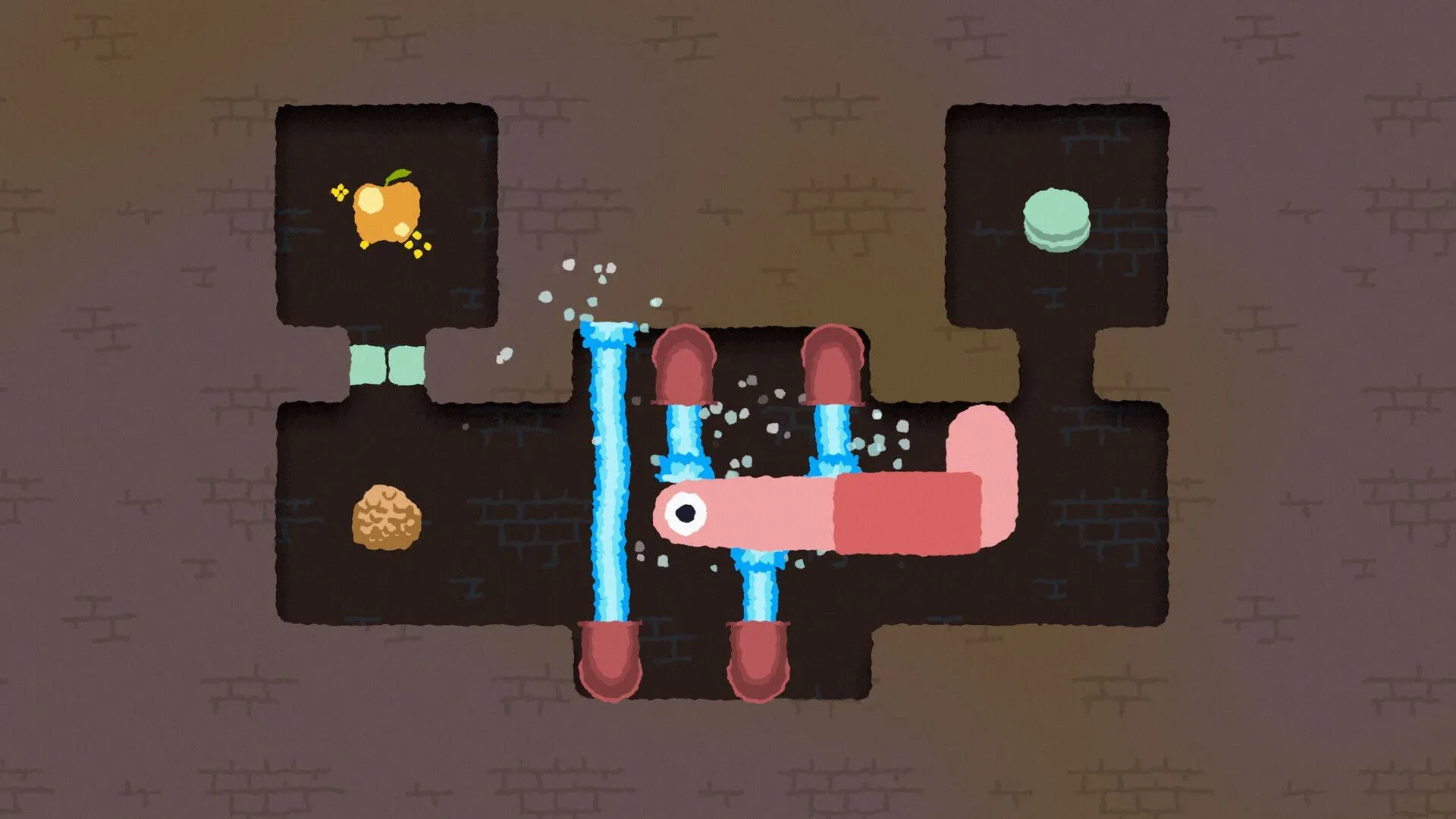
Hot Wax takes a recognizable puzzle-game silhouette and gives it a far less familiar objective: instead of treating completed horizontal lines as the natural end point, players must build a route that lets fire travel through candle-like tetrominoes. The result is a game about planned combustion, falling wax and the risk of sealing off the very flame needed to clear the board.
The game comes from PUNKCAKE Delicieux, the developer behind Shotgun King, and originated in a 2024 Ludum Dare game jam. That lineage matters because Hot Wax is not simply using a classic falling-block vocabulary for decoration. Its central rule changes what a good placement looks like. A tidy stack may be useful, but it is not automatically safe. The important question is whether the arrangement leaves an exposed, connected wick route for an ember to follow.
A block puzzle built around fire propagation
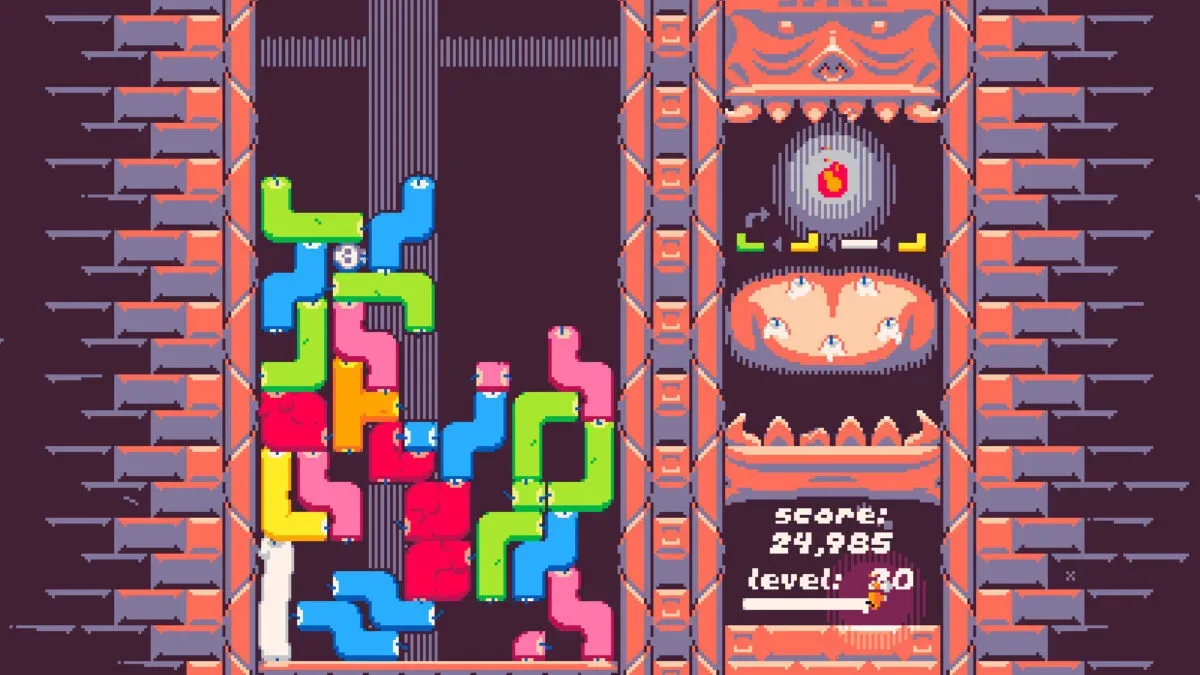
Hot Wax is set in a dark dungeon-like keep, where the player begins a summoning ritual using magical candles. Its pieces have tetromino shapes: forms made from four connected squares, best known from Tetris. But the similarity has a firm limit. Forming a full horizontal row does not make that row disappear.
Instead, the wax must be burned from the top down. After every few pieces, the game supplies a small ball of fire. This ember follows the candle’s path and can ignite other exposed twine that it reaches. In practical terms, a board state needs to do two things at once: hold incoming pieces in workable positions and preserve a route through which fire can spread.
That distinction shifts the puzzle from pure packing toward connectivity. Connectivity, here, means that the fire has a continuous usable path between candle sections. A player may see a satisfying, compact arrangement of pieces, yet still have a poor board if the twine is buried, interrupted or about to be covered by falling material. Conversely, a configuration with gaps or an odd-looking contour can be valuable if it provides the ember access to multiple sections of wax.
The game’s physical-looking consequence for burned material makes those choices more complicated. When wax sections are separated, remaining blocks fall downward, evoking the cascading terrain behavior associated with Mr. Driller. Falling can open fresh possibilities, but it can also create the game’s most dangerous failure condition: the ember can be smothered. Once covered, it goes out, leaving behind a basin of wax that can no longer be penetrated.
That is the central tension in Hot Wax. Fire is the clearing tool, but clearing changes the structure that fire still has to travel through. A successful burn can cause a collapse that improves the next setup, or it can drop wax into precisely the wrong place and extinguish the run’s momentum.
Why ordinary Tetris habits may not transfer cleanly
Traditional falling-block instincts reward efficient surfaces, low stacks and completed lines. Those principles are not useless in Hot Wax, but they are no longer the complete strategy. The player is not merely trying to minimize empty squares; they are trying to arrange a controlled burn.
That creates an interesting reversal. In many block puzzles, an enclosed pocket is a problem because it is difficult to fill. Here, it may be a problem for an additional reason: it can make twine inaccessible to the ember. Likewise, filling a gap can be a mistake if doing so seals a path that would have allowed one ignition to spread farther through the board.
Three ideas the game’s rules emphasize
- Exposure: Twine needs to remain available for the ember to touch. Buried or blocked candle paths cannot contribute to a larger burn.
- Sequencing: A placement that looks weak in isolation may prepare the board for the next ember. The timing of the fire matters as much as the shape of a newly placed piece.
- Collapse management: Because separated wax falls, players need to consider the post-burn board, not only the board before ignition. A collapse can either extend the chain or smother the ember.
This is why the game’s premise is more than a candle-themed take on falling pieces. The fire is effectively a second actor on the board. Players place tetrominoes, but then must account for an automated chain of movement and ignition. The puzzle includes both spatial planning—where a piece should go—and causal planning—what will happen after the wax burns away.
Modes alter the pace of a burn
The rules vary between modes. In the standard ritual, the flame advances one block per turn. That slower progression makes the fire’s movement part of the ongoing decision cycle rather than an instant resolution. Players have time to see the developing situation, but also have to keep planning while a burn remains in progress.
The standard ritual also includes devilish power-ups. Their specific effects have not been detailed, but their presence suggests a further layer beyond placement and ignition: players may have occasional tools that affect how they approach a risky board.
Other modes let the flame scorch straight through instead of moving a block at a time. The immediate appeal is obvious—watching a built-up candle route burn rapidly should make a successful setup feel decisive. But the faster behavior also serves an explanatory purpose. By resolving an ignition in a more direct sweep, it makes the underlying game logic easier to read: a connected and exposed route burns; a blocked or smothered one does not.
That readability is useful in a puzzle game whose rules challenge a deeply ingrained genre reflex. When a familiar visual language is paired with an unfamiliar win condition, players need clear feedback about why a plan worked or failed. The through-burning modes appear designed to make the chain reaction legible, while the turn-by-turn ritual turns that same logic into a longer tactical problem.
PUNKCAKE Delicieux keeps remixing established rules
Hot Wax fits a recognizable pattern for PUNKCAKE Delicieux: take a well-known game grammar and subject it to an aggressive change in purpose. Shotgun King did that to chess, while Hot Wax approaches the falling-block puzzle from below rather than reproducing its usual line-clearing loop.
The appeal of that approach is not nostalgia alone. Familiar forms give the player a starting point. Tetrominoes immediately communicate rotation, stacking and limited space. Then the altered rule forces a reassessment of the knowledge that recognition brings. In Hot Wax, the question is not “How do I complete this row?” but “Can I create a burn path that survives the consequences of being lit?”
The developer is also working on If Letters Had Pants, Would They Wear Them Like This?, which applies a similarly eccentric framing to word jumbles. Taken together, the projects suggest an interest in games that begin with a recognizable system and find the pressure point that can make it behave differently.
What is confirmed, and what remains unclear
The available details establish the core setting, candle-and-fire mechanics, differing mode behavior and the game’s game-jam origin. They do not establish a release date, price, target platforms, storefronts, or the full range of modes and power-ups. Those omissions are worth keeping separate from the mechanics already described, particularly for players trying to determine where or when they might play it.
For the broader PC puzzle audience, games like Hot Wax are a reminder that visual complexity and hardware demands are not the same thing. The current conversation around graphics capability can be found in this look at the graphics gap between an Apple M6 Mac mini and NVIDIA GPUs, but a rules-driven puzzle game is often defined more by clarity of systems and feedback than spectacle. That does not confirm any particular platform or performance target for Hot Wax; it simply explains why a small mechanical twist can be the story’s real draw.
Hot Wax therefore looks most promising not because it abandons the block-puzzle format, but because it puts a demanding new interpretation on it. Its wax does not politely vanish when a line is complete. It falls, blocks, exposes and threatens to extinguish the tool intended to remove it. The player’s job is to turn that volatility into a deliberate chain of fire.