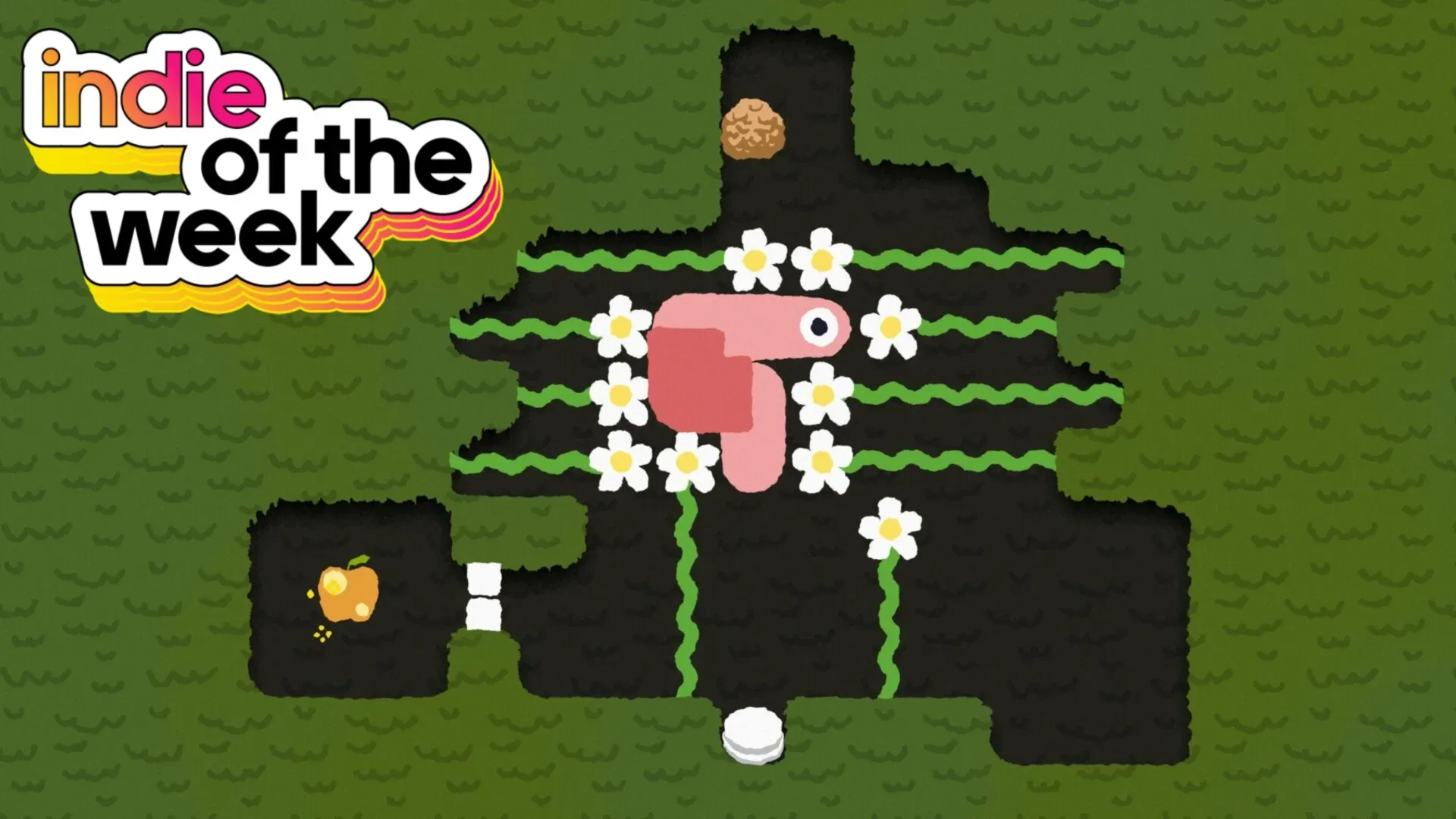
Woim is now available on Steam for $10, bringing a deceptively cute but notably demanding puzzle setup from solo developer dogspawn.net. Its central trick is an excellent one: take the ever-lengthening body-management tension associated with Snake, combine it with the spatial planning of a block-pushing puzzler, and make every apple potentially helpful, hazardous, or both.
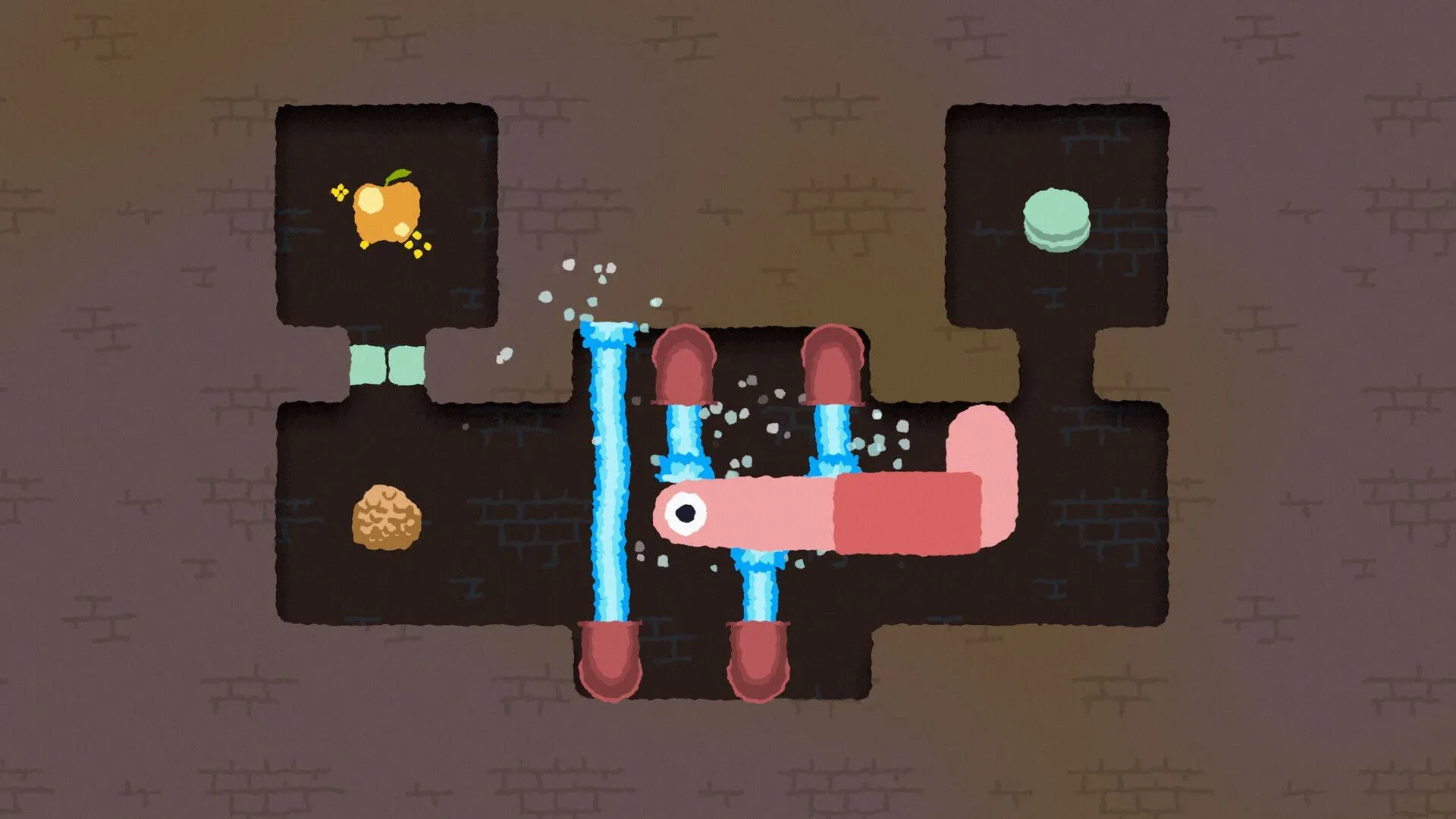
There are 50 puzzles in Woim, and the premise begins with a pink worm navigating earth-walled spaces. Eat apples, grow longer, manipulate the available space and reach the exit. The catch is that length is not just an upgrade. The worm may need to be long enough to touch a switch while also passing through the gate that switch opens. In another arrangement, that same extra segment can make a narrow corridor impossible to leave or allow the worm’s own body to block a route.
That makes Woim a game about state management as much as pathfinding. The state of a puzzle is not merely where the worm’s head happens to be. It includes its full shape, its length, the positions of pushed objects, which routes remain navigable, and whether a switch-and-gate relationship can be satisfied. A move that creates open space near the head may create a permanent liability at the tail.
Growth is a resource, not an automatic reward
Many games teach players to interpret a collectible as uncomplicated progress. An apple sounds beneficial because it makes the protagonist bigger, and bigger often sounds more capable. Woim turns that instinct into the main question of each room: when is more worm actually too much worm?
In a looping tunnel, for example, taking an extra apple might make it possible to reach a distant switch. It might also leave insufficient room to turn around, or force the body to occupy the only connection between two crucial parts of a maze. The important decision is therefore not simply whether an apple can be collected, but whether it should be collected now, later, or at all.
This is where the Snake comparison carries more weight than a visual similarity. In classic Snake, continued growth progressively narrows the safe movement options because the player must avoid colliding with the body. Woim applies that pressure to compact, deliberate puzzle rooms. The growing body is not background risk; it is the movable, persistent thing players must arrange with care.
What “Sokoban-like” means here
Woim is described as a 2D block-pushing puzzle game, placing it in conversation with Sokoban-style design. The defining puzzle tension in that tradition is commitment: pushing an object can solve a problem, but a careless push can leave it stranded in a position from which it cannot be retrieved or used correctly.
Woim adds another layer to that principle. Instead of only tracking where blocks go, players have to account for the worm’s changing body and the routes it will occupy. That creates a useful kind of mental friction. A player may identify the destination, yet still need to work backward through the order of moves: where the body must be when a switch is pressed, where it must not be when passing a gate, and how much room remains after each apple changes its size.
Related coverage includes Woim Twists Snake and Sokoban Into a Clever, Cheerful Puzzle Challenge.
The result is a compact puzzle language built from familiar ideas, but with an unusual lead character that is also part of the level geometry. The worm is the player avatar, but it can also become an obstruction, a bridge between objectives, or an accidental wall.
Switches and gates make position matter twice
The early switch-and-gate scenario captures Woim’s most interesting requirement. It is not enough to reach a switch. The worm must be arranged so one part remains in contact with that switch while another part can go through the opened gate. This is a positional puzzle with two simultaneous conditions.
That distinction is significant. In a conventional gate puzzle, activating the switch may permanently change the room and free the player to move on. Here, the gate can demand that the worm’s length and shape maintain the activation while the rest of its body proceeds. The answer is less about fast reactions than understanding how a continuous body can occupy multiple relevant locations at once.
It also explains why growth needs to be carefully rationed. A short worm may not span the necessary distance. A longer one may be able to reach both points, but then become too cumbersome to navigate elsewhere. Good puzzle design often makes a single rule create several competing needs; Woim’s body length appears to do precisely that.
Unlimited undo changes the mood of hard puzzles
The game’s most player-friendly feature may be its unlimited rewind button. Every move in a level can be reversed quickly, allowing experiments without the usual penalty of a full restart after a dead end.
That is more than a quality-of-life detail in a game based on irreversible-looking decisions. Puzzle players can test a theory, discover that an apple was taken at the wrong time, and zip back to the exact decision that caused the problem. If pushing, growing and navigating all interact, a rewind system reduces the friction between an idea and the evidence needed to judge it.
It also makes the difficulty more inviting. A hard puzzle can feel punishing when failure means replaying actions the player has already understood. Fast undo preserves the meaningful part: locating the flawed assumption, reconsidering the move order and trying a new configuration. Progress can still come from failure, but it need not come with excessive repetition.
For Woim specifically, rewind looks especially useful when the solution hinges on avoiding one additional apple or preserving access to a loop. Those are not always errors a player can see at the moment they are made. Being able to retract a sequence of moves encourages exploration of the puzzle’s possibilities rather than caution born of restart fatigue.
New mechanics arrive without a heavy tutorial wrapper
Woim expands its toolkit as players advance, introducing elements including mud, eggs and jigsaws. The game does not lean on lengthy explanations for these additions. Instead, players are left to encounter the new pieces and determine their role through the level design and experimentation.
That approach can make discovery itself part of the reward. Rather than being told every implication before a room begins, players can form hypotheses, use rewind to test them, then revise their understanding. The first appearance of being chopped in half signals the game’s willingness to surprise players with ideas that substantially change what seems possible.
There is a careful distinction here between unclear design and restrained instruction. Woim’s rewind system gives players room to investigate, while the room-sized puzzle format keeps each experiment focused. The game is not presented as a rush to absorb a tutorial checklist; it is built to let players learn through deliberate contact with its rules.
A cheerful presentation for a severe brain workout
The contrast between Woim’s lighthearted appearance and its strict spatial demands is part of the appeal. The visual setup may be cheerful, but the puzzles ask for close attention to movement order, available space and the unintended consequences of growth. That contrast can make a hard puzzle easier to approach: the game looks welcoming even when the room is quietly informing you that your tail has ruined everything.
Woim also benefits from being a focused proposition. It does not need elaborate action systems to produce tension. A maze, a worm, apples, a switch and a gate can be enough when every object matters to the final arrangement. The challenge comes from asking players to see the room as a connected system rather than a route from entrance to exit.
There was one unusual control issue observed with an Xbox controller: the worm was repeatedly pulled downward, creating the impression of gravity in the top-down underworld. That behavior was not intended, but it inadvertently produced a much harder alternate version of the game and required different techniques to manage movement. Players should regard that as a glitch rather than a standard Woim rule.
For players browsing recent PC releases, Woim is a small-scale puzzle game with a clear hook and a reassuringly forgiving approach to experimentation. The broader PC catalog is also receiving quality-of-life attention, including an Xbox PC app update focused on faster launches and a cleaner library, but Woim’s appeal is happily more immediate: grow carefully, do not corner yourself, and keep the undo button close.
At $10 on Steam, Woim offers 50 puzzles built around a simple question that grows harder with every apple: how much worm can one maze really handle?