Thanksgiving football has a peculiar way of making a single afternoon feel much larger than the standings. The audience is unusually broad, the routine is annual, and the games are attached to family memories as much as to box scores. That gives a dominant performance an unusually durable afterlife. For sports-card collectors, the connection can be even more direct: a player’s memorable holiday moment supplies context for cards from the same season, whether the card is a mainstream vintage issue, a low-numbered parallel, or a one-of-one with an autograph and memorabilia patch.
That relationship should not be overstated. A card’s market value is not a simple reward for one game; scarcity, condition, player legacy, set design and collector demand all matter. Still, Thanksgiving provides a useful lens for comparing eras. The list runs from Walter Payton’s all-purpose brilliance to Barry Sanders’ cutting runs, Randy Moss’ national unveiling and Mark Sanchez’s infamous fumble. It also shows why two cards connected to great players can sell for radically different amounts.
Tom Brady’s 2010 comeback and a true one-of-one
Tom Brady and New England entered halftime against Detroit down 17-10, then turned the second half into a four-touchdown answer. Brady threw all four of his passing scores after the break as the Patriots won 45-24. He found Deion Branch twice and Wes Welker twice, completed his final 11 passes, and posted a 158.3 passer rating.
Passer rating is the NFL’s traditional efficiency formula for quarterbacks. It incorporates completion percentage, yards per attempt, touchdown percentage and interception percentage; 158.3 is its maximum possible score. Brady’s Thanksgiving rating put him alongside Dave Krieg as the only quarterbacks cited with a perfect rating on the holiday.
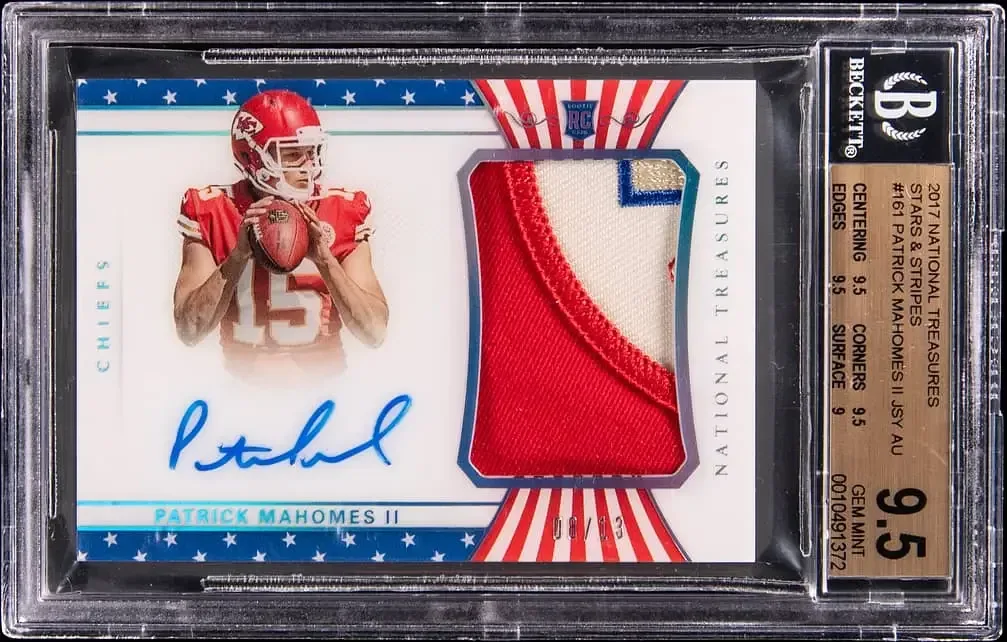
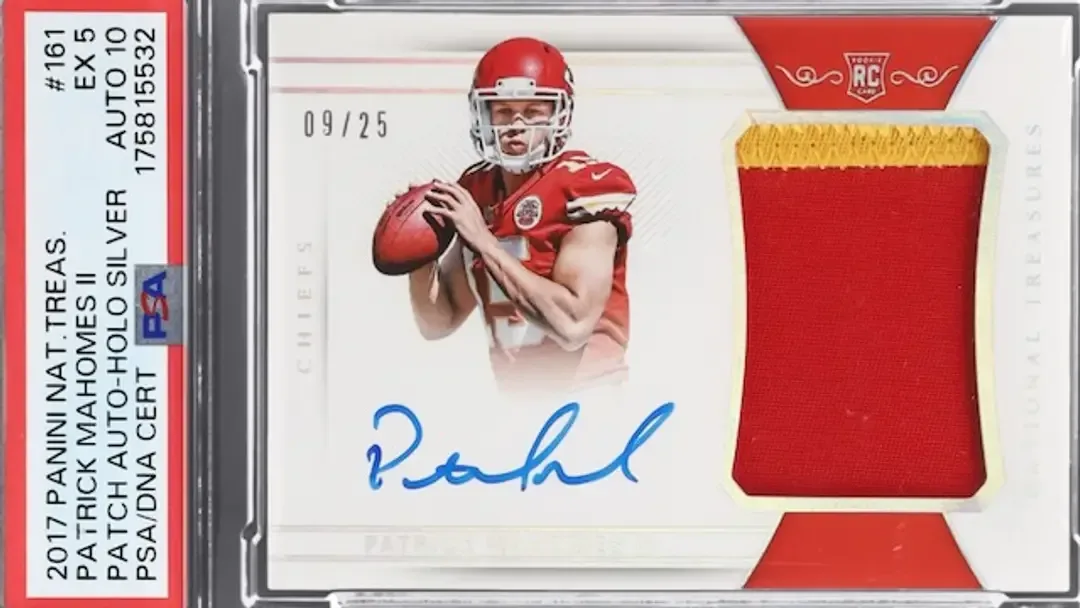
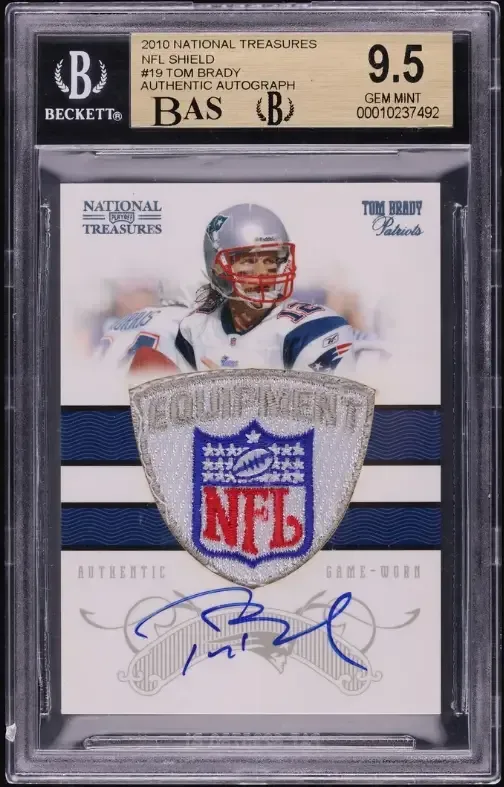
The game fit squarely inside a remarkable 2010 season. Brady led the league with 36 touchdown passes, threw only four interceptions—the lowest total of any full season in his career—and won the second of his three MVP awards. That seasonal profile helps explain the interest in premium 2010 issues. A BGS 9.5 example of his 2010 National Treasures NFL Shield Patch Auto, a one-of-one, sold for $168,000 in December 2024. Three other one-of-one Brady cards from that year also exceeded $50,000, including a Panini Absolute Memorabilia Dual Shield.
“One-of-one” means the manufacturer designated that particular card as the sole copy of its parallel or configuration. It does not automatically make every one-of-one equally desirable, but pairing that scarcity with Brady, an NFL Shield patch and an autograph creates an exceptionally specific collectible. A BGS 9.5 is a high grade assigned by Beckett Grading Services; the card is encapsulated in a protective graded holder commonly called a slab.
Peyton Manning’s nearly flawless 2004 Thanksgiving
Peyton Manning’s lone Thanksgiving appearance was a clinical demolition of Detroit. He threw six touchdown passes against just five incompletions, took no sacks and committed no turnovers. Three touchdowns went to Marvin Harrison and three to Brandon Stokley. Manning had already put Indianapolis ahead 41-9 when he exited with 2:11 left in the third quarter.
The six scores tied Bob Griese for the most passing touchdowns on Thanksgiving. It was also Manning’s fifth consecutive game with at least four touchdown passes during the campaign in which he set what was then the NFL single-season record with 49 touchdown passes and earned his second MVP.
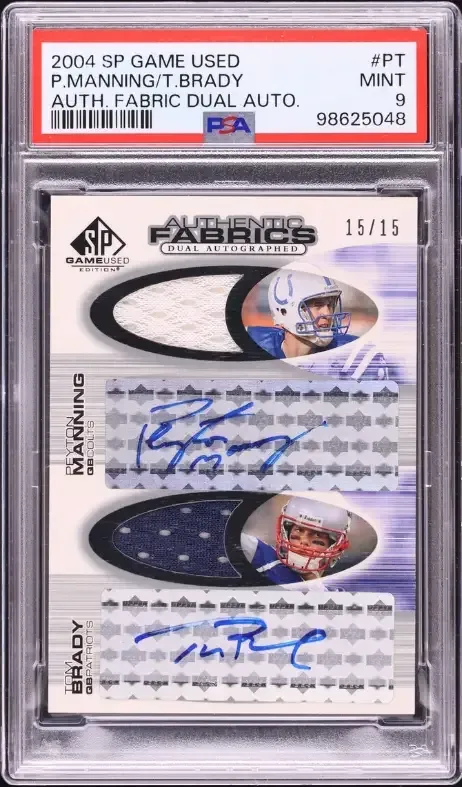
The season’s card market includes a particularly appealing shared piece: a 2004 SP Game Used Authentic Fabrics Dual Patch Auto featuring Manning and Brady, limited to 15 copies. A PSA 9 sold for $15,600 in December 2025. PSA, or Professional Sports Authenticator, is another grading company, while a dual patch auto combines swatches of memorabilia material with signatures from both players. Its limited print run helps, but the enduring appeal is the pairing of two rival quarterbacks whose careers became central to the era.
Walter Payton’s complete 1977 showcase
Walter Payton offered a reminder that a running back can dominate a game in more ways than carrying the ball. In Chicago’s 31-14 Thanksgiving win over Detroit in 1977, Payton rushed for 137 yards and a touchdown, then added four receptions for 107 yards, including a 75-yard receiving touchdown.
It was the peak Thanksgiving performance in a small but potent holiday body of work. Payton also ran for 123 yards in an overtime game against Detroit in 1980 and 179 yards in a 10-9 loss to Dallas in 1981. His 1977 season ended with 1,852 rushing yards, 579 more than the next-closest player, plus 14 touchdowns, First-Team All-Pro recognition and the league MVP.
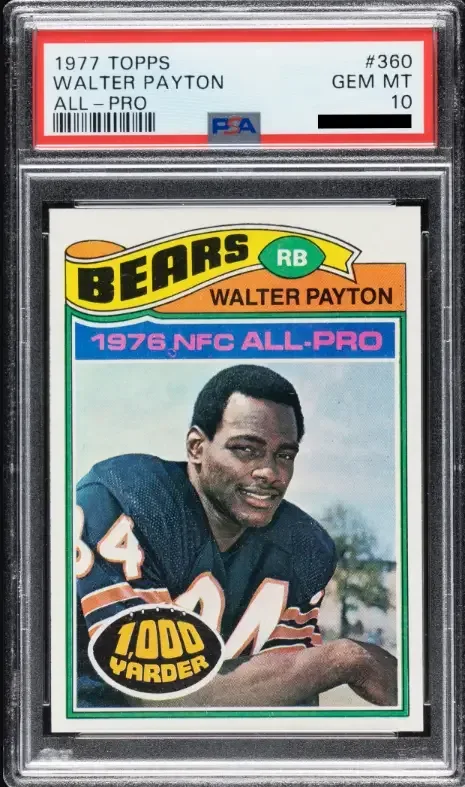
His 1977 Topps #360 is a second-year card, behind the 1976 Topps rookie in overall sale prominence. A PSA 10 copy last sold for $24,400. The gap between a gem-mint card and a merely strong copy is an essential vintage-card lesson: the reported PSA 9 value rose 86.97% year over year, from $1,750 to $3,272, but that remains far below the PSA 10 result. Centering, corners, edges and surface condition can have outsize financial consequences on cards that were originally handled, stored and traded by children.
Barry Sanders, Earl Campbell and the Thanksgiving running-back clinic
Barry Sanders recorded an NFL-record four Thanksgiving outings with at least 130 rushing yards. His 1997 game against Chicago delivered 167 yards and three touchdowns in a 55-20 Detroit victory, a total listed as the fifth-highest rushing output in holiday history. His scores came from 40, 25 and 15 yards out, a compact illustration of why Sanders’ open-field direction changes remain so memorable.
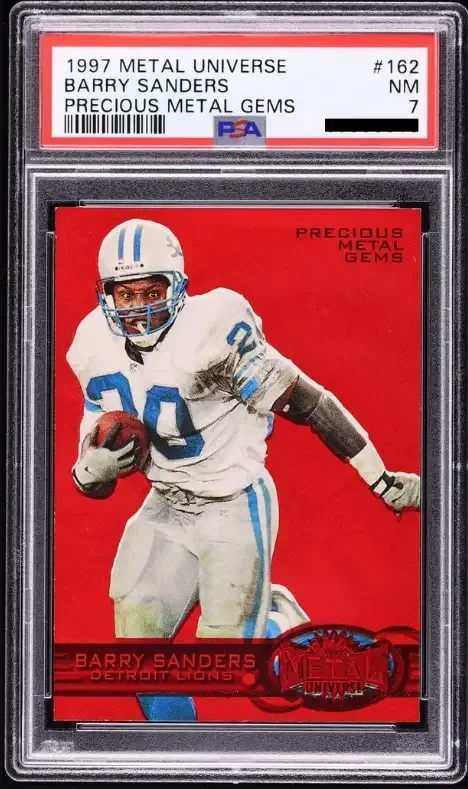
The corresponding centerpiece is the 1997 Metal Universe Precious Metal Gems Red, numbered to 135. A serial-numbered card has an explicit print limitation, here indicating an edition of 135. Sales cited for Sanders’ card rose from $19,200 in March 2023 to $28,800 in September 2025 and $34,167 in May 2026. Those are individual sale points rather than a promise that every example will command the same number, but they show sustained collector attention toward this celebrated parallel.
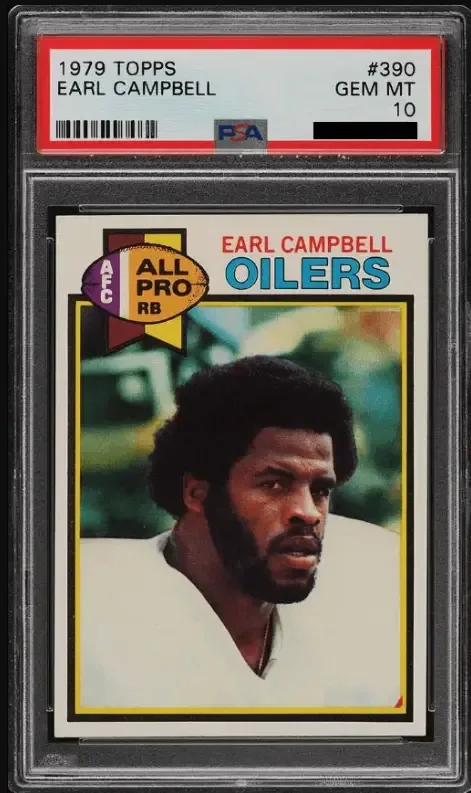
Earl Campbell offered the opposite visual style: force rather than evasion. Against Dallas, the Oilers runner produced touchdown runs of 61 and 27 yards in the first half and finished with 195 rushing yards in a 30-24 win. Only O.J. Simpson’s 273-yard Thanksgiving rushing total ranks above Campbell’s on the holiday list referenced here. Campbell led the NFL in both rushing yards and rushing touchdowns that season, received First-Team All-Pro recognition and edged Dan Fouts for MVP.
Campbell’s 1979 Topps #390 demonstrates how difficult high-grade vintage can be. The PSA 10 population is just 30, with a reported gem rate of 0.35%; its last sale came in just under $19,000 in February 2021. A PSA 9 increased 21.65% over the cited year, moving from $822 to $1,000. Population means the number of copies a grading company has assigned at a particular grade, not the total number of cards in existence. It is useful context, but it should not be treated as a complete census.
Randy Moss’ national arrival and a low-grade rarity
Randy Moss’ rookie Thanksgiving performance is the kind of stat line that needs no elaborate framing. With Randall Cunningham throwing to him, Moss caught touchdown passes of 51, 56 and 56 yards. The playmaking display introduced his talent to a vast holiday audience and foreshadowed a season in which he led the NFL with 17 touchdown receptions, a rookie record that still stands. His 1,313 receiving yards remain the sixth-highest total by a first-year player.
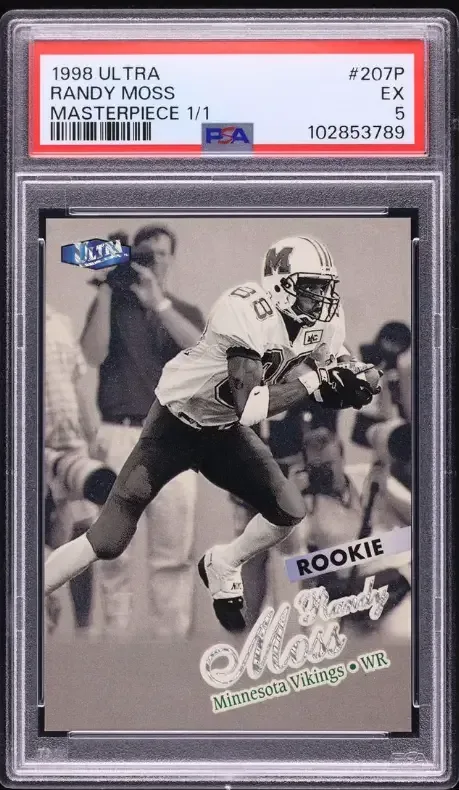
His 1998 Ultra Masterpiece #207P is a one-of-one that sold for $36,000 in February 2025, despite a PSA 5 grade. That detail matters. Collectors sometimes reduce grading to a single rule—buy the highest number available—but scarce cards complicate it. A PSA 5 ordinarily signals substantial condition limitations compared with a gem-grade example. Yet when the item is the only designated copy, its rarity, rookie-season relevance and Moss’ stature can outweigh the numerical grade for buyers. The sale was the second-highest rookie-year Moss card in the cited sales database, behind the E-X2001 Essential Credentials Future.
O.J. Simpson’s Thanksgiving rushing record
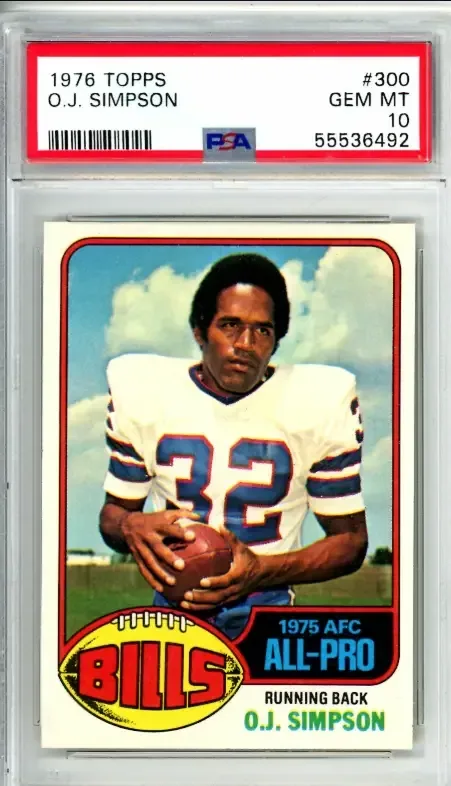
On the field, Simpson’s 1976 Thanksgiving performance remains the standard for raw holiday rushing production. He ran for 273 yards and a touchdown against Detroit in a 27-14 loss, breaking his own NFL single-game rushing record. The 273 yards still stand as the Thanksgiving record and rank sixth on the NFL’s all-time single-game list cited here.
Simpson also led the league in rushing that season and earned First-Team All-Pro and Pro Bowl honors, three years after his 2,000-yard season in a 14-game schedule. A PSA 10 1976 Topps #300 sold for $1,000 on November 23, the highest recorded sale noted for the card. Its reported PSA 10 population is 59, with a five-percent gem rate. The comparatively modest price beside some modern rarities is a useful warning against ranking cards by a player’s statistics alone: collector demand is affected by many factors beyond football accomplishments and scarcity figures.
Sterling Sharpe’s record four receiving touchdowns
Sterling Sharpe’s 1994 game against Dallas ended in a 42-31 Green Bay loss, but the individual output remains unmatched on Thanksgiving: nine catches, 122 yards and four receiving touchdowns. He later made the Pro Bowl after leading the league in touchdown receptions and placing fifth in catches.
That season became Sharpe’s last. A neck injury forced him to retire at 29 after seven seasons, and he was inducted into the Pro Football Hall of Fame in 2025. His playing-era cards do not carry the same premium breadth as later, more elaborate releases, but they give collectors a focused path into his career. A PSA 10 copy of 1994 Ultra Flair Hot Numbers #12 sold for $199 on September 29, 2026; a PSA 8 Finest Refractor sold for $129 the prior year. A refractor is a card treatment known for its reflective finish, often differentiated from the base version of the same design.
Mark Sanchez and the collectible value of infamy
Not every enduring Thanksgiving highlight is heroic. With the Jets trailing New England 14-0, Mark Sanchez ran into teammate Brandon Moore’s backside, lost the ball and watched Patriots safety Steve Gregory return it for a touchdown. New England scored three touchdowns in 52 seconds and went on to win 49-19. The play became widely known as the “Butt Fumble,” a mishap whose place in football culture has outlasted its original game context.
That notoriety creates a different collecting proposition from the Brady or Manning examples. A 2012 Panini Prizm Gold Prizm, numbered to 10, sold in PSA 10 condition for $1,600 in November 2025. The card is scarce, but its appeal can be driven by humor, nostalgia and a famous moment as much as by traditional superstar collecting. It is a reminder that the hobby does not exclusively preserve greatness; it also preserves the moments fans cannot stop replaying.
For more football-adjacent entertainment context, see our review of Madden. On the card side, the practical takeaway is simpler: identify the exact card, verify its grade and serial numbering, understand whether a reported figure belongs to a specific sale rather than an entire market, and let personal connection matter. Thanksgiving’s best games are remembered because the numbers were spectacular; the cards endure because they give those memories a physical, highly specific form.