The 2026 NFL season is three weeks old, which is just enough time for collectors to overreact responsibly, irresponsibly, and with at least one browser tab devoted to recent sales. The early card-market story is not simply that undefeated teams and hot players are attracting attention. It is that different kinds of football success are producing very different collecting decisions.
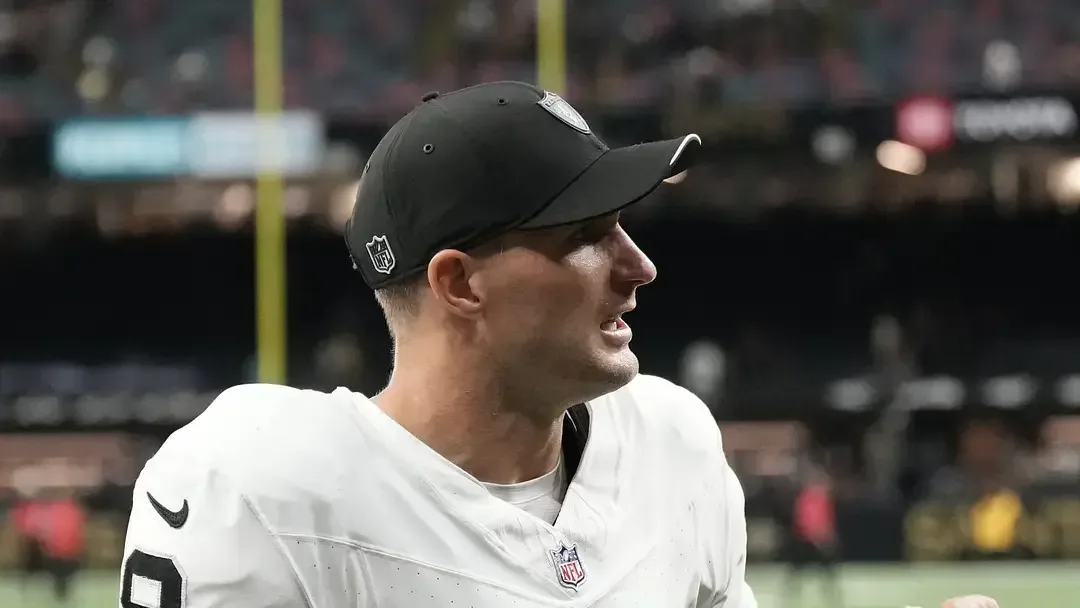
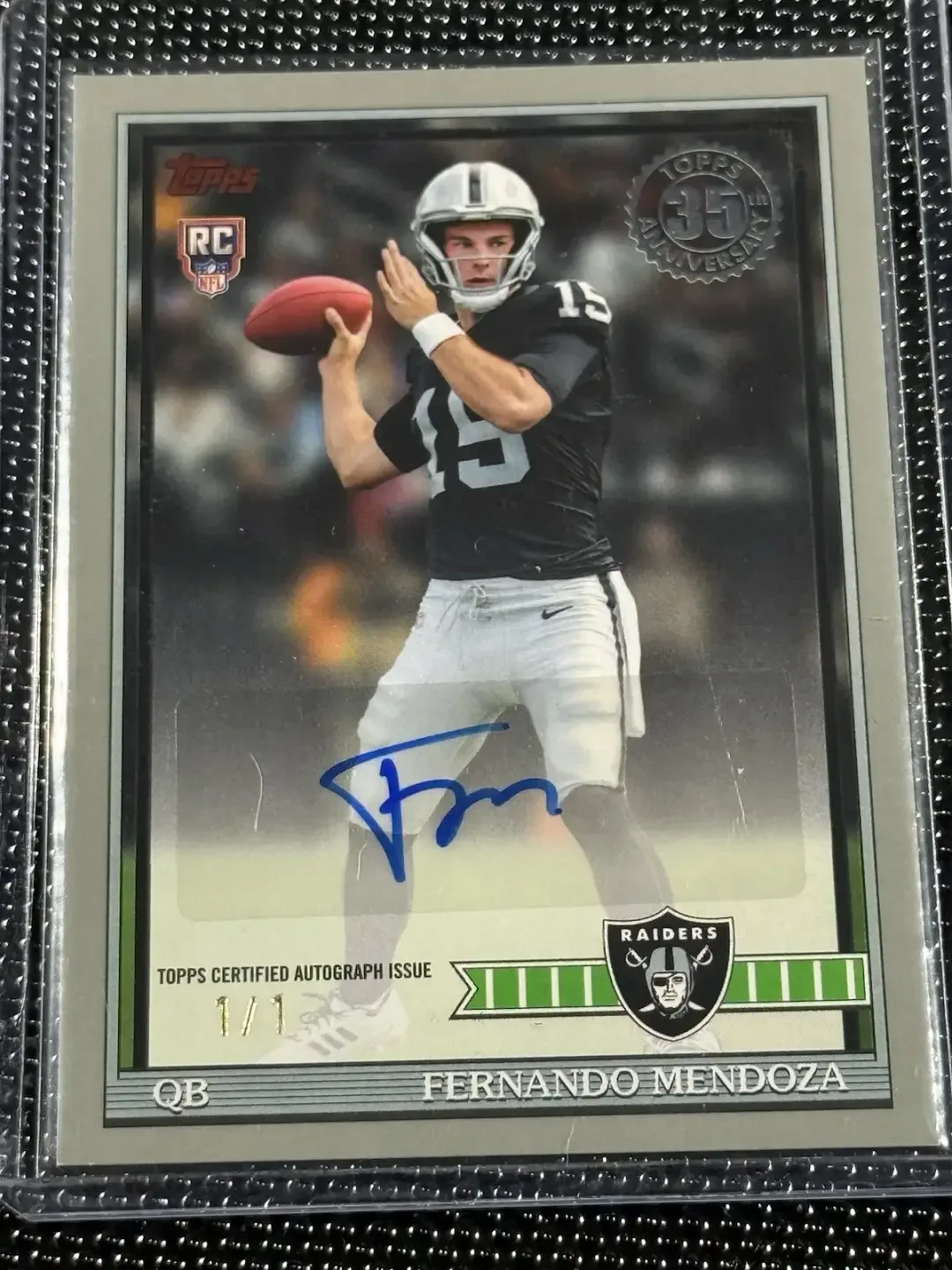
Las Vegas is 3-0 with Kirk Cousins playing well enough to make any immediate quarterback change difficult. That leaves No. 1 overall pick Fernando Mendoza in a strange position: he remains the Raiders’ long-term attraction, but the on-field event that could rapidly reprice his cards—his first meaningful NFL action—has been delayed by a winning team.
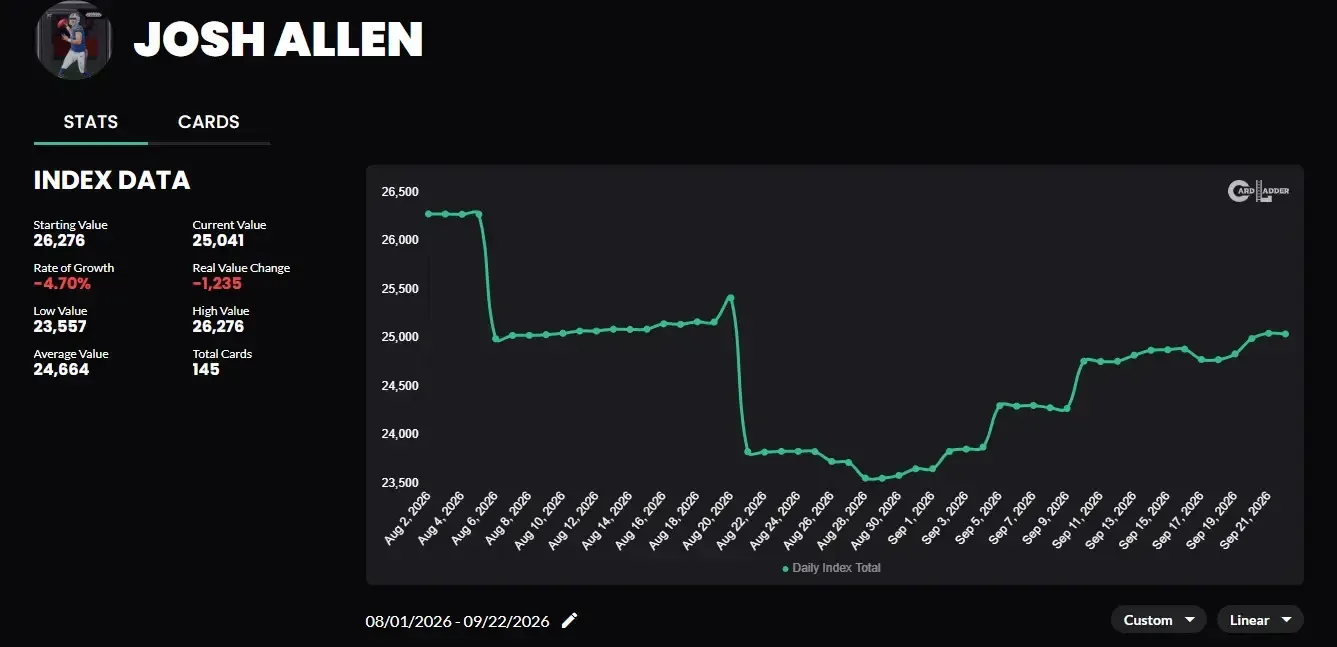
Elsewhere, Bijan Robinson and Jahmyr Gibbs are putting up startling early totals and their graded flagship-style parallels have moved higher than their summer levels. Josh Allen and Buffalo, meanwhile, offer the more complicated case. The Bills are unbeaten, Allen is the MVP favorite, and Buffalo has the second-shortest Super Bowl odds cited at +750, yet collectors remain reserved about how close his market can get to the game’s most celebrated quarterback cards without a championship run.
That is the useful Week 3 reminder: a card market does not merely price the last box score. It prices opportunity, scarcity, expectations, team context, and—sometimes most of all—the thing a player has not done yet.
The Raiders’ winning streak is both great news and an awkward rookie-card development
For the Raiders, a 3-0 opening is a notable departure from recent history. It is only the third time in 25 years that the franchise has begun a season undefeated through three games. It also creates an unusual situation for a team coming off a draft in which it selected Mendoza first overall.
The usual narrative around a highly drafted quarterback is simple enough for the hobby to understand. The veteran starts until the team falters, the rookie takes over, and the first starts create an immediate wave of attention around rookies, autographs, short prints, and numbered parallels. That path was already an assumption rather than a guarantee, but Las Vegas’ results have made it especially hard to treat as inevitable.
Cousins has thrown three touchdowns in each of his first three contests, and the team’s success has been linked directly to how well the offense is functioning under Klint Kubiak. A club that is winning decisively has very little sporting reason to bench its quarterback just to activate a more convenient rookie-card plotline. Football coaches, regrettably for anyone holding a stack of shiny cardboard, do not generally make depth-chart decisions to improve auction-page excitement.
Practical implication for Mendoza collectors: an expensive rookie card can remain expensive without becoming immediately more valuable. If Mendoza does not play, the market lacks fresh NFL performance data to reframe expectations. That can mean a period of relative stagnation rather than a collapse: the player is still the presumed heir apparent, but collectors have fewer reasons to rush into the market at higher prices.
Related coverage includes Raiders Start, RB Surge and Josh Allen Define Week 3 Card Market.
That is particularly relevant here because Mendoza is described as the most expensive rookie during Topps’ major licensed return to football. In collecting terms, a licensed product is one authorized to use league and team branding. It can be a significant factor in demand because many collectors strongly prefer cards that carry official uniforms, logos, and related visual identity. The result is a high-profile rookie with a high-profile product situation—and no obvious timeline for his first NFL start.
Why patience may be the less glamorous, more logical play
The bullish case for Mendoza has not disappeared. The 2026 rookie class is otherwise characterized as lackluster, leaving him as a central focal point for collectors seeking a quarterback prospect. If he does enter the lineup and plays well, the delayed debut could concentrate attention rather than erase it. A rookie quarterback producing in an offense that Cousins has already shown can score would be an extremely appealing story.
But that possibility needs to be separated from a conclusion. Cousins’ production does not prove Mendoza will immediately replicate it. The Raiders’ 3-0 record does not establish when a transition will happen. And a high price for a rookie card is not a promise that an NFL debut, whenever it arrives, will push prices further upward.
For collectors, the distinction is between buying a current role and buying a future outcome. Mendoza’s cards are overwhelmingly the latter at the moment. Someone collecting for personal enjoyment may be comfortable with that uncertainty. Someone treating a purchase as a short-term performance bet should recognize that the most obvious catalyst is currently being postponed by the exact success Raiders fans want.
There is also a team-wide angle worth watching. Ashton Jeanty and Brock Bowers have each delivered early week-winning moments. If the Raiders continue to win and eventually hand the offense to Mendoza, the appeal of collecting the club’s major offensive pieces could rise together. That is a scenario, not a guarantee, but it illustrates why quarterback changes can affect more than one player’s cards. A credible young offense gives collectors a shared narrative across several markets.
Robinson and Gibbs are forcing running back cards into the conversation
The running back market has long faced a credibility issue among sports-card buyers. Quarterbacks usually command the most attention because their visibility, positional importance, and long-term narratives can be enormous. Running backs can create spectacular weekly highlights and still encounter collector skepticism over career length, workload, and the tendency for the market to concentrate on passers.
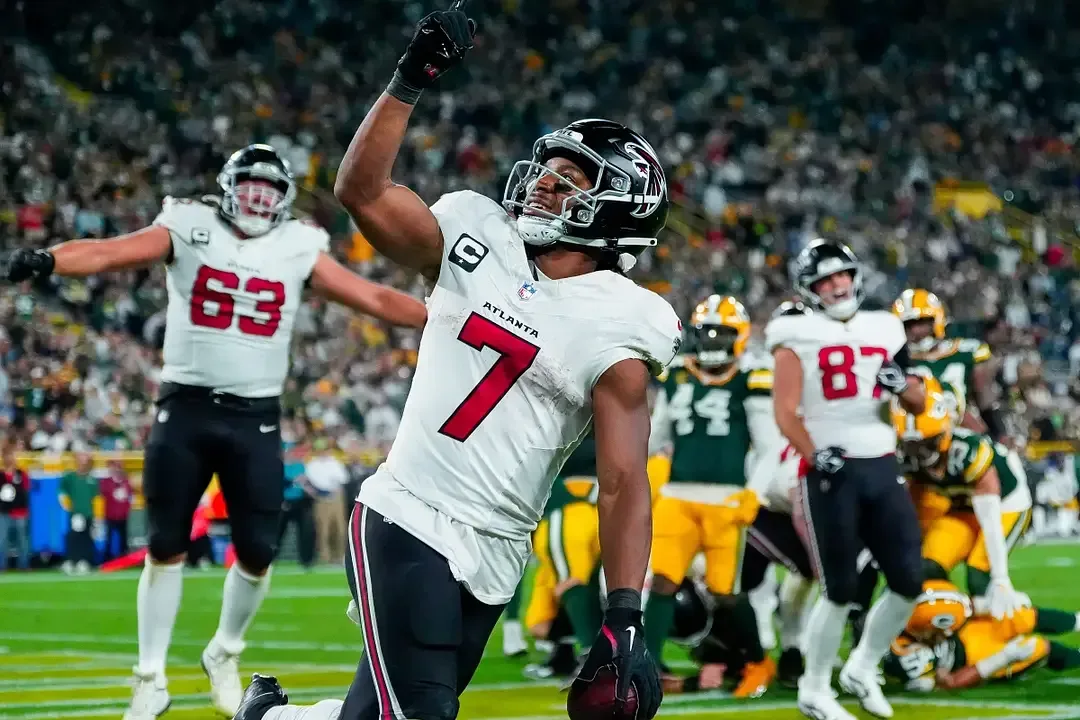
Bijan Robinson and Jahmyr Gibbs have supplied a very direct rebuttal through three weeks. Robinson has 467 total yards. Gibbs has 463 total yards and six touchdowns. Their combined early production trails only O.J. Simpson’s 491 total yards in 1973 and Emmitt Smith’s 474 in 1995 among the cited three-game starts since the NFL merger.
Those figures do not settle an entire season, much less redraw the long-term hierarchy of football cards. They do show why their markets have gained momentum. Exceptional counting stats make an easy collecting narrative, and the fact that both players entered the league in the 2023 draft gives buyers a natural comparison point. They are not unrelated hot streaks; they are a matched set of elite young backs producing at nearly the same historic pace.
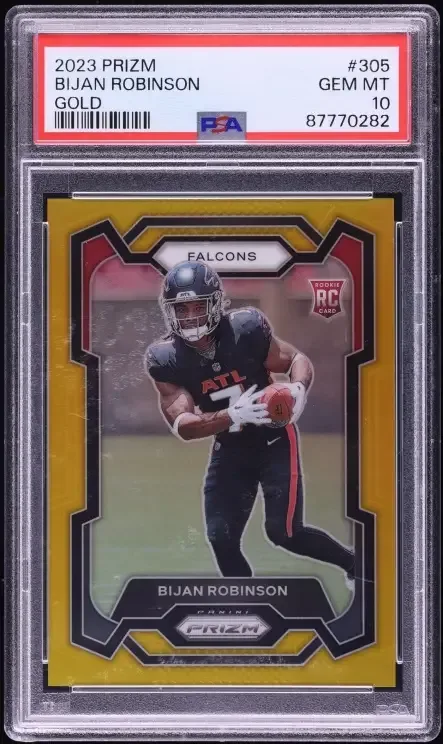
Recent sales suggest collectors have responded. Robinson’s 2023 Silver Prizm graded PSA 10 has recorded multiple sales around $220 after selling in the $150-to-$180 range over the summer. Gibbs’ comparable 2023 Silver Prizm PSA 10, which had sold near $200 during the summer, has had several sales near $300 within 60 days.
What those labels mean: Prizm is a card brand, while Silver refers to a parallel, or alternate version, with a distinctive finish compared with a standard base card. PSA 10 is a top grade assigned by Professional Sports Authenticator and signals a card assessed as gem mint under that company’s standards. A comparison between the same player, year, card type, and grade is far more useful than comparing a raw card with a graded one, or a rare autograph with a widely issued base parallel.
The percentage movement is notable, but buyers should avoid turning a handful of recent sales into a permanent valuation rule. Recent sales can reflect genuine rising demand, yet they can also be shaped by how many copies reached the market, the timing of a prime-time performance, and which buyers happened to be bidding. A completed sale is evidence of what one buyer paid at one moment; it is not an all-purpose appraisal for every copy.
The team context is different, and that matters
Robinson’s and Gibbs’ cards have risen amid very different team stories. Detroit’s offense has generated substantial production, but the Lions have allowed the most passing yards and the second-most total yards through three games. That leaves Gibbs with a fascinating card-market setup: explosive individual output plus a team that may need to keep scoring, alongside uncertainty created by a struggling defense.
Atlanta’s opening has been more uneven. The Falcons did not reach the red zone on any possession during the first two weeks despite Robinson’s work. Michael Penix’s return then helped reinvigorate the offense in a Thursday-night rout of Green Bay. For Robinson, the appeal is not just workload; it is the prospect of his outstanding total-yardage pace pairing with an offense capable of turning those drives into clearer scoring production.
For both players, sustained performance is the key word. Their early totals have made running back cards harder to dismiss, but the market will be testing whether this is a three-game spark or the beginning of a season-long case. Football cards can move quickly when a player looks like the answer to a weekly fantasy lineup. They become more durable collecting targets when the production survives changing game scripts, defensive attention, and the long middle of the schedule.
Collectors who want to follow the move should look for repeated comparable sales rather than a single headline result. Track the same card, same grade, and ideally similar sales setting over time. The broader principle applies across collectibles markets: knowing what “sales” represent, and what they do not, is essential when reading any debate about what sales actually mean.
Josh Allen’s market is still grading the postseason, not the September report card
Allen’s situation is almost the mirror image of Mendoza’s. He has no shortage of playing time, production, or visibility. Buffalo is undefeated through three weeks despite a difficult opening stretch, and the team’s offense has continued to function after Sean McDermott was replaced as head coach by former offensive coordinator Joe Brady.
Allen is the odds-on favorite for MVP, while Buffalo’s Super Bowl odds are listed at +750, behind the Rams at +650. Under normal hobby logic, that would seem like an ideal recipe for a meaningful leap: elite quarterback, undefeated team, individual award momentum, and credible championship odds. There has been some positive movement, but the described response has been cautious rather than explosive.
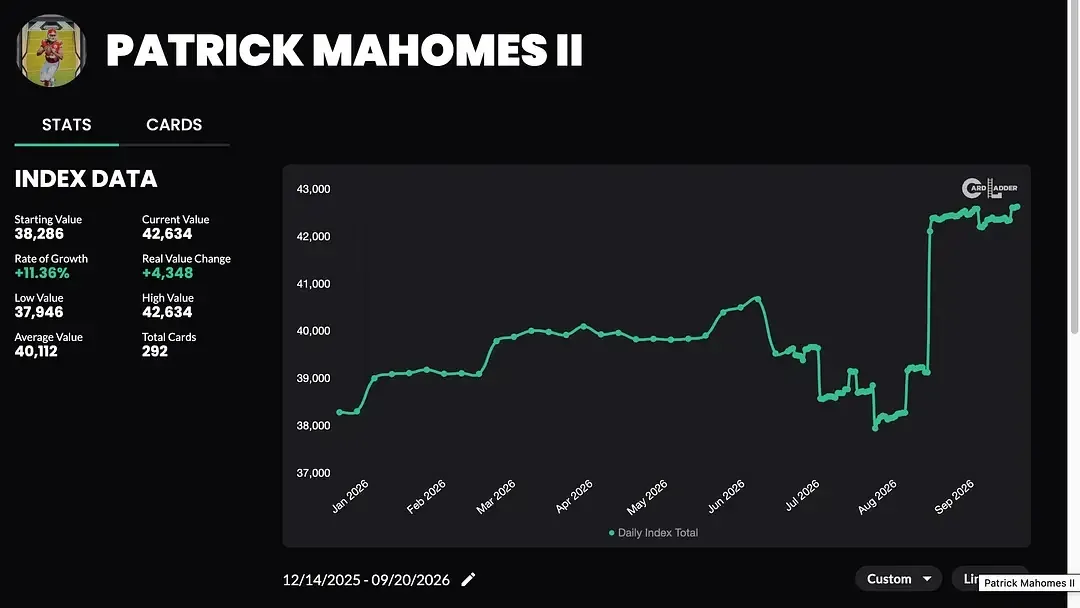
The reason is straightforward even if it is unforgiving. Allen’s card market is viewed through the lens of postseason achievement. Patrick Mahomes has already established the modern benchmark among active quarterback collecting markets, while the most iconic veteran markets, including Tom Brady’s, are out of reach for many collectors. Allen’s regular-season body of work is impressive, but the market appears to be reserving its biggest repricing for a Super Bowl appearance or victory.
This is the difference between performance value and legacy value. Performance value responds to the immediate season: touchdown totals, wins, MVP chatter, and memorable games. Legacy value reflects the accomplishments collectors believe will remain central years later. Championships often matter to that second category because they simplify the story buyers tell themselves about a player.
That does not mean regular-season success is irrelevant. An unbeaten Buffalo entering Week 9 would require wins over the Rams, Ravens, and Raiders, with two of those games carrying possible seeding significance. Clearing that stretch would give Allen and the Bills more than a strong record; it would provide a stronger argument that this roster belongs in the championship tier. From mid-November onward, Buffalo is projected to face only four teams with records above .500, making the early portion especially important to that narrative.
Still, collectors should recognize the market’s apparent stance: Allen does not need more proof that he is a great regular-season quarterback. He needs the kind of postseason result that changes the historical category in which many buyers place him. That is a much bigger hurdle than winning in September, even when winning in September looks as convincing as it has so far.
Week 3’s card-market lesson: opportunity is part of the price
The Raiders, the two running backs, and Allen offer three distinct forms of football-card uncertainty. Mendoza has prospect appeal but no immediate route to the field. Robinson and Gibbs have immediate production and rising comparable sales, but must sustain a position-defying pace. Allen has elite credentials and a winning team, but his largest market question is tied to playoff history rather than the next regular-season matchup.
That makes restraint less boring than it sounds. Track real sales, understand the exact card being compared, and identify what has to happen next for a narrative to change. The most important Week 3 developments may not be the prices that already moved. They may be the events collectors are still waiting to see: Mendoza’s debut, a sustained season from the league’s most dynamic backs, and whether Allen’s Buffalo finally turns regular-season dominance into the achievement the hobby appears to want.