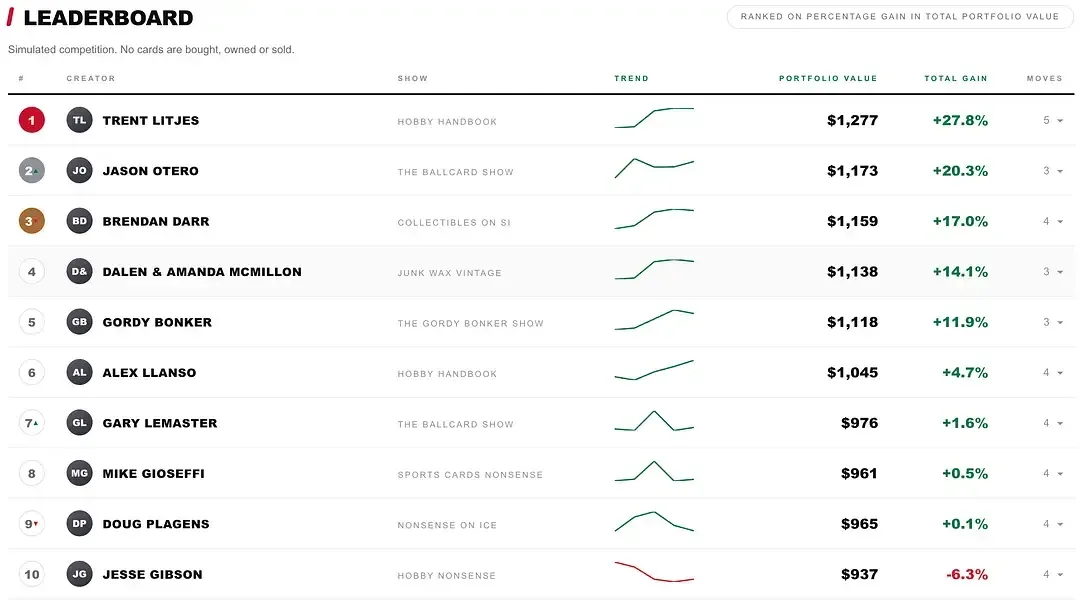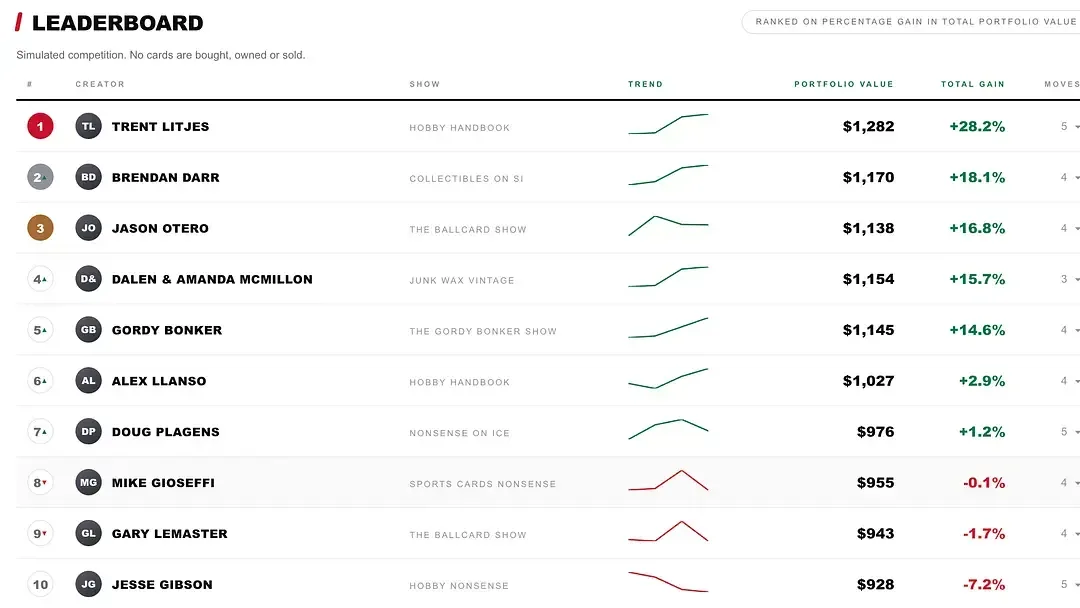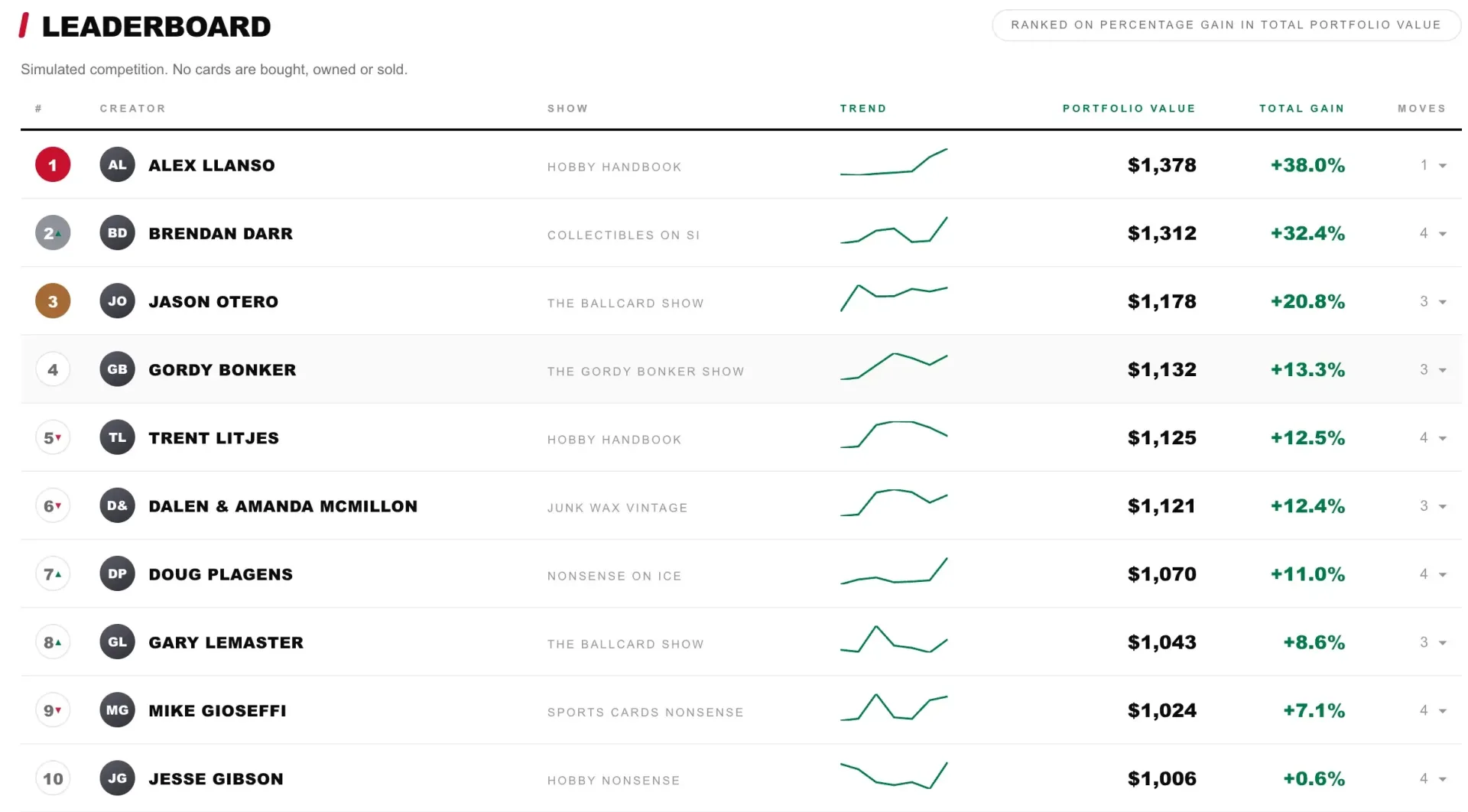
Every portfolio in the Week 7 football card challenge has moved into positive territory, a sharp contrast with the uneven returns earlier in the season. The standings have tightened after an active prior trading period, while the latest window brought an unusual pause: no participant made a new move.
That stillness is meaningful in a contest built around player-card performance. When every roster is showing a gain, participants have less immediate incentive to sell a position at a loss or chase a different player before the next slate of NFL games. It does not mean the market has stopped moving. Rather, the current leaderboard shows how much a single card’s grade, player momentum, and the decision to hold or sell can change a portfolio’s result.
A corrected Mahomes listing changes the picture
One of the biggest swings on the board came from a listing correction involving a 2025 Topps Chrome Patrick Mahomes Blue Wave /150. The card was bought for $193 and had briefly been represented as a PSA 9 listing rather than a PSA 10. That lowered the displayed value to $150. Once the PSA 10 listing was restored, the card’s tracked value returned to $369, putting the position up 90.2%.
The episode is a useful reminder that a card’s grade is not a decorative detail. PSA 10 and PSA 9 refer to different assessed conditions, and a market comparison must match the same grade to be meaningful. A price attached to the wrong grade can produce a misleading result even when the player, product, card number, parallel and serial numbering are otherwise identical.
For more context, explore Wiz Khalifa Adds Two Diamond Certifications as 10K Projects Reunion Begins.
For collectors following modern football cards, this is why identifying a card precisely matters before treating a sale as a benchmark. “Blue Wave /150” identifies a numbered parallel limited to 150 copies, but it does not erase the distinction between the condition grades. A PSA 10 price should be compared with other PSA 10 examples wherever possible; substituting a PSA 9 can make a portfolio appear weaker or stronger than it really is.
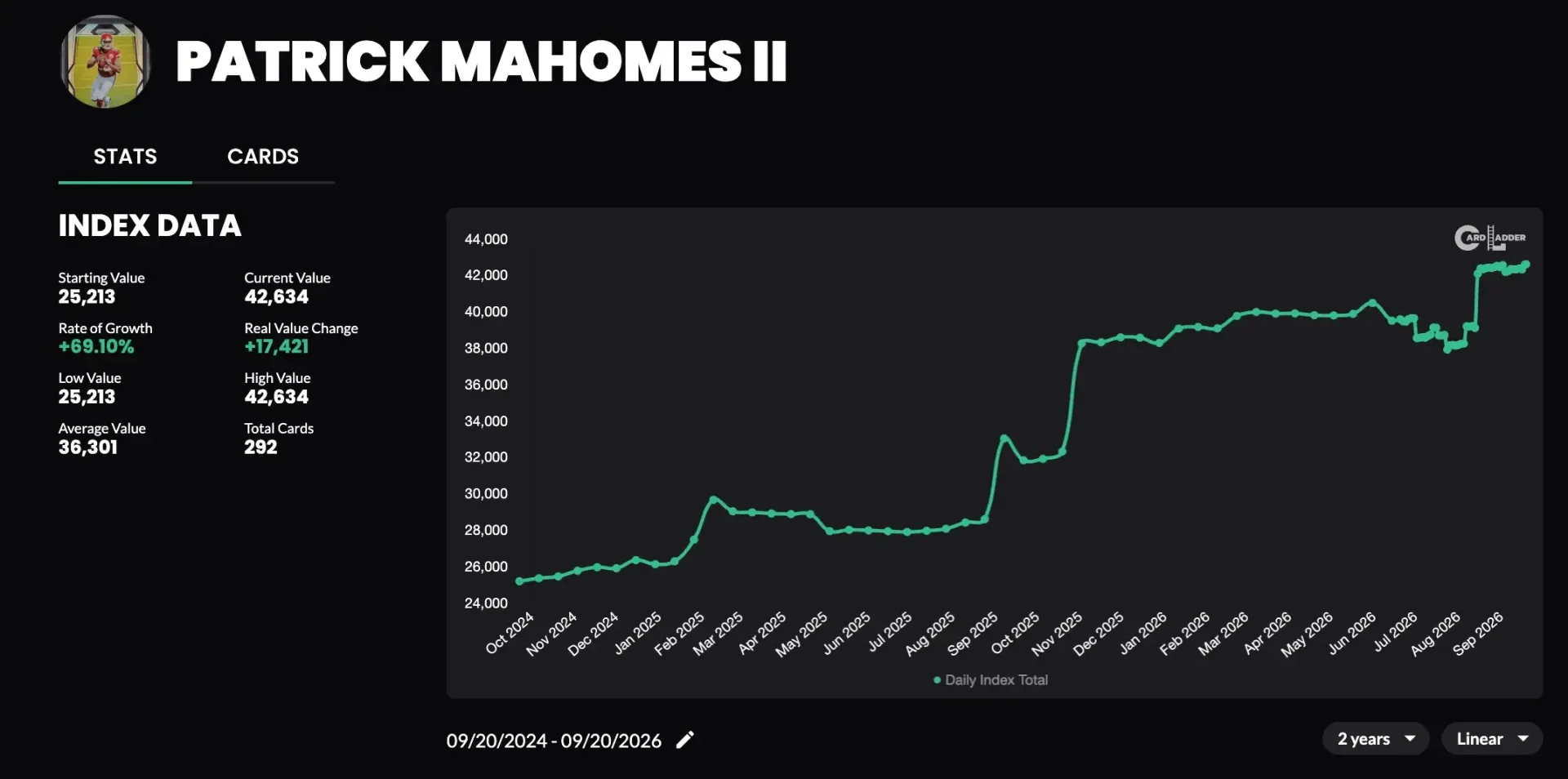
With the corrected entry in place, the Mahomes position has no cards in the negative and has returned its holder to the podium places. Mahomes has also been among the stronger player markets in recent weeks, alongside Brock Purdy. The challenge is tracking that momentum without assuming it automatically persists through the next game week.
Peyton Manning drives a third-place surge
Jason Otero sits third overall, up 20.8%, powered by a 1998 Metal Universe Peyton Manning graded PSA 9. That specific card is up 260%, giving the portfolio a substantial lift. It is a clear example of concentration: one exceptional mover can transform an overall return even if another card in the same portfolio is lagging.
Related coverage includes Patrick Mahomes and Brock Purdy Card Momentum Builds as NFL Week 7 Trading Contest Tightens.
Otero’s remaining drag is a 2009 Topps Finest Matt Stafford, down 14.5%. The combination illustrates a basic portfolio reality. Being right on one player or card does not mean every position will move in the same direction. The Manning gain is currently large enough to offset the Stafford decline and keep the full lineup solidly positive.
It also underlines why a challenge leaderboard should be read at two levels. The total percentage shows the current contest position, while the individual cards explain what created it. A portfolio up 20.8% could be broadly healthy across several cards, or it could be anchored by one unusually large gain. Here, the Manning card is the central reason for the rise.
Llanso remains in front after selling Shough
Alex “CleverCubanCards” Llanso has held the top spot for a second consecutive week. His recent result was helped by a Tyler Shough card that climbed more than 200% before he sold it and reinvested. That sale matters because a gain on a held card can remain vulnerable to later market movement, while selling turns the card’s performance into completed capital for the next decision.
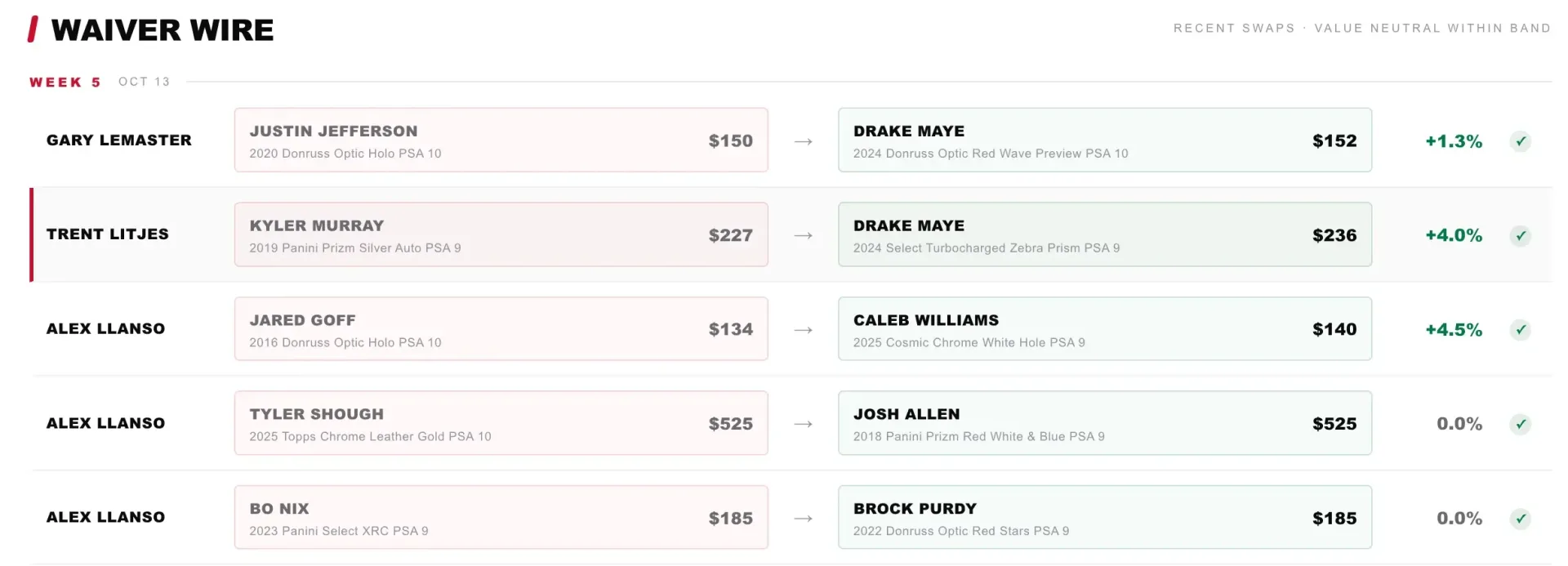
Llanso’s subsequent purchase, a 2018 Prizm Red, White, and Blue Prizm Josh Allen in PSA 9 condition, has already risen by more than 9% in one week. The move does not establish a long-term trend by itself, but it shows the immediate impact a successful reinvestment can have in a short tracking window.
In trading-card terms, a Prizm parallel is a variation of a card design within the Prizm product line. “Red, White, and Blue” identifies the parallel treatment, while PSA 9 identifies the card’s assigned grade. Those identifiers are essential because values can differ substantially between a base card, a particular parallel, and a copy at a different grade.
Llanso’s decision to exit both the Bo Nix and Tyler Shough markets before the current week is also notable. The prior waiver-wire activity appears to have worked out across the field, but the absence of new transactions before Week 7 suggests that the participants are currently more comfortable with their existing exposure than with making a reactive switch.
Why the quiet waiver wire matters
No one made a waiver-wire move entering Week 7. The timing coincides with every participant being in the green, which makes the lack of action understandable. When a roster is posting gains, selling requires a stronger reason than simply wanting something new: a participant must believe the replacement offers a better opportunity after accounting for the card being given up.
That does not make holding automatically correct. A card can be profitable and still be sold if its holder believes its current price already reflects the upside they expected. Conversely, a card that is down can be held if its holder sees a plausible path back. The challenge’s recent moves demonstrate both sides of that calculation: Llanso took a major gain on Shough, then redirected the proceeds into Allen; other participants remained with the cards already on their boards.
The pause also puts more attention on NFL performance as the next potential catalyst. Week-to-week player narratives can influence interest in modern football cards, but the board shows that the relationship is not always immediate or uniform.
C.J. Stroud’s on-field form has not yet translated
C.J. Stroud is the clearest example of that disconnect. He has played extremely well over the past several weeks, yet his card market has not followed with the same visible response. Jesse Gibson, currently at the bottom of the standings, would benefit from a Stroud rise if another strong performance prompts more market activity.
The distinction is important for anyone reading game results as a buying or selling signal. Strong play can create attention, but card prices do not necessarily react at once. The available sales, the exact card being tracked, its condition and the number of interested buyers can all affect whether player performance becomes a price move. In this case, Stroud’s recent form creates a possible reason to watch the market, not proof that any specific card will rise.
Joe Burrow is another player with an opportunity to close ground on the recent leaders. Mahomes and Purdy have been the prominent gainers in recent weeks, setting the pace that players such as Stroud and Burrow would need to match or exceed. The next round of games can alter the conversation, but it cannot guarantee a corresponding change in card values.
What to watch after Week 7
- Mahomes listing accuracy: The restored PSA 10 comparison shows how quickly a grade mismatch can distort a return.
- Manning’s outsized influence: Otero’s 260% gain on the 1998 Metal Universe Peyton Manning PSA 9 remains the key force behind his third-place position.
- Allen after reinvestment: Llanso’s 2018 Prizm Red, White, and Blue PSA 9 is already up more than 9%, following the sale of his Tyler Shough card.
- Stroud’s market response: Continued strong play may attract interest, but his recent on-field performance has not yet produced a matching card-market jump.
- The next waiver period: With every entry profitable, the first participant to move will be making a deliberate choice to exchange a winner or lock in gains rather than simply escape a losing position.
For now, the central story is not merely that the leaderboard is green. It is that different routes produced those gains: an accurately matched high-grade Mahomes listing, a vintage-era Manning card’s huge appreciation, a timely Shough sale followed by an Allen purchase, and the decision by everyone else to stand pat. Week 7 will test whether those positions keep their momentum—or whether the next market mover comes from a player whose recent production has yet to appear in card prices.