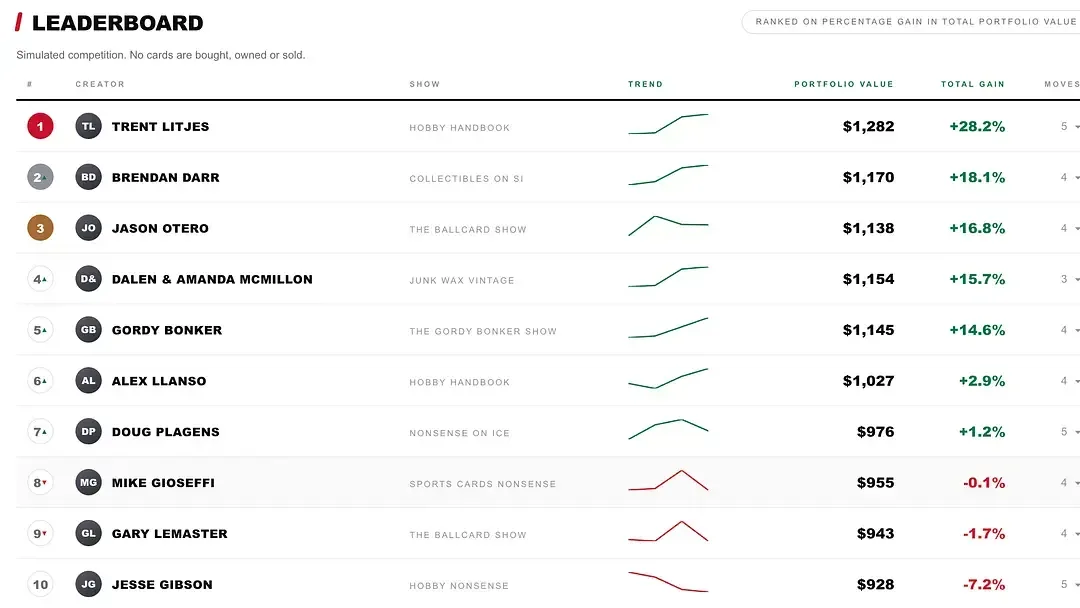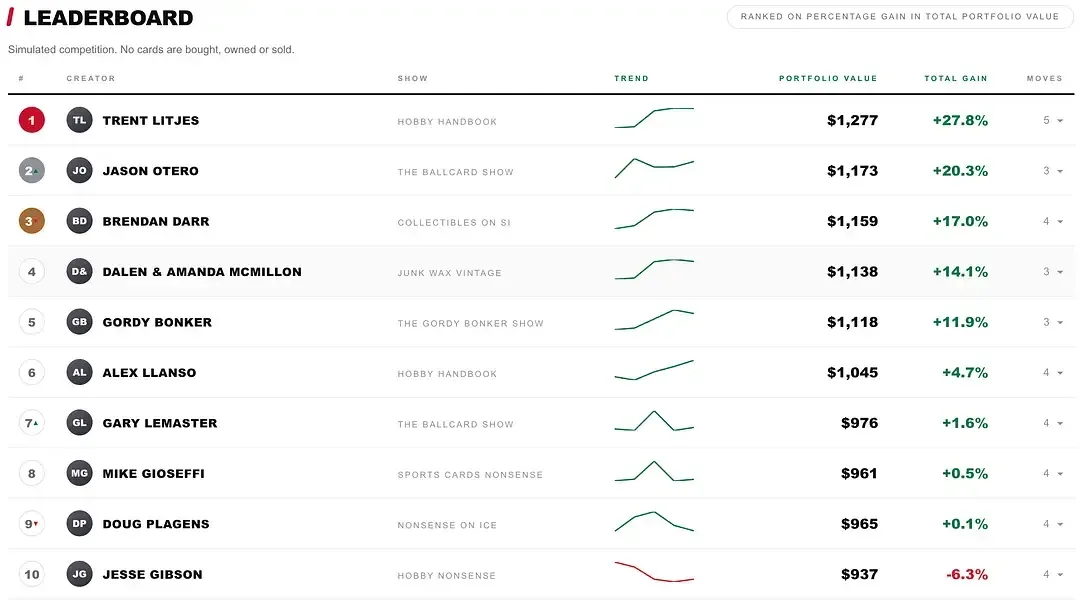
The SCN Challenge is beginning to look less like a simple weekly football conversation and more like what it is designed to be: a season-long card-market portfolio contest with fantasy-style roster decisions. After four weeks, the field has started to spread out, the waiver wire has become consequential, and one grading-level correction involving a Patrick Mahomes card has materially changed the podium.
Trent holds the early lead, supported by a Tyler Shough Panini Prizm Silver Auto graded PSA 9 that has risen 60% during the season so far. Jason Otero owns the competition’s most dramatic individual increase with a Peyton Manning Metal Universe PSA 9 up 257%, though a declining Matt Stafford card has kept that surge from turning into a runaway overall advantage. Meanwhile, the manager involved in the Mahomes waiver dispute has returned to third after the entry was corrected from a PSA 9 to the intended PSA 10.
The standings are still early-season standings, not a final judgment on any card or player. But they already illustrate the premise of the contest: player performance matters, scarcity and card type matter, and the exact graded copy assigned to a roster can matter just as much as the athlete on the front.
Trent’s early advantage is built on a clear card profile
Trent’s success has been led by the Shough Panini Prizm Silver Auto PSA 9, but the broader pattern is important. Most of Trent’s selections are Panini Prizm Silver autographs, and that approach has been rewarded while the relevant players have performed well. The result is an early lead after four weeks rather than a single isolated spike.
That is a useful distinction in a portfolio-format contest. A manager can have one exceptionally strong card and still be exposed elsewhere. A repeatable selection preference, by contrast, can create several avenues for gains. In this case, the emphasis has been on rookie autographs and Prizm Silver versions, including cards graded PSA 9.
What those labels mean in this challenge: “Auto” identifies an autograph card; “Silver” distinguishes a particular Prizm card variation; and PSA 9 or PSA 10 identifies the grade attached to the individual copy. The same player, year, card design and serial-numbered parallel can therefore represent different portfolio assets when the grade differs. That is not merely a label issue when sales of the two grades move differently.
The early takeaway is not that every rookie autograph or Prizm Silver card will behave the same way. The available results are much narrower than that. It is that Trent’s cluster of similarly profiled cards has produced positive results at the same time, with the Shough card’s 60% rise serving as the clearest example.
Jason Otero has the biggest riser, but one Stafford card changes the picture
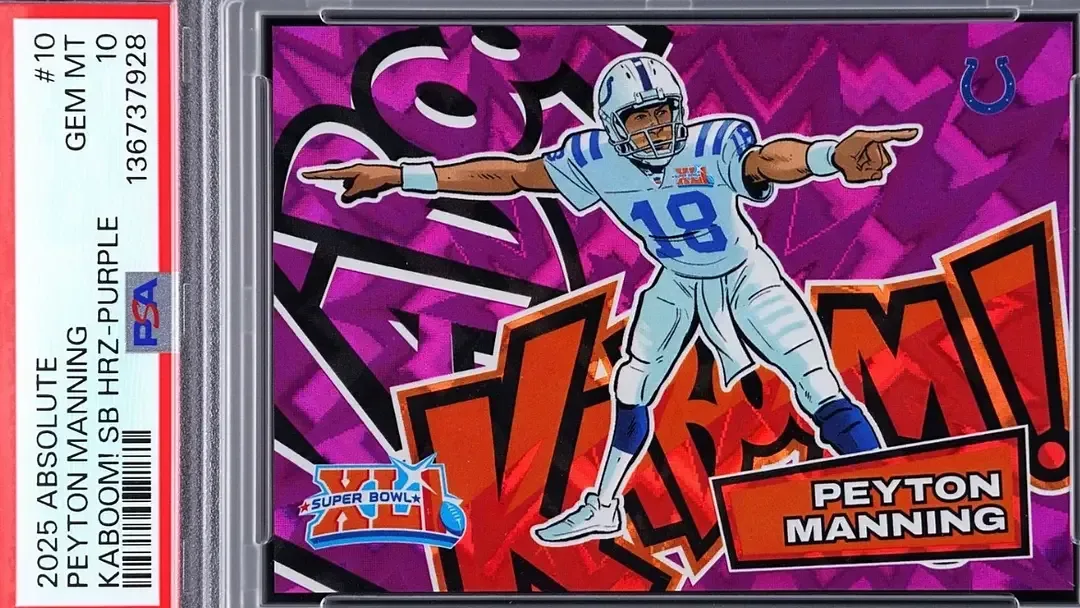
Otero’s Peyton Manning Metal Universe PSA 9 is the single largest mover in the competition to this point. The card has increased 257% since the contest began, an extraordinary gain in a field where every selection is meant to contribute to a full portfolio. The Manning card is identified as a rookie card, making its rise the defining positive move of the first four weeks.
Related coverage includes Patrick Mahomes Waiver Fix Shakes Up Week 4 Sports Card Portfolio Challenge Standings.
Yet portfolio contests can be mercilessly arithmetic. Otero’s Matt Stafford 2009 Topps Finest PSA 10, described as his hero card, has fallen sharply during Stafford’s difficult start to the season. That decline has offset a meaningful portion of the Manning gain. Without it, Otero would have had a much wider margin over the rest of the field.
“Hero card” is best understood here as the prominent Stafford selection in Otero’s roster rather than a guarantee that the card will lead the portfolio. The contrast with the Manning result shows why a contest like this cannot be read through one headline sale alone. A massive percentage increase on one card can coexist with a weaker overall rank if another major position is falling.
Stafford is also a wider concern in the league. Three managers holding Stafford cards are currently down, with one position off by as much as 15%. That makes his Week 5 performance relevant to several portfolios at once, not just Otero’s.
The Mahomes waiver ruling was about grade, not just the player
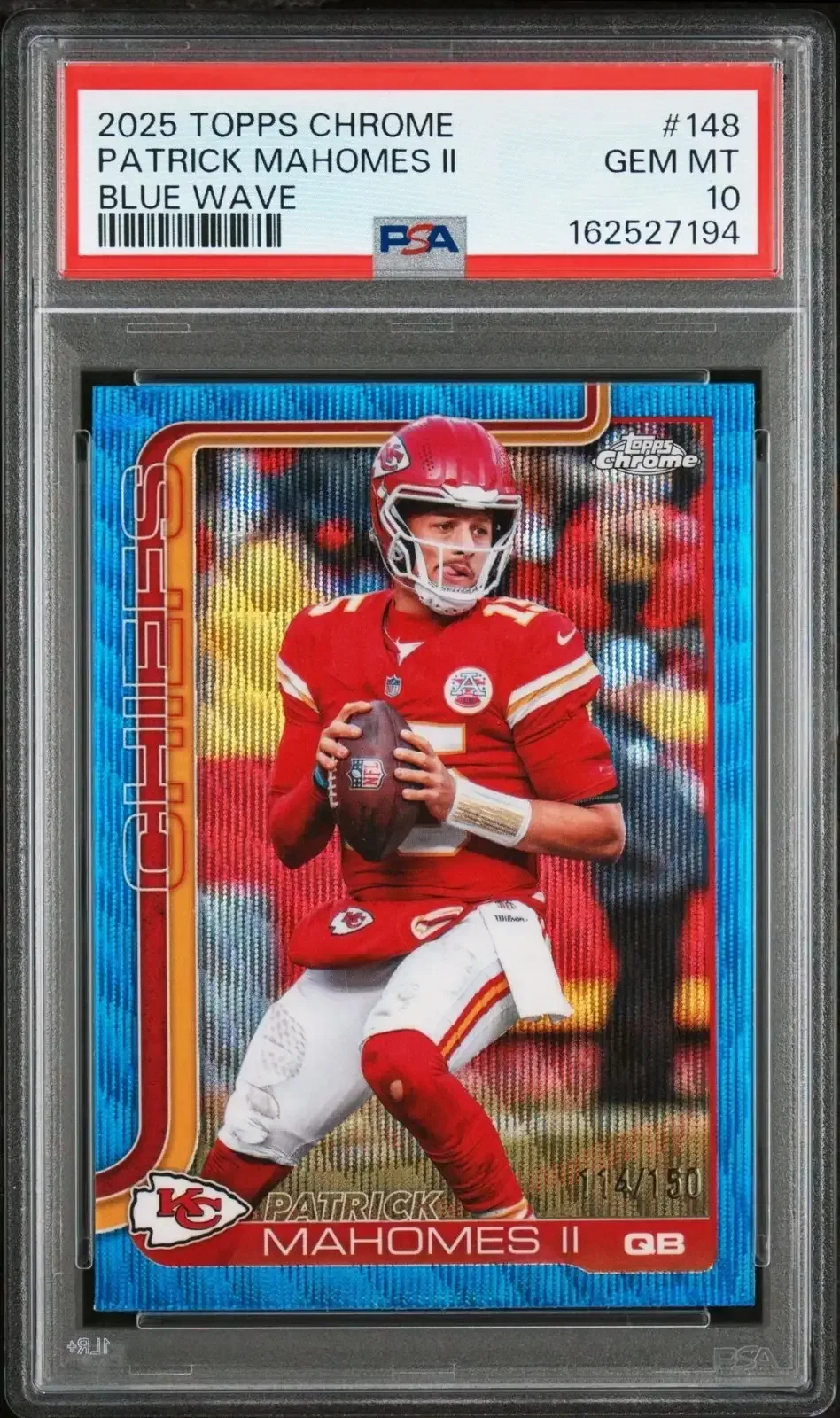
The Week 4 standings were also reshaped by a waiver correction involving a 2025 Topps Chrome Patrick Mahomes Blue Wave /150. The manager had replaced a 2023 Panini Prizm Jaxson Smith-Njigba Green Scope Auto /75 graded PSA 9 with what was intended to be a Mahomes Blue Wave /150 graded PSA 10.
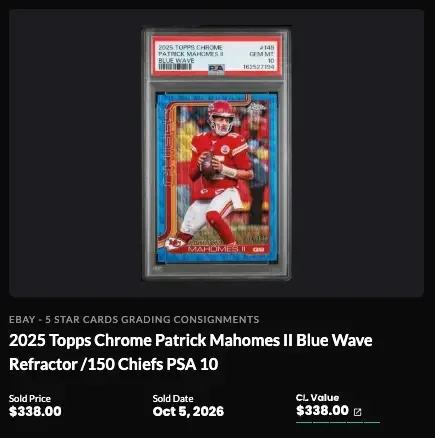
Instead, the roster was initially credited with the PSA 9 version after a PSA 9 sale appeared at a price similar to the prior PSA 9 sale. Following a review by the contest’s decision-makers, the entry was restored to the PSA 10 version. That correction moved the manager out of the bottom of the standings and back into third place.
The episode is a compact lesson in why a portfolio league needs precise asset definitions. “Patrick Mahomes Blue Wave /150” does not completely identify the position. The grade is part of the asset description, just as the /150 serial numbering is. A PSA 9 and a PSA 10 may share the same player and card parallel, but they are separate graded versions with their own sale histories.
The timing made the correction more important. A notably strong sale for the Mahomes Blue Wave PSA 10 arrived after Sunday’s game, giving the properly assigned card a significant boost. The decision was therefore not a cosmetic adjustment; it determined which market result the portfolio was permitted to capture.
There is also a practical contest-management point here. Waiver moves require more than naming a player or set. Managers and organizers need to establish the card year, product, variation, serial-number detail and grade. When a replacement is based on a comparable sale, the comparable needs to match the specific graded card being entered. That level of specificity reduces the chance that a roster gets valued against the wrong version of its own card.
Burrow’s reversal shows the volatility behind the standings
The Mahomes correction did not solve every problem for the third-place manager. A Joe Burrow Optic Blue Hyper PSA position swung from roughly $70 in profit to $40 below its starting point in a single week after unfavorable sales. That reversal occurred despite Burrow playing well while missing his top two receivers.
It is the clearest reminder in the Week 4 update that on-field narratives and card-market results do not always move in a neat, immediate line. A player can perform well and still see a particular card lose ground if the sales recorded for that card are weaker. Conversely, a strong sale after a game can have an outsized effect on a narrowly defined graded card position.
For observers, the important word is specific. The challenge is not tracking a generic “Burrow market” or “Mahomes market.” It is tracking individual cards in specific grades. That approach makes the contest more exact, but it also means a small number of sales can sharply alter the visible result from one update to the next.
That volatility is one reason the standings after Week 4 should be read as a snapshot. Trent’s lead is real, the Manning rise is real, and the Stafford pressure is real, but each portfolio remains exposed to subsequent player results and subsequent card sales through the Super Bowl.
Week 5 puts Stafford and Nacua under a shared spotlight
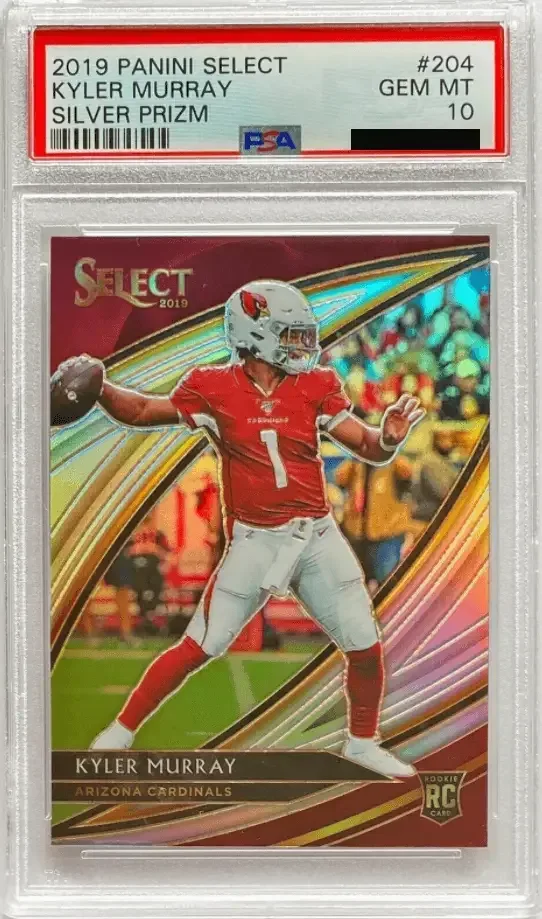
Mike Gioseffi has already made one notable adjustment, moving out of a 2019 Select Silver Kyler Murray PSA 10 after Week 3. His replacement is a Puka Nacua card, but it needs a substantial increase to compensate for other cards in the portfolio that have not produced much momentum.
Nacua and Stafford are linked by more than a coincidental place in the standings. With three Stafford holders down and Gioseffi needing the Nacua position to rise, a strong Week 5 from both players would be especially helpful to the lower end of the table. It would not automatically repair every lagging card, but it could improve the football case behind multiple positions at once.
For a broader look at how collectible markets can turn on individual releases and sales momentum, see our coverage of Amazing Spider-Man #1000’s impact on weekly comic-shop sales. The categories differ, but the underlying observation is familiar: concentrated demand around a specific collectible can influence the shape of a market snapshot.
What to watch after Week 4
- Whether Trent’s Prizm Silver Auto approach continues to produce multiple winners. The Shough PSA 9 has been the headline card, but the strategy’s strength is its broader consistency so far.
- Whether Manning’s 257% rise can outweigh Stafford’s drag for Otero. The league’s largest individual gain has not yet created an insurmountable overall lead.
- How the Mahomes PSA 10 responds after its major post-game sale. The card is now correctly represented in the third-place portfolio, making future sales directly meaningful to that position.
- Whether Burrow’s Optic Blue Hyper PSA can recover from its rapid reversal. Its move from a profit of about $70 to a loss of about $40 demonstrates how quickly card-by-card valuations can shift.
- Whether Stafford and Nacua deliver the Week 5 lift several managers need. Their performances could matter across more than one struggling portfolio.
The SCN Challenge has reached the point where roster construction, player performance and sale-by-sale valuation are all visibly pulling on the standings. Trent has the lead, Otero has the strongest individual card gain, and the Mahomes correction has restored a disputed contender to the podium. The next movement will depend not only on Sunday football, but on which exact graded cards find buyers afterward.