Tom Brady’s most famous trading card remains far beyond the reach of most collectors, but the latest online sales show the market is not confined to one untouchable rookie grail. Signed early-career cards, a Super Bowl-themed relic and even a low-numbered modern release all landed among the strongest recent results.
That breadth is the important part of the story. Brady’s signed 2000 Playoff Contenders Rookie Ticket is the defining card: a rookie-season issue with an on-card autograph, while the Championship Ticket version is limited to 100 copies and has reached $3.1 million. Yet the newest notable sales did not include that card. Instead, collectors competed for distinct pieces of Brady’s career and card catalogue, with results from $25,000 to more than $45,000.
For buyers, that does not make every card carrying Brady’s name a substitute for a Rookie Ticket. It does illustrate how a collector can evaluate alternatives by asking a more useful question: what kind of Brady card is this? Rookie status, autograph format, serial numbering, physical relic content, condition and direct links to a major career moment all affect what a particular card represents.
Three Brady cards stood out in the auction results
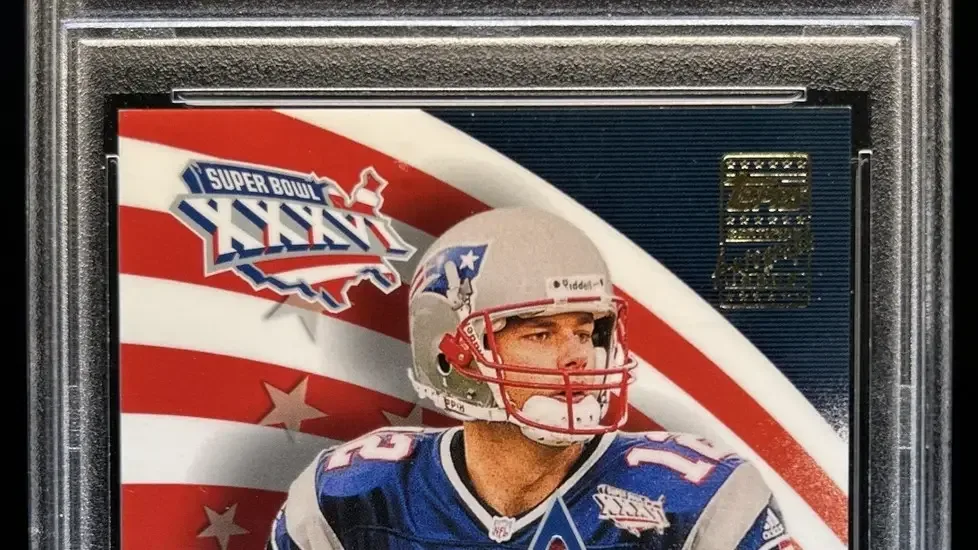
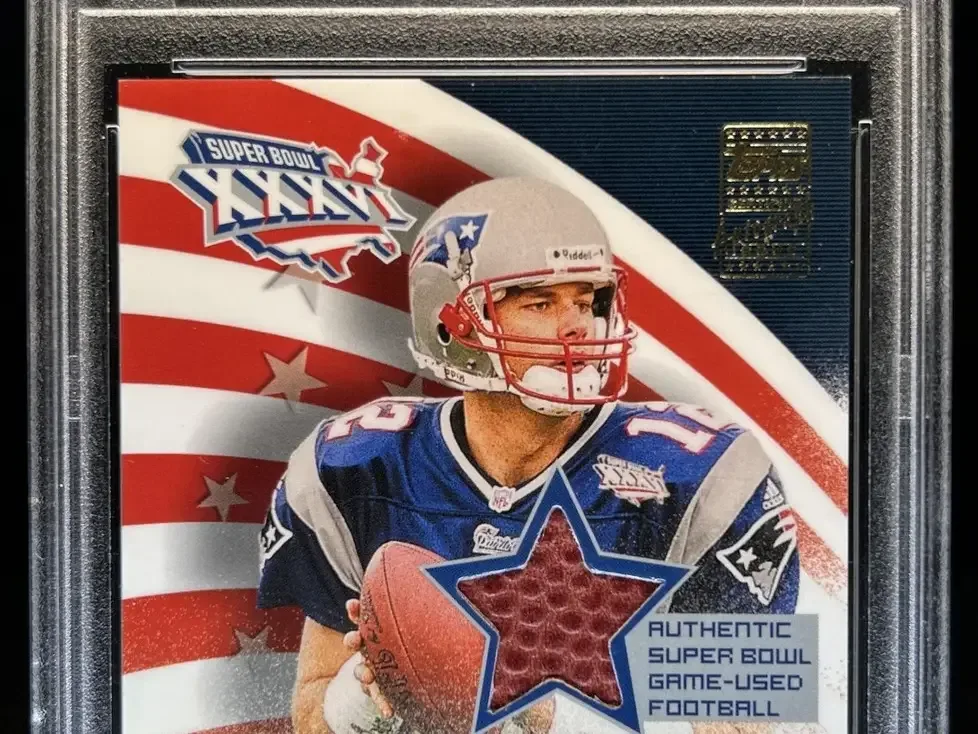
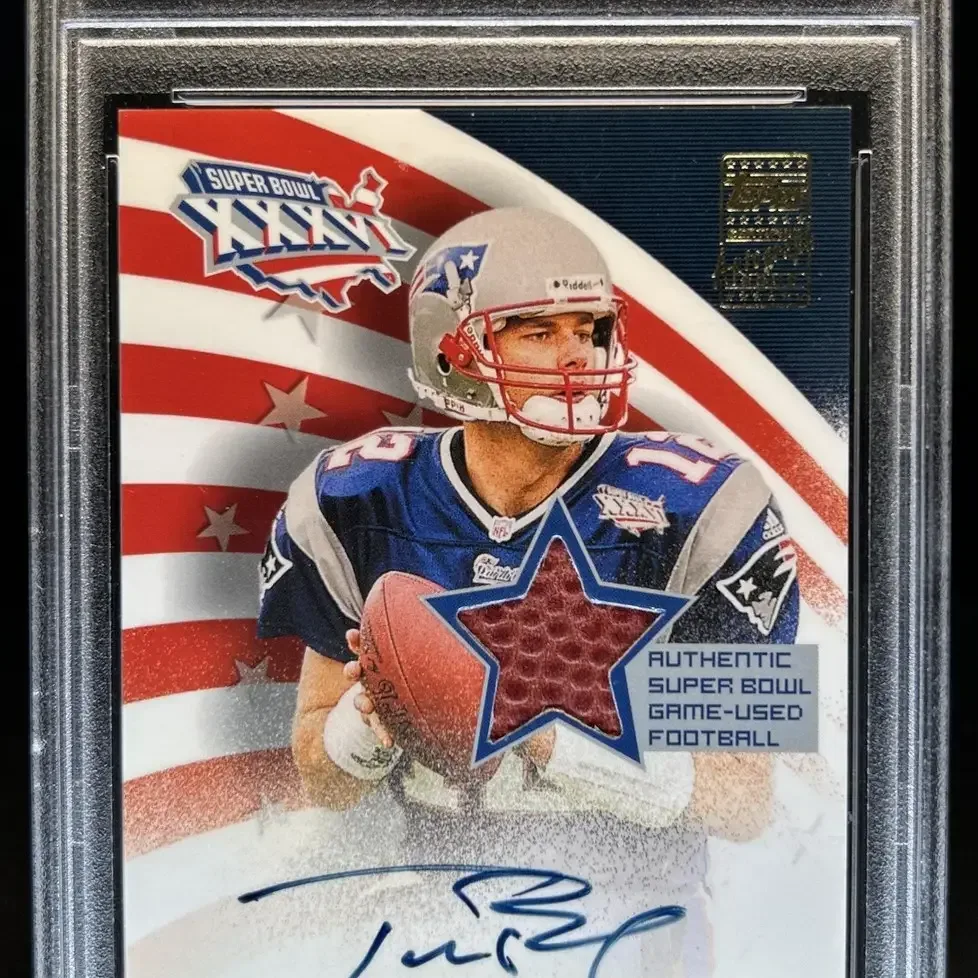
The highest recent Brady result was a 2002 Topps Super Bowl card, numbered 124/150, that sold for $45,160 on 85 bids. It pairs an autograph with a relic cut from a game-used football from Super Bowl XXXVI and carried a PSA 8 grade.
That combination gives the card several separate collecting hooks. The print run is explicitly capped at 150. It is signed. And its relic traces to a football used in the Super Bowl that became a pivotal early Brady moment, as he led a late drive in the Patriots’ win over the Rams. A relic card is a card containing a physical piece of associated material; in this case, the listing identified the material as part of a game-used football. That is more specific than merely presenting a patch or swatch without the same game-level connection.
Close behind came a 2000 Score Rookie Preview autograph, graded PSA 10, at $45,000 on 55 bids. Its appeal is easier to state: it belongs to Brady’s rookie year and is signed. The result also helps demonstrate that collectors have substantial appetite for rookie-era Brady autographs outside the Playoff Contenders line.
The third major sale was a 2025 Topps Chrome Red Refractor autograph, serial-numbered 5/5, which realized $26,112 on 45 bids despite a PSA 7 grade. A Refractor is a variation with a distinctive reflective finish; “Red Refractor” identifies the parallel’s color treatment, while the 5/5 numbering means this was one of five copies in that version. Its sale is a reminder that modern cards can command serious attention when an autograph and extremely limited stated production meet a player whose collecting profile remains enormous.
Just below that group, an ungraded 2016 Panini Impeccable Elegance autographed jersey-patch card, numbered 1/5, sold for $25,000. It was outside the latest top-20 list, but it reinforces the same pattern: collectors are paying for different configurations of Brady rarity rather than concentrating exclusively on one flagship issue.
The Rookie Ticket is still the reference point
None of these sales changes the hierarchy at the very top. The 2000 Playoff Contenders Rookie Ticket remains Brady’s signature card because it unites several qualities that collectors often prize: rookie-year status, a ticket-style design, an autograph signed directly on the card and a clear association with the beginning of an improbable NFL career.
Brady entered the league having been picked after nearly 200 other players and without the attention usually given to highly rated quarterback prospects. Across 23 seasons, primarily with the New England Patriots, he appeared in 10 Super Bowls and won seven. He also accumulated five Super Bowl MVP awards, three regular-season MVP awards, 649 touchdown passes and 89,214 passing yards. Those achievements explain why cards from the beginning of his pro career retain outsized importance.
Recent lower-grade Rookie Ticket sales also provide a useful reality check for anyone who sees the $3.1 million Championship Ticket record and assumes all versions trade in that territory. A BGS 8.5 example previously sold for $62,558, while a PSA 6 copy brought $40,100. The card’s identity matters enormously, but condition still has a meaningful effect on price.
Grading firms use numerical assessments to communicate a card’s observable condition, but grades from different companies are not interchangeable labels. PSA and BGS are distinct graders, and the supplied sale records identify both the company and the grade. Buyers comparing sales should preserve that detail rather than treating every 8, 8.5 or 10 as a direct one-for-one comparison. Cards can also receive separate card and autograph grades, as some other auction entries demonstrate.
What the wider leaderboard says about the bidding
The Brady cards appeared in a larger group of high-value sports-card sales led by a 2008-09 Upper Deck Exquisite Kobe Bryant Limited Logos autographed patch card, numbered 17/24, which sold for $305,100 on 65 bids. A 2003-04 Topps Chrome LeBron James Refractor graded BGS 9.5 followed at $177,879 on 54 bids.
Brady’s $45,160 Super Bowl relic placed fourth in the top 10, immediately ahead of the $45,000 Score Rookie Preview. The bid counts do not settle what any individual collector should pay, but they do show that the two sales were not quiet one-bid outcomes. Eighty-five bids pushed the Super Bowl card to its result, while 55 bids went into the Score auction.
The broader list included two PSA 9 copies of the 1986-87 Fleer Michael Jordan, at $43,999 on one bid and $40,550 on 16 bids. That contrast is a useful caution against relying on a sale price alone. A card can be visually and descriptively similar to another one and still finish at a different number. The auction format, timing, bidding participation, grade and the exact copy all matter.
Other top results emphasized modern scarcity and player legacy in different combinations: a one-of-one 2025-26 Topps Definitive Stephen Curry Nameplate autographed card with a game-used jersey “C” patch sold ungraded for $38,600; a 2019 Panini Select Kobe Bryant In Flight autograph graded PSA 10 sold for $35,000; and a PSA 10 2025 Topps All Kings Shohei Ohtani sold for $31,802.
Below the top 10, the $26,112 Brady Red Refractor sat among cards such as a 2024 Bowman Chrome Shohei Ohtani Orange Refractor autograph numbered 20/25 at $30,400 and a 2026 Topps Chrome Ohtani Sapphire Red numbered 4/5 at $30,100. The comparison is not a verdict that all low-numbered cards are equivalent. It does show how serial numbering remains one visible shorthand for scarcity in current sports-card auctions.
How to read the descriptors without overreading them
A sales listing compresses a lot of information into a few words. Newer collectors can break it down before using the price as a benchmark:
- Year and set: These establish the card’s release and product family. A 2000 Brady card has rookie-year context that a 2025 card cannot replicate.
- Parallel and serial number: “Red Refractor” and 5/5 identify a particular limited variation. A serial number documents the stated size of that card’s print run, not a guarantee of future value.
- Autograph: A signed card adds an additional collectible feature. The Brady Rookie Ticket’s on-card signature is a key part of its reputation.
- Relic or patch: These terms indicate embedded material. Read the listing closely for what the material is described as being and, where specified, whether it is tied to game use.
- Grade: The grader and numeric grade are part of the identity of the specific sale. “Ungraded” means no numerical card grade was listed, not necessarily that a card is damaged or undesirable.
- Bid count: It supplies context about the auction’s competition, but does not replace examining comparable copies.
That approach is especially valuable in a Brady market with nearly 200,000 collectibles listed on eBay alone. A huge number of listings does not mean every item has the same collector appeal. The recent results reward specificity: an early autograph, a direct Super Bowl connection, a stated five-copy parallel, or a scarce autographed patch construction.
Brady’s present visibility adds context, not a price formula
Brady remains a visible figure through NFL analysis work, appearances at hobby events and commercial partnerships with Fanatics. He also signed and inscribed a Topps NOW card in the FOX Sports booth during the Packers-Patriots game. Those factors keep his name in current hobby conversation while collectors can revisit the playing career that established his long-term importance.
But publicity should not be mistaken for a universal valuation rule. The sales listed here vary sharply even within Brady’s own catalogue: a signed rookie-year preview at $45,000; a signed, numbered Super Bowl football relic at $45,160; a PSA 7 modern signed Red Refractor limited to five at $26,112; and an ungraded 2016 signed jersey-patch card numbered to five at $25,000.
For collectors considering a purchase, the practical takeaway is to compare like with like. Match the exact set, parallel, serial number, autograph status, relic description, grading company and grade. Then consider whether a card’s appeal is rooted in rookie-year significance, a documented career event, very low stated production, or some combination of all three. The market’s latest Brady results suggest there are meaningful lanes below the Hobby’s biggest blue-chip ticket—but those lanes are distinct, not interchangeable.
Collectors watching other modern sports-card movement can also compare how player momentum and card-specific details interact in this look at Jaxon Smith-Njigba’s card market. Brady’s case is different in scale and career completeness, but the same discipline applies: identify the exact card before drawing conclusions from the number attached to a single sale.