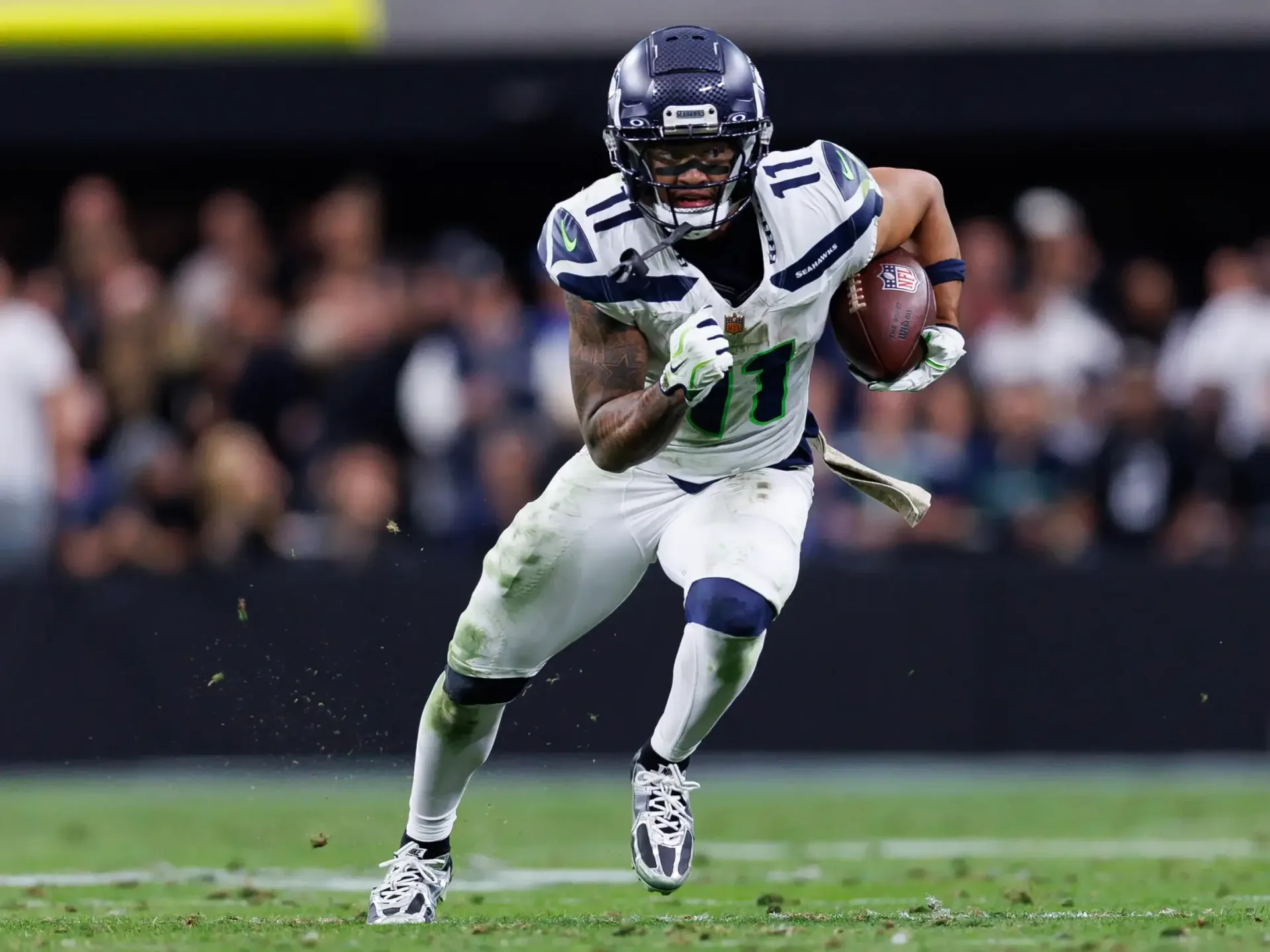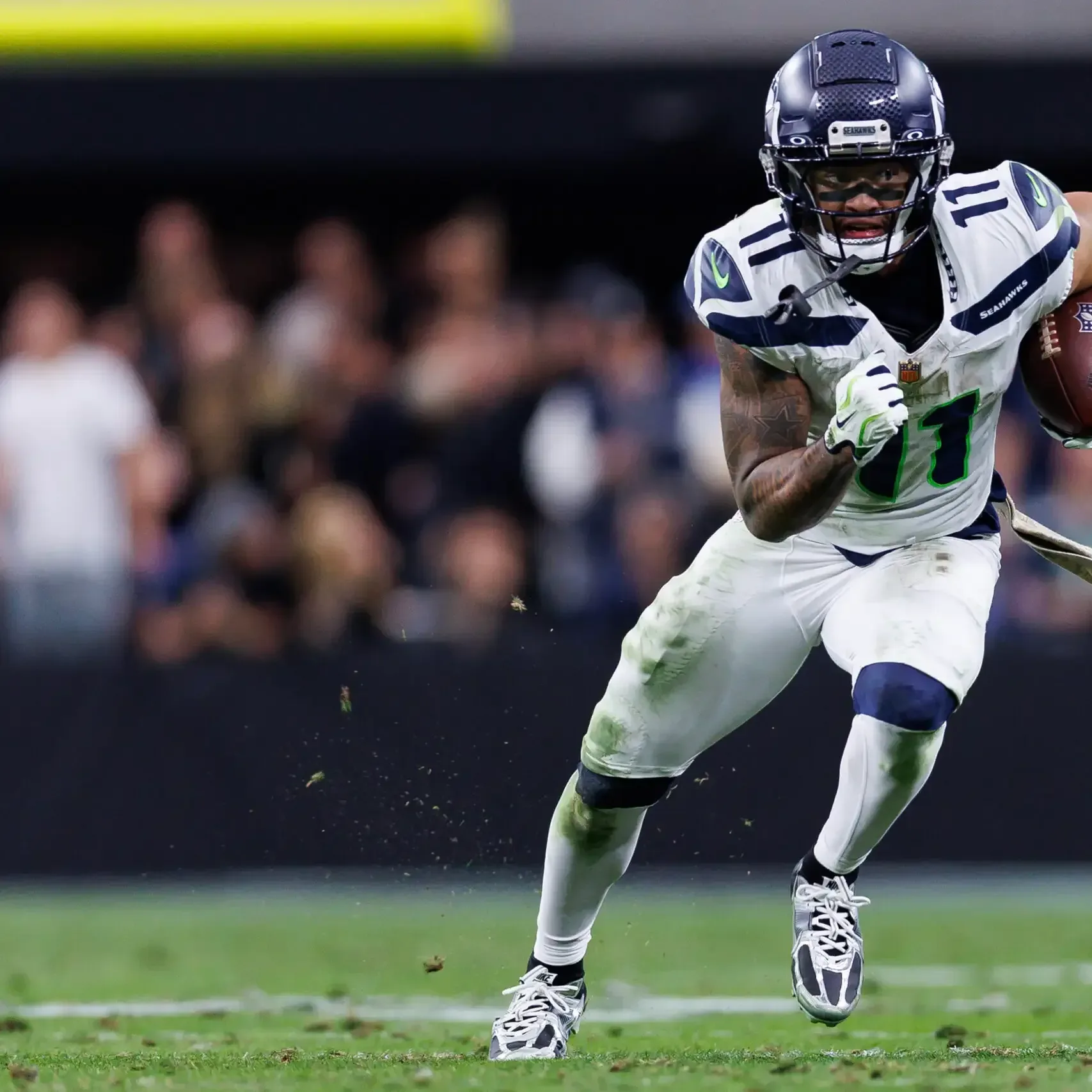
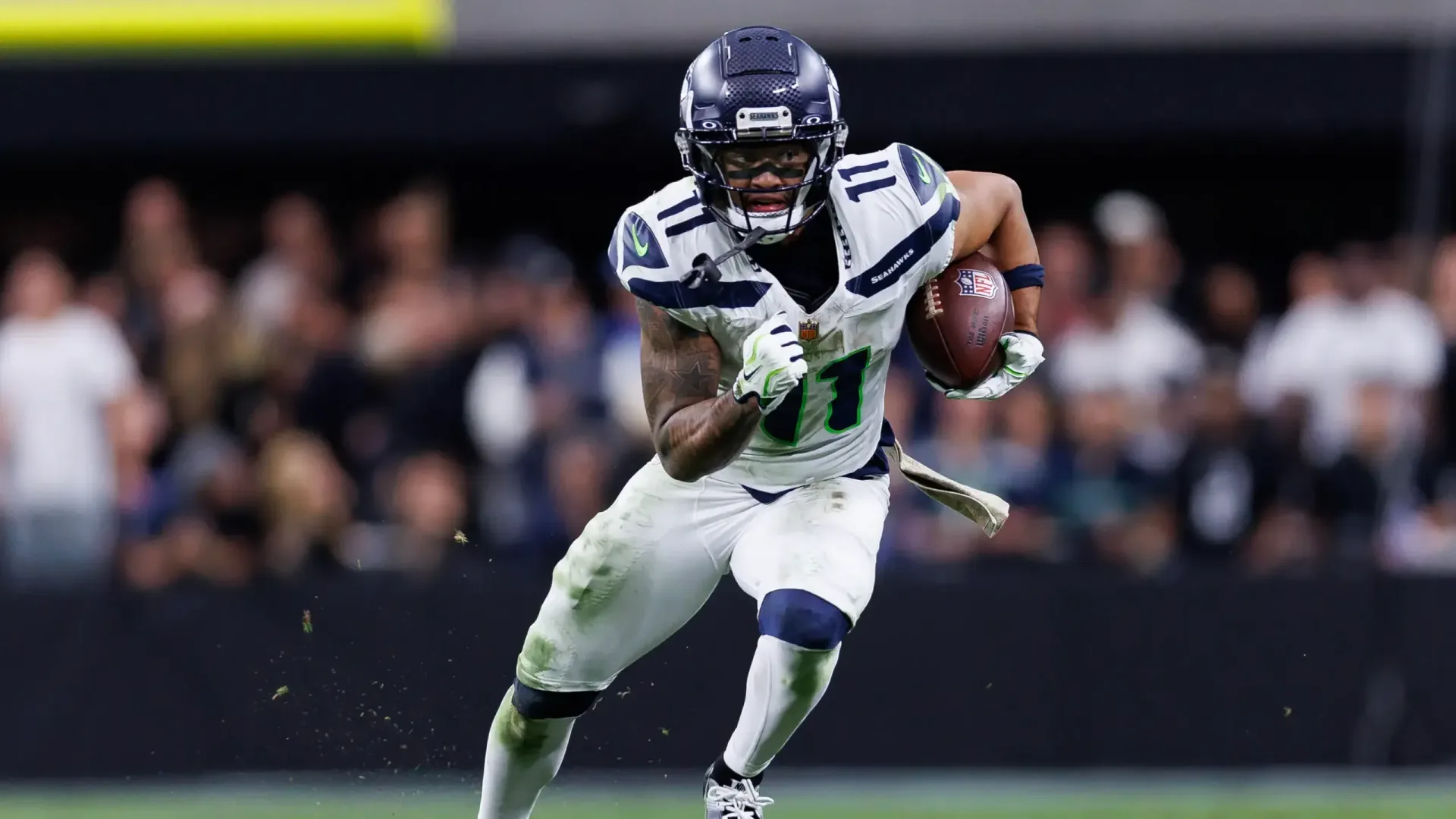
Jaxon Smith-Njigba’s on-field ascent is easy to spot in the numbers. His trading-card market is more complicated.
The Seattle Seahawks receiver went from 63 catches and 628 receiving yards as a 2023 rookie to 100 catches and 1,130 yards in 2024, then 119 catches and 1,793 yards in 2025. Through nine games of the 2026 season, he had 71 receptions, 1,036 yards and nine touchdowns. At that point, his pace projected to 134 catches, nearly 2,000 yards and 17 touchdowns for the season.
That production is the foundation of the current collecting argument around Smith-Njigba, often shortened to JSN. It also gives collectors a useful reminder: a player’s market does not rise in one uniform, predictable line just because the stat sheet keeps getting louder.
Recent auction results show that the highest-end Smith-Njigba cards are not being ignored. They are already commanding four-figure prices, especially when they combine rookie-year status, scarce serial numbering, autographs, premium inserts or high third-party grades. At the same time, those results should not be treated as a universal price guide for every JSN card in a checklist.
The production case for Smith-Njigba
Smith-Njigba’s season-by-season receiving totals show sustained growth rather than a single brief spike. His catches rose from 63 to 100 to 119 over his first three NFL seasons. His receiving-yard totals climbed from 628 to 1,130 to 1,793 in the same span.
Touchdown production has been present, too. He scored 20 touchdowns across his first three seasons and had nine after nine games in 2026. For collectors, that combination matters because it connects volume, yardage and scoring rather than relying on only one headline statistic.
Still, “on pace” is not a completed-season result. A projection based on nine games is a helpful way to describe the scale of a start, not a guarantee that a player will finish with that total. The distinction is especially important in a sports-card market, where buyers can react quickly to a hot stretch and just as quickly reassess after later games.
For anyone new to his name, the pronunciation is in-JIG-buh. The abbreviated JSN search term has gained traction, but it has a practical downside for shoppers: it can be less precise than searching the full name and may not return every listing that a full-name query does.
What the auction records actually say
A snapshot of recent completed eBay auctions, excluding Buy It Now sales, places the most expensive reported Smith-Njigba card at $4,405. That sale was for a 2023 Panini Prizm Manga rookie card and drew 105 bids.
Several other results underline how strongly collectors are valuing rarity and presentation at the top of the market:
- A signed 2025 Topps Chrome Red Refractor, serial-numbered 3/5, sold for $3,495 on 35 bids.
- A 2023 Panini Prizm White Sparkle rookie graded PSA 10 reached $2,613 on 21 bids.
- A 2023 Panini Prizm autographed Gold rookie, numbered 1/10 and graded PSA 9, sold for $2,551 on 34 bids.
- A 2023 Panini Prizm Blue Shimmer rookie, numbered 4/25 and graded PSA 9, sold for $2,235 on 25 bids.
- A 2023 Panini Absolute KABOOM! Horizontal graded PSA 10 sold for $2,400 on 14 bids. Two other PSA 10 copies brought $2,225 on 46 bids and $2,051 on 36 bids.
- An ungraded 2023 Panini National Treasures autographed patch card with a Nike logo patch, numbered 2/2, sold for $2,060 on 36 bids.
- A 2025 Topps Resurgence Superfractor numbered 1/1 sold for $1,875 on 53 bids.
Those numbers are evidence of demand, but they are also a list of unusually differentiated cards. A Manga insert, a one-of-one Superfractor, a card numbered to two, a logo patch autograph, and high-grade examples of premium rookie cards sit in a different market tier from standard base cards or more plentiful parallels.
In other words, the observation that Smith-Njigba cards may have room to run can coexist with the fact that his elite cards are already expensive. “Bargain” depends on the exact card, its condition, its serial number, whether it is signed, and the competition on the particular auction night.
A quick guide to the card terms in these sales
Serial-numbered cards
A card marked 3/5, 1/10, 4/25 or 2/2 has a stated production number within that parallel. The first number identifies that copy; the second identifies the announced print run for that version. Scarcity does not automatically determine value, but it gives collectors a clear supply ceiling for that particular card variation.
One-of-ones and Superfractors
A 1/1 is presented as the only copy of that specified card version. “Superfractor” is the name used for a one-of-one parallel in the cited Topps Resurgence sale. One-of-ones can attract strong bidding because collectors seeking the most singular version have no equivalent copy to pursue, although the desirability of the design, set and player still matters.
Autographs and patch cards
An autograph adds a signed element to the card. A patch card contains a piece of material, while the National Treasures example also included a Nike logo patch. These features make the card more complex than a standard issue and can make direct price comparisons difficult: two Smith-Njigba cards may share a year and brand but have materially different collector appeal.
PSA 9 and PSA 10
PSA 9 and PSA 10 identify grades assigned by Professional Sports Authenticator. A grade is intended to communicate an assessment of a card’s condition and can significantly separate prices for otherwise similar copies. The cited results include both PSA 9 and PSA 10 examples, while the 2/2 National Treasures patch autograph was ungraded. Grading is therefore one factor in the sale price, not a substitute for comparing the actual card, parallel and serial number.
Why auction context matters
Completed auctions are generally more useful than asking prices for understanding what someone actually paid. But a single result still has limits. Bid count offers a little context—105 bids on the Prizm Manga rookie suggests broad competition, while 14 bids on one KABOOM! result shows a different bidding path—but it does not establish a permanent market level.
Collectors considering a purchase should compare multiple completed sales for the same card wherever possible. If no exact match exists, the next-best approach is to separate the variables instead of treating all parallels as interchangeable: compare the same set, then the same serial-number tier, then the same grade, then autograph or patch status. A PSA 10 KABOOM! should not be benchmarked against an ungraded base card merely because both feature the same player.
It is also worth distinguishing auctions from Buy It Now listings. The reported figures here intentionally leave out Buy It Now transactions. Auction sales reveal a price reached through bidding on that occasion; fixed-price listings can reflect a seller’s target rather than a completed agreement. Neither format alone gives a complete picture.
Search volume is attention, not a valuation
eBay showed roughly 67,000 items under Smith-Njigba’s full name and another 7,000 under “JSN” at the time of the snapshot. That is a notable volume of searchable merchandise, but listing count is not a count of distinct cards, nor is it a measure of sold inventory. Listings can include lots, supplies, different years and repeated or unsold items.
The practical takeaway is simple: use the full name for a broader starting point, then narrow by year, brand, card number, parallel, serial number and grade. The abbreviated search can be useful as an additional check, particularly because collectors and sellers use the initials, but it should not replace the full-name search.
How to approach the market without confusing momentum for certainty
Smith-Njigba’s trajectory creates a credible reason for collectors to pay attention. The rise in receptions and yards over multiple seasons, followed by a striking nine-game start in 2026, is stronger evidence than a short run of highlight clips. The auction record also confirms that collectors are willing to compete for rare, premium versions.
But a sound collecting approach starts with defining the goal. A fan who wants an attractive rookie card may be better served by choosing a design and condition they enjoy at a comfortable budget. A collector pursuing scarcity might focus on serial-numbered parallels while accepting that the most exclusive copies are already in a premium bracket. Someone interested in graded cards should compare like-for-like grades rather than assume every slabbed card behaves the same way.
Historical card-set research benefits from the same card-by-card discipline. For an example of how a set’s finish, rookie composition and notable veterans can shape attention, see this look at 1987 Fleer Baseball cards.
Smith-Njigba’s market has a clear tension at its center. His performance profile suggests a player gaining stature, yet the eye-catching auction examples show collectors already paying aggressively for the best available versions. That leaves room for selective shopping, not a blanket claim that every card bearing his name is undervalued. As ever in modern sports cards, the player is only part of the equation; the exact card is the real product.