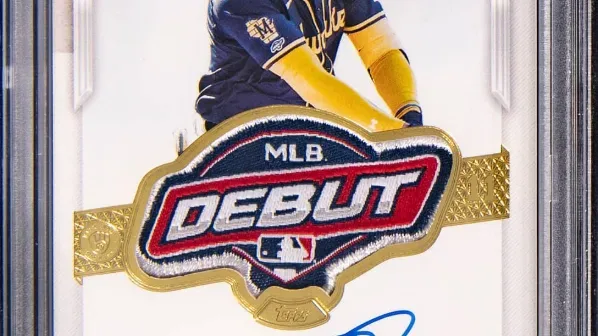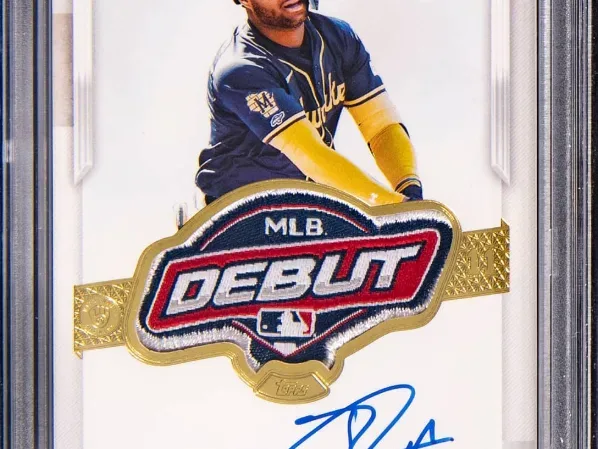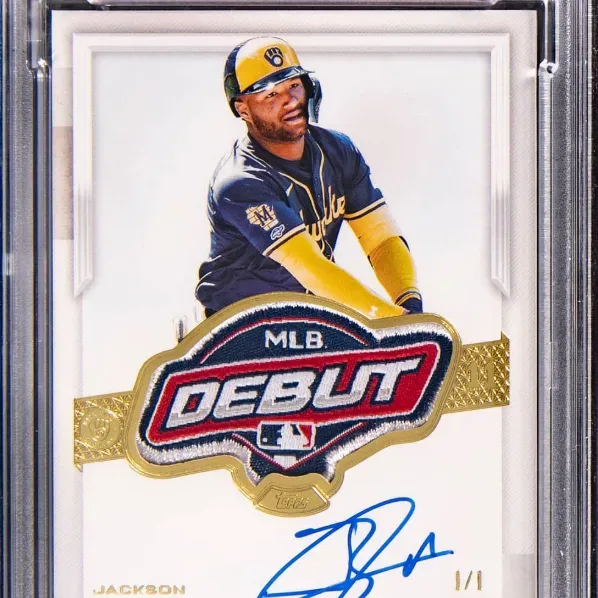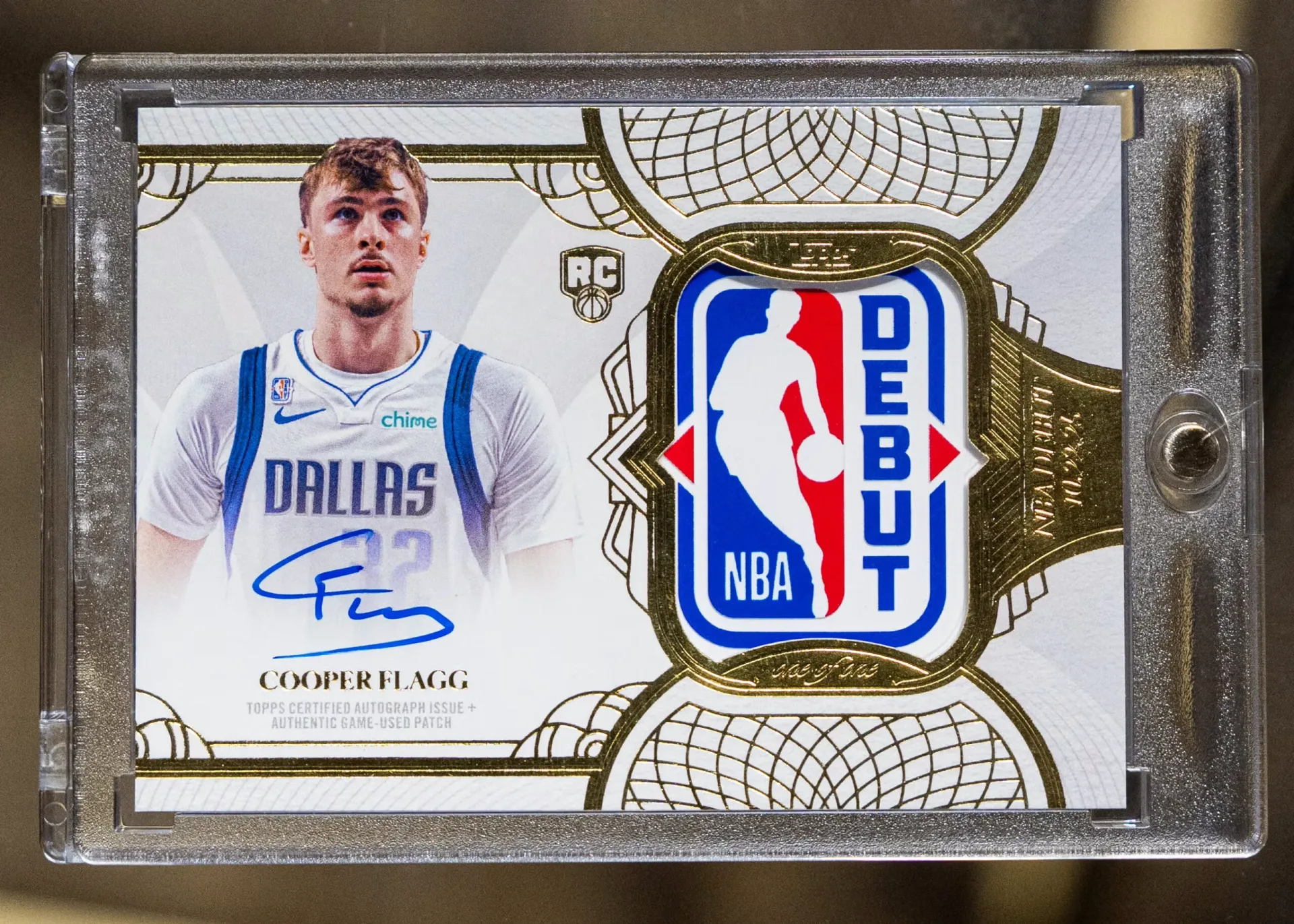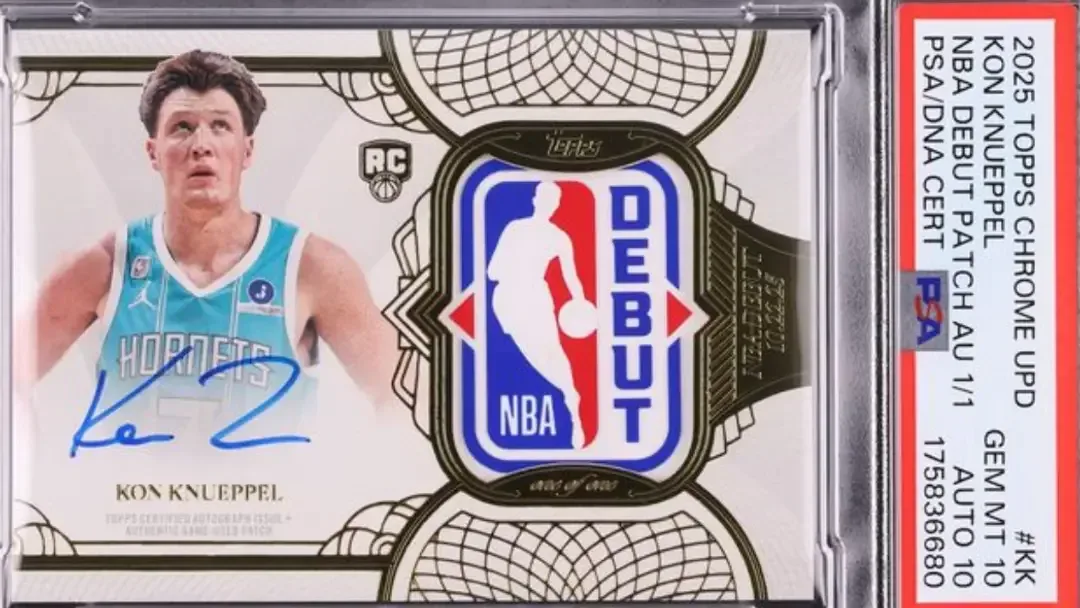
Jackson Chourio’s World Series spotlight has quickly extended from the field to the high-end card market. With Milwaukee holding a 2-0 lead over Tampa Bay in the 2026 World Series, the Brewers outfielder’s 2024 Topps Chrome Update MLB Debut Rookie Patch Auto is drawing an early bid of $120,000 in Goldin’s Monthly Sports Elite Auction.
The card is a #1/1, meaning it is the only copy carrying that specific one-of-one designation. It is also described as Chourio’s most prestigious and sought-after card, making it a particularly timely lot while the young player is contributing on baseball’s largest stage. The auction is scheduled to run through November 14.
Chourio is in his third MLB season and has opened the series 4-for-9, with two runs, one RBI and two stolen bases over the first two games. He also finished third in National League Rookie of the Year voting in 2024. Those facts do not guarantee where an auction will finish, of course, but they help explain why a unique card tied to his early MLB identity is attracting immediate attention during a live championship run.
A one-of-one card with several premium hooks
It is useful to separate the card’s individual descriptors, since each points to a different element of its appeal:
- Topps Chrome Update identifies the product line and release context.
- MLB Debut ties the card to Chourio’s major-league arrival.
- Rookie Patch Auto indicates a combination of a patch element and an autograph.
- #1/1 denotes the card’s unique serial-numbered status within that version.
For collectors at this end of the market, that stack of attributes matters. A player’s on-field record is central, but card-specific details—including scarcity, autograph content, memorabilia material and placement within a product—are also part of what distinguishes one item from another. A one-of-one should not be confused with an automatic universal “best card” label: collectors can have different preferences for flagship rookies, prospect issues, particular designs or a player’s debut-year releases. In this case, however, the card has been positioned as Chourio’s top-tier offering and is receiving a correspondingly large early bid.
“Early bid” is the important phrase. The reported $120,000 is a point in an active auction, not a final sale price or a fixed market valuation for every Chourio card. Bidding can change considerably before a closing date, especially where the available item is singular and prospective buyers have no identical copy to compare against.
Why the World Series timing matters
Sports-card auctions often put players and their accomplishments in the same frame, and a World Series creates an unusually concentrated version of that attention. Chourio’s early production includes hits, runs, an RBI and stolen bases, while Milwaukee’s 2-0 series advantage has kept the club at the center of the baseball conversation.
That does not mean a few October games redefine a player’s career or establish a lasting card-market floor. It does mean bidders are making decisions while interest is heightened, the games are current and the player is visible in a setting that can deepen the story attached to a card. For a unique rookie patch autograph, narrative is inseparable from the physical object: the lot represents a specific player at a specific point in his professional arc.
Related coverage includes Jackson Chourio MLB Debut Rookie Patch Auto Draws Early Heat as World Series Auction Builds.
Collectors following current baseball may also see a broader context in Chourio’s 2024 Rookie of the Year finish. Being third in the NL voting establishes that the attention is not appearing from nowhere; the World Series is amplifying an existing rookie-season recognition rather than supplying the card’s only claim to relevance.
For another example of how changing baseball roles can add a new angle to card conversations, see Hideki Matsui’s return to the Yomiuri Giants and what it means for interest in his cards.
Ohtani brings a different kind of scarcity signal
Chourio is not the only baseball headliner in the auction. Shohei Ohtani’s 2018 Bowman Chrome Rookie Autographs Gold Refractor signed rookie card is also included. This particular copy received a BGS 9.5 grade and is identified as the highest-graded example of the card by BGS.
A numerical grade is an assessment assigned by a grading company to a submitted card; it is distinct from a serial number, a player’s achievement or the auction bid. The stated BGS 9.5 distinction matters because it identifies this copy’s standing within that grader’s recorded population for the exact card. It does not make every Ohtani rookie autograph a BGS 9.5, nor does it make different graders’ scales interchangeable.
The Chourio and Ohtani lots illustrate two separate routes to high-end attention. Chourio’s card is built around one-of-one uniqueness, a patch autograph and current World Series relevance. Ohtani’s offering is a signed rookie card with a top BGS grade for its issue. Both are scarce or elite in their own ways, but the grounds for comparison are not identical.
Game-worn Freeman cleats broaden the baseball slate
The sale also moves beyond cards with a pair of Under Armour cleats worn by Freddie Freeman in Game 7 of the 2025 World Series, when the Dodgers secured their second consecutive championship. That lot belongs to a different collecting category than a serial-numbered trading card.
Cards are manufactured collectibles whose condition, print treatment, numbering and grading can be central to value. Game-worn equipment derives much of its significance from its connection to an athlete and a particular event. Here, the supplied game association is unusually specific: Freeman, Game 7, the 2025 World Series and a championship-clinching moment for Los Angeles. In an auction containing both kinds of material, collectors are effectively considering different types of provenance and different forms of sports history.
LeBron James holds the largest reported early bid
Basketball is strongly represented as well, led by a 2003-04 Upper Deck Exquisite Collection LeBron James Rookie Patch Auto graded PSA 6. It had already reached an $850,000 bid, the largest reported early figure among the lots described.
The card’s PSA 6 grade is a notable reminder that high-end demand is not solely a pursuit of the highest possible numerical condition. A landmark rookie patch autograph can retain major appeal even with a midrange grade, particularly when the player, card brand, rookie status and patch-auto format carry such importance to collectors. The grade remains useful information, but it is one factor among several rather than a complete summary of an item’s significance.
That distinction is especially worthwhile for newer collectors. It is easy to reduce a card to a single number, whether that means grade, print run or bid total. The auction’s leading examples show why that shortcut can be misleading. Chourio’s case revolves around unique serial-numbered scarcity and the moment around the player. Ohtani’s includes top population standing at BGS. James’ lot demonstrates the continued weight of a celebrated rookie patch autograph even at PSA 6.
Wembanyama, Curry and the auction’s modern-basketball depth
LeBron James appears in a second major basketball lot alongside Victor Wembanyama: the 2023-24 Topps Mercury Chromium Dual Autographs SuperFractor #VW-LJ. A dual autograph card contains signatures from two athletes, while “SuperFractor” identifies a premium parallel designation. Pairing James with Wembanyama connects an established NBA icon with one of the game’s most prominent contemporary names.
Steph Curry has three listed cards in the auction:
- A 2009-10 Panini Playoff National Treasures Rookie Patch Auto graded BGS 9.
- A 2009-10 Topps Chrome Gold Refractor #101 rookie graded BGS 9.5.
- A 2025-26 Topps Chrome Update Sapphire Edition Autographs Padparadscha card signed by Curry.
The Curry group spans rookie-era cards and a newer signed issue, giving bidders several very different collecting propositions without needing to leave the same player. The National Treasures card combines rookie status, patch content, autograph content and a BGS 9 grade. The Topps Chrome Gold Refractor is likewise a rookie card but emphasizes a different product and parallel treatment, along with BGS 9.5 condition. The Sapphire Edition Autographs Padparadscha entry is a much newer autograph card, demonstrating that elite auction catalogs can place legacy rookie pieces beside current premium releases.
What bidders should keep in perspective
The auction’s biggest names can make the category feel simple: stars, rarity and enormous bids. The practical picture is more nuanced. A bidder evaluating a card should read the complete lot description and distinguish between the things that are being claimed. Is a card one of one? Is it an autograph? Does it contain a patch? Which company assigned its grade, and what exact grade was assigned? Is the number being discussed an opening or early bid, or a completed result?
For Chourio’s card, the established details are clear: it is a 2024 Topps Chrome Update MLB Debut Rookie Patch Auto, it is numbered 1/1, and it has reached $120,000 in early bidding while the World Series is underway. The larger question—where the bidding ends—remains unanswered until the sale closes.
That uncertainty is not a flaw in the story. It is the point of an active auction. The card has arrived at the intersection of singular scarcity, a fast-rising player and a World Series in progress. By November 14, bidders will determine what that combination is worth for this particular Chourio collectible.