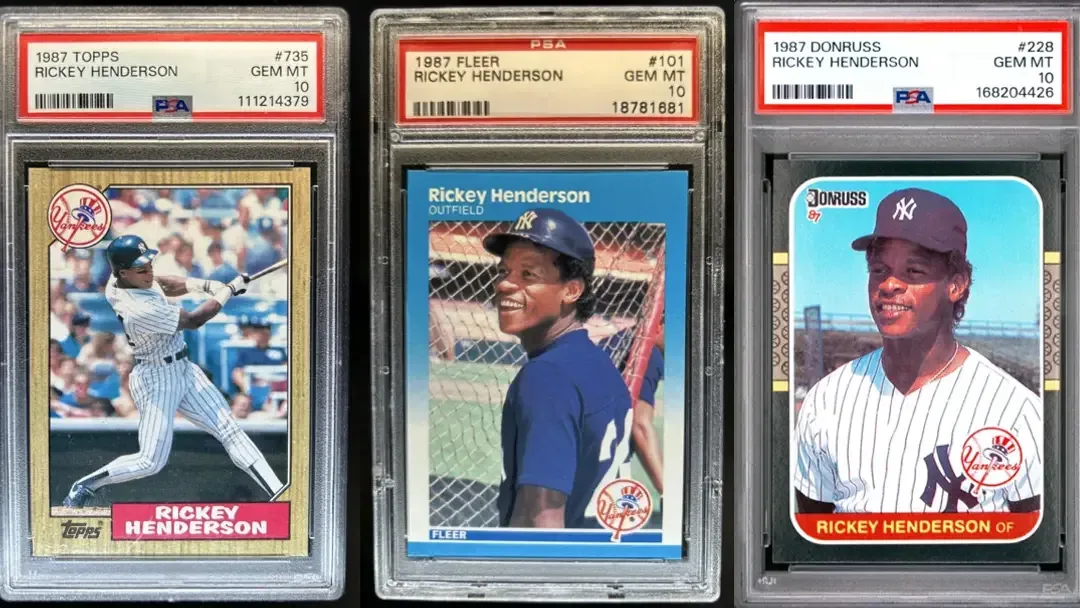
The 1987 Fleer baseball set comes from an era of memorable visual identities. Alongside Topps’ wood-grain treatment and Donruss’ black borders, Fleer chose a two-tone blue frame that remains immediately recognizable. Yet its appeal is not simply a matter of design nostalgia. The 660-card release combines rookie cards of Barry Bonds, Bo Jackson, Barry Larkin, Greg Maddux, Mark McGwire and Will Clark with established stars such as Nolan Ryan and Don Mattingly.
That mixture makes the set a useful reminder that collecting value is not determined by whether a card is a rookie card alone. The strongest recent PSA 10 result among the highlighted cards belongs to a veteran: the 1987 Fleer Glossy Nolan Ryan #67, at $3,000. The ordinary version of the same Ryan card recently sold for $670 in PSA 10. Barry Bonds’ base rookie sits next at $585, while his Glossy card reached $1,050. Bo Jackson’s Glossy rookie, meanwhile, sold for $1,250 despite a regular PSA 10 sale of $356.
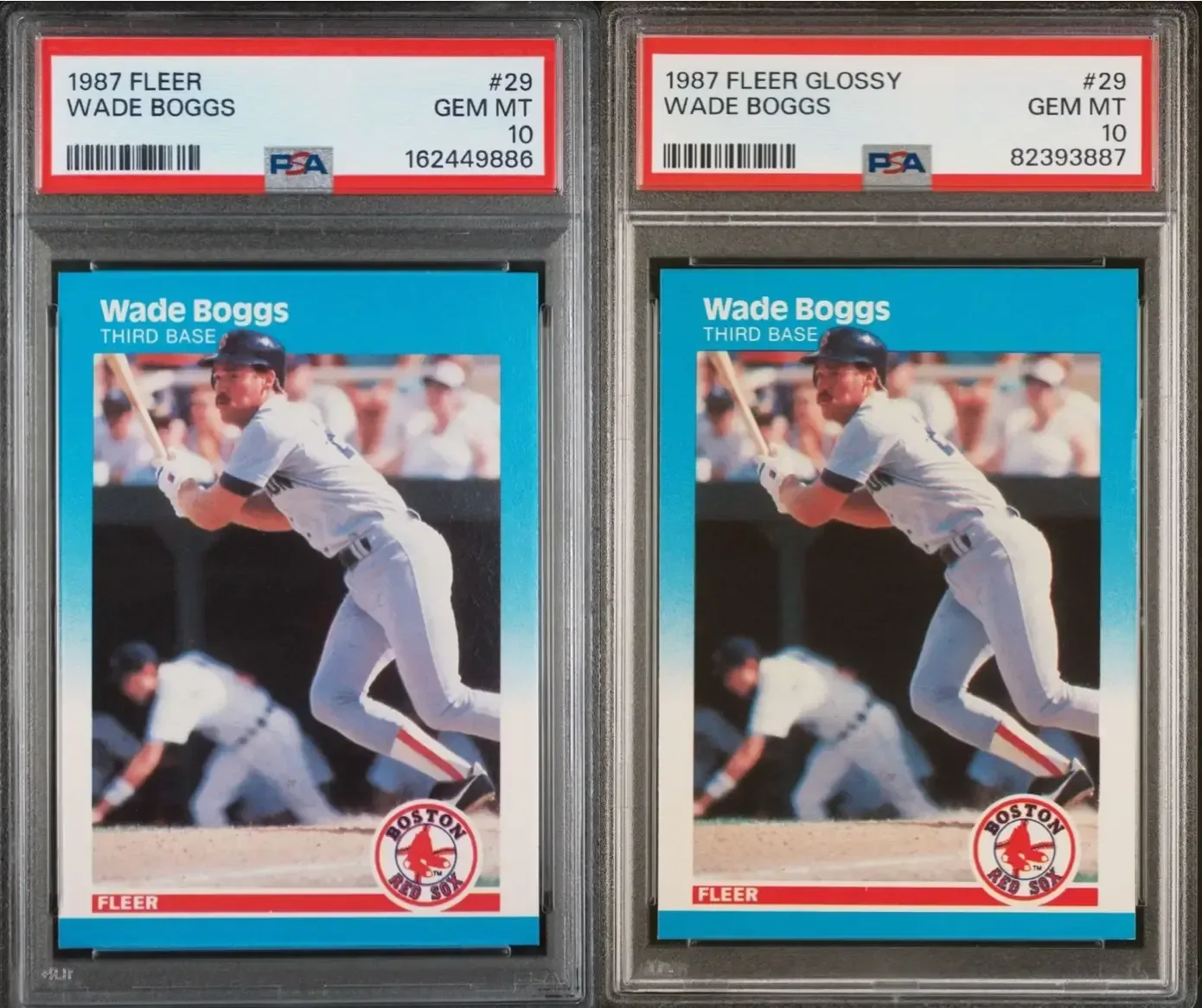
The gap between those versions is the central story of 1987 Fleer. The regular cards were widely distributed in wax packs, which increased from 15 to 17 cards that year. The Glossy cards arrived in commemorative factory tin sets instead, with a high-gloss coating on the card front. They are almost indistinguishable in pictures and have no back-of-card designation. That means collectors assessing an example should not assume that a scan, front image or checklist description settles the question of which version they are viewing.
Understanding the regular and Glossy 1987 Fleer cards
Fleer produced Glossy sets from 1987 through 1989. The estimated 1987 run was 75,000 sets. In practical market terms, a lower estimate is only one part of the explanation for a price premium. Condition and demand still matter, particularly when the comparison is at PSA 10, a grade that reflects a card’s condition rather than merely its identity.
Population, often shortened to “Pop,” is another important term in the sale results. It refers here to the number of cards graded at that level in the cited PSA population data. It should be treated as context, not an automatic price formula. For example, the base Barry Bonds #604 has a PSA 10 population of 1,295 and a recent sale of $585. Nolan Ryan #67 has a population of 124 and a recent sale of $670. The Glossy Ryan has a population of 25 and a recent sale of $3,000. Those figures show why collectors look at grade populations, but they also reflect the strong demand attached to Ryan as a longtime hobby favorite.
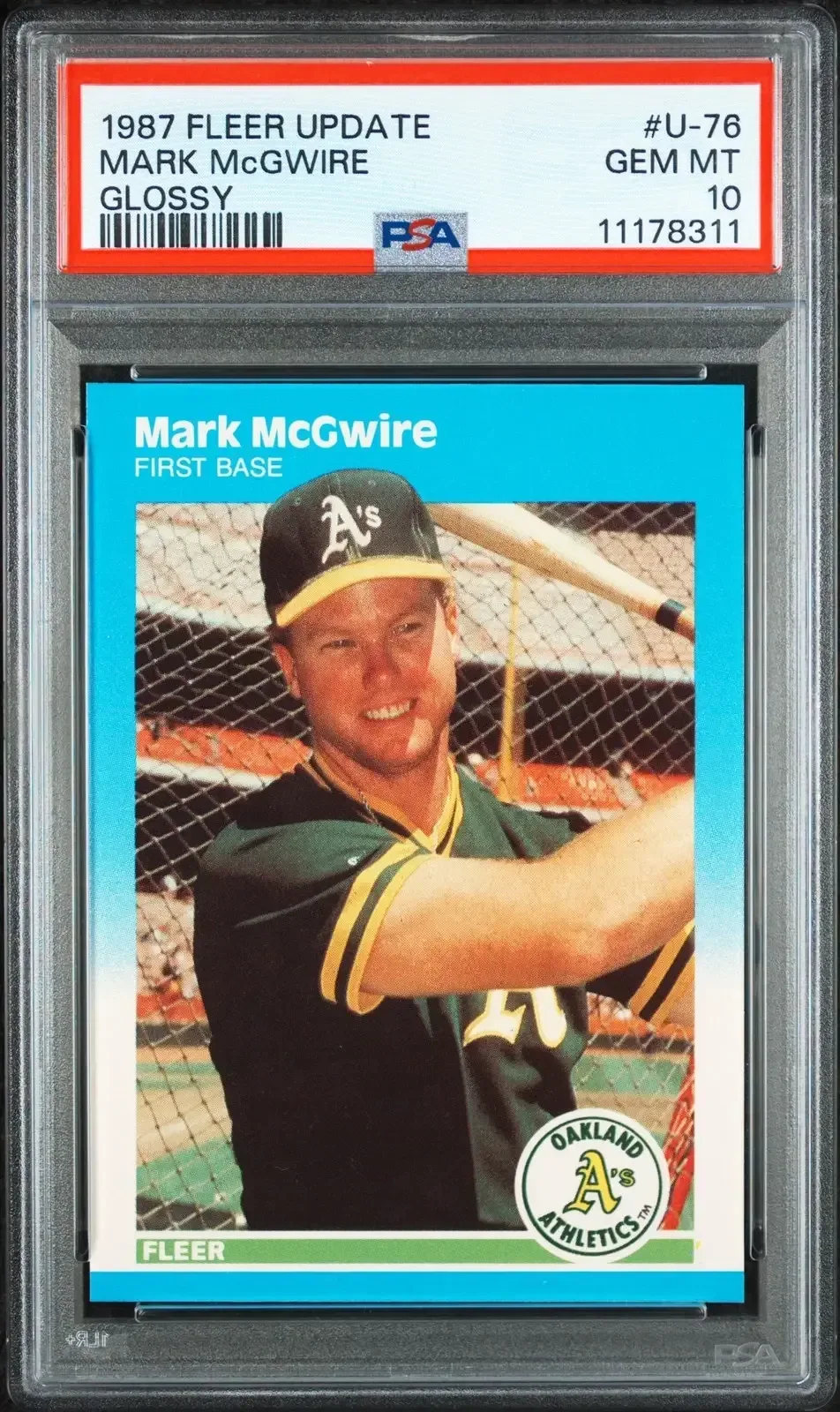
There are cases where a Glossy card’s PSA 10 population is greater than the base card’s reported PSA 10 population. Mark McGwire’s Glossy Update #U-76 is listed at 751, compared with 504 for the standard version; Greg Maddux’s Glossy Update #U-68 is listed at 1,050 versus 936. The sales premiums for their Glossy examples were relatively measured as well: $161 against $120 for McGwire, and $230 against $200 for Maddux. The lesson is straightforward: “Glossy” is a meaningful variation, but it does not create the same price spread for every player.
A same-day comparison involving Wade Boggs illustrates the distinction clearly. A regular 1987 Fleer Boggs sold for $34.99, while a Glossy counterpart brought $105.50. Since the surface treatment is more evident in person than in photographs and the back does not label the parallel, careful identification matters before comparing a sale to a card in hand.
The seven headline cards and their recent PSA 10 results
1. Barry Bonds rookie card #604
The standard 1987 Fleer Barry Bonds rookie recorded a recent PSA 10 sale of $585, with a population of 1,295. Its Glossy counterpart sold for $1,050, with a population of 606. Bonds’ 1986 Topps Traded and 1987 Topps cards are generally regarded as his most iconic issues, but the Fleer rookie remains a substantial entry in the broader group that includes 1987 Donruss and 1987 Donruss Opening Day.
The movement in the base PSA 10 makes its recent market attention especially visible: a copy sold for $150 in October 2023, versus the $585 recent result cited here. That is a sharp change, but it is not a guarantee that every future sale will follow the same path. Sales are individual transactions, and grade is particularly consequential with a mass-era card.
2. Nolan Ryan #67
Nolan Ryan’s #67 is the outlier that gives the set much of its personality. It is not a rookie card, but its recent PSA 10 sale of $670 exceeded the cited PSA 10 prices for the Bonds and Jackson base rookies. The Glossy version reached $3,000. Reported PSA 10 populations were 124 for the standard card and 25 for the Glossy.
Ryan was 40 during the 1987 season, when he led the majors with 270 strikeouts and a 2.76 ERA, while finishing 8-16. His status as one of the hobby’s most collected stars and demand from collectors building a PSA Nolan Ryan Master Set Registry help explain why this particular veteran card can command a price normally associated with more celebrated rookie cards. It is a useful case study in set collecting: the key card in a release is not always the youngest player or the player with the most famous rookie designation.
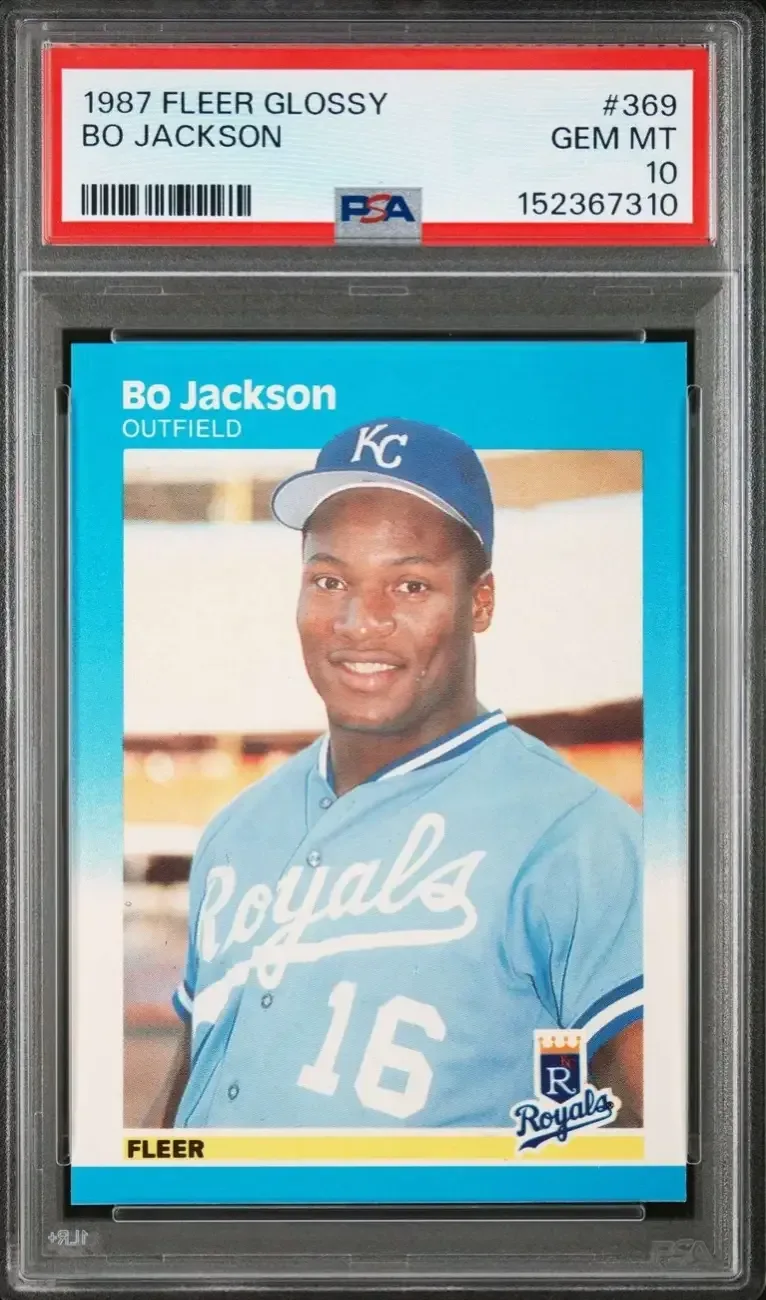
3. Bo Jackson rookie card #369
Bo Jackson’s base rookie recently sold for $356 in PSA 10, with a reported population of 686. The Glossy PSA 10 sold for $1,250, with a population of 194. That divide is one of the most dramatic among the seven cards. Jackson’s collecting appeal goes beyond a conventional single-sport résumé: he became the first athlete selected to both an MLB All-Star Game and an NFL Pro Bowl.
His career was shortened by injury, but his place in 1980s sports culture remains a major part of his appeal. A cited comparison puts the Glossy PSA 10 at just $40 twenty years earlier, underscoring the extent to which demand for Jackson cards has changed over time.
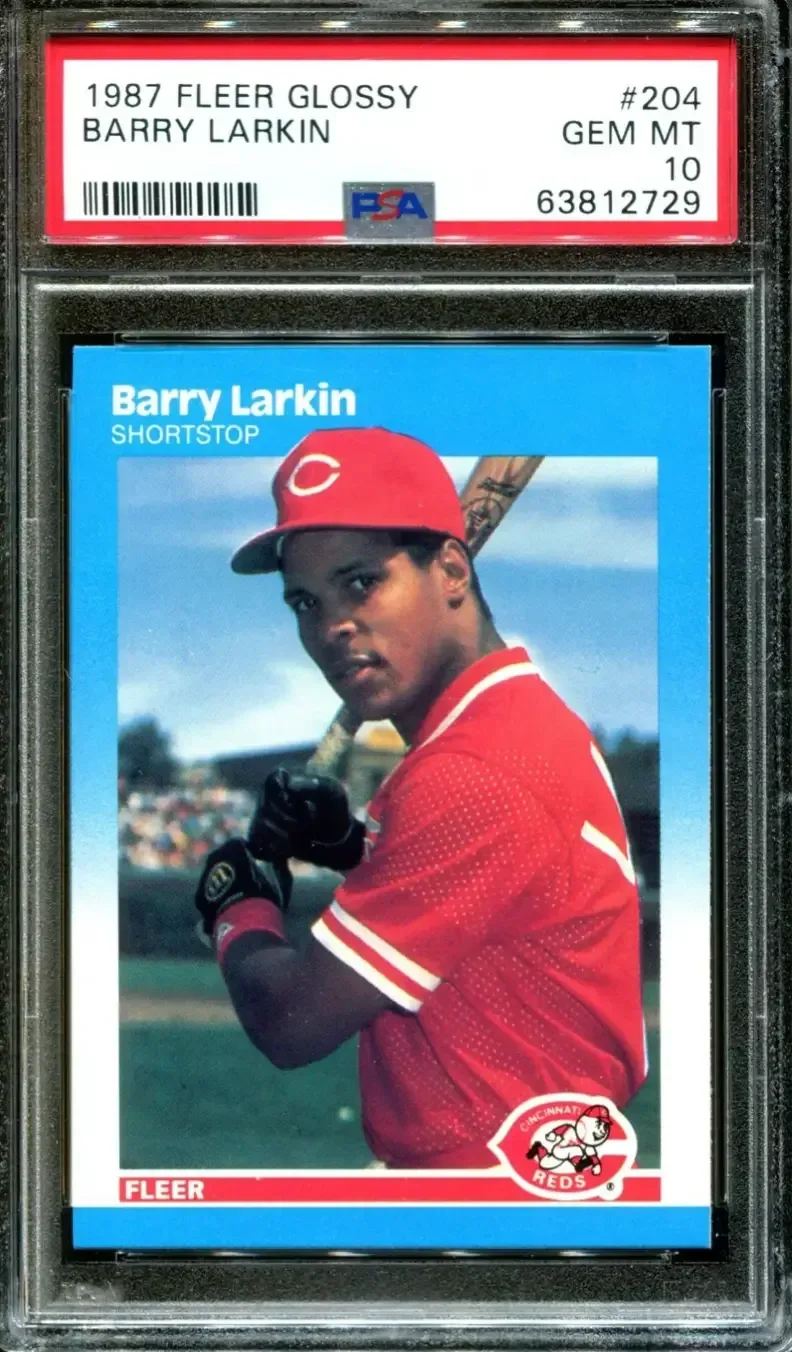
4. Barry Larkin rookie card #204
Barry Larkin’s base PSA 10 recently sold for $237, with a population of 452. The Glossy PSA 10 sold for $432, with a population of 146. Larkin spent his entire 19-year major-league career with the Cincinnati Reds, won the 1990 World Series and was National League MVP in 1995.
For collectors not pursuing top-grade copies, Larkin is an accessible Hall of Fame rookie-card route: a PSA 9 example could be found for about $20. That is a different collecting proposition from chasing a PSA 10, and it is worth separating the two. The premium at the highest grade is not a statement that all copies are costly.
5. Greg Maddux Update rookie card #U-68
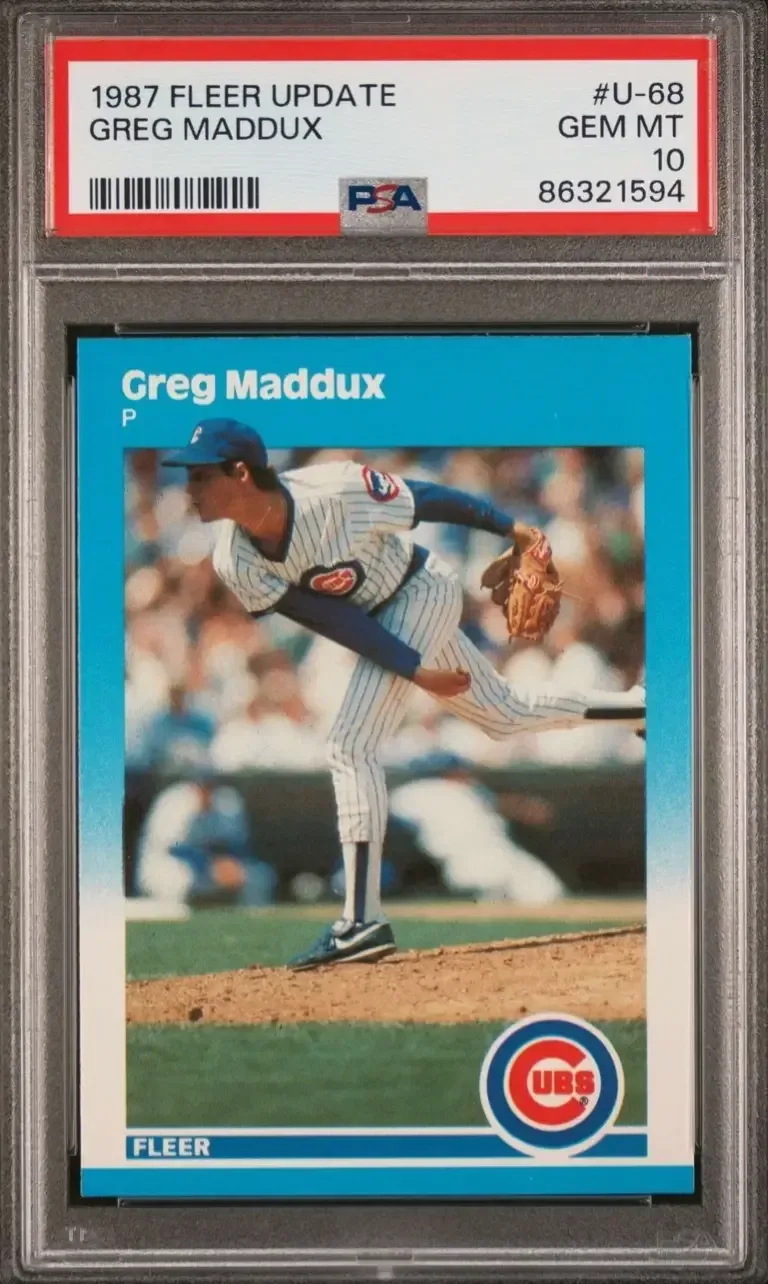
Greg Maddux’s Update rookie has a recent PSA 10 sale of $200, with a population of 936. The Glossy version recorded $230, with a population of 1,050. Maddux’s 1987 season with the Cubs was difficult: he went 6-14 with a 5.61 ERA. His later achievements put that early line into perspective—355 wins, four straight Cy Young Awards and a record 18 Gold Gloves.
The card is also a reminder that an Update issue is part of the 1987 Fleer conversation. Fleer did not include every important rookie in its original flagship checklist, then added notable players through the Update set. A PSA 9 Maddux could be found for around $25, offering another example of how sharply price can change between grades.
6. Will Clark rookie card #269
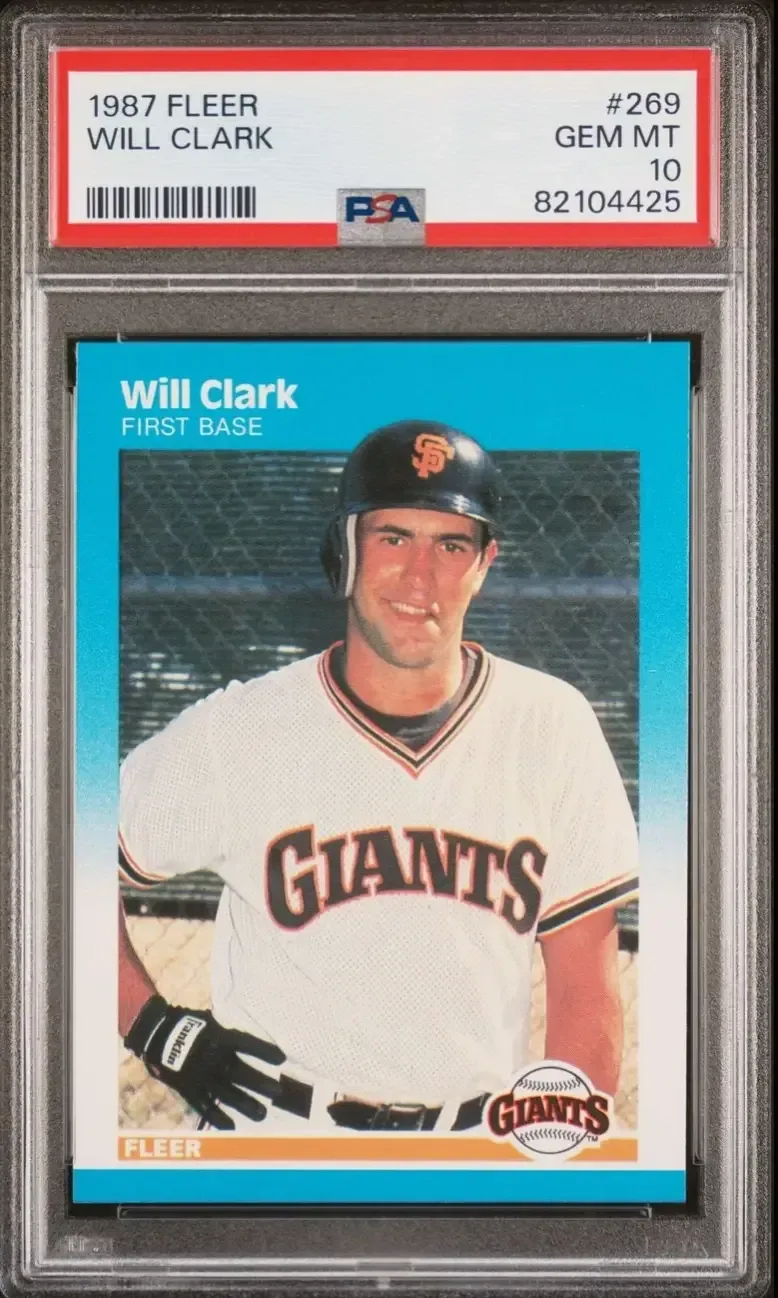
Will Clark #269 sold recently for $198 in PSA 10, with a population of 246. Its Glossy PSA 10 brought $203, with a population of 352. The small difference between those results is a useful counterweight to the much larger Glossy premiums attached to Ryan, Jackson and Bonds.
Clark appeared in 1986 Fleer Update, though that issue is traditionally classified as an extended rookie card, or XRC. His 1987 Fleer #269 is therefore treated as his first true Fleer rookie card. Clark was among baseball’s best hitters from 1987 through 1991, even though his shorter career kept him from piling up the conventional cumulative totals often associated with Hall of Fame candidacies.
7. Mark McGwire Update rookie card #U-76
Mark McGwire was absent from Fleer’s initial 1987 flagship release but appeared in Update as #U-76. A base PSA 10 recently sold for $120, population 504, while the Glossy PSA 10 sold for $161, population 751. In 1987, McGwire hit 49 home runs, setting the major-league rookie record at that time and earning the American League Rookie of the Year Award unanimously.
Collectors may encounter a different hierarchy when comparing McGwire rookies across brands. His 1985 Topps Team USA is regarded as his most iconic rookie card, while his 1987 issues are generally available for less. Within a focused 1987 Fleer collection, though, the Update card remains essential because it fills the flagship-set omission.
Other cards that deepen the checklist
The set’s depth does not end with the seven biggest names. Recent PSA 10 sales listed for notable honorable mentions include Don Mattingly #104 at $177, Bobby Bonilla rookie #605 at $180, Fred McGriff Update rookie #U-75 at $100 and Jose Canseco #389 at $70. Those cards reinforce the appeal of the 660-card checklist: it can support a player collection, a rookie-focused project, a star-card run or a full set without relying on one single chase card.
Fleer also expanded beyond the core set with Headliners, All-Stars and World Series subsets. That broader 1987 output reflects competitive pressure among the era’s three major manufacturers, all seeking ways to stand apart through design and product configuration. For anyone exploring other collectible-card coverage, this look at a fan-made Brigade Amateur Edition offers a very different example of how collecting communities respond to product identity and availability.
What to take from the 1987 Fleer market
The 1987 Fleer market rewards precision. Collectors should distinguish the standard issue from the Glossy version, distinguish base-set cards from Update cards, and compare like-for-like grades rather than using a PSA 10 result as a proxy for every copy. “Rookie card” also needs context: the Clark XRC distinction and McGwire’s more prominent 1985 Team USA card show that rookie status is not always a simple one-card answer.
The set also complicates the familiar assumption that large-era production makes every card inexpensive. Many regular 1987 Fleer cards can remain accessible, including cited PSA 9 examples of Larkin and Maddux around $20 and $25. At the same time, condition-sensitive PSA 10 copies, low-population variants and player-specific demand can create prices far above that baseline. Nolan Ryan’s #67 is the clearest proof: the highest cited sale in this group belongs to a 40-year-old veteran card, not to a rookie.