The 1963 Topps baseball issue is a 576-card set with enough enduring names to make even its supporting cast feel star-studded. It has Mickey Mantle, Willie Mays, Hank Aaron, Roberto Clemente, Sandy Koufax, Yogi Berra, Ernie Banks and Bob Gibson. It also has a Pete Rose rookie card that has become the set’s signature chase, plus Willie Stargell and Tony Oliva rookies. The result is a vintage release with several different ways to collect it: marquee singles, rookies, late-series scarcity, attractive multiplayer cards and the separate Peel-Off insert run.
Its visual formula is central to the appeal. Individual base cards combine a large color player photograph with a smaller black-and-white image, while colorful borders run along the bottom. That lower-border treatment gives the set a look all its own, but it creates a material challenge, too: the edges chip easily. A card can have a strong image and still take a substantial condition hit through border wear, so surviving high-grade examples are unusually difficult to find.
For collectors, that makes 1963 Topps a useful reminder that a card’s value is not simply a measure of a player’s greatness. Card number, series placement, condition rarity, rookie status, design and collector demand can pull in different directions. The gap between Mays and Mantle sales within this very set illustrates the point.
Why the 1963 Topps set stands apart
Topps was operating from a position of remarkable depth in 1963. Its checklist ran to 576 cards, while Fleer produced only 67 cards that year. Fleer tried to enter the market with cards packaged alongside a cherry-flavored cookie rather than gum, but Topps successfully sued and Fleer did not move beyond its first series. Topps consequently retained control of the baseball-card market for years afterward.
The set’s size permits it to tell a broader story than a simple run of single-player portraits. It includes league-leader cards, team combinations and other multiplayer subjects. These cards can be a compelling alternative for someone seeking Hall of Fame talent without paying the same premium attached to every individual star card.
That is because multiplayer cards often trade below comparable solo cards. No one player completely defines the card, and the multiple portraits reduce the visual space given to each athlete. Those traits can soften demand, but they also create a value proposition: one piece of cardboard may include several all-time players.
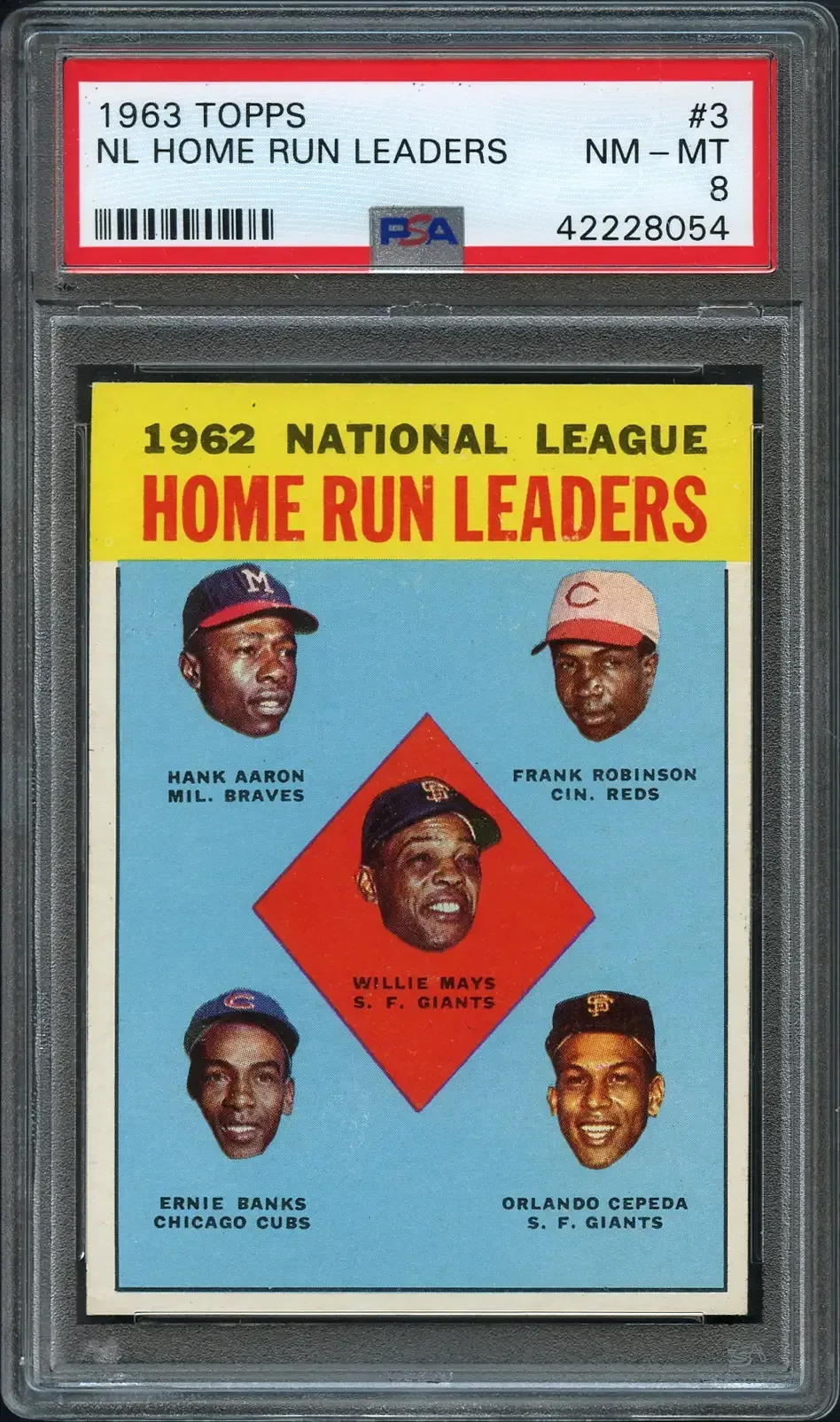
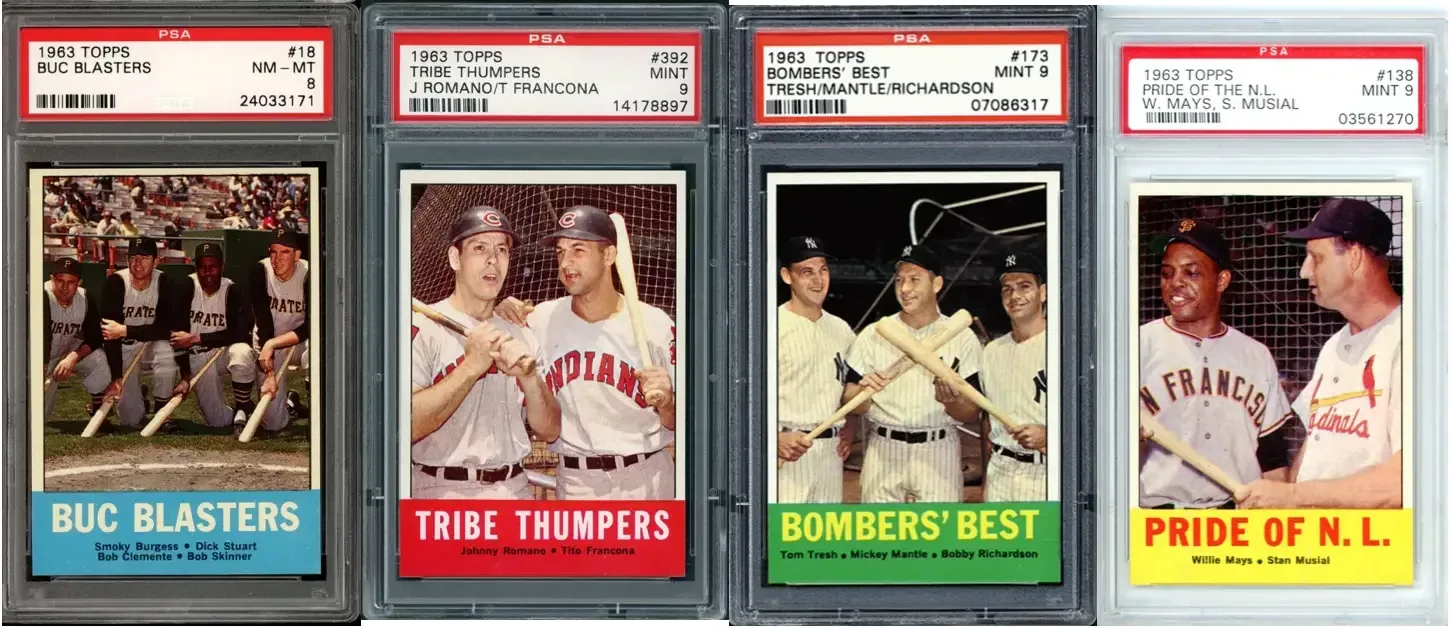
The standout is card #3, the 1962 National League Home Run Leaders card. It brings together Willie Mays, Hank Aaron, Frank Robinson, Ernie Banks and Orlando Cepeda—five Hall of Famers. Other notable group cards include Buc Blasters #18, Bombers’ Best #173, Power Plus #242, Tribe Thumpers #392 and Dodgers’ Big Three #412. Rather than treating those as mere checklist extras, a collector can reasonably view them as a focused subcollection within the larger set.
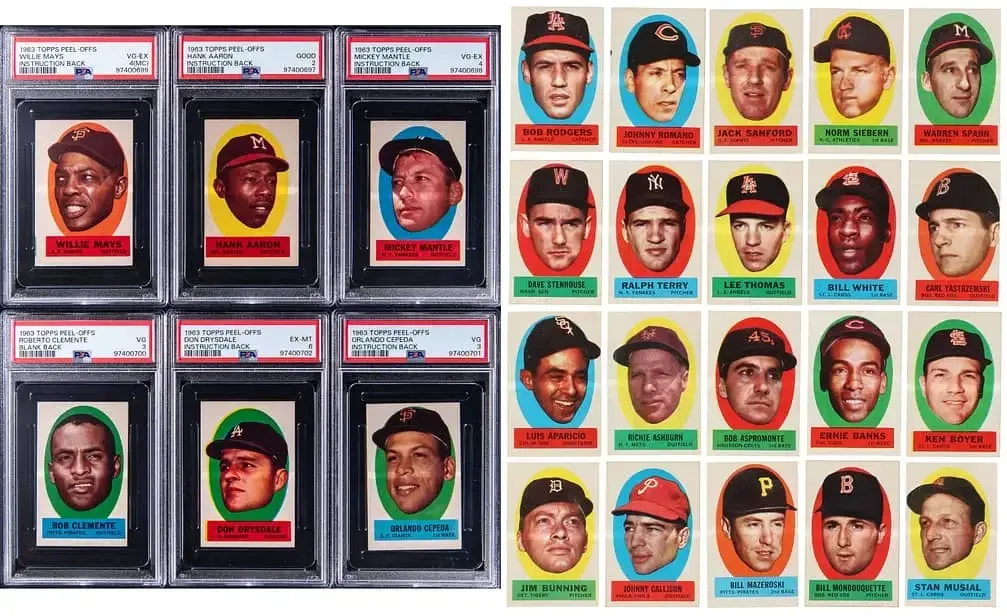
There is also a 46-player, unnumbered Topps Peel-Offs insert set. Randomly placed in five-cent packs, these inserts used peel-away stickers and included figures such as Mantle, Mays, Aaron, Clemente and Stan Musial. They are distinct from the 576-card base checklist, an important distinction when building a want list or assessing a purported complete set.
Physical-media collecting is never just about the featured image; packaging, fragility and survival matter as well. That same broader relationship between the object and its format is explored in this look at Nintendo’s physical media history.
The six cards that define the set
1. Pete Rose #537, Rookie Stars
Pete Rose’s 1963 Topps #537 Rookie Stars card is the set’s most consequential rookie and, for many collectors, its defining card. It is sometimes confused with Rose’s 1964 issue, but PSA and Beckett classify the 1963 “floating heads” card as his sole rookie card. Rose earned National League Rookie of the Year honors in 1963 after hitting .273 and collecting 170 hits for Cincinnati.
It is a shared rookie card rather than a Rose solo issue, which is a key visual and cataloging detail for buyers. Yet Rose’s presence has made it the dominant card. The recorded high sale cited for the card is $264,000 for an SGC 10 in May 2021. Reported reference points include $3,380 for a PSA 6 and $1,385 for a PSA 3, while PSA’s population is listed at 7,712 copies, including one PSA 10 and 30 PSA 9s.
Its appreciation also demonstrates why grade labels need context. A PSA 2 copy sold for $394 in 2020; the last PSA 2 noted sold for $1,344. That is not a guarantee of future pricing, but it does show that demand has extended well below near-mint territory.
2. Mickey Mantle #200
Mantle’s #200 is a classic example of an icon whose market pull can exceed a straightforward reading of on-field circumstances. Mantle won his third MVP in 1962, but a broken foot and knee injury held him to 65 games in 1963. Even so, his base card is a cornerstone of the issue.
The card’s reported record is $317,200 for a PSA 9 sold on October 24, 2026. That is an extraordinary change from a PSA 9 sale of $3,800 in 2009. At more accessible grades, the cited figures are $2,300 for PSA 6 and $603 for PSA 3. PSA’s population count is listed as 8,960, with two PSA 10s and 40 PSA 9s.
Mantle appears elsewhere in the release, including #2, 1962 AL Batting Leaders with Pete Runnels and Leon Wagner, and #173, Bombers’ Best with Bobby Richardson and Tom Tresh. Those alternatives offer a different route into the set’s Mantle material, although they are not substitutes for the visual impact and demand of #200.
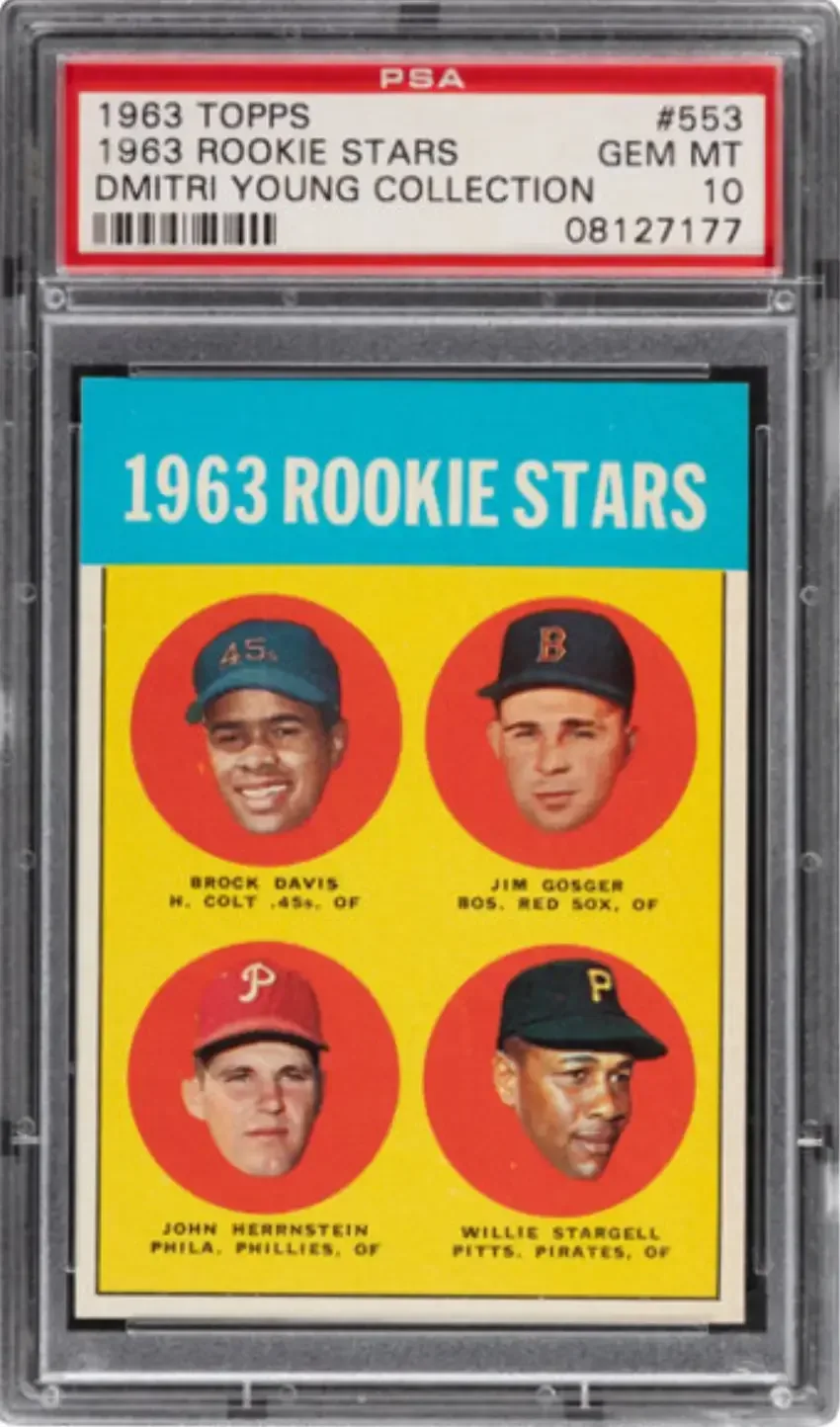
3. Willie Stargell #553, Rookie Stars
Willie Stargell’s #553 is the other Hall of Fame rookie that commands attention. Like Rose, Stargell appears on a shared Rookie Stars card, joined by Brock Davis, Jim Gosger and John Herrnstein. The format is an essential part of its identity: collectors are buying a multi-player rookie card whose long-term significance rests overwhelmingly with Stargell.
The card’s reported peak sale is $63,000 for a PSA 10 in May 2021. Listed reference prices are $652 at PSA 6 and $234 at PSA 3. PSA’s reported population is 3,656, including two PSA 10s and 35 PSA 9s.
Stargell’s later career provides the historical weight. In 1979, he became the only player to win National League MVP, NLCS MVP and World Series MVP in one season. For a collector working through 1963 Topps rookies, #553 is therefore more than a secondary card behind Rose—it is one of the set’s two major rookie pillars.
4. Hank Aaron #390
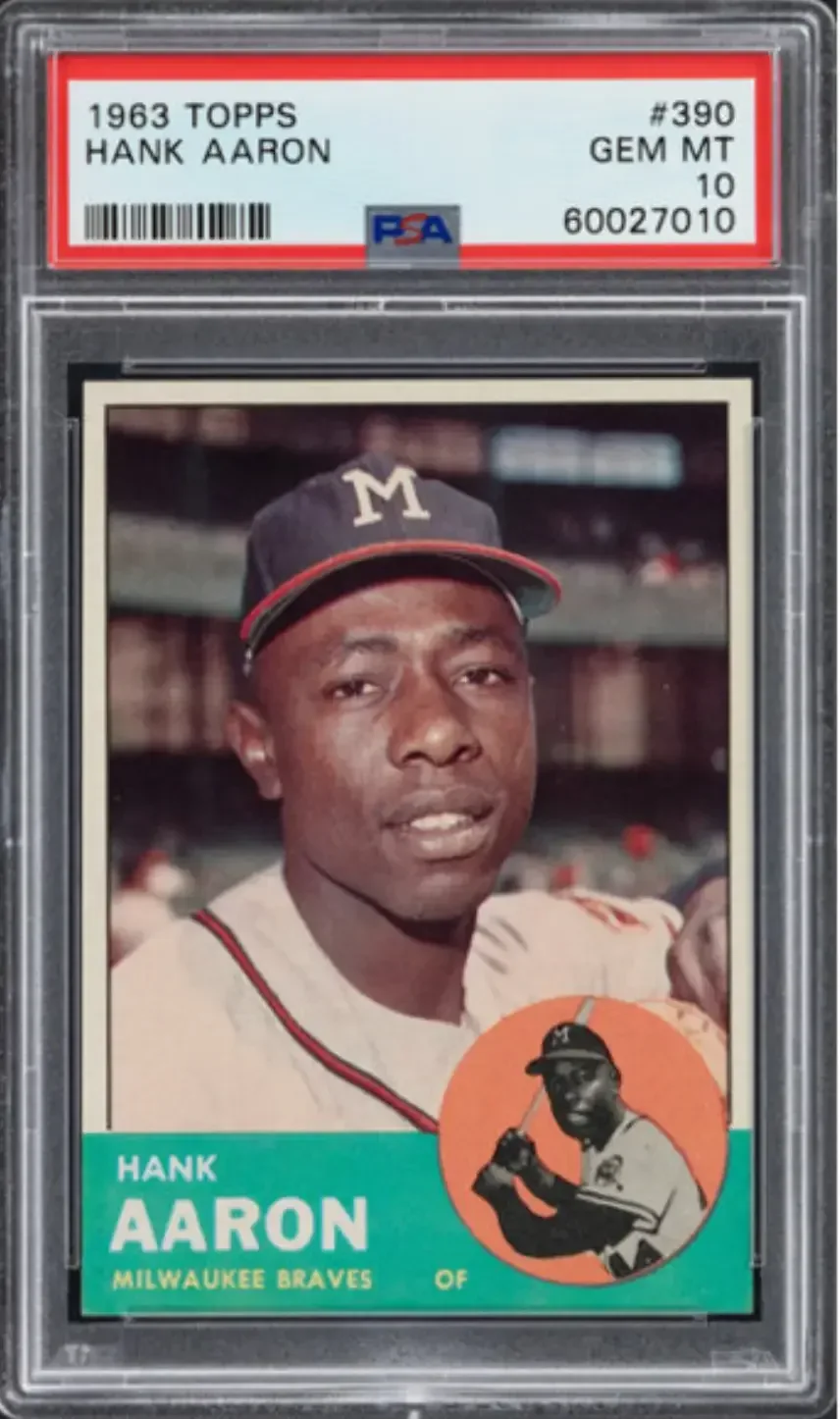
Hank Aaron’s #390 captures a player who was still producing at an exceptional level. In 1963, Aaron hit .319 with 44 home runs, 130 RBIs and 31 stolen bases, leading the National League in homers and RBIs.
Condition has driven some dramatic results. A PSA 10 sold for a reported $222,000 in November 2022. The provided PSA 6 and PSA 3 reference points are $585 and $190, respectively, and the listed PSA population is 4,007, with two PSA 10s and 38 PSA 9s. A PSA 8 that could reportedly be found under $200 in 2018 now sells above $2,000.
Collectors who want more Aaron in the same design can look to #242, Power Plus with Ernie Banks, or #3, the five-Hall-of-Famer home-run leaders card. Those group cards are a useful reminder that the 1963 checklist rewards collecting by theme rather than strictly by the highest-priced singles.
5. Roberto Clemente #540
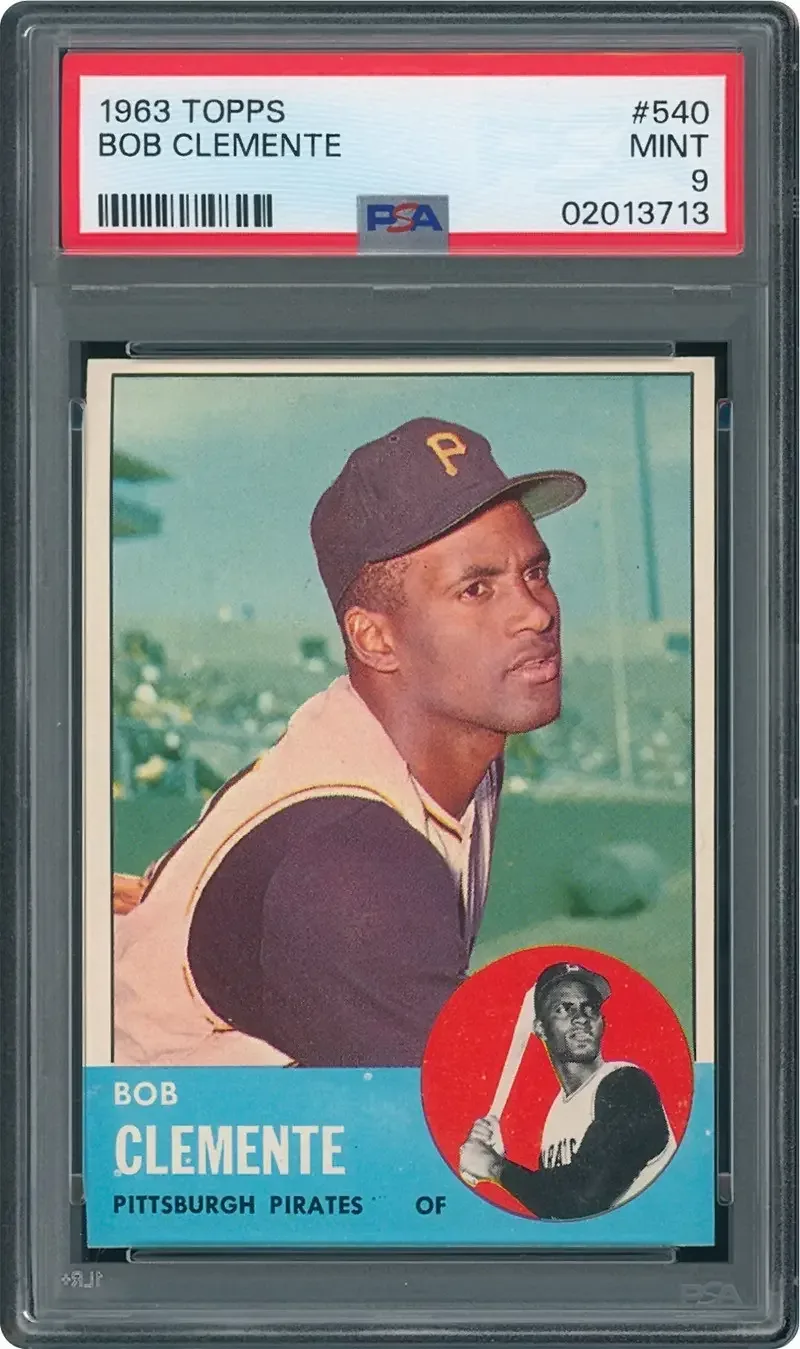
Roberto Clemente’s #540 gains an extra layer of interest from where it sits in the release. It arrived in the seventh and final series, making it one of the more difficult cards in the set to locate. Late-series status is not a grading term; it refers to placement late in a product’s original distribution, where surviving supply can be more challenging than for earlier cards.
Clemente finished second in the National League batting race in 1963. His #540 has a cited record sale of $56,047 for a PSA 9 in January 2023. The reported PSA 6 price is $569 and PSA 3 price is $250; PSA’s population is listed at 3,725, with two PSA 10s and 35 PSA 9s. A PSA 7 was available for less than $250 in 2019, while a recent example sold for $920.
He also appears on #18 Buc Blasters and in the Peel-Offs run. For a Clemente-focused collection, those cards provide variety, while #540 remains the essential base-card target.
6. Willie Mays #300
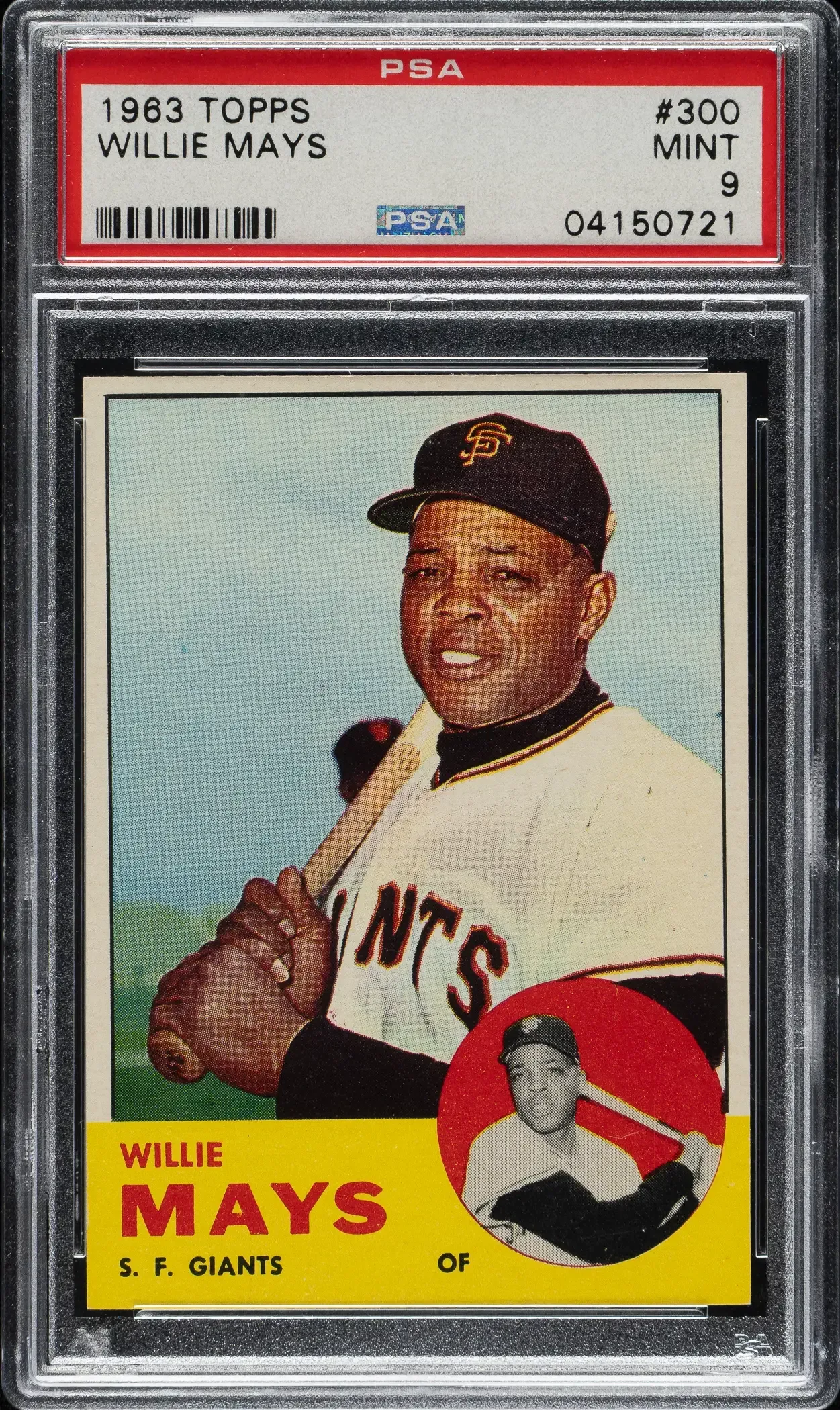
Willie Mays #300 has the profile of a marquee vintage card: a central Hall of Fame subject, a striking set design and high-grade scarcity. Mays had hit a career-best 49 home runs in 1962 and helped the Giants reach the World Series. He followed with a 10.6 WAR season in 1963, among his best totals.
WAR means wins above replacement, a statistic designed to estimate a player’s overall contribution compared with a replacement-level player. It is useful context for Mays’s extraordinary baseball value, but the card market does not mechanically rank players by WAR. The record sale reported for #300 is $24,500 for a PSA 9 in February 2026, while the listed PSA 6 and PSA 3 prices are $420 and $160. The PSA population is 4,225, including one PSA 10 and 38 PSA 9s.
The contrast with Mantle is revealing. A PSA 9 Mays sale of $12,300 is cited alongside Mantle’s $317,200 PSA 9 result from the same set. Mays may have been the better overall player, but collector preference, iconic status within the hobby and demand dynamics can produce a radically different result.
A practical 1963 Topps collecting approach
Start by deciding whether the goal is a player collection, a rookie collection, a condition-focused project or a set run. Each route has a different pressure point. Rose and Mantle demand substantial budgets even in lower grades. Clemente introduces late-series difficulty. Aaron and Mays offer elite-player appeal with reported PSA 3 and PSA 6 prices below Mantle’s. Multiplayer cards offer a less expensive path to a dense concentration of Hall of Fame names.
When comparing slabs, do not compare the number on the label in isolation. A PSA 6, PSA 9, PSA 10 and SGC 10 are not interchangeable market categories, and a record sale at one grade should not be used as a shortcut for valuing a lower-grade copy. Examine the exact player, card number, grader and condition tier being discussed. The fragile colored bottom border makes close visual evaluation particularly important for this issue.
Beyond the six headliners, the set retains considerable depth. Cited PSA 6 reference prices include Sandy Koufax #210 at $355, Yogi Berra #340 at $333, Ernie Banks #380 at $255, Bob Gibson #415 at $250, Tony Oliva’s rookie #228 at $226 and Bob Uecker #126 at $200. Those names make it possible to build a meaningful 1963 Topps group without attempting to chase every headline sale.
That depth is the set’s lasting advantage. 1963 Topps can be approached as a Rose rookie hunt, a Mantle centerpiece, a late-series Clemente challenge, a condition-sensitive vintage design, or a Hall of Fame multiplayer-card project. It has enough star power to support all of those paths—and enough nuance that the cardboard, not just the names, still matters.