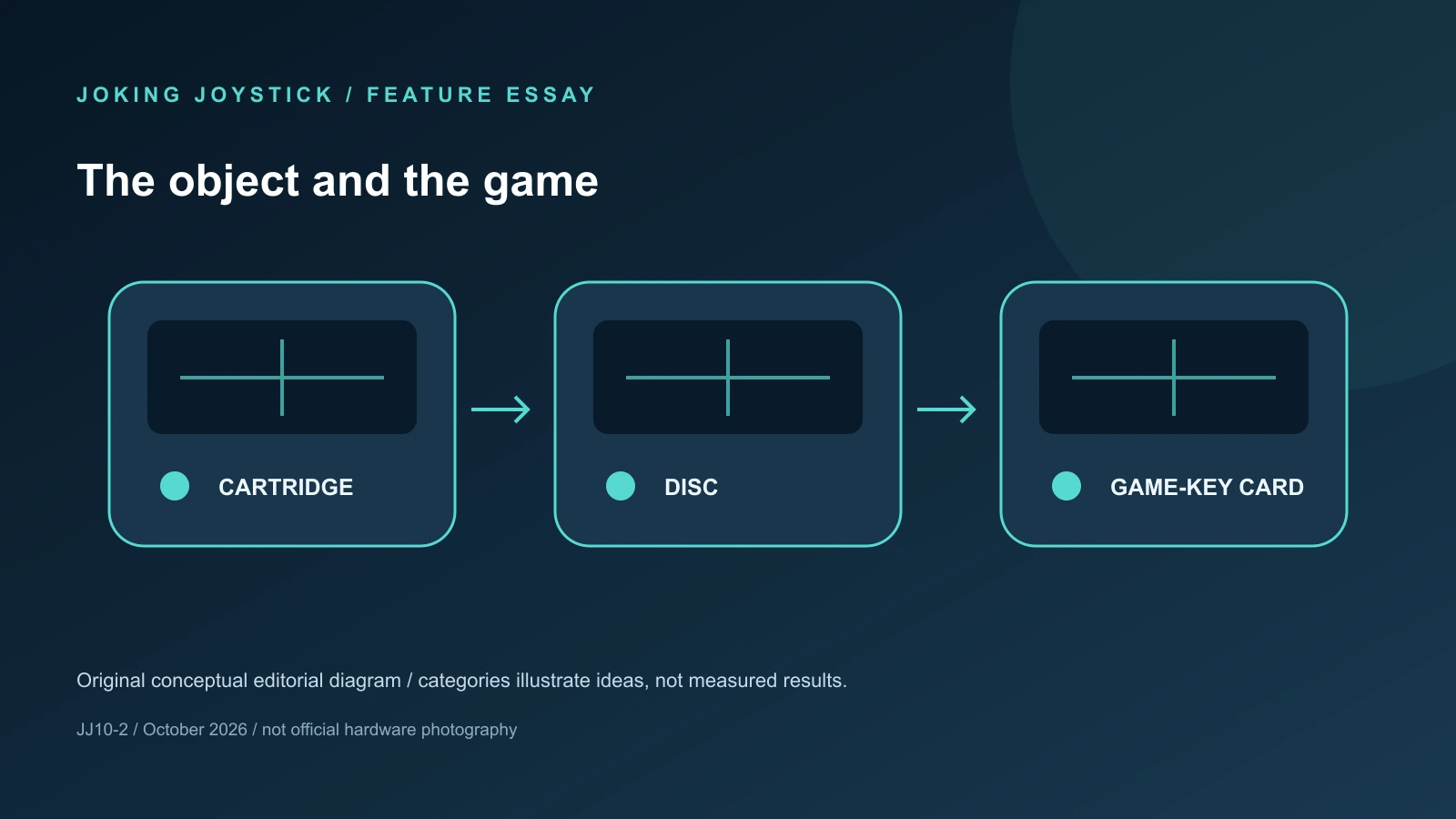
How to Measure Nintendo Physical Media
A history of Nintendo’s physical software needs a measurement system before it needs a timeline. “Bigger cartridge,” “larger disc,” and “physical game” sound straightforward until the underlying units and storage layers are separated. A cartridge advertised as 32 megabits is not a 32-megabyte cartridge. A disc with a nominal capacity of several gigabytes may contain padding, partitions, duplicated files, or unused sectors that are not playable game content. A modern card may be physically present in a box while the software it launches is downloaded elsewhere. These are different situations, and treating them as equivalent produces misleading comparisons.
The basic conversion is simple: eight bits equal one byte. Therefore, 32 megabits equal 4 megabytes before headers, padding, separate memory devices, or other structures are considered. Manufacturers and game documentation often described early cartridges in megabits because the figure referred to the amount of ROM installed on the board. Modern storage is more commonly described in gigabytes or megabytes, but the principle remains the same: the unit must be identified before the number has meaning.
Bits are individual binary values, while bytes are groups of eight bits. A bit can represent a one or a zero; a byte can represent a small character, part of an instruction, or a piece of graphical data. “Megabit” and “megabyte” are not interchangeable words, even when both are casually shortened to “mega.” A 64-megabit ROM is 8 megabytes at the basic conversion level. That does not necessarily mean that an 8-megabyte file extracted from a cartridge will contain 8 megabytes of unique, actively used game material. The board may have unused address space, alignment gaps, a separate save device, or a dump format that includes technical information beyond the title’s files.
ROM, or read-only memory in the historical sense, is where a cartridge or card stores relatively fixed program instructions, graphics, music, text, and other assets. It is the storage that makes the physical object a game carrier. RAM is different. Random-access memory is working space used while the console runs the software. Code and assets can be copied into it, decompressed there, or manipulated during play, but RAM capacity does not tell us how much software is present on the cartridge.
This distinction matters because Nintendo repeatedly used the game medium as an extension of the console. A cartridge might contain a mapper that exposes different portions of a larger ROM to the console’s processor. It might include an enhancement processor, extra working RAM, or a circuit that handles graphics or arithmetic. None of those facts can be reduced to a single “game size” figure. A cartridge with 4 megabytes of ROM and a cartridge with 4 megabytes of ROM plus an enhancement chip have the same nominal ROM capacity but not necessarily the same capabilities.
Save memory is another separate category. Battery-backed SRAM, EEPROM, and flash memory can hold a player’s progress, settings, or records. They are writable, unlike the game ROM in a conventional cartridge, and their capacities are usually tiny compared with the program and asset ROM. A failed battery can affect the retention of saves without erasing the game itself. Later platforms moved some save data to memory cards, internal console storage, or removable SD media. Those devices belong to the storage environment around the game, not automatically to the game medium.
It is useful to distinguish at least five meanings of capacity. Format maximum means the largest capacity supported by a medium or documented hardware family. Common retail size means what ordinary releases typically used during that platform’s commercial life. Title data means the game’s actual program and asset content. Raw image size means the size of a complete dump of the physical object, including whatever structures the dumping method preserves. Installed size means the storage consumed after software is copied or downloaded to a console or memory card.
| Format | Capacity evidence | What the figure means |
|---|---|---|
| Famicom/NES | Mapper- and board-specific PRG and CHR ROM arrangements | No single universal retail maximum; examples must identify board, region, PRG ROM, CHR ROM, and total ROM separately. |
| Famicom Disk System | Nintendo describes roughly three times the storage of contemporary ROM cartridges | A historical comparison, not a universal decimal byte count. |
| Game Boy/Game Boy Color | Banked ROM classes varied by cartridge and later title | Cartridge ROM capacity, separate from save memory and used data. |
| Super Famicom/SNES | Representative releases range from small early Game Paks to named late high-capacity titles | Measured or documented title-specific ROM, not one universal SNES ceiling. |
| Nintendo 64 | Named retail examples include 12 MiB and 32 MiB ROM images | Observed ROM-image size, separate from system RAM and Expansion Pak memory. |
| Game Boy Advance | Nintendo technical documentation maps Game Pak ROM through a 32-MB address space | A mapped format ceiling, not a statement that ordinary games used 32 MB. |
| Nintendo DS | Nintendo developer documentation lists 64-, 128-, 256-, and 512-megabit mask-ROM classes and larger PROM classes | Nominal card-ROM class, separate from backup memory and used title data. |
| Nintendo 3DS | Nintendo support describes Game Cards ranging from 2 GB to 4 GB | Card-capacity classes, not automatically unique game data or installed size. |
| GameCube | Dolphin documentation identifies complete GameCube disc images of approximately 1.36 GiB | A complete-image value, not nominal medium capacity, filesystem size, or unique title data. |
| Wii | Dolphin documentation identifies approximately 4.38 GiB single-layer and 7.93 GiB dual-layer image values | Ripping or complete-image measurements, not automatic playable-data totals. |
| Wii U | Nintendo documents a proprietary disc format but no universal usable disc-capacity figure in the cited support material | Discuss the disc separately from the documented 8-GB and 32-GB console-storage tiers. |
| Switch/Switch 2 | Nintendo distinguishes regular cards, game-key cards, and download-code packages | No universal public card-capacity table; use title-specific packaging and support information. |
The figures in the chapters below are identified as Nintendo-published, developer-documented, or measured from a named retail image. Where no reliable universal maximum is public, the comparison states that limitation instead of turning one unusually large release into a format-wide limit.
Those numbers can diverge sharply. A cartridge may have a ROM chip larger than the data required by the title because chips were available in fixed capacity steps. A disc image may include alignment padding or partitions that are not part of the game’s ordinary files. A downloaded version may have a different download size from its installed size, but that is a title- and platform-specific possibility rather than a universal rule. Conversely, an update or downloadable expansion can increase installed size without changing the capacity of the original physical object.
Optical discs require especially careful language. Their nominal capacity describes the physical medium’s design, not necessarily the space available to the game’s files. The console’s filesystem may reserve areas for system information. A release may duplicate data to reduce seek times, include filler to meet manufacturing or layout requirements, or ship across multiple discs because its usable arrangement cannot fit on one. A raw image preserves the disc’s structure; an extracted filesystem reports something else; the unique content created by the developer is another figure again.
The same caution applies to “downloaded data.” A title can have a physical base carrier, an update stored on console storage, downloadable content tied to an account, and a required installation component. Those pieces should not be described as though they were all printed on the disc or card. The physical object may remain essential even when it is not sufficient by itself.
Switch 2 makes this distinction explicit. Nintendo identifies regular game cards, game-key cards, and physical packages containing download codes as separate forms of physical software. A regular card is a game card format, while a game-key card does not contain the full game data. It requires an initial download, enough space in system storage or on a compatible microSD Express card, and an internet connection for that download. The card remains necessary for launching the downloaded game afterward. A box containing a download code may contain no game card at all.
Thus, “physical” describes the presence of a manufactured object, not one universal relationship between that object and the software. In one era the object held fixed ROM. In another it could be rewritten magnetic media. On optical platforms it held a structured disc image whose nominal capacity exceeded or differed from its useful files. On Switch 2, it may carry complete data, a title-specific subset, or a key that authorizes the initial download. The chapters that follow use these distinctions rather than treating every medium as a container measured by one headline number.
Famicom/NES: Cartridges as Hardware Extensions
The Famicom, launched in Japan in 1983, established a physical software model that would shape Nintendo’s home consoles for more than a decade. The game arrived in a cartridge, but the cartridge was not merely a passive box of instructions. It could contain program ROM, graphics data, writable save memory, bank-switching hardware, and specialized chips. The console supplied the processor, video system, audio system, and other core facilities; the cartridge could extend what those facilities could address or calculate.
Early descriptions of Nintendo cartridges often separate program ROM from character or graphics ROM. That distinction reflects the way the Famicom and NES addressed software data. Program instructions and game logic occupied one region, while graphical patterns could occupy another. The exact arrangement varied by board. A cartridge’s total ROM figure therefore might mean the sum of several physical chips, not one continuous file presented to the processor in a modern filesystem-like way.
The console’s immediately visible address space was smaller than the total amount of software that later cartridges could carry. Bank-switching, usually implemented through a mapper, solved that problem. The mapper selected which bank of a larger ROM was visible in a particular address window. The game could change banks as needed, bringing new levels, graphics, music, or program routines into view. The processor still saw only the currently mapped portion at any one moment, but the cartridge held more data overall.
This is why a simple statement such as “the NES supported only one cartridge size” is misleading. There were common board families, common early capacities, and later high-capacity examples, but no single number describes every official Famicom and NES release. The relevant maximum depends on whether the subject is program ROM, graphics ROM, the total ROM inventory, a mapper family, or the largest observed retail cartridge. A title could also use less of the available addressable space than the chips technically provided.
Some cartridges included battery-backed RAM for saving. The battery supplied power while the cartridge was removed from the console, preserving the contents of the writable memory. This save component was not part of the game ROM. A cartridge could therefore be described simultaneously by its program capacity and its save arrangement. Another title might have no save memory at all, relying on passwords or on uninterrupted play. The physical shell did not reveal all of those board-level differences.
Other cartridges went further by including enhancement circuitry. The exact capabilities varied among manufacturers and titles, but the principle was consistent: software could bring additional hardware into the system. A mapper might primarily manage memory banks, while a more specialized circuit could support arithmetic, timing, or other functions. These additions should not be counted as extra ROM. They changed how the console accessed or processed the game rather than simply increasing the number of stored bytes.
The Japanese Famicom and North American NES also demonstrate why regional variants must be treated separately. Famicom cartridges use a different physical style from the familiar North American NES cartridge. The connector arrangements, shells, and the surrounding console mechanisms are not interchangeable details. North American NES cartridges were designed for the front-loading console and its physical locking and authentication arrangements, while Japanese cartridges followed the Famicom’s own form factor. A number printed on one region’s board should not automatically be generalized to the other region’s retail catalog.
PAL releases require their own qualification rather than being treated as simple copies of either Japanese or North American versions. The systems, timing standards, packaging, product codes, and release practices differed by market. Even when the underlying game concept was shared, a regional cartridge could have different board details, software behavior, or physical construction. “NES cartridge” is therefore a family label, not proof that every example used the same electrical design.
Retail capacity is best shown through named, region-specific boards. An early NROM reference is 10-Yard Fight (Japan), whose MAME software-list entry identifies an IREM NROM-128 board with 16 KiB of PRG ROM mirrored to a 32-KiB PRG area and 8 KiB of CHR ROM: 24 KiB of physical fixed ROM in total. The mirrored 32-KiB CPU address area does not add physical ROM to that Japanese cartridge. A North American 10-Yard Fight entry uses an NES-NROM-256 board with 32 KiB of PRG ROM and 8 KiB of CHR ROM, or 40 KiB of fixed ROM without a separate save-memory device. These are representative early boards, not a universal cartridge specification.
A later MMC3-era example is Nintendo's North American Kirby's Adventure. MAME identifies its board as NES-TKROM with MMC3C and records 524,288 bytes, or 512 KiB, of PRG ROM. MAME also records 262,144 bytes, or 256 KiB, of CHR ROM and an 8-KiB battery-backed writable-memory area. The PRG and CHR ROM total is 768 KiB; writable save memory is separate. The important comparison is the board change: early NROM software used fixed PRG and CHR regions, while the later MMC3 board banked a much larger program region. These examples demonstrate capacity growth without implying that every Famicom or NES cartridge used either arrangement.
The safest conclusion is narrower than the familiar “NES maximum” claim: official Famicom and NES releases used multiple board families and capacity arrangements, and later mapper designs permitted larger cartridges than early fixed-mapping boards. The largest supported or observed value depends on the named board, region, and measurement method. A cartridge dump may also preserve unused or padded address space that was physically present but not used by the title.
There is a further difference between installed ROM and used game data. Manufacturers commonly selected chips in standard capacity steps. If a title needed more than one available size but less than the next, unused space could remain. A cartridge dump may preserve that unused region, while a researcher examining the game’s files may identify only the occupied portion. Neither number is automatically the “real” size without explaining what has been measured.
The cartridge’s strength was consequently broader than its storage figure. It offered direct access to solid-state data, no optical drive, and the possibility of customizing the board for a particular game. Its weakness was that every increase in ROM or every special chip affected manufacturing cost and board complexity. The decision facing a publisher was not simply how many megabits the game required. It was whether the additional capacity or circuitry justified the cost of producing that particular physical object.
Famicom and NES cartridges thus began Nintendo’s physical-media history as hardware extensions. The console was not the complete platform by itself. A cartridge could enlarge its addressable software space, preserve saves, and add processing functions. That pattern would reappear in more advanced forms on later cartridge systems, even after Nintendo experimented with a rewritable magnetic alternative.
Famicom Disk System: Rewritable Magnetic Software
The Famicom Disk System, released in Japan on February 21, 1986, was not simply a larger Famicom cartridge. It was a separate physical-software branch built around magnetic Disk Cards. The system required a Famicom, a RAM adapter, and a disk drive. The adapter connected the console to the drive and provided the route by which disk-based software was loaded into the system. Without that chain of hardware, the Disk Card was not playable software on its own.
The Disk Card changed the meaning of a physical game. A conventional ROM cartridge was manufactured with its program data fixed in place. The Disk System’s medium could be rewritten. Nintendo’s historical description presented the Disk Card as offering roughly three times the storage capacity of ROM cartridges of the period. That is a comparison with contemporary cartridges, not a universal capacity figure that can be applied to every ROM board or every disk side. It nevertheless shows why the format appealed to developers working within the Famicom’s constraints.
Magnetic storage also made save functionality a standard part of the Disk System experience. Instead of requiring each publisher to add battery-backed save RAM to a cartridge board, the disk format supported saving as part of the medium’s intended use. A player could write progress to the Disk Card, subject to the format’s handling and protection arrangements. Save data was still conceptually distinct from the program data, but the same physical object could carry both in a way that made saving more broadly available.
The most unusual feature was the Disk Writer service. Participating locations could rewrite a Disk Card with another title. Nintendo’s historical material records a price of 500 yen at the time for rewriting many games. This was not an internet download and not a rental account. It was a retail-era replacement service in which the customer brought a physical medium to a machine, paid a fee, and received different software on that medium. The object remained physical, but its contents changed.
Editorial inference: the Disk Writer arrangement complicates the modern assumption that possession of a box or card always means possession of one permanent, unalterable game. A Disk Card could represent a sequence of software identities over its useful life. The owner’s relationship was partly with the medium and partly with the title currently written to it. A rewrite could make the previous game unavailable on that particular card unless another copy or another rewrite was obtained.
The Disk Writer model also altered the economics of distribution. A publisher did not necessarily need every customer to receive a newly manufactured ROM cartridge for every title. Existing media could be reused, and the rewrite service could lower the price of acquiring additional games compared with buying a fresh cartridge each time. The benefit was specific to Japan and to the Disk System’s participating network. It should not be generalized into a claim that Nintendo’s cartridge business everywhere was replaced by rewritable media.
The required RAM adapter is another reason not to describe the Disk System as merely a Famicom with a floppy drive. The adapter served as an intermediary between the console and disk hardware and provided the memory environment needed to load and run disk software. The drive supplied the physical medium and reading mechanism; the console and adapter supplied processing and access. The game was therefore distributed across a coordinated system rather than contained entirely in a self-sufficient card.
Magnetic media introduced its own preservation concerns. A ROM cartridge’s principal vulnerabilities include connector contamination, board damage, and the failure of a battery-backed save component. A Disk System adds the condition of the magnetic surface and the mechanical health of the drive. Disk handling, write protection, alignment, belts, and other drive-dependent factors become relevant. The fact that a disk is physically present does not make it as mechanically independent as a solid-state cartridge.
The format was also regionally limited. The Famicom Disk System was a Japanese-market platform and should not be presented as a standard North American or PAL NES medium. There were no equivalent official Disk Writer networks that made the format a general worldwide successor to NES cartridges. Its significance lies in the experiment itself: Nintendo tested a physical medium that combined greater contemporary storage, built-in saving, and the possibility of rewriting.
That experiment sits between cartridge software and later downloadable distribution. The user still handled a tangible Disk Card, but the card’s contents could be replaced by a service provider. The transaction was local rather than online, and the medium did not rely on an account or remote server at launch. Yet the underlying idea—that the physical object and the software content need not be permanently identical—would become important again decades later when Nintendo’s physical products began to include downloads and launch keys.
The Famicom Disk System therefore deserves separate treatment from both the Famicom cartridge and later optical formats. It was rewritable magnetic software with a dedicated adapter and drive, not a universal capacity upgrade for all NES hardware. Its roughly three-times comparison, standard save functionality, and 500-yen Disk Writer service show a different answer to the same problem facing cartridge designers: how to provide more software and more convenient saving without making every new title a more expensive custom ROM board.
Game Boy and Game Boy Color: Banking, Batteries, and Compatibility
Game Boy software continued Nintendo’s cartridge tradition in a smaller physical object called the Game Pak. The important story for physical media is not the handheld’s industrial design but the way its cartridges separated fixed game data, writable saves, memory banking, and compatibility categories. A Game Pak could look simple from the outside while containing a carefully organized board that allowed a small system to run software much larger than its processor’s immediately visible address window.
The Game Boy’s processor could not see an unlimited amount of cartridge ROM at once. Memory-bank controllers solved that limitation by selecting which portion of a larger ROM was mapped into the accessible address range. As the game moved between worlds, menus, or data tables, the controller could switch banks. The title’s total ROM therefore exceeded the space visible at any one moment. This was not compression in itself and did not increase the console’s RAM; it was an addressing method that made a larger physical software store usable.
Game Boy cartridges appeared in several capacity classes over the platform's life. The MAME software list records the worldwide Tetris release at 32 KiB of ROM on a simple DMG-AAA-03 board with no separate save area listed. A later Nintendo Pokémon Red Version sample is recorded at 1 MiB of ROM on an MBC3 board with 32 KiB of nonvolatile memory and a CR2025 battery. The latter is an 8-megabit ROM image, not an 8-megabyte cartridge. These examples provide an exact early-to-late contrast without implying that every Game Boy title used either capacity.
For a Game Boy Color-era comparison, the MBC5 family provides a useful observed class without establishing a universal Nintendo-published maximum. Regional Pokémon entries in the MAME software list include 1-MiB ROM images paired with 32 KiB of nonvolatile memory and a battery. That 1-MiB figure is therefore reported as an observed retail class, not as a format-wide ceiling for every MBC5 cartridge.
These examples show the direction of growth without implying that the largest cartridge was typical. The memory-bank controller allowed the processor to reach successive ROM banks even though only a limited window was visible at one time. A cartridge could therefore contain more total fixed data than the console's immediate address range suggested. The ROM figure must still be separated from the save device: Tetris is listed with a 32-KiB ROM and no separate nonvolatile save area, while Pokémon Red is listed with a 1-MiB ROM, MBC3 banking, 32 KiB of nonvolatile memory, and a battery. The battery-backed memory is not part of the 1-MiB game ROM.
Save data was stored separately from the main game ROM. Many cartridges used battery-backed SRAM: the memory held the player’s progress while the battery supplied the small amount of power needed when the Game Pak was removed from the system. Other production designs used different writable components in particular titles or revisions, including EEPROM or flash where documented. These technologies were not standard across the entire Game Boy catalog. A dead battery usually threatens retained saves, not the fixed program and graphics data in the ROM.
That distinction matters when preserving or describing a Game Pak. A ROM dump can represent the game’s fixed software while omitting the current contents of the save memory. A physical inspection can identify a battery or memory chip without revealing what progress a particular player stored there. “The cartridge contains the game” and “the cartridge contains the player’s save” are related but not identical statements.
Nintendo’s own Game Boy-family classifications also prevent a common compatibility mistake. There were original Game Boy titles, Game Boy/Game Boy Color-compatible titles, and Game Boy Color-only titles. Original Game Boy software could operate across relevant members of the family, including later color-capable hardware. A Game Boy Color-only cartridge required color-capable hardware such as Game Boy Color or Game Boy Advance-class systems. The cartridge shape alone did not tell the whole compatibility story.
The distinction was partly physical and partly enforced by software and hardware behavior. A color-only Game Pak could use capabilities that the original monochrome Game Boy could not provide. Some cartridges used a different shell profile or identifying features so that they would not be treated as ordinary original Game Boy software. Meanwhile, dual-category releases were designed to detect the host system and provide an appropriate presentation or feature set. Compatibility was therefore a classification of the title and its requirements, not simply a question of whether the connector fit.
Game Boy Advance compatibility adds another layer. Game Boy and Game Boy Color software categories could operate on Game Boy Advance hardware, but that does not mean every Game Pak behaved identically on every model. The host system’s support for older software and the title’s own requirements both mattered. A Game Boy Color-only release could work on Game Boy Advance while still failing on the original Game Boy. The phrase “backward compatible” needs a named direction and a named system.
Regional differences were generally less like the optical-disc region locks that appeared on home consoles, but they were not irrelevant. Japanese, North American, and European cartridges could have different labels, shells, product codes, language content, and production revisions. The same title concept could be represented by separate regional products. Save behavior, board revisions, and the compatibility expectations printed in packaging could also differ. It is safer to identify the exact model and region than to assume every Game Boy Game Pak is electrically and operationally identical.
The cartridge’s small size also encouraged a misleading comparison with larger home-console media. A Game Boy title’s ROM capacity does not measure the amount of RAM available to it, the number of sprites that can appear simultaneously, or the complexity of every asset in use. Bank switching lets the title hold more total data, while RAM remains the temporary workspace for active game state. A large ROM can coexist with modest RAM, just as a small ROM can require substantial working memory relative to its stored content.
Physical Game Paks thus combined a fixed software object with a replaceable memory environment. The ROM held the program and assets; a controller exposed larger banks; a battery-backed or other writable component preserved progress; and the host system determined which category of software could run. Those layers explain why “Game Boy cartridge size” needs more precision than a single maximum number.
Game Boy and Game Boy Color also show how compatibility can evolve without abandoning the physical format. Nintendo retained the basic Game Pak idea while dividing releases into original, dual-compatible, and color-only categories. The medium remained recognizable, but its board, shell, memory controller, save hardware, and software requirements could all change. That flexibility allowed Nintendo to extend the family without treating every generation as a completely separate physical ecosystem.
In this period, physical ownership still normally meant possessing the fixed game data itself. The owner did not need an internet connection or a remote account to load the ROM. But even here, the object was not a single undifferentiated block: game data, bank-selection hardware, save memory, and system compatibility each occupied a different role. Later Nintendo formats would make those distinctions more visible, but the underlying pattern was already present in the Game Pak.
Super Famicom/SNES: Bigger Game Paks and Enhancement Chips
The Super Famicom and Super NES Game Pak was more than a container for a larger program. It was a semi-custom hardware platform whose board could combine several kinds of memory and processing. A title might include program ROM, graphics data, battery-backed save memory, additional working RAM, and an enhancement processor. These components served different purposes, so a cartridge’s headline capacity cannot describe everything that made one Game Pak more capable than another.
Program ROM stored the instructions that controlled the game, while graphics data stored character patterns, backgrounds, interface elements, and other assets. On the SNES, those areas were not necessarily presented as one modern-style file. Board layouts and memory organization varied by title and publisher. A reported size might mean the total mask ROM installed on the board, the combined size of separately organized program and graphics regions, or the capacity of a particular dump format. Before comparing two Game Paks, it is necessary to establish what the quoted number measures.
The unit itself can also mislead. A 32-megabit Game Pak contains 4 megabytes at the basic bits-to-bytes conversion, not 32 megabytes. Four verified MAME software-list entries provide a useful title-specific comparison. Super Mario World (USA) is recorded at 524,288 bytes, or 512 KiB, with a separately recorded 2-KiB nonvolatile-memory area. Star Fox (USA, revision B) is recorded at 1,048,576 bytes, or 1 MiB, and uses the GSU-1 enhancement processor. MAME lists a 32-KiB NVRAM data area for this revision but explicitly marks the physical capacity as uncertain because the board is epoxy-covered. The Japanese Star Ocean is recorded at 6,291,456 bytes, or 6 MiB/48 megabits, on an S-DD1 board with an 8-KiB nonvolatile-memory area. These are title-specific ROM-image and board observations, not a universal SNES maximum.
For a further late comparison, Nintendo's Super Mario World 2: Yoshi's Island (USA) is recorded at 2,097,152 bytes, or 2 MiB, with GSU-2 enhancement hardware and 32 KiB of nonvolatile memory. That example is useful because its larger ROM and enhancement processor are separate facts: the GSU-2 adds processing capability, while the 2-MiB figure describes the listed ROM image.
| Example | Recorded ROM image | Board, enhancement, or save detail | Qualification |
|---|---|---|---|
| Super Mario World (USA) | 524,288 bytes: 512 KiB | 16 KiB battery-backed SRAM listed separately | Early conventional Game Pak; title-specific image value. |
| Star Fox (USA, rev. B) | 1,048,576 bytes: 1 MiB | GSU-1 enhancement processor; 32 KiB nonvolatile memory listed separately | The processor adds capability, not ROM bytes. |
| Super Mario World 2: Yoshi's Island (USA) | 2,097,152 bytes: 2 MiB | GSU-2 enhancement processor; 32 KiB nonvolatile memory listed separately | Late enhancement-chip example, not a universal maximum. |
| Star Ocean (Japan) | 6,291,456 bytes: 6 MiB or 48 megabits | S-DD1; 64 KiB SRAM and 8 KiB nonvolatile area listed separately | Observed upper-end title-specific ROM image; not the format ceiling. |
Because the four examples measure title-specific ROM images and board inventories, the 48-megabit figure must not become a claim that every SNES cartridge could hold 48 megabits or that Star Ocean used 6 MiB of unique assets. Physical ROM, dump size, enhancement hardware, padding, compression, and actual occupied data remain separate fields. The table establishes numerical contrast among a 512-KiB conventional release, a 1-MiB enhancement-chip release, a 2-MiB later enhancement-chip release, and a 6-MiB S-DD1 release; it does not establish a universal SNES maximum.
Chip availability encouraged capacity steps. A game needing more than one standard ROM size might receive the next larger chip even if some address space remained unused. Conversely, a title’s files could occupy less space than the physical ROM inventory. Padding, alignment, duplicated data, compression, and the way a dump preserves empty regions all affect the result. “This cartridge is 32 megabits” and “this game contains 32 megabits of unique playable assets” are not interchangeable statements.
Save memory was a separate part of the design. Games that retained progress could use battery-backed SRAM or another writable component on the cartridge board. The battery powered the save memory while the Game Pak was outside the console; it did not power the mask ROM containing the game. A cartridge could therefore have a large ROM, a relatively small save-memory device, and additional logic controlling how both were accessed. A failed battery affected save retention, not normally the fixed game program.
Some Game Paks also included extra RAM. This could provide temporary working space for a title or support the operation of an enhancement chip. Added RAM should not be added to the ROM figure. ROM answers how much fixed game data is physically present; RAM answers how much temporary data the game can manipulate during play. The two resources could be closely related in a board design while remaining different in function and measurement.
The best-known enhancement families illustrate the distinction. DSP chips assisted with specialized calculations used by particular games. Super FX added a processor capable of handling operations that would otherwise have placed heavier demands on the SNES’s main CPU, including the calculations needed for certain polygonal or effects-heavy scenes. SA-1 provided a more substantial enhancement platform, with additional processing and memory-management capabilities. Other custom chips supported particular graphics, arithmetic, or data-handling requirements.
None of those processors should be counted as extra storage. A Super FX Game Pak did not become larger merely because it contained a Super FX chip. The chip changed what the software could calculate and how quickly certain tasks could be performed. A title with a 16-megabit ROM and an enhancement processor could have capabilities that a title with a larger ROM but no such processor lacked. Storage capacity and processing capability were separate axes of cartridge design.
The chips also demonstrate why a Game Pak could function as a hardware extension. Nintendo did not need to place every new capability inside a revised console. A suitable title could carry the necessary processor, memory, and support circuitry on its own board. The base console remained the same, while the cartridge supplied a specialized addition for that particular game. This approach increased manufacturing complexity, but it allowed ambitious software to appear without making every owner buy a new console revision.
Regional variants complicate physical comparisons. Japanese Super Famicom cartridges, North American SNES cartridges, and PAL releases use different shells and product arrangements. The North American shell is notably different from the Japanese form, while the cartridge connector and physical keying arrangements also vary. Lockout hardware and regional product details mean that a board observed in one market should not automatically be treated as representative of all releases. PAL versions require separate consideration of their regional hardware and software context rather than being folded into a single worldwide cartridge standard.
Labels and shells also conceal board variation. Two cartridges with similar external dimensions can contain different ROM organizations, save components, or enhancement chips. Conversely, the same broad board family can support games with different data arrangements. A physical catalog that records only title, region, and shell misses much of the format’s technical history. The useful description includes the ROM capacity, save hardware, extra RAM, enhancement processor, and any relevant regional board distinction.
Capacity growth was driven by more than visual ambition. Larger games needed room for additional maps, animation frames, music, dialogue, and sometimes more elaborate compression schemes. Yet developers also had to consider the cost of the ROM chips and the expense of assembling a more complicated board. An enhancement processor could solve a performance problem without requiring an enormous ROM, while a larger ROM could hold more content without making the console’s processor faster. Publishers selected a combination suited to the title rather than simply filling the largest available cartridge.
The 48-megabit Star Ocean example is therefore useful only as an observed upper-end retail reference tied to a named Japanese release and a named software-list entry. It does not establish a universal SNES limit, a common capacity, or a measure of unique title data. Most releases used smaller configurations, and a physical ROM image could contain unused or technically reserved space. The correct comparison is between identified cartridges and identified measurements, not between one late outlier and an imagined standard Game Pak.
The Super Famicom and SNES therefore represent the mature form of Nintendo’s cartridge strategy. The Game Pak could be a storage device, a save device, a memory expansion, and a processor carrier at once. Its physical capacity mattered, but it was only one part of the platform. By the end of the generation, the cartridge was no longer merely delivering a program to the console; it was helping define the performance envelope of the individual game.
Nintendo 64: Solid-State Capacity and System Memory
The Nintendo 64 returned Nintendo’s principal home-console software to solid-state Game Paks after the company’s optical-media experiments had begun elsewhere. The decision preserved fast access and avoided a mechanical disc drive, but it also made capacity and manufacturing cost especially visible. Every increase in ROM density affected the physical cartridge, while every asset that could not fit had to be compressed, reduced, duplicated selectively, or omitted.
Early Nintendo 64 releases used relatively small Game Paks by the standards of the later library. Named software-list examples make the growth easier to describe: GoldenEye 007 is recorded at 12 MiB, while The Legend of Zelda: Majora’s Mask is recorded at 32 MiB. Those are ROM-image values for identified releases, not Nintendo’s universal specification for every Game Pak. A later 64-MB-class example should be included only when the exact title, region, and image source are named.
| Example | Recorded ROM image | What it does not measure |
|---|---|---|
| GoldenEye 007 | 12 MiB | Not system RAM, Expansion Pak memory, or unique asset data. |
| The Legend of Zelda: Majora’s Mask | 32 MiB | Not a universal N64 Game Pak maximum. |
The comparison demonstrates capacity growth without pretending that all Nintendo 64 releases followed the same curve. A cartridge’s installed ROM could exceed the title’s actively used data because of standard chip sizes, alignment, or unused address space. Conversely, compression could allow a game to present more content than a simple count of uncompressed assets would suggest.
The distinction between Game Pak ROM and console RAM is essential on the Nintendo 64. The system’s main memory could hold code, textures, geometry, sound data, and active game state while software was running. The Game Pak stored the larger body of fixed data from which those materials could be loaded. A bigger cartridge did not automatically give the console more working memory, and more system RAM did not enlarge the cartridge’s ROM.
The Expansion Pak made this separation especially clear. It added 4 megabytes of system memory, increasing the Nintendo 64’s total from 4 megabytes to 8 megabytes. It was a memory upgrade for the console, not an enlargement of Game Pak storage. Software that required or benefited from the Expansion Pak could use the additional working space for more detailed scenes, larger buffers, or other runtime needs, but the accessory did not change how many bytes were physically present on the cartridge.
Game Pak saving involved its own choices. Some titles used memory on the cartridge, including battery-backed memory or other writable components. Others used a Controller Pak inserted into the controller. The two arrangements should not be merged into one generic “N64 save.” A cartridge save remained associated with that Game Pak, while a Controller Pak save resided on a separate removable accessory. Nintendo’s documentation treated these as distinct storage locations, and a preservation record should do the same.
The Controller Pak’s removable nature also changed how players thought about the physical software package. The Game Pak supplied the executable game and its fixed assets, but the progress might travel with a separate memory device. A player could own the cartridge without possessing the relevant save data, or could move a Controller Pak between compatible games. This was an early example of the game medium and the player’s persistent data occupying different physical objects.
Nintendo 64 Game Paks used solid-state access, which helped games retrieve data without the seek behavior associated with optical drives. That advantage had a cost. ROM chips were more expensive than optical discs at comparable nominal capacities, and the cartridge board required a molded shell, connector, and assembly. Developers and publishers therefore had to balance the benefits of rapid access against the price of fitting a larger game into a cartridge.
Capacity affected game design as well as budgets. A disc-based game could duplicate frequently accessed assets to reduce seeking, while a cartridge could access its ROM directly but had less room to spend. Textures, music, speech, and pre-rendered material competed for cartridge space. Compression could increase the apparent amount of content, but decompression required processing time and working memory. Asset duplication, meanwhile, could improve access or simplify loading while consuming more ROM. The practical result was not captured by a capacity number alone.
Regional shells provide another warning against treating every Game Pak as physically identical. Japanese and North American cartridges have different external shapes and notches associated with their respective consoles. PAL releases belong to a separate regional context, with their own hardware and software qualifications. A cartridge photographed or measured in one market should be identified by region before its shell, board, or capacity is used as evidence about the entire Nintendo 64 catalog.
Physical shape could also affect interchangeability independently of the data stored on the board. A title might contain the same broad program and asset inventory across regions while using a different shell, label, product code, or regional software build. Conversely, a region-specific release could differ in language, timing, content, or save behavior. The format history is therefore about physical products, not just abstract ROM files.
Later commercial Game Paks show that Nintendo's solid-state strategy did not impose one small fixed ceiling. The 12-MiB GoldenEye 007 and 32-MiB Majora's Mask examples already show substantial growth from earlier releases, but they remain title-specific observations. No single universal upper boundary is asserted here because the cited public material does not establish one for every Nintendo 64 Game Pak. Many ordinary games remained smaller, and a cartridge's capacity still did not identify how much of that space the title actively used.
Manufacturing economics also influenced third-party decisions. A publisher choosing between a smaller and larger Game Pak was not merely choosing between two storage values. It was choosing different production costs, inventory risks, and potentially different technical compromises. A title might use compressed speech instead of uncompressed audio, omit duplicated assets, or divide content differently to remain within a target capacity. These decisions became more conspicuous when competing platforms used cheaper optical media with much larger nominal space.
It would nevertheless be too simple to describe the Nintendo 64 cartridge as only an expensive alternative to a disc. Its direct access, resistance to disc-surface damage, and ability to include save memory or specialized hardware were part of the format’s value. The cartridge could deliver a predictable data stream without a drive mechanism, while the Expansion Pak and other accessories addressed separate memory needs. The trade-off was a smaller and more costly storage object, not a failure to provide capable software.
The Nintendo 64 Game Pak was therefore a carefully divided system. ROM capacity determined the fixed software inventory. Cartridge save hardware or a Controller Pak held progress. Main memory determined runtime workspace. The Expansion Pak doubled that system memory without adding a single byte to the Game Pak. Once those layers are separated, the format’s history becomes a story of expanding ROM, specialized save arrangements, and continuing negotiation between access speed, asset demands, and manufacturing cost.
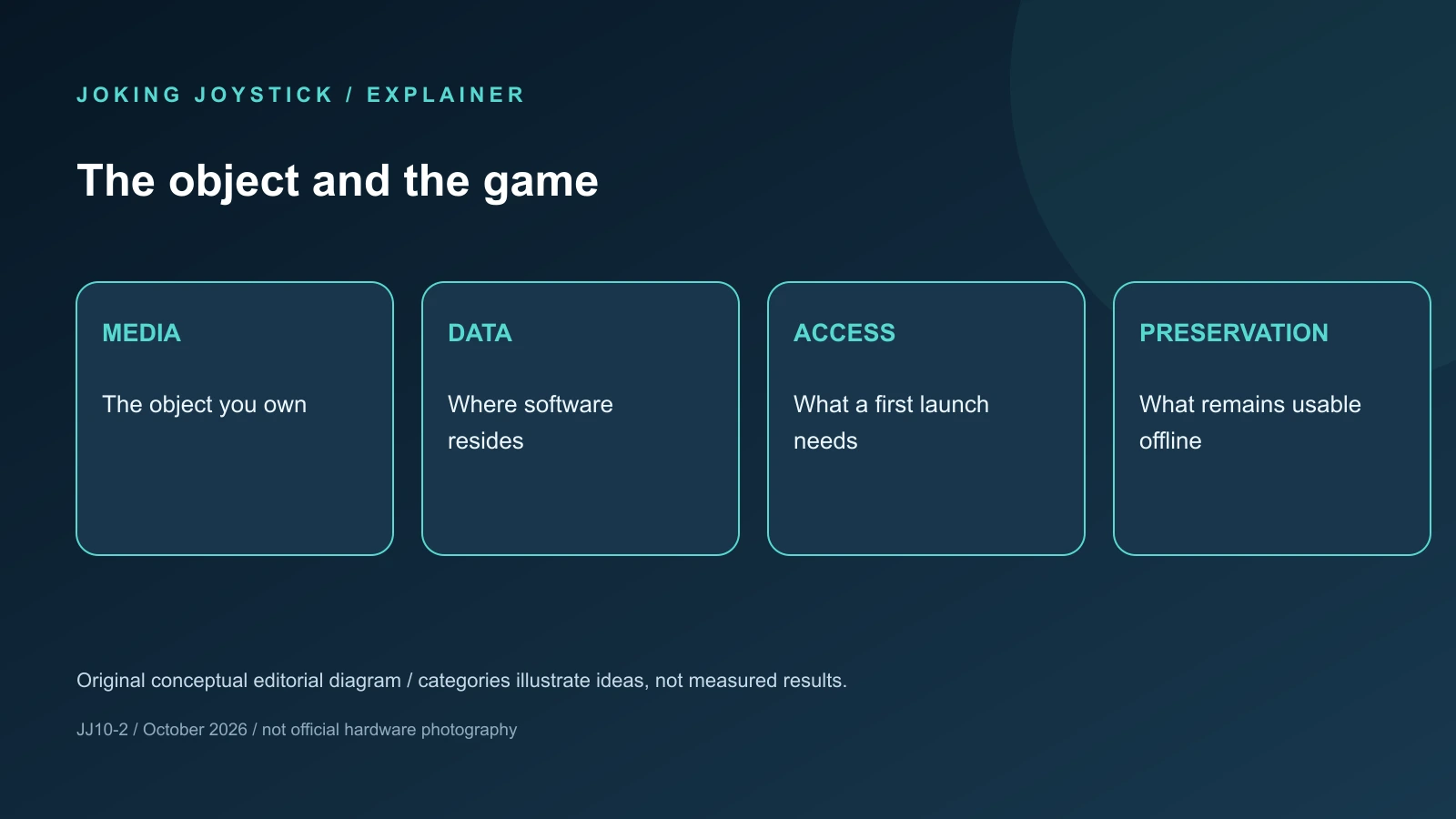
Game Boy Advance: A Distinct Game Pak and a Compatibility Bridge
Game Boy Advance software used a distinct Game Pak format rather than the original Game Boy cartridge design. Nintendo’s Game Boy Advance documentation identifies a dedicated Game Pak slot and separately distinguishes Game Boy Advance, Game Boy Color, and dual-mode Game Paks. The physical and electrical distinction mattered: a Game Boy Advance Game Pak was not compatible with a Game Boy Color system, even though Game Boy Advance hardware could run supported older Game Boy-family software through its compatibility mode.
The GBA Game Pak carried fixed program and asset data in solid-state memory, with capacity varying by title rather than following one universal retail size. Nintendo’s technical documentation maps Game Pak ROM through a 32-MB address space, which is best treated as a documented format ceiling rather than a statement that ordinary games used 32 MB. Representative retail images include 007: Everything or Nothing at 8 MiB and Pokémon Emerald at 16 MiB in the MAME software list. Those examples demonstrate common lower and middle configurations without implying that every title used either value.
A title’s ROM capacity must be separated from its writable save component. Depending on the game and production revision, saves could use battery-backed memory, EEPROM, or flash memory. For example, the MAME entry for 007: Everything or Nothing identifies EEPROM separately from its ROM image. These technologies were title-specific and should not be presented as features of every Game Pak. Save storage was distinct from the ROM containing the game itself.
| GBA example | Observed ROM image | Separate save or hardware note |
|---|---|---|
| 007: Everything or Nothing | 8 MiB | EEPROM listed separately. |
| Pokémon Emerald | 16 MiB | Save component must be recorded separately from ROM. |
| Documented mapped ceiling | 32 MB address space | Technical mapping, not a typical retail size. |
Game Boy Advance hardware extended the Game Pak model while preserving a bridge to earlier handheld software. Original Game Boy and Game Boy Color compatibility did not make the older cartridges physically interchangeable with GBA Game Paks. The host system, cartridge category, and software mode all mattered. A Game Boy Color Game Pak could run on supported Game Boy Advance hardware, while a GBA Game Pak could not be inserted into a Game Boy Color system.
Some GBA releases also used special physical cartridges for functions beyond ordinary game storage, including titles that depended on additional hardware or a particular accessory. Those cases should be described individually rather than treated as a separate universal cartridge standard. The format’s central pattern remained straightforward: a removable solid-state Game Pak carried the fixed game, while title-specific writable memory handled progress.
The GBA therefore belongs in the format history as both a new cartridge generation and a compatibility bridge. It did not simply enlarge the Game Boy Color medium, and it did not replace the older Game Pak categories. Instead, it introduced a distinct card-and-slot system whose host hardware could also run supported earlier software. That separation becomes important when comparing GBA capacity, save technology, and physical compatibility with the GameCube-era optical transition that followed.
GameCube: Mini-DVDs and Usable Disc Space
GameCube marked Nintendo’s first home console to use optical discs for its games instead of cartridges. The change was substantial, but the format was not an ordinary full-size DVD package. GameCube used proprietary 8-centimeter Game Discs, paired with a drive designed to read them. Nintendo thereby exchanged the cartridge’s board-level flexibility for a disc-based medium with greater nominal capacity and lower per-unit storage cost.
The Game Disc's physical format is often described in consumer and technical references as approximately 1.5 gigabytes, but the cited Nintendo manual does not establish that figure as an official usable-capacity specification. The supported technical measurement used here is Dolphin's approximately 1.36-GiB complete-disc-image value. That image figure must not be confused with nominal medium capacity, filesystem-visible regions, or unique playable game data. Those measurements may be close for one disc and noticeably different for another.
A raw disc image preserves physical structures that an extracted file listing may not show. Depending on the format and the image method, it can include alignment areas, padding, system-related information, and other regions outside the game’s ordinary content. A filesystem view may omit or interpret some of those structures. Neither measurement alone answers how much unique data the developer created. A disc filled to its physical boundary is not necessarily filled with additional playable material.
Developers could use duplication as well as compression. Repeating frequently accessed files could reduce the need for the optical head to move between distant areas of the disc, improving loading behavior at the cost of space. Compressed assets saved room but required decompression during play. Padding might exist because files or partitions were aligned to format requirements rather than because the game contained more content. The usable capacity of the medium was therefore shaped by both technical layout and production decisions.
Some releases shipped across multiple Game Discs. A multi-disc package is evidence that the title’s physical arrangement exceeded what the publisher chose or was able to place on one disc, but it does not prove that the unique game data equaled the sum of both nominal capacities. The discs might contain duplicated system data, repeated assets, or separate portions of the game that were not simultaneously installed. Disc count is a practical retail fact, not a direct measure of content volume.
Memory Cards were separate from Game Discs. The disc carried the fixed game software, while the Memory Card stored player progress, settings, and other save information. This arrangement differed from a cartridge with battery-backed SRAM because the writable medium was removable and reusable across titles. A player could replace or manage Memory Cards without altering the game disc. The game’s physical carrier and the player’s persistent data were distinct objects.
That separation also changed preservation. A complete experience might require the disc and an appropriate Memory Card, even though the card did not contain the main game. A disc image can preserve the title’s fixed data while omitting the player’s saves. Conversely, a Memory Card can preserve saves for a title whose disc is missing. The two media should be cataloged independently rather than treated as one combined capacity.
GameCube discs were regionally qualified. Japanese, North American, and PAL releases were separate products, and compatibility was affected by regional encoding and the console’s configuration. A disc’s physical appearance could be similar across markets while its software identity and compatibility rules differed. Region should therefore be recorded alongside the title and disc size. A raw capacity comparison that ignores region may compare different builds with different files or release arrangements.
The move to optical media also changed the physical risks. Cartridges depend on electrical contacts and board components; GameCube depends on an optical surface, a drive, and the drive’s ability to interpret the proprietary format. Scratches, disc deterioration, spindle or laser problems, and replacement-drive compatibility become part of the preservation picture. An intact disc is not fully independent of the hardware that reads it, just as a cartridge is not entirely independent of a functioning connector.
Optical distribution did provide room for larger soundtracks, more video, higher-resolution textures, and broader asset libraries than many earlier cartridges could economically carry. Yet the practical advantage was not simply that the disc’s number was larger. Developers had to account for access patterns, loading time, compression, duplicate files, and the layout of the disc’s filesystem. The format’s capacity was useful because it offered more room within a different access model, not because every sector translated directly into game content.
This is also why comparisons with later full-size optical formats need care. GameCube’s 8-centimeter disc was proprietary and physically distinct from standard DVDs, even if its nominal capacity was discussed in similar units. The console’s drive, filesystem, region behavior, and image structure determined what the medium meant in practice. Describing it as “a small DVD” may communicate its size, but it obscures the format-specific requirements that made it a Game Disc.
Multiple versions of a title could also use the disc differently. A regional release might contain different language assets, altered video, or other build-specific material. A later revision could change files without changing the disc’s nominal capacity. The physical medium establishes an upper boundary and a distribution method; it does not by itself establish identical content across every pressing or market.
GameCube therefore introduced a new kind of capacity problem to Nintendo’s history. With cartridges, the central question was often how much ROM and hardware could be economically placed on a board. With the Game Disc, the question became how much of a nominal optical medium could be made practically useful after filesystem structures, access strategy, padding, duplication, and regional builds were considered. The result was a larger physical software carrier, but not a simple container measured by one headline figure.
The GameCube disc and Memory Card together form a transitional model. The game itself moved to optical media, while saves remained on a separate reusable device. The disc could contain more data than many previous cartridges, but it depended on a mechanical reader and a structured filesystem. Nintendo had gained capacity and reduced cartridge-board customization, while accepting a new set of loading, regional, and preservation concerns.
Nintendo DS: Compact Cards for Larger Software
Nintendo DS Game Cards carried the cartridge idea into a system whose software ambitions exceeded the small physical size of the card. The card occupied Slot 1, while the system separately identified the Game Boy Advance slot used by compatible software. This distinction matters because the DS Game Card was not simply a continuation of the older Game Pak with a new label. It was a newer card format with its own boot process, capacity classes, header information, and save arrangements.
A DS card contains format information used during startup as well as the game’s program and assets. The card’s header identifies properties needed by the system and software environment; it is not merely an optional label placed before one uninterrupted game file. Developer-maintained and reverse-engineered compatibility documentation also distinguishes areas involved in boot and access behavior. Those technical descriptions explain why a raw card image is not identical to extracted title files, but they should not be presented as Nintendo-published specifications for every internal card area.
Capacity expanded through several card classes over the platform’s life. Nintendo’s developer card documentation lists mask-ROM classes of 64, 128, 256, and 512 megabits—8, 16, 32, and 64 megabytes—and also lists one-time PROM classes extending to 1 gigabit, or 128 megabytes. These are nominal card-ROM classes, not guarantees that a commercial title filled every byte or that the image size equals unique game data.
| Card class | Basic byte conversion | Interpretation |
|---|---|---|
| 64 megabits | 8 MB | Early or smaller card class. |
| 128 megabits | 16 MB | Common middle class for larger software. |
| 256 megabits | 32 MB | Larger retail class. |
| 512 megabits | 64 MB | Upper mask-ROM class listed in the developer documentation. |
| 1 gigabit PROM | 128 MB | Documented PROM class, not evidence that ordinary DS releases used it. |
A particular retail title must still be identified before its card class is described as its game size. The card also carried backup memory, which was a separate save component. Header information, boot structures, reserved areas, and any unused card space can make a raw image differ from the extracted files that constitute the title.
The conversion between bits and bytes remains important here. A card described in gigabits has a capacity eight times smaller when expressed in gigabytes at the basic unit level. A 1-gigabit card represents 128 megabytes before format structures and unused space are considered. Larger classes could hold more dialogue, music, graphics, video, and code, but the retail data occupied by a particular title could be considerably lower than the card’s nominal class.
Save data was handled separately from the main game storage. Depending on the title, production revision, and card design, writable memory could use different technologies and capacities. The save component might be a small EEPROM, flash memory, or another writable device rather than part of the fixed game ROM. This is why two cards with similar game capacity could have different save behavior, and why a card’s ROM size does not reveal how much progress data it can retain.
Some DS cards also changed their relationship with later hardware. Original Nintendo DS software was designed for the DS family, but Nintendo distinguished ordinary DS-compatible software from Nintendo DSi-enhanced titles. A DSi-enhanced card could run in a way that used features or capabilities available on DSi hardware, while its broader compatibility depended on the title’s design and the system in which it was inserted. The physical presence of a Slot-1 card did not guarantee identical functionality across DS, DSi, and 3DS systems.
This creates two different compatibility questions. The first is whether the system can recognize and start the card. The second is whether the title’s enhanced features are available on that system. A DSi-enhanced game could remain recognizably card-based while offering additional behavior on DSi hardware. A 3DS could support much DS software while still being a different host environment from an original DS or DSi. Compatibility should therefore name both the card category and the system model.
Regional variation also needs qualification. DS software was sold in separate markets with different packaging, labels, product codes, language content, and release builds. Many DS titles did not impose the same broad region restrictions associated with 3DS software, but that does not make every card universally interchangeable in every practical sense. A particular title may depend on system features, peripherals, language assumptions, or a later model’s compatibility rules. Physical fit is only the first test.
The DS card’s compactness affected the type of software Nintendo and other publishers could distribute. Solid-state access avoided an optical drive and made the card suitable for a portable system, while higher capacity than earlier handheld cartridges allowed more elaborate graphics, audio, and video. The card could also be produced in different sizes according to the needs and budget of the title. A small puzzle game and a voice-heavy adventure did not need the same physical configuration.
Manufacturing revisions could matter even when the retail product name did not change. A publisher might use a different save-memory component or a later card revision while preserving the same broad capacity class. For preservation, the title, region, card revision, ROM capacity, and save technology are useful separate fields. A single dump may represent the game data without representing every possible save-memory revision or the state of a particular physical card.
The DS also demonstrates that a card can have meaningful overhead without being wasteful in the ordinary sense. Boot information, access structures, alignment, and reserved areas support the system’s ability to identify and load the software. Those bytes are part of the physical format even though they are not levels, characters, music tracks, or executable routines a player experiences directly. A raw card image and a list of title assets answer different questions.
Unlike the Famicom Disk System, the DS Game Card was not a user-rewritable retail medium. Its game data was fixed for ordinary use, and save storage did not turn the card into a general-purpose rewrite object. Unlike an optical disc, it did not require a mechanical reader or a disc filesystem with seek-oriented duplication. It occupied a middle position: compact, solid-state, capacity-scalable, and able to carry more ambitious software while retaining the direct physical relationship associated with cartridges.
That relationship became more layered as DSi features and later system compatibility entered the picture. The card remained the physical carrier, but the hardware host could determine which parts of the software experience were available. A DS Game Card was therefore not just a fixed amount of memory in a shell. It was a structured software object whose boot information, storage class, save mechanism, regional build, and hardware requirements all contributed to what the owner could actually play.
Wii: Full-Size Optical Discs and Dual-Layer Releases
The Wii continued Nintendo’s move away from cartridges, but its optical software was not simply GameCube software placed on a larger disc. GameCube used proprietary 8-centimeter Game Discs. Wii used a larger optical format, giving publishers substantially more room for code, textures, audio, video, and duplicated assets intended to reduce loading delays. The change made many larger releases possible on a single disc, even though the disc’s nominal capacity still needs to be separated from the amount of game data a player actually encountered.
Wii Game Discs were distributed in single-layer and dual-layer forms. Those terms describe the physical recording arrangement and its potential storage capacity, not the amount of unique playable content in a particular release. A dual-layer disc did not automatically contain twice as much game as a single-layer disc. The publisher might leave space unused, duplicate assets for access reasons, include system-related material, or organize the disc into regions that were not all presented as ordinary game files.
A raw Wii disc image can therefore be larger or differently structured than an extracted list of game assets. Wii discs contain partitions, including areas associated with the system and with updates, as well as the game partition itself. Dolphin’s developer documentation also distinguishes single-layer images of approximately 4.38 GiB from dual-layer images of approximately 7.93 GiB for ripping purposes. Those are complete-image or medium-handling values, not automatic measurements of unique playable data.
The exact arrangement varies by sampled title and image. A Wii release may contain a raw image, a game partition, an update or system partition, an extracted filesystem, and unique title data that do not have identical sizes. Padding and alignment are image or filesystem features rather than automatically playable content. The partition structure of one release should not be generalized to every Wii disc.
The distinction matters particularly for dual-layer releases. The physical medium provided a larger ceiling, but developers still had to decide how to arrange files and how much content the title required. A game with extensive video might use the additional space for cinematics, while another might benefit from higher-quality audio or a larger collection of environments. A third could use the larger disc primarily to avoid removing content from a release that had been designed for another platform. Capacity created options; it did not prescribe the final data arrangement.
Wii discs were region-encoded. A disc’s physical similarity to another regional release did not make the two products interchangeable. Japanese, North American, and European releases could carry different language assets, product codes, software builds, and compatibility qualifications. Region is therefore part of the identity of a Wii physical release, not merely a packaging detail. A capacity comparison that combines regional versions without checking their contents can mistake different builds for one universal edition.
The Wii’s relationship with GameCube software also varied by hardware model. Nintendo identifies the original RVL-001 Wii as supporting GameCube games. That model included the physical provisions needed for GameCube discs and related accessories. Later Wii revisions removed GameCube compatibility. Consequently, the presence of a GameCube disc in a Wii owner’s collection did not by itself establish that every Wii console could use it. The model number was a functional qualification, not a cosmetic distinction.
This compatibility relationship illustrates how physical formats can overlap without becoming identical. The original Wii could read both Wii Game Discs and GameCube Game Discs, but the two media retained their own physical dimensions, software environments, and regional rules. A Wii disc was not a larger GameCube disc in the same sense that a Wii console was not simply a GameCube with more memory. Nintendo supported the earlier format under specific hardware conditions while introducing a separate optical format for new software.
GameCube and Wii also differed in how much space a publisher could expect from one physical release. The larger Wii medium reduced the frequency with which ambitious games needed multiple discs. That did not eliminate multi-disc software throughout the industry, nor did it guarantee that every large title fit comfortably on one disc. It did, however, give Wii publishers more room for content that would have placed greater pressure on the smaller GameCube medium.
Loading strategy remained important. Optical discs offer more capacity than many earlier cartridges, but data must be read through a drive and arranged in a way that makes access practical. Developers could compress assets to save space, duplicate commonly used files to reduce seeking, or group related data into regions that the game could load efficiently. These decisions mean that two games using the same disc class could have very different relationships between their raw image size and their apparent content.
Wii physical software also existed alongside distribution that was not contained entirely on a retail disc. A disc could remain the base carrier while an update corrected bugs, changed online functionality, or added compatibility for later services. Downloadable content and supplementary software could introduce further dependencies. The existence of a disc therefore established that the original retail game was physically distributed, but it did not prove that every later version of the experience was present on that disc.
That distinction is different from the modern game-key-card model. A Wii disc normally carried the base executable and assets needed to start the retail game, subject to the console and software’s own requirements. A later update could be separate without changing what the disc was designed to contain. The disc was therefore a base software carrier with possible additions around it, rather than a physical object whose main function was to authorize a download of the complete game.
Wii’s optical format introduced preservation concerns distinct from those of cartridges. Cartridges can suffer from connector corrosion, failed batteries, or damaged board components. Discs depend on the readable condition of the recording surface and on a compatible optical drive. A well-preserved disc may still be difficult to use if the appropriate console or drive is unavailable. Conversely, a disc image can preserve the data structure without reproducing the original physical object’s regional identity, packaging, or hardware dependencies.
For a useful Wii capacity comparison, at least four measurements should be kept apart: the nominal single- or dual-layer medium; the raw image; the game partition; and the files that make up the title. Dolphin’s ripping documentation provides approximate complete-image requirements of 4.38 GiB for single-layer Wii discs and 7.93 GiB for dual-layer discs. Nintendo’s support material identifies Super Smash Bros. Brawl as a dual-layer release, making it a suitable named example rather than evidence that every Wii title used the larger medium.
Update and system-related partitions should therefore be identified separately rather than silently counted as playable content. There is no single universal “Wii game size”: the result depends on the title, region, image method, partition selection, padding, duplicated assets, and whether the measurement describes physical media or extracted files.
The Wii Game Disc was thus a larger optical successor to the GameCube disc, but its significance was not simply a bigger number. It combined more room with a different access model, region encoding, partition structure, and hardware dependence. The original RVL-001 Wii extended that transition backward by supporting GameCube discs, while later Wii software increasingly existed in an ecosystem where updates and supplementary downloads could sit beside a physically complete base release. Physical media remained central, but “on the disc” had already become a more precise question than the box suggested.
Nintendo 3DS: Cards Beside Downloadable Retail Software
Nintendo 3DS physical software used Game Cards while the platform also offered complete retail games as downloads. These were not two names for the same physical object. A Game Card carried the title’s principal retail software in a fixed, removable form. A downloadable retail version was stored on the system’s SD card, with its ownership and management handled through the platform’s digital software system. Both could represent a full retail release, but their storage, transfer, and dependency models were different.
3DS Game Cards used more than one capacity class during the platform’s life. Nintendo support material states that Game Card space varies between 2 GB and 4 GB. Those are card-capacity classes, not automatic measurements of unique game data, raw dump size, update data, downloadable content, or installed size. A publisher could choose a card large enough for the title while leaving capacity unused or organizing files in a way that made the physical inventory larger than the game’s unique content.
| 3DS card figure | What can safely be said | What cannot be inferred |
|---|---|---|
| 2 GB | Nintendo documents this as one Game Card capacity class. | It does not prove that a particular 2-GB release used 2 GB of unique files. |
| 4 GB | Nintendo documents this as the larger stated Game Card class. | It does not establish a universal title-data or installed-size maximum. |
For any named game, Nintendo's card-capacity statement, a verified physical image, an extracted filesystem, and the title's downloadable size remain different measurements. A reliable comparison must preserve those distinctions rather than collapse them into one headline figure.
As with earlier solid-state formats, the card could contain more than an undifferentiated program image. Boot information, format data, and title files formed part of the card’s structure. Nintendo states that ordinary game progress for retail 3DS Game Card software is saved to the Game Card, while downloadable software’s save data is stored with the system’s downloadable software. Some SpotPass or StreetPass information may be stored on the SD card or in system memory, so those auxiliary categories should not be confused with the game’s primary save data.
The 3DS also made regional compatibility more explicit than many earlier handheld formats. Nintendo’s documentation states that relevant Nintendo 3DS and Nintendo DSi software must match the system’s region in the applicable compatibility context. A card from another market might have the same broad title and similar capacity while still being a different regional software product. Language, product code, system qualification, and region rules all belong in a catalog record. Physical fit alone does not establish compatibility.
Region affected downloadable retail software differently because the download was associated with the system’s digital distribution environment and account history rather than with a removable card from another market. That did not make the digital version universally interchangeable. The store region, account context, system configuration, and title availability remained relevant. Comparing a physical card with a downloaded retail version therefore requires more than comparing their game files; it requires comparing how each version was acquired and managed.
Updates created another separation. A 3DS Game Card did not automatically contain patches released after manufacturing. Update data could be downloaded and stored separately, while downloadable content occupied its own category again. The base game could remain on the card even when later corrections, extra levels, costumes, or other additions were stored on the system’s SD card. Removing the card did not turn those additions into part of the card, and owning the card did not by itself mean possessing every later download.
Full retail downloads used the SD card as their main storage location. This made the SD card functionally different from a save-only accessory. It could hold the downloaded game, update data, and downloadable content, while the system maintained the software’s management and account relationship. A physical Game Card reduced the need to reserve SD space for the main retail program, but it did not necessarily eliminate SD requirements. Updates and DLC could still accumulate there, and some titles could have separate system-stored data.
Save data needs its own description because the 3DS platform separated several categories that players often treated as one. The card could contain the fixed game. The system could hold save data, update data, and downloadable content. Downloaded retail software could occupy the SD card. A transfer process might move or recreate digital software and related data under Nintendo’s supported procedures, but that process was not the same as transferring a physical card. The removable object and the player’s stored progress were not automatically one package.
Transfers also exposed the difference between possession and account-linked distribution. Moving a physical card between compatible systems moved the card, but it did not automatically move a system’s save data or downloaded additions. Conversely, moving digital software through Nintendo’s supported system-transfer process involved the systems and their stored data rather than a removable retail card. The platform’s transfer rules applied to digital software and system data; they did not transform a physical card into an account-linked copy.
The end of 3DS and Wii U eShop sales on March 27, 2023, at 5:00 p.m. Pacific Time, made these distinctions more consequential. Existing physical Game Cards remained physical products, but a card did not automatically include later patches or DLC. Existing downloaded retail software and previously obtained additions were governed by Nintendo’s support policies for the digital platform. A physical release could therefore remain playable as a base game while its surrounding downloads had separate availability and account conditions.
This does not mean that a physical card was merely an incomplete version. The card was the intended retail carrier for its base software, and many games could be played from the card without installing the complete title to SD storage. The important qualification is that the retail experience could change over time. A launch card represented the software manufactured for that release; it did not rewrite itself when Nintendo or a publisher later issued an update.
The distinction between card capacity and common game size is similarly important. A late, high-capacity card class may have supported a large title, but ordinary releases could occupy much less. A game’s data might also be compressed, padded, or arranged with unused capacity. Reporting only the largest card class would exaggerate what most players received, while reporting only the extracted title files would conceal the physical format selected by the publisher.
3DS Game Cards also carried forward the advantages of solid-state distribution. They were compact, removable, and did not depend on an optical drive. Their access behavior suited a portable system, while their scalable capacities gave publishers more room than earlier handheld cartridges. But the platform surrounded the card with a growing storage ecosystem: SD media for downloaded games and updates, system memory for saves and management data, and account-linked services for digital distribution.
The 3DS therefore represents a clear transition rather than a clean division between physical and digital. The Game Card remained a tangible retail object whose base software was carried on the card. At the same time, Nintendo offered the same broad retail model through downloads, and updates and DLC existed outside the card even when the card was the primary game carrier. To describe a 3DS release accurately, one must identify the card, the save location, the update data, the DLC, the region, and whether the retail software was physical or SD-stored.
Wii U: Proprietary Optical Discs and Local Storage
Wii U retained optical retail software but placed it within a more storage-dependent platform. Its proprietary Wii U discs were structurally distinct from GameCube and Wii media, yet Nintendo did not turn the console into a general-purpose Blu-ray, DVD, or CD player. Nintendo’s compatibility documentation states that Wii U supports Wii U and Wii Game Discs, but not GameCube discs, Blu-ray discs, DVDs, or CDs. The disc format was designed for Nintendo software, not for broad optical-media compatibility.
Wii U’s ability to read Wii discs created backward compatibility with the immediately preceding Nintendo console, while the absence of GameCube support marked a clear hardware boundary. A Wii U owner could use supported Wii and Wii U retail discs, but a GameCube disc required appropriate GameCube-capable hardware rather than the Wii U drive. Physical media compatibility was therefore format-specific: optical discs were not interchangeable merely because they shared a broad shape or because the console used an optical drive.
The nominal disc medium and a title’s files are different measurements. Nintendo identifies a proprietary Wii U optical format and compatibility with Wii U and Wii Game Discs. That does not make the console’s internal-storage specification a disc-capacity figure.
Wii U discs should not be called Blu-ray discs or assigned a 25-GB usable capacity without an exact primary technical source. Wii U's documented 8-GB and 32-GB figures belong to the console's internal storage tiers, not to the optical disc. The disc medium, extracted title files and installed updates are different measurements.
Disc content and later downloaded updates should be recorded separately when describing a particular game. A useful title-specific entry identifies the edition, region and software revision, then states exactly which data is being measured. This is a reporting method, not a claim that every Wii U disc has one uniform partition arrangement.
The Wii U’s internal storage made this distinction practical for ordinary owners. The Basic model contained 8 GB of internal storage, while the Premium model contained 32 GB. Those figures described the system’s installed storage tier, not the amount available for games. Nintendo noted that system data and preinstalled content occupied part of the space, leaving less for user data. A console advertised with 8 GB or 32 GB did not provide that entire amount as an empty game library.
Retail discs could reduce the need to store the main game internally compared with full digital downloads. In that sense, a disc remained a useful physical carrier even as Wii U encouraged more local storage. But the disc did not eliminate storage requirements altogether. Save data, updates, downloadable content, and other title-specific files could consume internal or external space. A disc owner and a download owner might have different storage demands, but neither necessarily operated without additional data.
Nintendo documented support for up to 2 TB of external storage. This capacity applied to the console’s external storage environment rather than to the optical disc. An external USB drive could provide room for downloaded software and other supported data, but it did not change the physical capacity of a Wii U disc or turn a retail disc into an installed copy. The disc, internal storage, and external storage remained separate layers of the software arrangement.
The difference between disc-carried and storage-carried software was visible in retail comparisons. A full downloadable title could require more free space than the Basic model practically offered, while a retail disc could supply the principal game data without consuming an equivalent amount of internal storage. That advantage was not absolute: patches and DLC could still increase the disc owner’s storage needs, and some software functions could depend on data obtained after manufacture.
Wii U therefore occupied an intermediate position in Nintendo’s physical-media history. Its retail disc could remain the base software carrier in a manner familiar from Wii, but the console’s storage tiers and external-drive support made downloaded software increasingly ordinary. The physical disc and the installed data no longer represented mutually exclusive models. A title could be purchased on disc, played from that disc, and still leave a growing footprint in console storage as updates and additional content accumulated.
A format’s capacity and a game’s storage requirement answer different questions. As a general analytical distinction, a larger container does not prove that a particular title uses all of it. Comparisons of individual releases therefore need comparable measurements rather than a presumed relationship between package type and content volume.
Wii U discs were also dependent on a proprietary reader and console environment. A disc’s physical survival did not guarantee indefinite usability if the appropriate hardware was unavailable or defective. The same preservation concerns associated with other optical formats applied: surface damage, drive condition, region qualifications, and the difficulty of reproducing a proprietary disc structure. At the same time, a disc could preserve a substantial base release without relying on an account-linked download to identify the owner.
That last distinction matters when comparing Wii U with later physical software. A Wii U retail disc normally served as the physical bearer of the base game, even when patches and DLC existed separately. It was not generally a card whose principal purpose was to authorize a complete download. The disc could be incomplete relative to the newest version of the software, but its role remained that of a data-bearing retail medium.
Wii U’s storage model also separated save data from game data. Save files were stored on the console or supported storage rather than being written into the proprietary optical disc. A player could own the disc while losing or transferring the associated save data independently. Downloaded content and updates likewise occupied categories distinct from the disc’s fixed manufacturing state.
The result was a bridge between two distribution assumptions. Nintendo still sold packaged software whose principal program and assets were physically present on an optical disc. Yet the console offered internal storage tiers, external USB support, digital retail releases, updates, and DLC that made local storage part of ordinary software ownership. The Wii U did not abandon physical media, but it made clear that a physical retail object and the complete current software experience could be different things.
Nintendo Switch and Switch 2: From Game Cards to Game-Key Cards
Nintendo Switch returned to a card-based physical format for a system that served both as a home console and a portable machine. Switch game cards were removable, solid-state retail media, but Nintendo did not publish a single universal card-capacity table covering the complete Switch catalog in the cited support material. Some titles place the principal game on the card, while others use the card alongside a required or optional download. The package is physical, yet the exact boundary between card data and downloaded data is title-specific and depends on the particular packaging and official product information.
That boundary makes “physical Switch game” an insufficient description on its own. A card can carry the base program and assets while an update corrects faults or adds compatibility. Downloadable content can remain separate from the card. Some releases require additional data because the complete title exceeds the card configuration selected for production. The card is still a physical software carrier, but physical possession does not automatically mean that every later or supplementary file is present on the object.
Save data occupied another layer. Switch save data is stored on the console rather than on the game card. Moving a card between systems therefore does not move the player’s progress with it. A physical card can be inserted into another compatible console, but the receiving system’s save data, update data, and downloadable additions remain separate matters. This separation had already appeared in earlier Nintendo formats, but Switch made it central to a software environment where cards and downloads coexist routinely.
Switch 2 continues to support regular game cards while adding a second physical category: the game-key card. Nintendo states that some Switch 2 games use regular game cards and others use game-key cards. Its current support explanation describes regular physical game cards as carrying game data on the card itself, while a game-key card does not contain the full game data and instead supplies the key needed to download it. It is therefore incorrect to describe every Switch 2 card as a game-key card, or to assume that every packaged Switch 2 release requires a full download. The card type must be identified from the official product information or packaging for the particular release.
A regular Switch 2 game card is the conventional data-bearing option in this comparison. Nintendo’s support material treats it separately from a game-key card, and a regular card is intended to provide the software associated with that physical release when inserted into a compatible Switch 2 system. Title-specific updates, downloadable content, or other supplementary files can still exist outside the card. “Regular” does not mean that every possible later file is permanently fixed on the object.
A game-key card has a different function. Nintendo says it does not contain the full game data. Instead, the physical card contains the key required to download and start the software. The initial download requires an internet connection and sufficient free space in the console's system memory or on a compatible microSD Express card. Nintendo's support instructions require an appropriate system update before game-key-card use. The precise version number is time-sensitive; the practical requirement is to keep the console updated and follow the instructions for the particular card.
Nintendo says that an internet connection is required when launching a game-key-card title for the first time. After the game has been downloaded, Nintendo says the game can be started without an internet connection. The card must remain inserted for play, however. This creates a specific relationship among the three components: the download supplies the game data, the card supplies the physical launch credential, and the console or microSD Express card supplies the storage location.
The initial download should not be confused with a traditional download code printed in a box. Nintendo distinguishes game-key cards from physical packages that contain only a download code. A download-code package may include no game card at all; the code is redeemed through the account-linked digital distribution system. A game-key card is a physical card that remains necessary for play after the download. Both require downloading, but their physical and account relationships are different.
Nintendo also distinguishes Switch 2 Editions from ordinary Switch 2 game-key-card releases. Nintendo says the physical version of a Switch 2 Edition includes the original Switch game and its upgrade pack on the same game card. The variation is that some publishers may instead issue a physical package containing only a download code and no game card. A Switch 2 Edition may run on the original Switch as the Switch version, while its Switch 2-only enhancements remain unavailable there. A Switch 2-exclusive card, by contrast, does not run on the original Switch.
Storage requirements make Switch 2’s removable media more complicated than earlier cards. A regular card can reduce the need to download the principal game, but updates and additional content may still require space. A game-key card necessarily requires enough local storage for the initial download. Nintendo identifies microSD Express storage as the relevant expandable medium for Switch 2 game-key-card data. Ordinary Switch microSD cards should not be assumed to provide the same function on Switch 2.
Ownership and transfer need careful wording because the physical card and the downloaded data are not the same object. Nintendo says game-key cards are not tied to a Nintendo Account and can be lent by physically handing the card to another person. The recipient can insert it into a compatible Switch 2 system, but the game data may need to be downloaded on that system, and the card must remain inserted for play. This functional lending rule does not establish that changing hands transfers save data, DLC, or any separate account-linked entitlement, and it should not be turned into a legal conclusion about ownership.
Save data remains stored in the console’s system memory. If a game-key card is moved between systems, the downloaded game data and the save data are separate: the receiving system may need to download the software, while the original system’s progress remains there unless transferred through Nintendo’s supported save-data methods. The card can identify and start the software on the receiving system after the necessary download, but it does not carry the original console’s progress.
Game-key cards should not be confused with virtual game cards. Virtual game cards are Nintendo’s account-linked method for managing digital software between supported systems and, under stated conditions, lending it within a family group. They are not physical cards and do not describe the behavior of a Switch 2 game-key card. One system manages account-linked digital software; the other uses a physical card that remains necessary after its associated game data has been downloaded.
The Switch 2 format therefore creates several versions of “physical software.” A regular game card is primarily a data-bearing object. A game-key card is a physical download-dependent credential. A Switch 2 Edition card may combine a base game and an upgrade arrangement. A boxed download code may be physical packaging for account-linked digital software without containing a card. These categories can look similar on a store shelf while imposing different internet, storage, transfer, and offline-play conditions.
That range is the endpoint of Nintendo’s format history so far. Cartridges and cards once placed nearly all fixed game data on a removable object, though saves and later updates could remain separate. Optical discs increased nominal capacity while introducing partitions, padding, drive dependence, and filesystem questions. Switch 2 preserves the physical retail object but allows that object to carry the game, part of the distribution arrangement, or the key that starts a locally stored download.
The correct conclusion is not that physical software has disappeared or that every modern card is merely a code. Nintendo’s current system contains both regular cards and game-key cards, alongside Switch 2 Editions and packages containing download codes. The physical object still matters, but its function must be identified precisely. In the game-key-card case, what the buyer receives is a transferable card required for play, plus access to a download that occupies local storage. That is a materially different format from a conventional cartridge, even though both arrive as cards in a box.
Related reading and hardware searches
Check the exact item, edition, seller, compatibility, regional fit, price and availability before buying.
Affiliate disclosure: As an Amazon Associate, Joking Joystick earns from qualifying purchases. Search results do not guarantee stock or price.