There is a new argument rattling around the top shelf of the football-card hobby: has Josh Allen overtaken Patrick Mahomes?
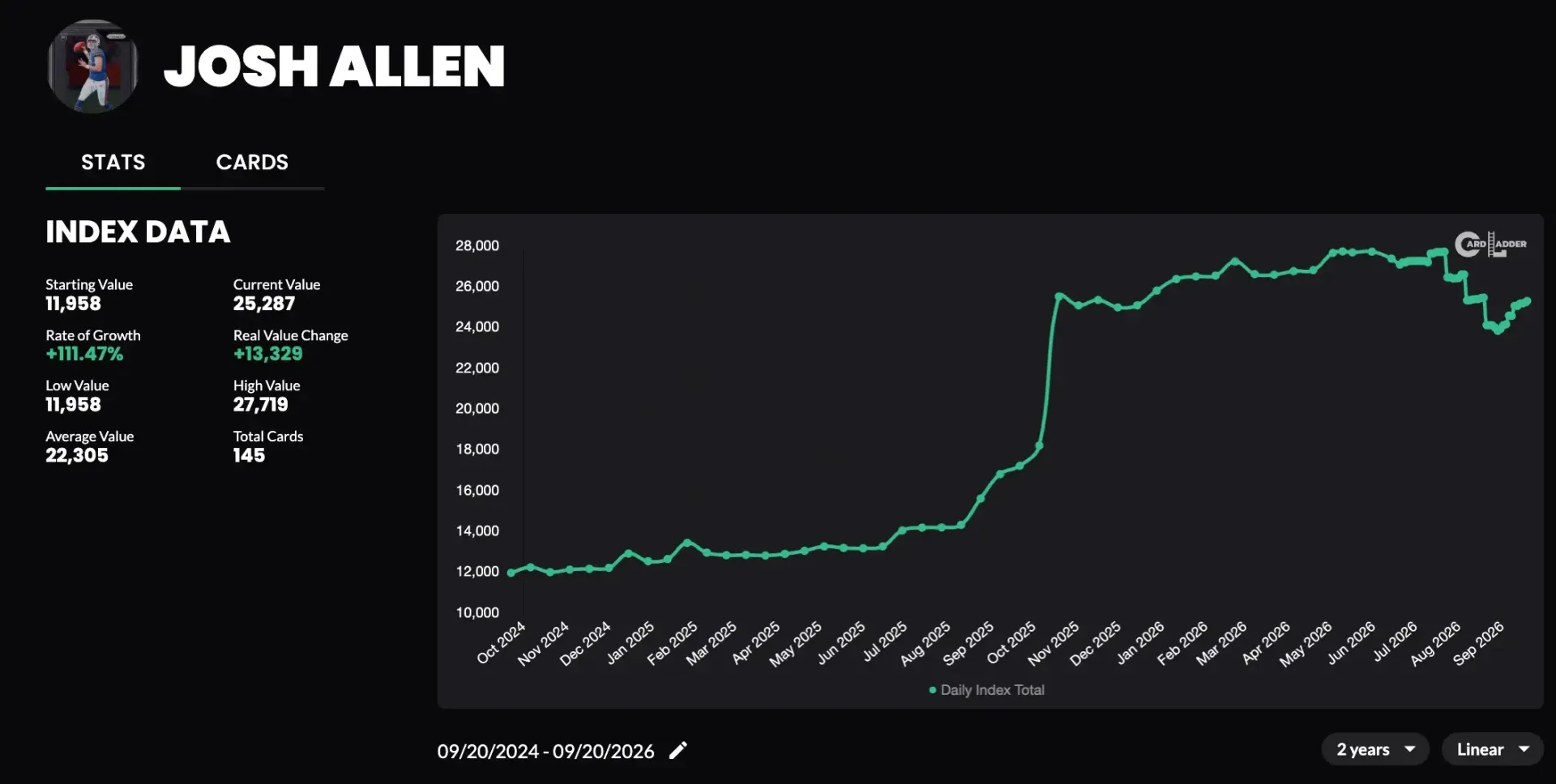
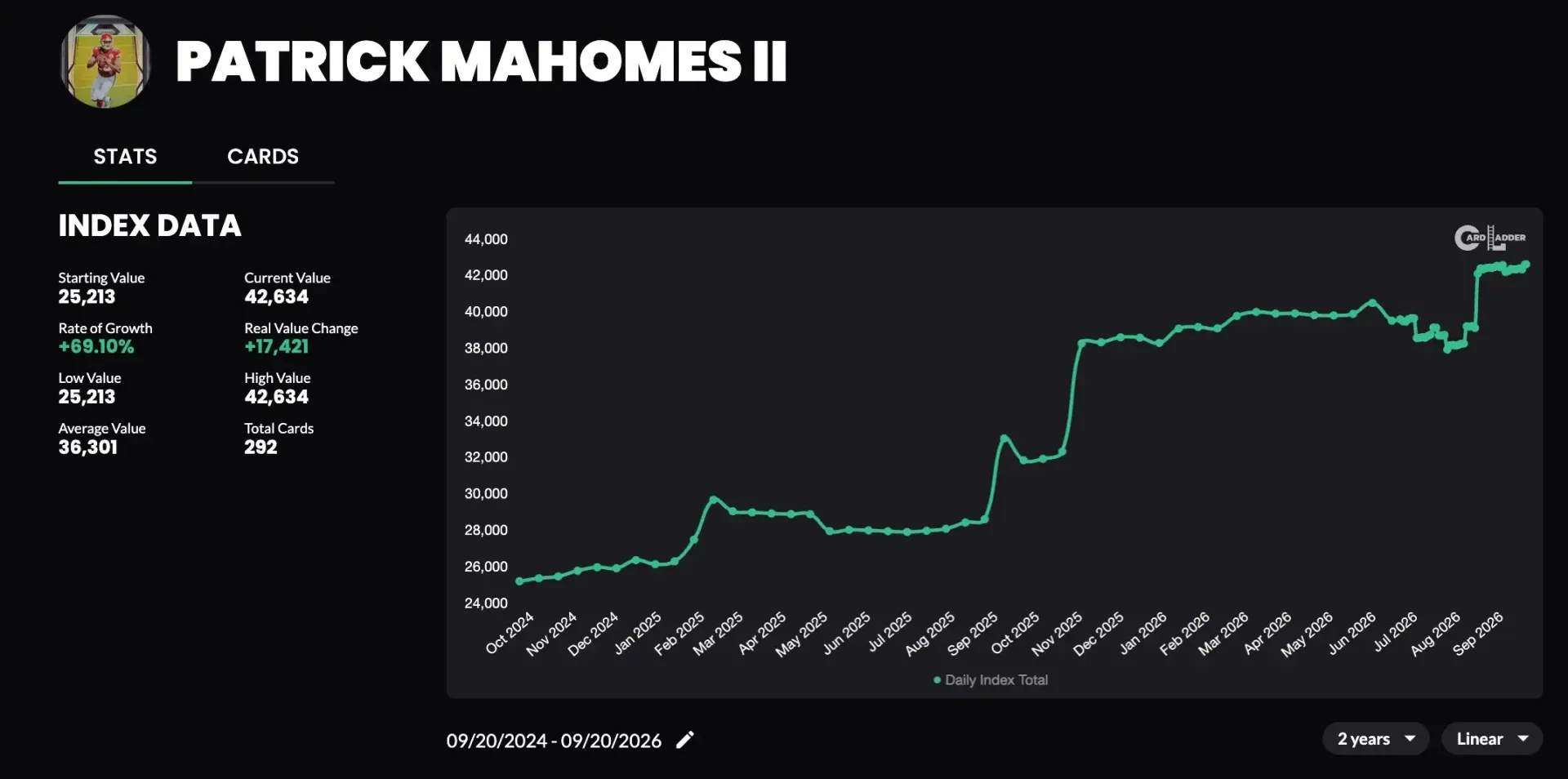
It is not a silly question anymore. Allen has produced two million-dollar card sales in 2026, tying Mahomes for the second-most million-dollar football-card sales, with Tom Brady still ahead of both. His measured market performance has also been notably stronger over the past two years: Allen’s Card Ladder Index is up 111.47%, while Mahomes’ is up more than 69% over the same span.
But the answer depends on what someone means by “overtaken.” If the question is who has the hotter momentum at the extreme high end right now, Allen has an exceptionally compelling claim. If it is who owns the deeper, more established modern football-card market across more readily traded cards, Mahomes remains in front. The hobby can hold those two ideas at once, even if a clean head-to-head ranking would be much more fun for the group chat.
Allen has reached the million-dollar club twice in 2026
Million-dollar results are uncommon enough to matter in football cards. The hobby reportedly went more than two years without one before Allen recorded the feat twice in 2026. That makes the recent activity significant beyond a single spectacular auction outcome: repeated seven-figure sales indicate that Allen has attracted serious attention among the collectors competing for the scarcest premium examples.
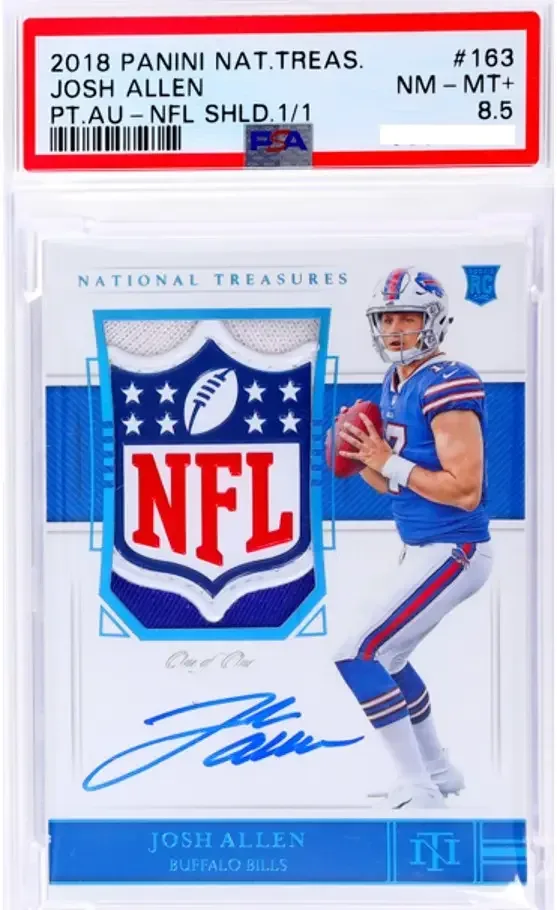
One of the cards associated with that tier is a 2018 Panini National Treasures Josh Allen NFL Shield Autograph rookie card, numbered 163, graded PSA 8.5 and limited to one copy. Its appeal is easy to explain at a basic level. It combines four qualities that high-end buyers often prize:
- Rookie-card status: it comes from Allen’s 2018 rookie season.
- A one-of-one limitation: only one version was made, eliminating any question about which collector owns that exact parallel.
- An NFL Shield element: the card includes a shield patch component, a premium memorabilia feature.
- An autograph and third-party grade: it carries Allen’s signature and has been evaluated by PSA.
None of those elements automatically guarantees a particular value. Together, though, they create the sort of unique, trophy-level object that can draw bidders whose priorities are fundamentally different from those of collectors shopping for more accessible copies.
That distinction is essential. A one-of-one sale tells the market something real about demand for a player’s best material, but it does not function as a complete price guide for every card bearing that player’s name. It is a competition for an item with no direct substitute. The buyer who misses it cannot simply wait for another identical copy next week.
Mahomes still holds football’s biggest card sale
Allen’s run has not erased Mahomes’ strongest market credentials. Mahomes still owns the highest reported sale ever for a football card: a 2017 National Treasures Shield RPA 1/1 graded BGS 8.5, with a 10 autograph grade, sold for $4.3 million.
“RPA” is shorthand for rookie patch autograph. Like Allen’s trophy card, Mahomes’ record setter is a rookie-year, one-of-one National Treasures card with a premium patch component and signature. It is therefore a useful comparison in card type, though not a shortcut to declaring one player’s whole market better than the other’s.
That $4.3 million benchmark remains a major divider between the two. It shows that Mahomes has already reached a peak transaction level that Allen has not matched. It also reflects a broader collecting case built over the period since Mahomes took over for Alex Smith in Week 17 of the 2017 season and became one of the hobby’s defining modern quarterbacks.
More importantly, Mahomes’ market is not being described as a collapse awaiting a dramatic montage. The available index figure places it up more than 69% across two years. That is meaningful growth, even if it trails Allen’s percentage increase and even if Mahomes has not recently repeated the record-setting headlines from earlier in his career.
Growth percentage is not the same as market leadership
The 111.47% versus 69%-plus comparison is the clearest numerical reason Allen has entered this conversation. Allen’s measured market has risen by roughly twice Mahomes’ rate over the stated two-year window. His cards also spiked after his 2024 NFL MVP season and have remained elevated despite a slight dip in the tracked index.
Still, percentage growth should be read carefully. It measures movement from a starting point; it does not, by itself, establish that two markets now have the same overall value or depth. A market can grow faster while remaining smaller. That appears to be the key qualification in this case: Allen has made larger recent gains, yet the aggregate value of his more liquid cards has not caught Mahomes’.
Liquidity means how readily an asset can be bought or sold at a price the market broadly recognizes. In cards, a liquid player market generally has more regular transactions and more available reference points for widely collected issues. That matters to collectors who may eventually sell, trade, insure, or simply want a clearer sense of what a card is worth.
A unique National Treasures one-of-one is inherently illiquid in a neutral sense because there is only one. It may be hugely desirable, but it cannot trade often. More commonly transacted cards provide a different type of evidence: they show how broad demand behaves beyond a handful of headline buyers.
This is why Allen’s million-dollar pair and superior two-year gain are persuasive without being a final verdict. They establish powerful momentum. They do not establish that every part of Allen’s market has surpassed Mahomes’ more mature and liquid base.
On-field narrative is pushing the current collector conversation
The card market is responding to a football story as well as cardboard scarcity. Allen won the 2024 NFL MVP award and has taken a major step in his play. At the same time, Buffalo has not reached the Super Bowl and has not matched the recent team success of Kansas City.
That contrast gives collectors two distinct narratives to weigh. Mahomes represents the established winner: a quarterback attached to sustained Chiefs success and the market’s top all-time football-card sale. Allen represents the ascendant superstar: an MVP whose performance has generated fresh excitement and whose rarest cards are producing extraordinary recent results.
Neither narrative invalidates the other. Hobby markets are often driven by a mixture of accomplishment, anticipation, player visibility, rarity, aesthetics, grading, and the preferences of individual buyers. “Flashier” play and a feeling of current momentum may make Allen especially attractive to collectors looking for the player whose market story is still accelerating. Mahomes’ established status may appeal to collectors who value the proven track record and the larger body of market history.
The practical implication is that a debate about a player’s best card is not identical to a debate about the player’s total card ecosystem. High-end collectors may currently favor Allen, while Mahomes can still lead across the more commonly traded end of the market.
How to read the indexes without turning them into a crystal ball
A card index is a tracking tool built from selected cards. It can be useful for seeing broad direction over time, but it should not be treated as a guarantee of what any particular card will sell for. Allen’s index, for example, has shown a slight dip among the cards being tracked even while large sales continue to arrive. That is not necessarily a contradiction.
Different cards move differently. A marquee one-of-one can set a seven-figure result while more available cards soften, hold steady, or rise at another rate. Conversely, an index can improve without every desirable card participating equally. The key is to separate three related but distinct questions:
- What has the player’s selected-card index done? Here, both Allen and Mahomes are up over two years, with Allen ahead in percentage growth.
- What are the rarest trophy cards doing? Allen has been especially prominent in 2026, with two million-dollar transactions.
- What is happening in the more liquid market? Mahomes still has the stronger overall position on that measure.
Collectors evaluating a card should also avoid confusing an ambitious listing with a completed transaction. The distinction matters in every segment of the hobby, as illustrated by the difference between headline asking prices and actual sales. A sold result records what a buyer paid; an asking price records what a seller hopes to receive. They are not interchangeable evidence.
So, who is football card king right now?
Allen is winning the momentum case. Two million-dollar sales in one year, a 111.47% two-year index increase, and sustained attention following his 2024 MVP season make him the most forceful challenger to Mahomes in the current market.
Mahomes is still winning the established-market case. His $4.3 million National Treasures Shield RPA remains the all-time football-card record, and his market has still risen more than 69% over two years. His more liquid cards also retain an overall value advantage.
That leaves the sensible answer somewhere more nuanced than a coronation ceremony. Allen has not definitively displaced Mahomes across the whole football-card hobby. He has, however, turned the race into a legitimate one—and at the rarest, most expensive end of the market, he is setting the pace in 2026. With Mahomes healthy and both markets rising, the next major result could change the temperature again in a hurry.