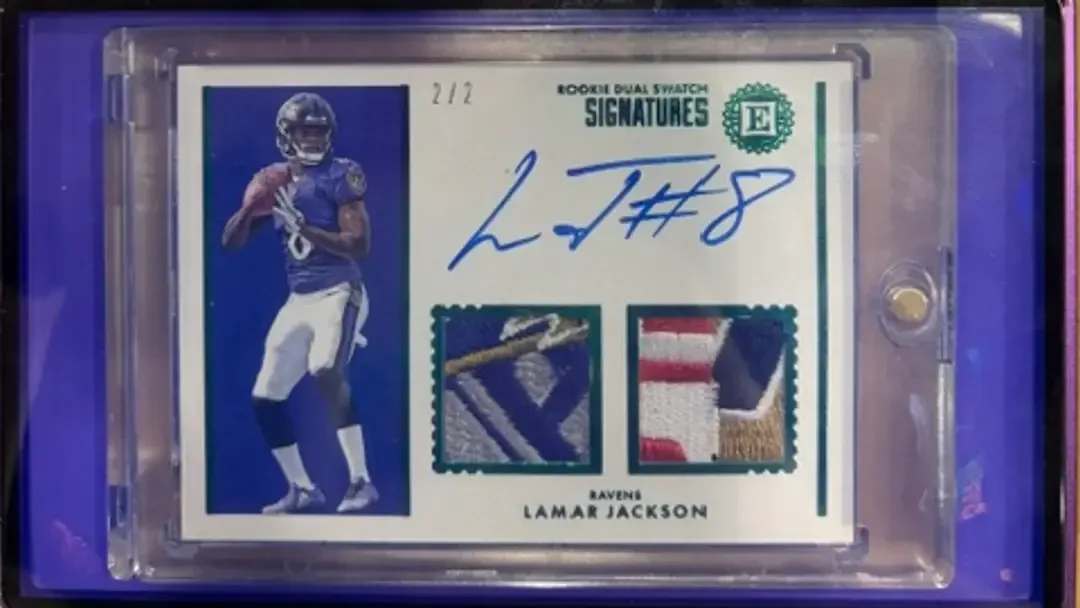
Lamar Jackson’s latest injury has put an abrupt question mark over one of football cards’ largest modern quarterback markets. The Ravens quarterback had already missed three weeks with a high-ankle sprain before returning in Week 8 against the Bills. He then suffered a thumb injury to his throwing hand that requires surgery, leaving his availability unclear for the foreseeable future.
For collectors, the important distinction is between a player’s long-term résumé and the short-term attention that drives weekly demand. Jackson remains a multi-time MVP and one of the sport’s most distinctive stars. Yet a season in which he may not return removes the most immediate catalyst for his cards: meaningful games, playoff momentum and a potential championship push. It also changes the outlook for Baltimore skill-position cards tied to the offense around him.
At the same time, Jacksonville’s Trevor Lawrence and Cincinnati’s Joe Burrow have narratives that could attract more hobby attention. Lawrence’s Jaguars are 5-2, while Burrow has delivered two huge games after Cincinnati’s bye. Neither story guarantees a rise in card values, but both demonstrate why collectors often follow quarterback performance, team expectations and the calendar as closely as they follow the card itself.
Jackson’s absence creates a difficult short-term setup
Jackson carries a substantial place in the quarterback card market of the past decade. That matters because a large, established market can react quickly when a player’s season becomes uncertain. Collectors who bought cards expecting a Ravens surge now have less football to support that thesis, and prospective buyers may become more selective while recovery and offseason questions remain unresolved.
The uncertainty goes beyond the thumb injury. Jackson is 29, enters the offseason with one year left on his contract, and could potentially have missed 26 of Baltimore’s 102 games since 2021. Availability is not the whole story of a quarterback’s career, particularly for an athlete with Jackson’s accomplishments, but it is part of how collectors assess present-day risk. A card can remain important to a player collection while becoming harder to value as a short-term performance play.
A thumb injury on a throwing hand is particularly relevant in football because passing is central to a quarterback’s production and public perception. Surgery also makes a quick, straightforward forecast difficult; recovery windows can differ by the nature of the injury and rehabilitation. The key point for the market is not to assume a final outcome before there is clarity on Jackson’s timetable.
What “market cap” means in card discussions
In hobby market commentary, market cap broadly refers to the combined estimated value represented by a player’s cards. It is not a fixed official number like a public company’s market capitalization. It is a way to describe the scale of a player’s footprint across major issues, grades and sales histories. A quarterback with a large market footprint can have many categories of cards moving at once, from accessible modern rookies to scarcer premium releases.
That scale is why an injury can create broad concern without proving that every Jackson card will decline by the same amount. Different cards have different audiences. A scarce rookie card, a top-grade flagship parallel and a lower-priced base issue do not necessarily move in lockstep. Collectors focused on Jackson’s career legacy may see a downturn differently from buyers who expected to flip during a Ravens postseason run.
Related coverage includes Lamar Jackson Injury Shifts NFL Card Market Focus to Trevor Lawrence and Joe Burrow.
The practical message is restraint. An injury headline can generate emotional selling, but a card’s individual details still matter: the set, scarcity, condition, grade, sale history and buyer demand. A lower asking price is not the same thing as a completed sale, and one sale is not a full market trend.
Baltimore teammates may lose the quarterback-driven spotlight
The ripple effect could reach Zay Flowers, Mark Andrews, rookie Ja’Kobi Lane and Derrick Henry. Their card markets are not identical to Jackson’s, but Baltimore’s offensive expectations affect how frequently each player receives national attention. Without the franchise quarterback, the team is expected to rely immediately on undrafted rookie UConn free agent Joe Fagnano.
That situation does not erase the accomplishments of established veterans such as Andrews or Henry. Nor does it decide the long-term value of Flowers or Lane. It does mean that projected production and the likelihood of marquee games may change. For cards bought chiefly because of an anticipated offensive breakout, that is a meaningful difference.
Collectors should also be wary of treating every teammate as a direct substitute for Jackson demand. Quarterback collectors, receiver collectors and rookie-card collectors often have overlapping but separate motivations. A team-level setback may reduce the general excitement around Baltimore, while an individual player can still produce a performance that changes his own conversation.
Lawrence has the cleanest Jacksonville hobby narrative
Jacksonville’s 5-2 start gives Trevor Lawrence a more favorable short-term setting. The Jaguars are scheduled to face Baltimore in Week 9, and a win would put them at 6-2 for only the third time in franchise history. Lawrence has a 17-to-4 touchdown-to-interception ratio, listed as the league’s third-best mark to this point.
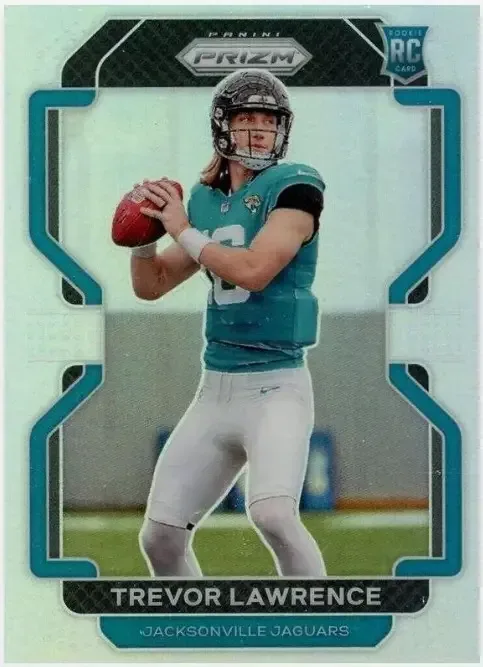
His card market has already shown movement. A 2021 Panini Prizm Silver rookie graded PSA 10 rose from $1,000 at the start of September to $1,275. A broader Lawrence card index showed 11% growth over the same span. Those figures are useful markers, but they should be read carefully. The single Prizm card tracks one specific combination of player, year, product, parallel and grade; the index attempts to represent a larger group of featured Lawrence cards.
Why the exact card matters
PSA 10 identifies a card graded Gem Mint by PSA, a third-party grading company. Third-party grading evaluates a card’s physical condition and places it in a tamper-evident holder. The grade can be crucial because collectors may value a PSA 10 very differently from an ungraded copy or a copy assigned a lower grade.
Prizm Silver refers to a parallel version of a card rather than a standard base card. Parallels are visually or structurally distinct versions within a set, and their relative scarcity and collector appeal can give them a separate price path. So a jump in a Lawrence Silver PSA 10 should not automatically be applied to every Lawrence rookie card.
Lawrence is also the clearest Jacksonville focal point for collectors. Parker Washington has stood out at times, but there are relatively few featured rookie cards for a sixth-round pick from the 2023 draft. Travis Hunter is a prominent player because of his ability to play receiver and defensive back, although he has played just 36 offensive snaps through seven weeks while being used more at cornerback. Bhayshul Tuten is having a breakout year but ranks 15th in rushing yards. If the Jaguars gain more recognition, Lawrence has the strongest case to absorb the largest share of that hobby attention.
The upcoming schedule provides potential opportunities rather than promises. Jacksonville has two games against Tennessee with a Week 11 matchup against the NFC East-leading Giants between them. A favorable stretch can support a quarterback’s narrative, but it can just as easily reset after a poor game or injury. That is the central risk of buying around weekly results.
Burrow’s case depends on sustained team progress
Joe Burrow has put together an emphatic two-game stretch after Cincinnati’s bye: 724 passing yards, nine touchdowns, three interceptions and a completion rate just under 77%. The Bengals followed an early deficit with a 43-36 overtime victory over Tennessee, giving collectors another reminder of how quickly a high-profile quarterback can reclaim attention when the offense catches fire.
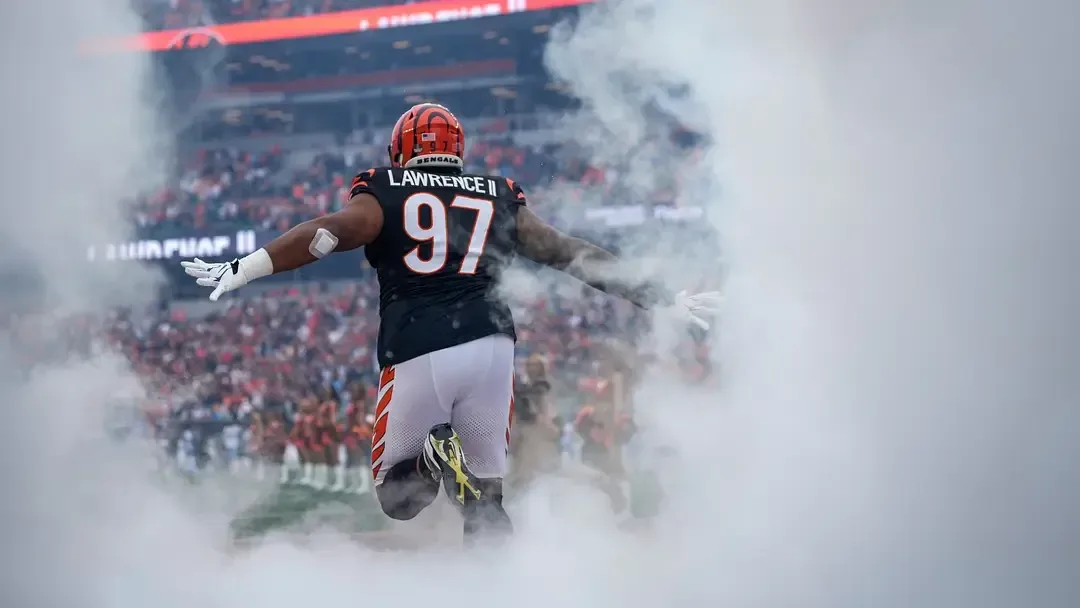
Ja’Marr Chase and Tee Higgins remain central to that passing game, combining for more than 60% of the cited yardage total. The more intriguing shift may be Cincinnati’s defense. The club reworked its defensive line by adding Boye Mafe and Jonathan Allen, then acquiring Dexter Lawrence in a trade for the 10th overall selection in the 2026 NFL Draft.
Lawrence has five sacks, tied for the most by an interior pass rusher, plus nine tackles for loss, second at the position. A tackle for loss is a tackle that stops an opponent behind the line of scrimmage, making it a useful measure of disruptive play. Defensive improvement does not directly set the value of a Burrow card, but it can matter enormously to the quarterback’s team outlook. Better team results can create the playoff games, awards conversations and sustained media attention that fuel hobby interest.
Burrow’s market has been relatively stagnant since the beginning of the season. That makes the Week 10 game against Pittsburgh a notable test of whether Cincinnati’s momentum can develop into a broader narrative. It does not mean a single result will settle the market. It does mean that divisional games can amplify collector focus when a club appears capable of taking control of a competitive race.
A practical read for football card collectors
- Separate the player from the weekly thesis. Jackson’s injury challenges a 2026 Ravens-playoff wager; it does not rewrite his MVP accomplishments or permanently define every card in his catalog.
- Compare completed sales carefully. Match the same year, set, parallel and grade before deciding that a price has genuinely changed.
- Do not confuse an index with every card. An index can describe a useful broad direction, while individual cards can behave very differently.
- Watch the team context. Lawrence benefits from a strong Jaguars start, while Burrow’s case is strengthened if Cincinnati’s defensive overhaul translates into more wins.
- Account for uncertainty. Surgery news, opponent quality, playoff positioning and a small number of sales can all cause fast reactions that later reverse.
Sports-card markets are built on scarcity and condition, but they are also powered by attention. That makes them responsive to the same big-picture forces found across the sports business, even as card pricing remains its own specialized field; broader commercial momentum is visible in stories such as UFC’s revenue growth and TKO’s higher full-year targets. For NFL collectors, however, the immediate focus is simpler: Baltimore has lost a major source of optimism, Jacksonville has a quarterback with a stronger opening, and Cincinnati has a former Super Bowl quarterback with fresh momentum.
None of those narratives is a guarantee of future card prices. They are reasons to follow the next few weeks with more care, to distinguish evidence from excitement, and to let the exact card—not only the loudest headline—guide a collecting decision.