
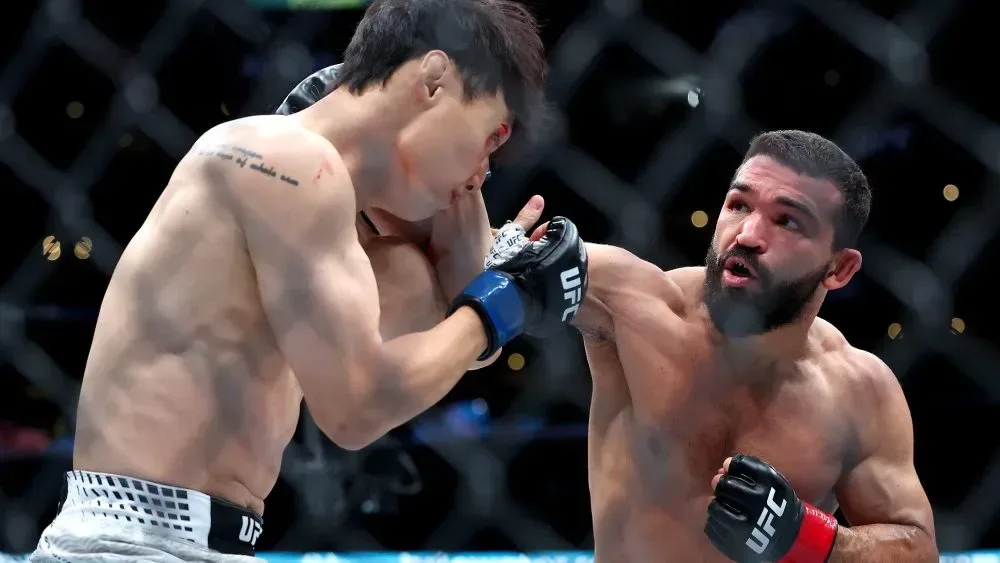
TKO’s third-quarter results were driven by a major upswing at UFC, where revenue rose 60% year over year to $519.2 million. The mixed martial arts business supplied the largest piece of a broader quarter in which TKO recorded $1.36 billion in total revenue, up 21%, and $555.7 million in adjusted EBITDA, up 54%.
For audiences who encounter UFC chiefly through a fight-night broadcast, a streaming app or a sports game, the report is a useful reminder of how many businesses sit behind the action in the cage. UFC’s quarter was not dependent on one revenue line. Media rights, production and content delivered the largest increase, while sellout events also helped lift live-event and hospitality income. Partnerships, marketing and licensing added further growth.
The company has consequently increased its full-year financial targets for a second time this year. Its forecast now calls for revenue between $5.790 billion and $5.830 billion, alongside adjusted EBITDA of $2.295 billion to $2.315 billion.
What powered UFC’s quarter
UFC’s $519.2 million in quarterly revenue represented a $194 million year-over-year increase when measured against the stated 60% growth rate. The report identifies several distinct contributors:
- Media rights, production and content: up $132.3 million.
- Live events and hospitality: up $36 million.
- Partnerships and marketing: up $20.5 million.
- Consumer-product licensing and other revenue: up $5.2 million.
Media rights, production and content were clearly the biggest factor. In plain terms, media rights are the agreements that enable a broadcaster or platform to carry programming. Production and content revenue concerns the making and use of programming around that core product. These categories matter because they can be less tied to the number of seats in a particular arena than gate-driven event income is, though the figures here do not disclose the precise composition of the increase.
The $36 million increase in live events and hospitality, meanwhile, aligns with a run of sellout UFC events. Hospitality generally refers to premium event experiences and packages around attendance, rather than a standard ticket alone. The rise shows the importance of the in-person side of the business even as media is the largest reported growth contributor.
Partnerships and marketing added $20.5 million. That category captures commercial relationships built around the league and its events. Consumer-products licensing and other revenue, up $5.2 million, was a smaller contributor but still expanded. Licensing is especially relevant to the wider entertainment ecosystem: it concerns the authorized use of a brand and its intellectual property on products. The reported results do not break out individual licensed product lines, so they should not be read as evidence about the performance of any specific UFC game or merchandise category.
Adjusted EBITDA: the earnings measure behind the headline
TKO reported adjusted EBITDA of $555.7 million for the quarter, a 54% increase. EBITDA stands for earnings before interest, taxes, depreciation and amortization. It is commonly used to show earnings from operations before financing costs, tax treatment and certain accounting charges. The word adjusted means the company has made further specified adjustments to the measure; it is therefore not the same thing as net income.
That distinction is worth keeping in mind whenever a company highlights EBITDA. It can be a useful way to compare operating performance across periods, but it does not describe every cost or cash obligation. Here, it shows a strong improvement in the company’s selected earnings measure, rather than providing a complete substitute for every line of a financial statement.
UFC accounted for a $119.7 million increase in adjusted EBITDA, while WWE contributed a $9.4 million gain. TKO’s adjusted EBITDA margin rose to 41%, from 32% in the comparable period a year earlier. An EBITDA margin expresses adjusted EBITDA as a percentage of revenue. The move from 32% to 41% indicates that adjusted earnings grew faster than revenue under the company’s reporting measure.
WWE had a more difficult comparison
WWE did not match UFC’s quarter, in part because its comparable quarter a year earlier included three additional main-roster events. That is an important qualifier rather than a minor footnote. Comparisons across years can be affected by the timing and count of events, meaning a softer result does not automatically establish a change in audience demand or the health of the brand.
Even so, WWE still posted the stated $9.4 million adjusted EBITDA increase. TKO’s raised outlook covers UFC, WWE and IMG. IMG includes On Location, the company’s premium-events operation, which also had a strong quarter amid major events around the World Cup.
The combined portfolio matters because it gives TKO several ways to participate in the premium live-events market: combat sports, professional wrestling and high-end experiences attached to major events. Management described favorable long-term trends for live events and sports consumption, while also saying that most existing revenue is contractually locked in for the next five to seven years.
“Our business is durable and our fundamentals are solid, with the vast majority of our existing revenues locked in for the next five to seven years,” TKO president and COO Mark Shapiro said.
Why this matters beyond a quarterly earnings report
The immediate takeaway is straightforward: UFC was the principal growth engine in this quarter, and the gains came from both media-related income and the physical event business. A sellout crowd can support ticketing, hospitality and sponsor visibility at once, while compelling programming can support media and content revenue. The report presents those effects as complementary rather than competing parts of the business.
For entertainment and gaming audiences, it is also a sign of why sports properties remain valuable partners across media. A strong league can generate programming, live-event spectacles, sponsorship opportunities and licensed products from a single recognizable brand. That does not guarantee a particular game, platform arrangement or product announcement. TKO’s figures offer no such details. But they demonstrate the commercial scale behind the franchises that can extend into interactive entertainment and collectibles.
It is important to separate that observation from a prediction. No new UFC video game, release schedule, licensing agreement or feature set was disclosed in these results. Financial momentum at the league level is not evidence that any specific game project is in development or that an existing game will receive an update. It does, however, underline the continuing value of sports brands whose reach extends across broadcasts, arenas and consumer products.
The company’s higher annual guidance is a forward-looking target, not a completed result. Management’s confidence rests on the quarter’s momentum and its view that contracted revenue offers visibility for years ahead. Actual future performance can still vary, and the report itself gives only limited detail on how individual future events, contracts or product categories will contribute.
For a broader look at how entertainment franchises and game businesses can influence one another, see our coverage of Square Enix’s interest in new Final Fantasy games alongside screen stories.
The numbers to watch next
The next reports will show whether UFC can sustain this mix of media, event and commercial growth, and whether WWE’s results strengthen once its event calendar is compared against a different prior-year period. On Location’s contribution around major global events will also remain significant to the overall TKO picture.
For now, the clearest result is UFC’s $519.2 million quarter and its 60% year-over-year revenue increase. With $132.3 million of added media rights, production and content revenue, plus meaningful gains in live events, hospitality and commercial partnerships, UFC provided the strongest lift to a quarter that prompted TKO to raise both revenue and adjusted-EBITDA expectations for the full year.