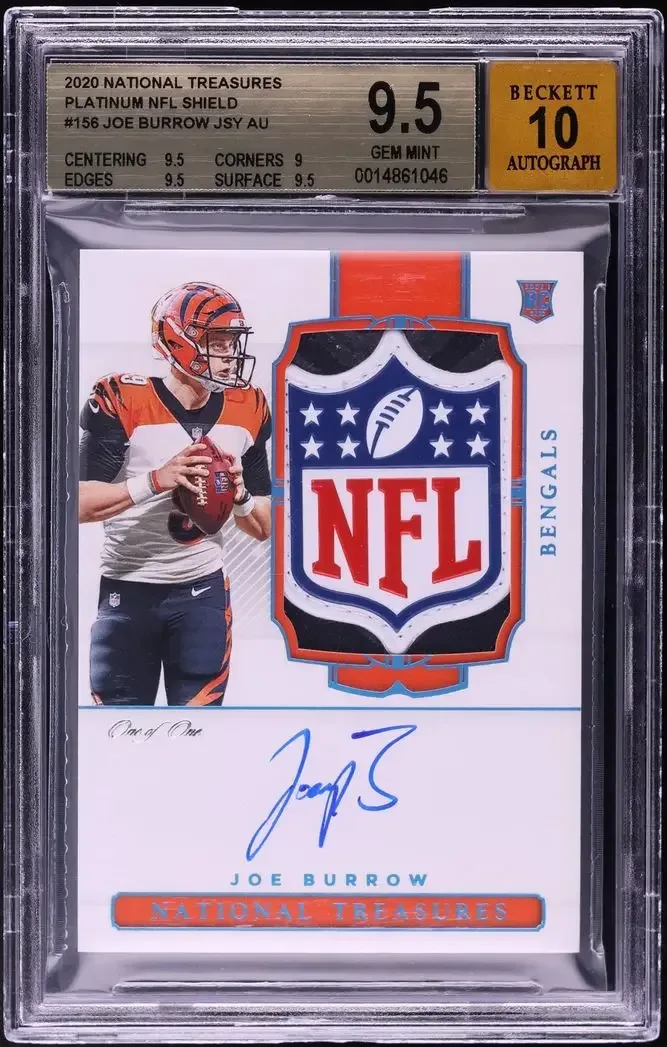
Joe Burrow’s 2020 Panini National Treasures Platinum Shield Auto /1 reportedly sold for $960,000 on November 20, 2026, a result that towered over an already high-end group of football-card transactions. The Burrow sale led a week in which Tom Brady and Patrick Mahomes cards also crossed six figures, giving the market a particularly concentrated showcase of modern quarterback collecting.
The reported results are notable not merely because the dollar figures are enormous, but because each card leans on a different part of the hobby’s value equation: singular scarcity, rookie-year significance, autograph and memorabilia elements, visually distinctive inserts, and elite third-party grading. In short, this was less one market than several collector priorities meeting at the expensive end of the auction block.
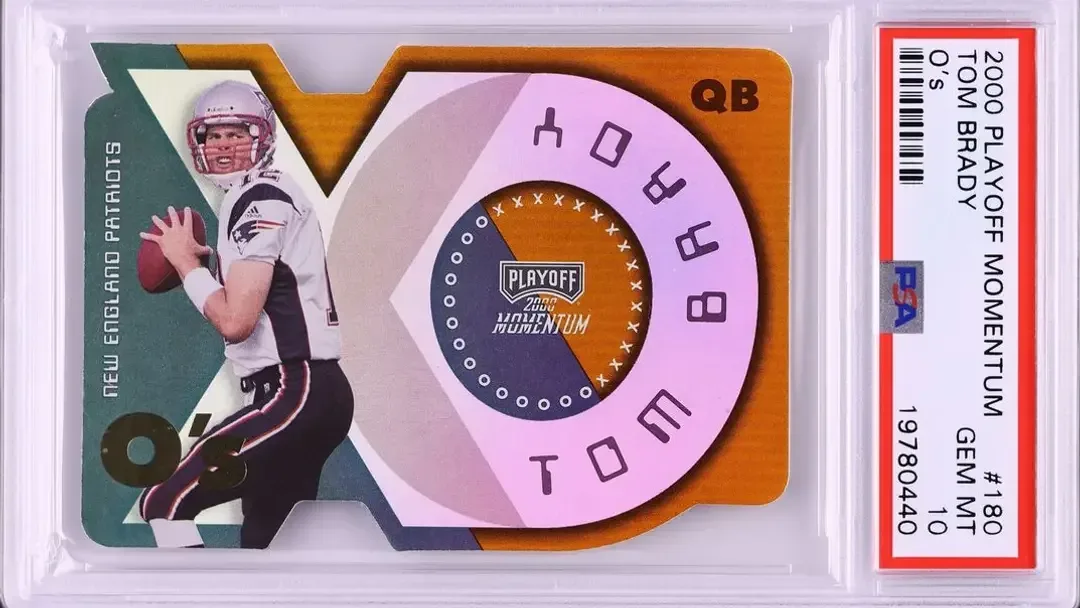
There is one date discrepancy worth keeping in view. The listing information for the 2000 Playoff Momentum O’s Tom Brady PSA 10 describes a November 20, 2025 sale, while its associated caption says November 20, 2026. The figure of $99,000 is consistent across the supplied sale details, but the year should be treated as unconfirmed until the sale record is clarified.
The headline result: Burrow’s one-of-one Shield Auto
The week’s clear leader was the 2020 Panini National Treasures Platinum Shield Auto /1 Joe Burrow, graded BGS 9.5 with a 10 autograph grade. Its reported $960,000 result was almost six times the next-highest sale in the group.
For more context, explore John Turturro on Blockbusters, Creative Balance and Why ‘Inner Life’ Needs Protecting.
The “/1” designation means the card is numbered as a one-of-one: its specific version has a stated print run of just one. That does not mean it is the only Joe Burrow rookie card or necessarily the only premium Burrow card, but it does establish an unmistakable scarcity claim for this particular Platinum Shield Auto version. When an established high-end release, rookie-year status, a patch-style design element and an autograph appear together on a one-of-one card, the resulting package can attract collectors who are chasing a definitive example rather than simply a representative rookie.
National Treasures is represented twice among these results, with Burrow and Mahomes both appearing in premium patch-autograph formats. That overlap illustrates how set identity can matter alongside the athlete. Collectors often do not evaluate a card only as “a Burrow” or “a Mahomes”; the product line, numbering, card construction, signature and grade combine to create the precise item being pursued.
The supplied information also says this is Burrow’s second appearance at the top of the weekly list during the 2026 season. That repetition does not establish a broader long-term market trend by itself, but it does show that premium Burrow material has surfaced in major sales more than once over the season.
Mahomes takes two spots with scarcity and design doing different jobs
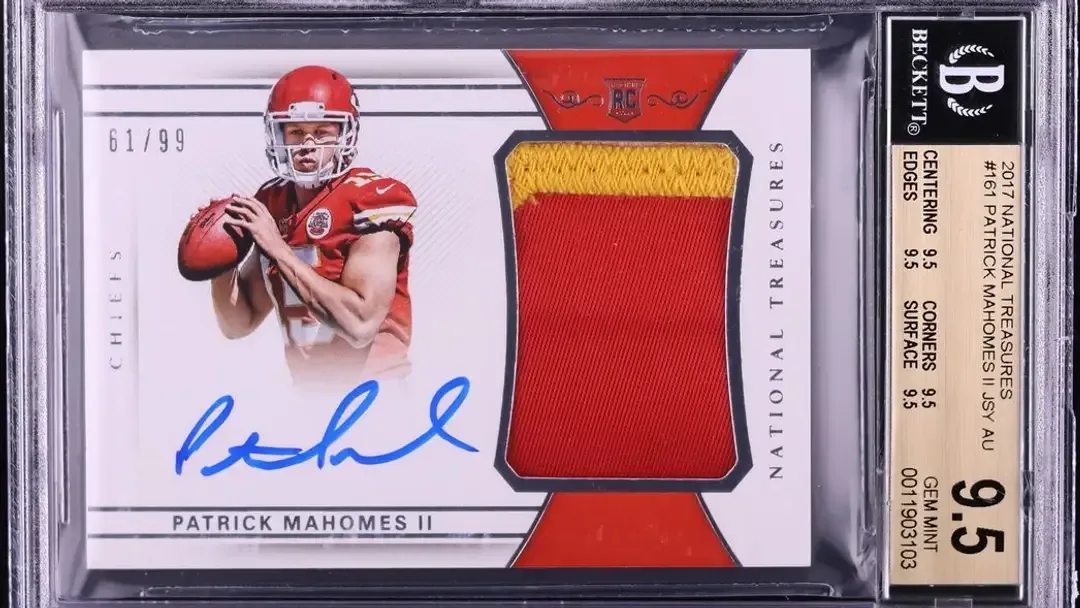
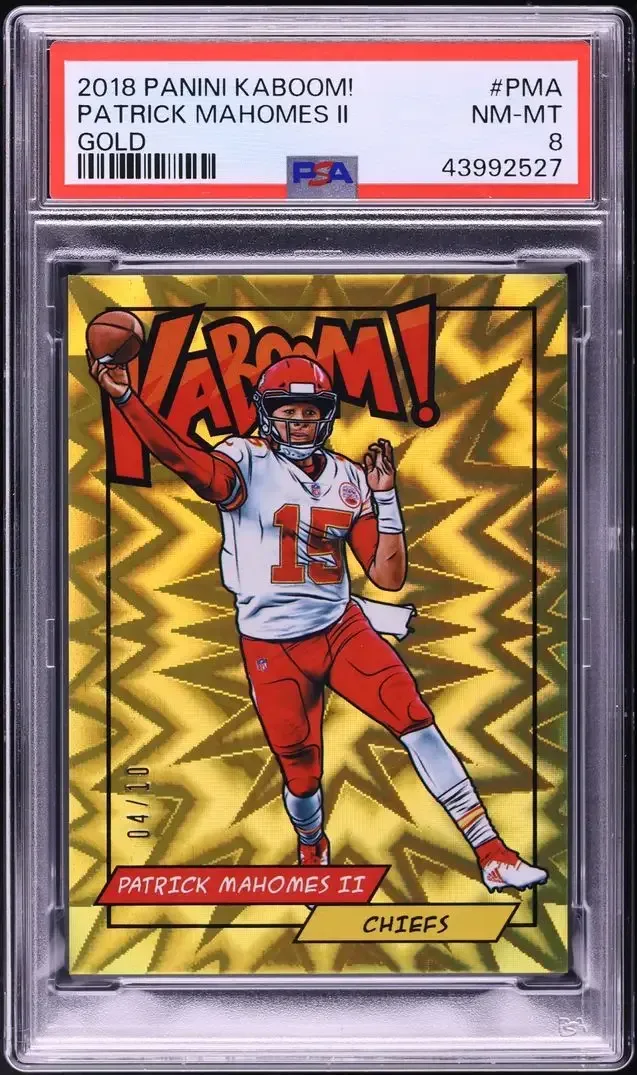
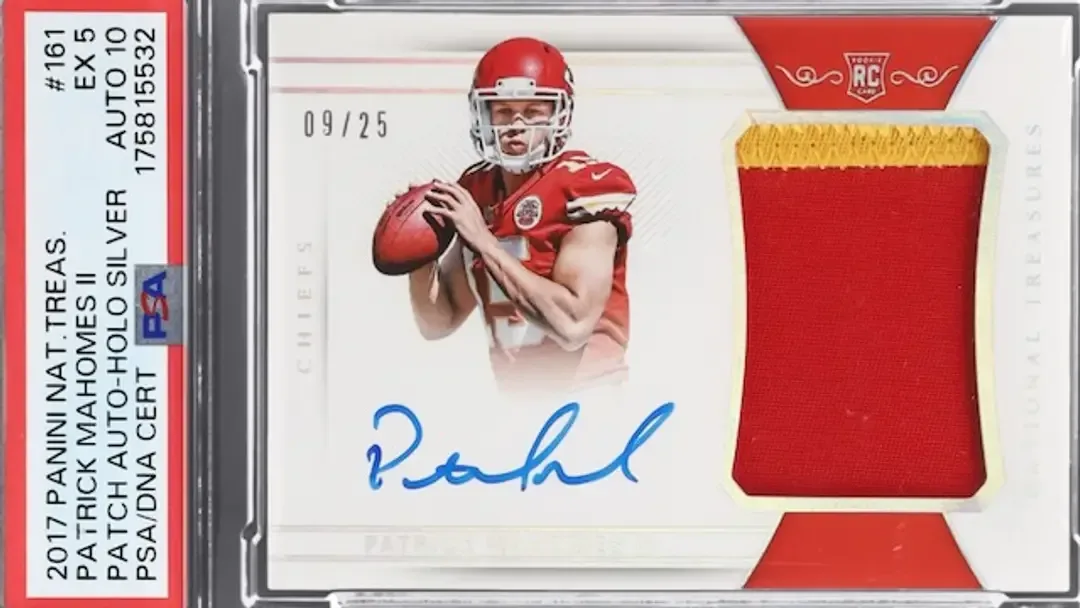
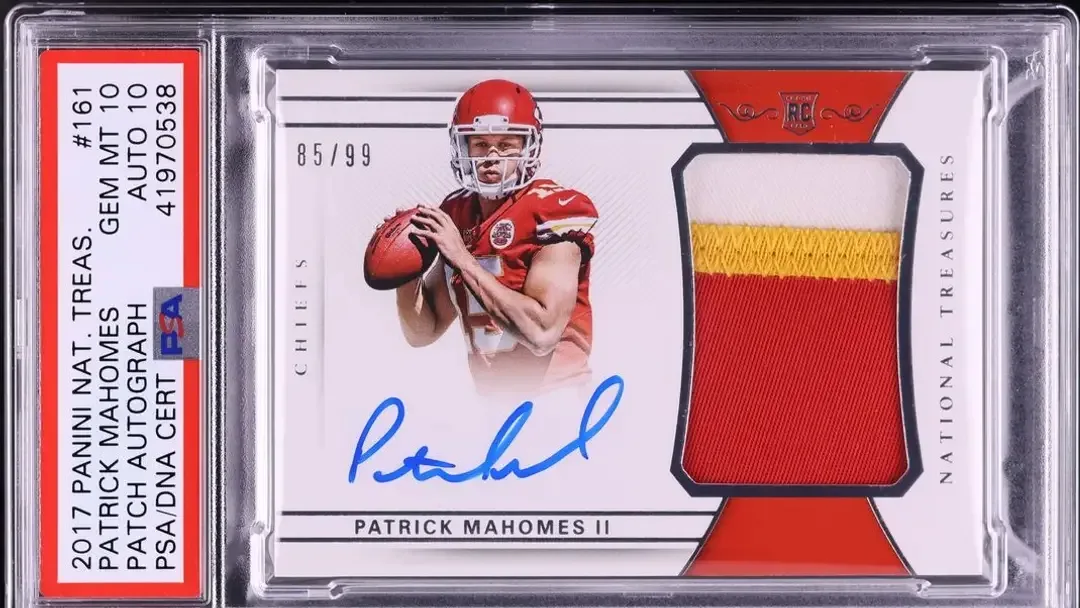
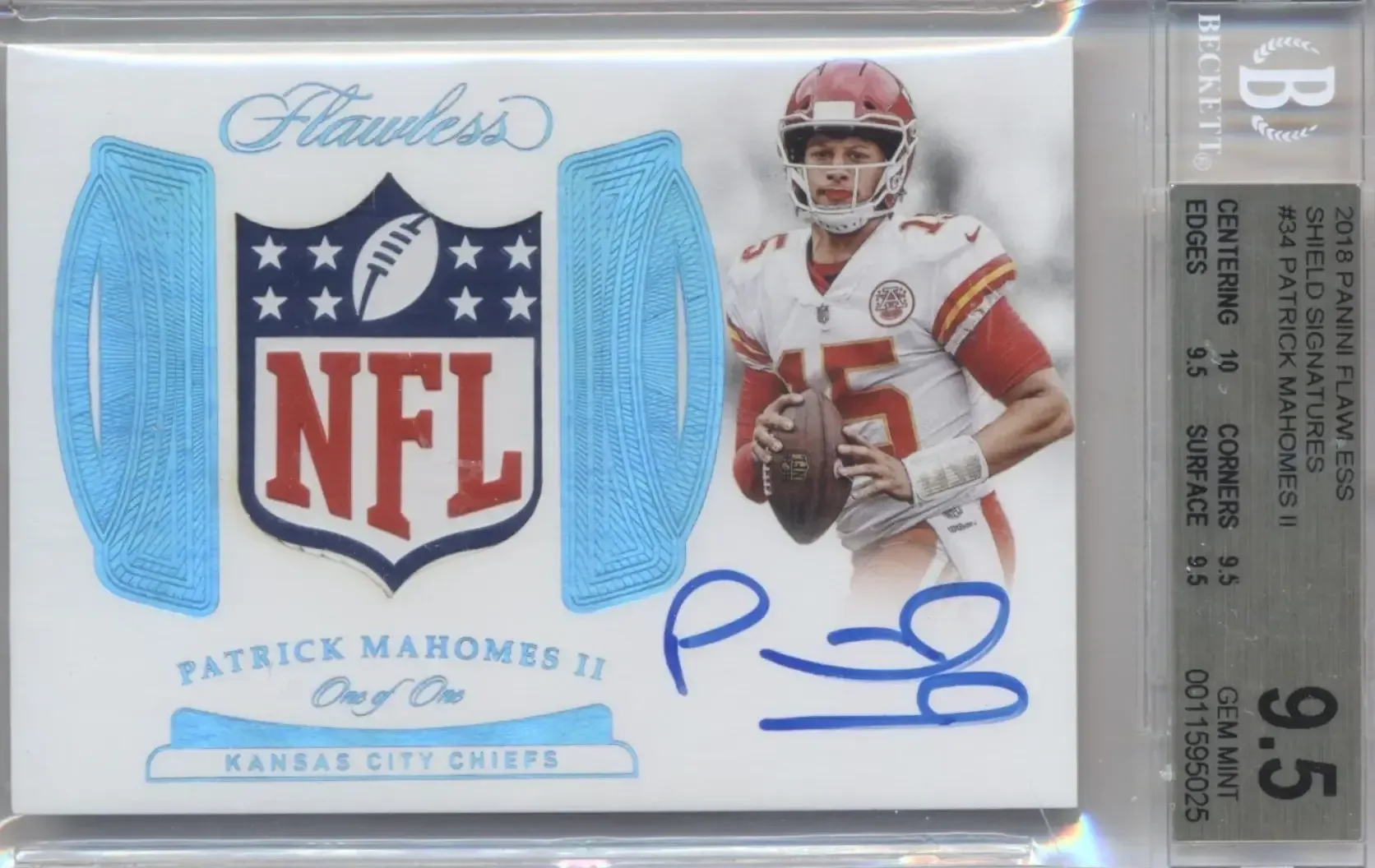
Patrick Mahomes accounted for two of the five ranked results, combining for $270,000. The higher sale was a 2018 Panini Kaboom! Gold /10, graded PSA 8, at $168,000. A 2017 Panini National Treasures Patch Auto /99, graded BGS 9.5 with a 10 autograph grade, followed at $102,000.
The contrast is useful. The 2017 National Treasures card is a rookie-year Rookie Patch Auto, commonly abbreviated as RPA. In hobby language, an RPA generally refers to a card that brings together rookie designation, a memorabilia patch and an on-card or card-based autograph. Here, the serial number /99 means the version is limited to 99 copies, rather than being unique.
The Kaboom! is a different kind of premium collectible. It is an insert, meaning a special card included within a broader card release instead of the standard base-card lineup. Its comic-book-influenced imagery and “Kaboom!” presentation make it visually distinct from the more traditional, luxe National Treasures aesthetic. The Gold version is limited to 10 copies, and that low serial number helped make it the No. 2 reported sale despite the PSA 8 grade.
That pairing is a practical reminder that grade is only one factor. A PSA 8 is below the near-perfect and pristine grades elsewhere on the list, yet this Mahomes card still reached $168,000. Low stated supply, a popular player, a recognizable insert and a desirable parallel can collectively outweigh the appeal of a higher numerical grade on a more available card. It is not a rule that applies to every card, but it is exactly why collectors should resist treating grades as an automatic price ranking.
Brady’s rookie-card breadth fills the middle of the board
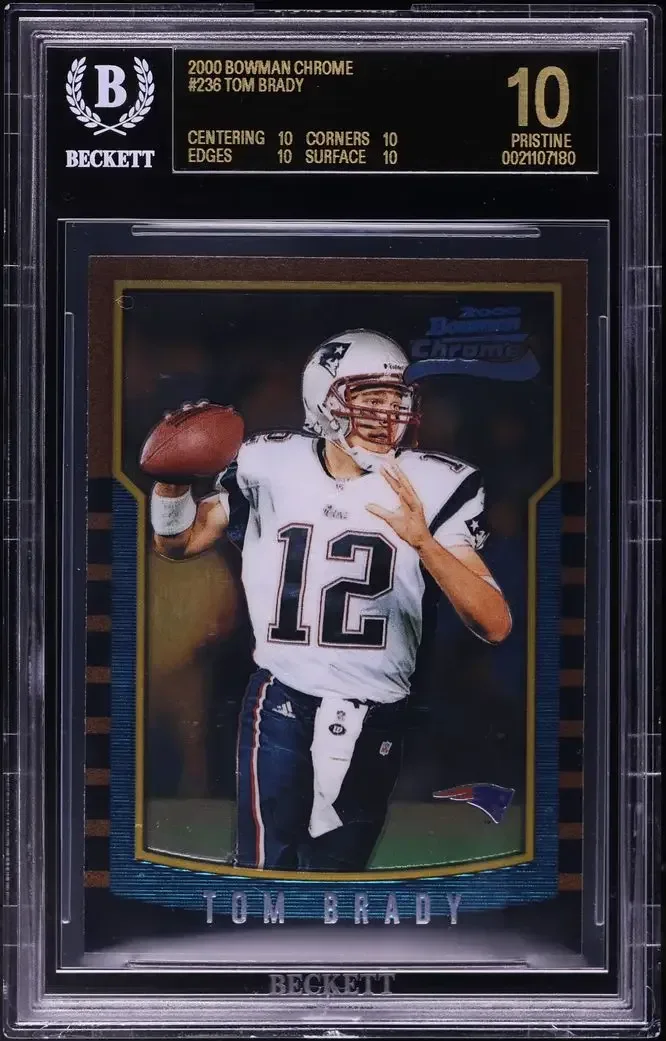
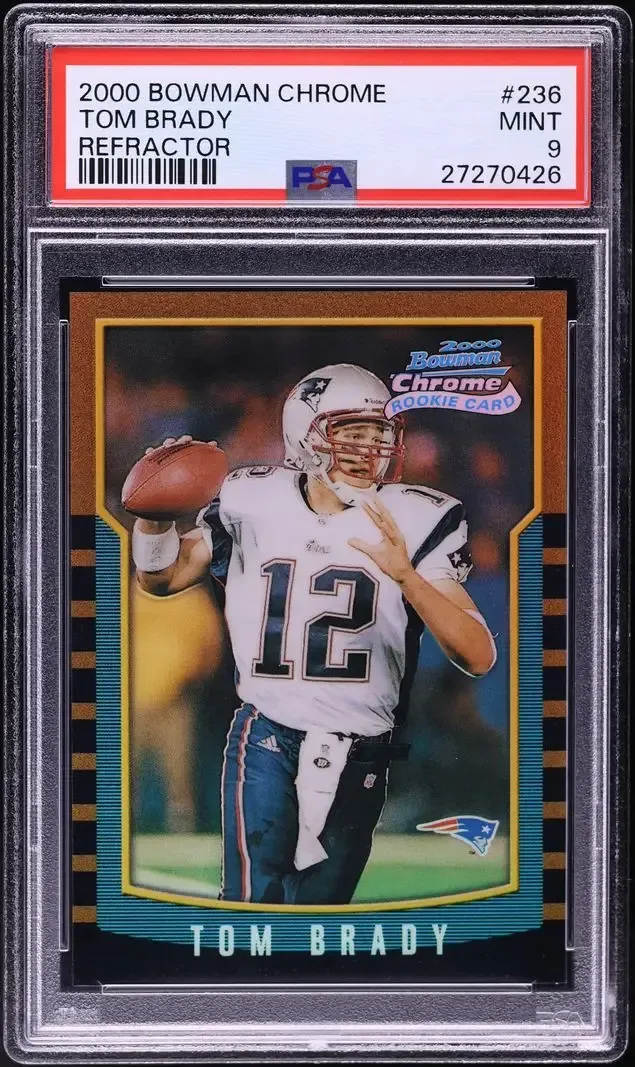
Tom Brady cards occupied three positions when the extra, unranked bonus result is included. Together, the three reported Brady transactions totaled $375,000: a 2000 Playoff Momentum O’s PSA 10 at $99,000, a 2000 Bowman Chrome #236 with a BGS 10 Black Label at $144,000, and a 2000 Bowman Chrome Refractor #236 PSA 9 at $132,000.
The $144,000 Bowman Chrome is especially grade-driven. A BGS 10 Black Label is the grading company’s top-tier designation, and the supplied sale details identify this copy as Pristine. For a card from Brady’s 2000 rookie season, such an elite grade can materially separate one copy from another that is otherwise the same card.
The $132,000 refractor result shows another collector preference: parallel treatment. A refractor is a shiny, light-responsive parallel finish. It is visually different from the regular Bowman Chrome version, and its surface can display a shifting reflective quality under changing light. Although this refractor carries a PSA 9 rather than a 10, it landed close to the Black Label copy’s price, emphasizing that version scarcity and visual identity can produce outcomes that do not follow a simple grade ladder.
The Playoff Momentum O’s Brady card offers a third angle. It is a die-cut, meaning the card is cut into a nonstandard shape rather than a basic rectangle. Die-cuts can have extra corners and edges, increasing the number of areas vulnerable to wear, chipping or handling flaws. The supplied details specifically identify the PSA 10 grade as a key reason this copy stands out. A card’s physical format therefore matters in grading: the same numerical grade can have a different practical meaning depending on how many delicate features the design contains.
The reported sales at a glance
- 2020 Panini National Treasures Platinum Shield Auto /1 Joe Burrow, BGS 9.5/Auto 10: $960,000.
- 2018 Panini Kaboom! Gold /10 Patrick Mahomes, PSA 8: $168,000.
- 2000 Bowman Chrome #236 Tom Brady, BGS 10 Black Label: $144,000.
- 2017 Panini National Treasures Patch Auto /99 Patrick Mahomes, BGS 9.5/Auto 10: $102,000.
- 2000 Playoff Momentum O’s Tom Brady, PSA 10: $99,000, with the reported sale year requiring clarification.
Bonus reported sale: a 2000 Bowman Chrome Refractor #236 Tom Brady, graded PSA 9, sold for $132,000.
What these results actually say—and what they do not
The five ranked results total $1,473,000. Including the Brady refractor bonus pushes the reported six-card total to $1,605,000. Burrow alone represents roughly two-thirds of that six-card figure, so it would be a mistake to read the aggregate as evenly distributed demand across all premium football cards. It is, rather, a snapshot shaped heavily by one unique Burrow card.
Likewise, these transactions should not be used as blanket valuations for every card bearing these players’ names. A standard card, a different parallel, another serial number, a lower grade, or a copy with a different autograph assessment may trade at a dramatically different level. Collectors considering a purchase or sale need to match the exact year, set, card number, parallel, serial numbering, grading company, card grade and autograph grade before using any reported comp as a reference point.
Still, the week gives a clean reading of the attributes buyers were willing to pay for at the highest end: rookie cards from Brady, Mahomes and Burrow; extreme serial-numbered scarcity; premium National Treasures construction; recognizable Kaboom! artwork; and exceptional condition where condition is difficult to achieve. The $960,000 Burrow result is the loudest number, but the broader story is how multiple routes to desirability—one-of-one status, iconic insert design, refractor appeal and top-level grading—can coexist in the same market window.