Gale Sayers’ football-card market is a compact lesson in what makes vintage sports cards compelling—and difficult to evaluate. The player’s career, Chicago Bears legacy, rookie-card status and surviving condition all converge in a short list of cards whose highest recorded sales range from $3,983 to $58,800.
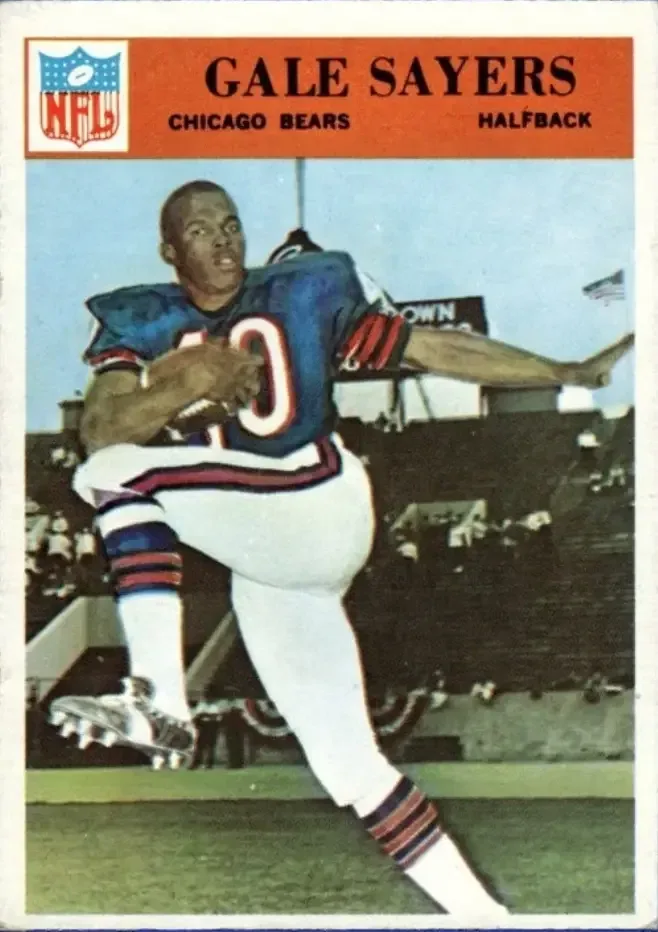
At the top is the 1966 Philadelphia Gale Sayers #38, his rookie card. A PSA 9 copy sold for $58,800 on May 13, 2022. That result places it in a very different tier from the four later Topps issues in this selection, even though each is tied to one of football’s most celebrated players.
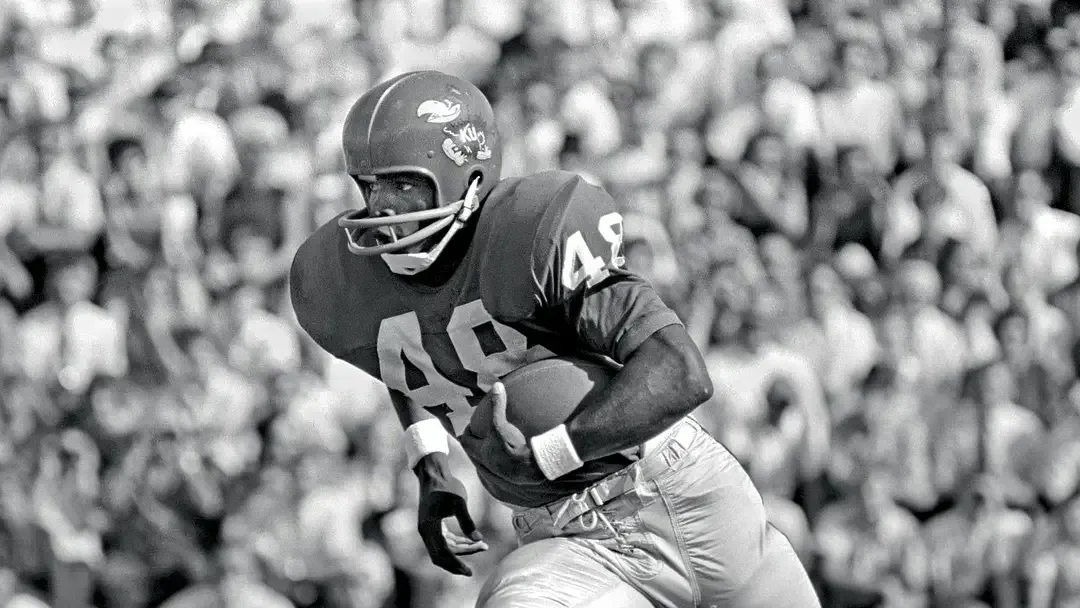
Sayers played college football at Kansas, where his speed earned him the nickname “Kansas Comet.” He was a two-time All-American in 1963 and 1964, then became the fourth overall selection in the 1965 draft by the Bears. His No. 40 is retired by Chicago. He was inducted into the Pro Football Hall of Fame in 1977 at age 34, a remarkably early honor that reflects the stature of a career shortened by injury.
For collectors, the key point is not that every Sayers card carries the same value. The recorded results show a market where year, issue and condition matter enormously. A Sayers card can be historically meaningful in any grade, but the highest prices cited here belong to exceptionally well-preserved examples—and the number of examples receiving those elite grades is very small.
The five leading recorded Sayers card sales
- 1966 Philadelphia Gale Sayers #38 — PSA 9 sold for $58,800 on May 13, 2022.
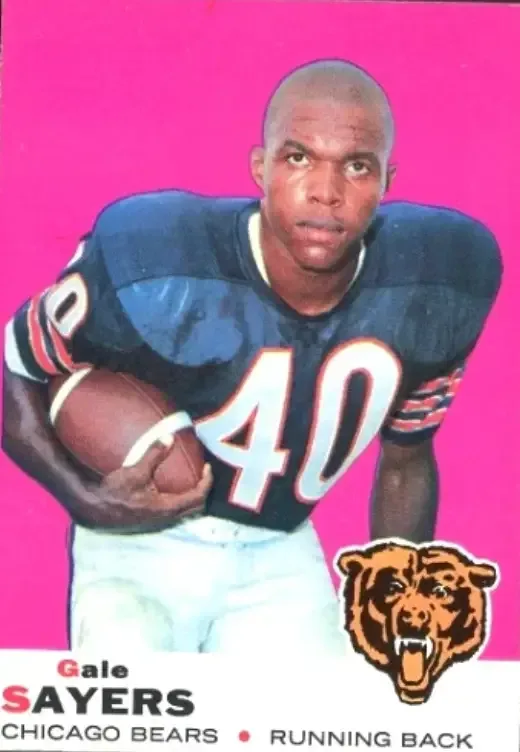
- 1969 Topps Gale Sayers #51 — PSA 10 sold for $12,426 on May 30, 2020.
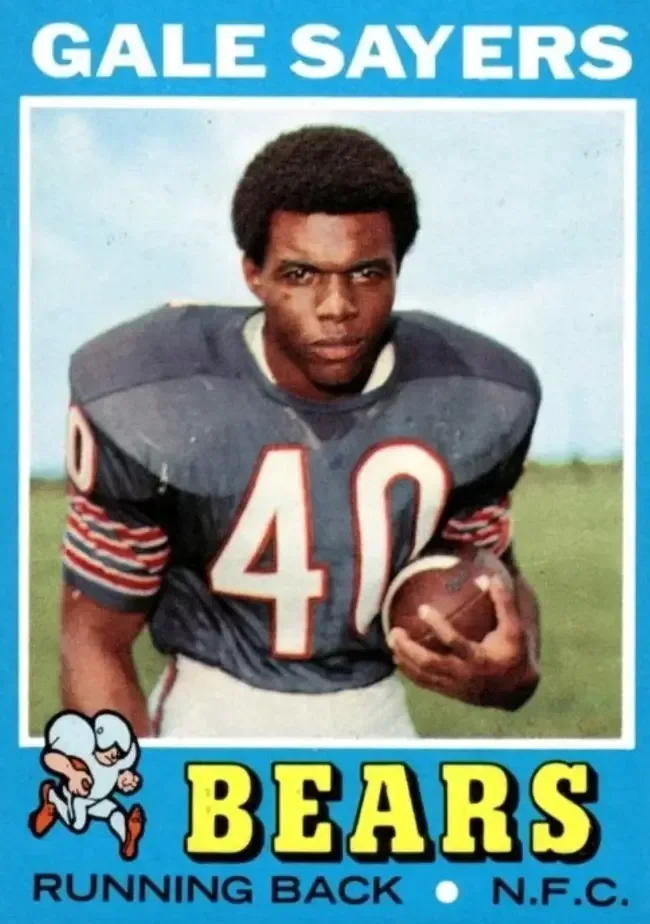
- 1971 Topps Gale Sayers #150 — PSA 10 sold for $10,166 on January 23, 2019.
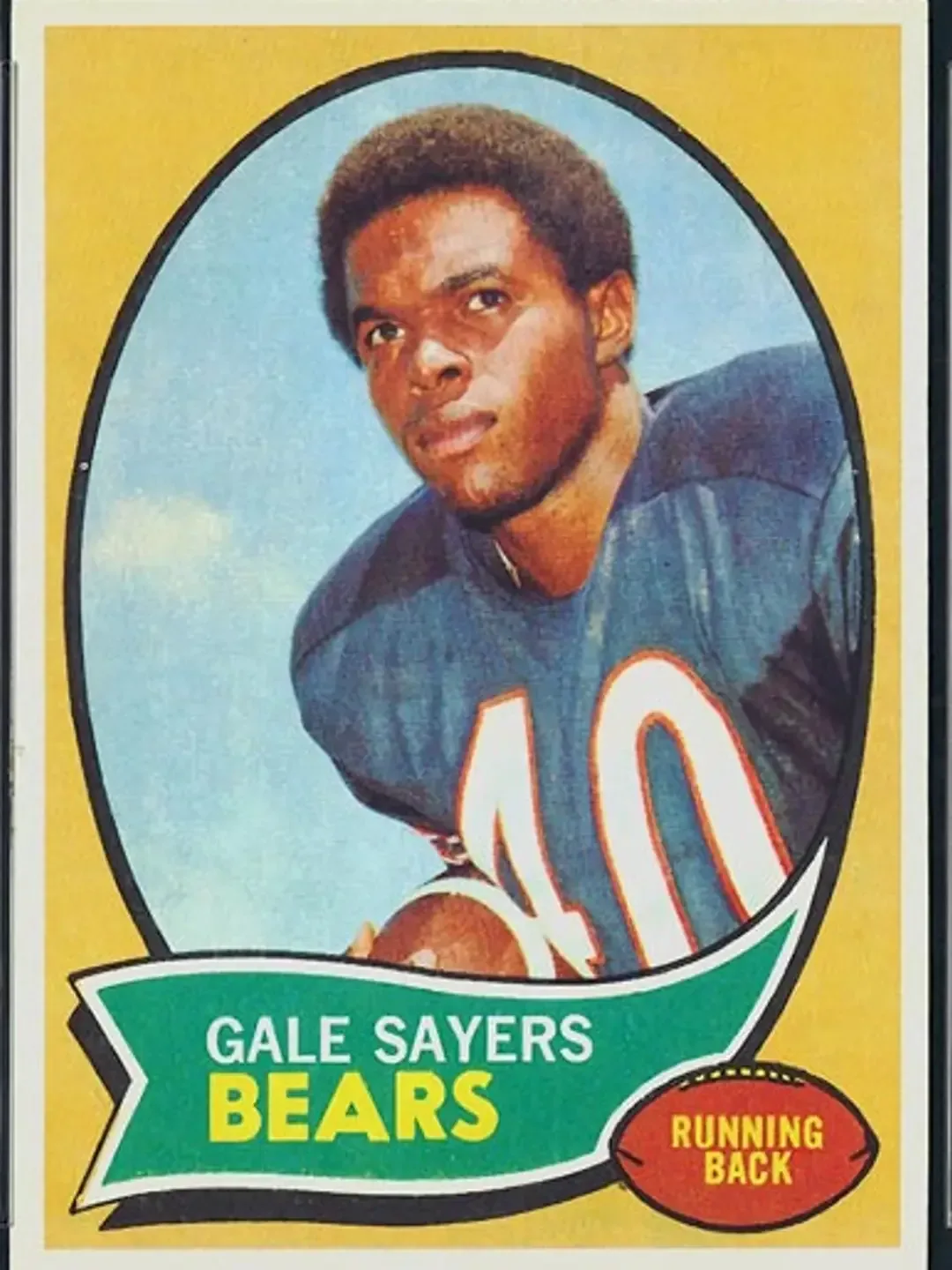
- 1970 Topps Gale Sayers #70 — PSA 10 sold for $6,867 on September 23, 2018.
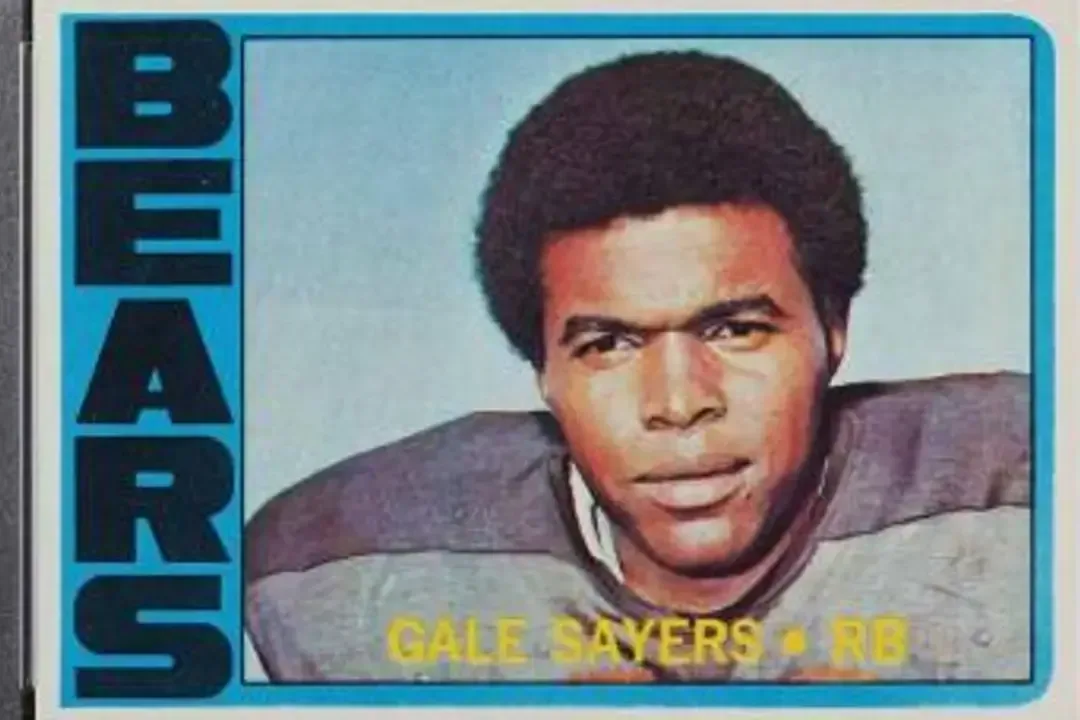
- 1972 Topps Gale Sayers #110 — PSA 10 sold for $3,983 on April 23, 2021.
These are individual historical sales, not a price guide or a guarantee of what a similar card would sell for now. The sale dates also span 2018 through 2022, with a further 2026 result noted for the rookie card. That makes direct, card-to-card comparison useful for illustrating hierarchy, but less useful as a shortcut to a present-day valuation.
1. 1966 Philadelphia Gale Sayers #38: the rookie-card centerpiece
The 1966 Philadelphia #38 is the defining Sayers card in this group. Its $58,800 PSA 9 sale is more than four times the next-highest result listed, and the available sales record is overwhelmingly dominated by this issue: the top 12 Sayers sales available for review are all versions of the 1966 Philadelphia rookie.
That dominance is meaningful. In card collecting, a rookie card is generally the earliest mainstream card associated with a player’s professional playing career. It is often treated as the central card for a player collection because it connects a collector to the beginning of that player’s NFL identity. For Sayers, that appeal is reinforced by a Bears career that secured lasting recognition despite its abbreviated length.
Condition remains crucial. The $58,800 sale was for a PSA 9, not a PSA 10. A PSA 9 is a very high grade, while a PSA 10 is the top grade on PSA’s familiar 10-point scale. The supplied population figure lists 38 PSA 9 copies. Separately, an SGC population reference lists one gem-level example and a 0.02% gem rate, though no sale information is attached to that SGC result.
Related coverage includes The 5 Most Valuable Gale Sayers Cards and Their Recorded Sales.
A later PSA 9 sale for $32,940 on August 23, 2026 shows why collectors should avoid treating one auction as an immutable value. Both results concern the same card and the same grade, yet they are distinct transactions at distinct moments. Differences in individual eye appeal, auction setting and the particular bidders present can matter, even before considering broader changes in collecting demand.
2. 1969 Topps Gale Sayers #51: the strongest later Topps result
The 1969 Topps #51 is the most valuable later-career Sayers card in the group by its stated top sale. A PSA 10 realized $12,426 on May 30, 2020. Only one PSA 10 is listed in the population figure, placing enormous weight on the grade attached to that particular sale.
That population number needs careful interpretation. A population report, often shortened to “pop,” is a count of cards a grading company has evaluated at a given grade. It is not necessarily a count of every surviving copy. Some raw cards have never been submitted; a card could also be resubmitted in pursuit of a different grade. Still, when a reported PSA 10 population is one, it tells collectors that the grade represented by the record sale is extraordinarily scarce within that grading company’s records.
The practical implication is straightforward: a 1969 Topps Sayers card should not automatically be compared to a $12,426 benchmark simply because it is the same card number. That record is specifically for a PSA 10. A collector assessing another copy would need to distinguish the identity of the card from its state of preservation and from the third-party grade, if any.
3. 1971 Topps Gale Sayers #150: a one-of-one PSA 10 population
The 1971 Topps #150 reached $10,166 on January 23, 2019 in PSA 10. Like the 1969 issue, it has a listed PSA 10 population of one. That combination—an elite grade and a single-card population at that grade—helps explain why the highest documented sale stands well above the results for the 1970 and 1972 cards.
The card also represents a player whose reputation was far larger than the length of his healthy playing window. Sayers appeared in more than two games in only five NFL seasons, yet he is recognized on multiple all-time NFL teams. That is an important part of the collecting story: vintage cards preserve not only a season-by-season record but also a player’s longer cultural and sporting standing.
Collectors can separate two questions when viewing a card like this. The first is historical: does this card belong in a Sayers, Bears or vintage-football collection? The second is financial: what evidence actually applies to this specific copy? The historical answer can remain strong regardless of condition. The financial answer, however, requires discipline around grade and comparable sales.
4. 1970 Topps Gale Sayers #70: retired-number appeal, condition-led value
The 1970 Topps #70 features Sayers wearing No. 40, the number retired by the Bears in his honor. Its leading stated result is a $6,867 sale for a PSA 10 on September 23, 2018. The PSA 10 population is listed at five.
Five PSA 10 copies is still a narrow population, but it is different from the single PSA 10 cited for the 1969 and 1971 cards. That distinction illustrates an essential point about scarcity language. “Rare in top grade” does not necessarily mean “rare in every grade,” and a low count at one grading level does not describe the total number of cards in existence.
For someone building a collection rather than pursuing registry-grade examples, that distinction can be freeing. The card’s connection to Sayers and the Bears exists on any authentic copy. The record sale is most useful as evidence of what an exceptionally graded version once commanded, not as a universal label for the issue.
5. 1972 Topps Gale Sayers #110: a final-season-era card with a different context
The 1972 Topps #110 rounds out the list with a PSA 10 sale of $3,983 on April 23, 2021. Six PSA 10 copies are listed. It is a card with distinctive career context: Sayers participated in the 1972 preseason but retired before the regular season because of injury.
Its place at the bottom of this five-card ranking should not be read as a verdict on its importance. The card documents the end of an NFL chapter and remains one of the key mainstream Sayers issues. It simply has a lower cited high sale than the other entries, including the rookie card’s vastly higher results.
Chronology is also useful for collectors who want a focused run. The five cards form a compact sequence: Philadelphia in 1966, then Topps issues in 1969, 1970, 1971 and 1972. A collector can appreciate the progression without confusing it with a single price ladder. Each card’s reported result is attached to a particular date and an unusually high grade.
How to read the numbers without overreading them
The Sayers results underline several practical principles for vintage-football collecting:
- Match the exact issue and card number. The rookie is 1966 Philadelphia #38; the later issues are 1969 Topps #51, 1970 Topps #70, 1971 Topps #150 and 1972 Topps #110.
- Keep grade beside price. Four of the five leading results are PSA 10 sales. The rookie-card high is a PSA 9. Removing the grade strips away a central piece of the comparison.
- Treat population as context, not a complete census. It measures cards graded by that service at that level, not all cards that survive.
- Remember that auction records are dated evidence. The listed results occurred across several years, so they identify notable completed sales rather than a permanent asking price.
- Separate collecting goals. A player collection, a Bears collection, a rookie-card collection and a high-grade set pursuit can all lead to different choices.
Sayers’ story also illustrates why sports cards function as small historical objects. His autobiography led to the film Brian’s Song, and his post-football work included roles as a stockbroker, athletic director and businessman. The cards do not capture every part of that life, but they maintain a physical link to the football career that made him an enduring figure.
That preservation role has parallels with other collecting and archival efforts. For a different example of how ephemera can protect a specific era from fading away, see this digital archive of Japan’s turn-of-the-millennium game scene.
For Gale Sayers collectors, the hierarchy is clear: the 1966 Philadelphia rookie is the centerpiece, while the 1969–72 Topps cards offer a tightly defined group of significant follow-ups. The record prices are compelling, but their real lesson is precision. Know the card, know the grade, know the date of the sale—and let the history of the player remain larger than any one auction result.