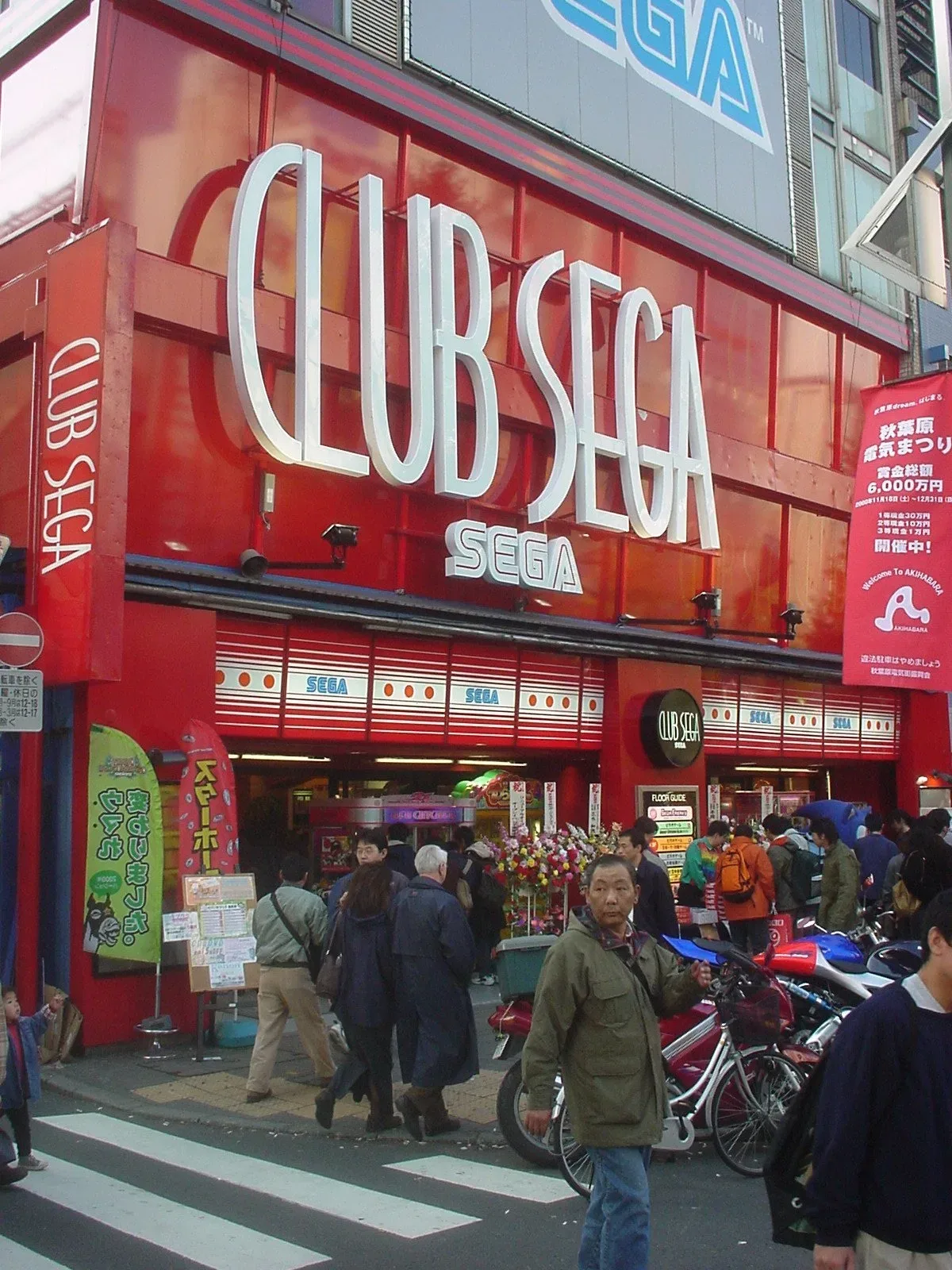
The Video Game History Foundation has added the Colin Williamson Photography Collection to its free Digital Library, making more than 300 photographs of Japanese video game culture from the late 1990s and early 2000s available in digitized form.
The images document a period that is often remembered through games, magazine coverage, commercials and isolated promotional photos. Williamson’s collection offers something more environmental: evidence of how games occupied show floors, retail-adjacent streets, arcades and the day-to-day visual landscape of Tokyo. The result is not simply a gallery of familiar software and hardware. It is a record of the places, displays, signs and crowds that gave that software a public presence.
A record of games as they appeared in public
Colin Williamson worked as a journalist in Japan during the late 1990s and early 2000s, contributing to publications including IGN and PC Gamer. While there, he photographed events including the Tokyo Game Show and the JAMMA Show, as well as developer interviews, street promotions and scenes around Akihabara and other Tokyo gaming districts.
That range matters. Major trade shows are designed to be photographed, but everyday commercial spaces are usually more vulnerable to disappearing without a trace. Storefronts are renovated, signage is removed, hardware is replaced, advertising campaigns end and displays are dismantled. A photograph of an arcade exterior or a stack of CRT displays can become unusually valuable years later because it captures the practical setting around games, rather than only the products themselves.
CRT is short for cathode-ray tube, the display technology used by the televisions and monitors that were standard during the period documented by the collection. In the context of game-history photography, a stack of CRTs is more than old equipment. It can show how games were demonstrated, what a retail or arcade environment physically looked like, and how much space the technology required before flat-panel screens became widespread.
The newly available photographs include exhibits for Gran Turismo 3: A-Spec and Shenmue, the latter represented with a forklift display element. There are also images of a Space Channel 5 street promotion featuring producer Tetsuya Mizuguchi, Nintendo Space World presentations that include the Game Boy Advance, and advertising connected with Jet Set Radio and Final Fantasy IX.
These are recognizable names, but the photographs’ historical value is not limited to nostalgia for particular games. A trade-show booth can reveal what a publisher chose to make physically prominent. A street promotion can show how a game was framed for a public audience. A piece of themed scenery, such as the Shenmue forklift, illustrates how an event tried to turn a game’s imagery into a real-world attraction. Such details are easy to summarize in a written report, but considerably harder to reconstruct once event materials have been discarded.
Trade shows, arcades and Tokyo’s gaming districts
The collection includes photographs from both the Tokyo Game Show and the JAMMA Show. Trade shows serve different historical purposes from a studio press image or a finished game box. They capture games at a particular point in their marketing cycle, often alongside hardware reveals, corporate branding and temporary installations that existed only for the duration of an event.
Related coverage includes Colin Williamson’s Japan Gaming Photos Join VGHF Digital Library.
The images also move beyond convention halls. They include the exterior of Club SEGA, SEGA Hi Tech Land signage, Akihabara scenes and other Tokyo gaming districts. Those subjects help establish the wider context in which the games were encountered. For historians, researchers and fans, the interest may lie as much in the surroundings as in any individual advertisement: the scale of a sign, the storefront next to it, the displays visible on a street, or the ordinary infrastructure of a place strongly associated with game culture.
Akihabara is a Tokyo district closely associated with electronics, games and related enthusiast culture. In an archival photograph, identifying a setting like Akihabara can help researchers connect a game-related image to a broader urban and commercial setting. That does not turn every photo into a complete account of the district, but it gives future viewers a concrete point from which to ask better questions about how games were sold, promoted and experienced.
The same applies to arcades. A photo of Club SEGA or SEGA Hi Tech Land does not merely establish that a venue existed. It preserves branding, architecture and the public-facing identity of an arcade business at a particular time. As physical locations change or close, these visual records can become important companions to game software, arcade boards, flyers and magazines.
Why preservation needs more than the games themselves
Video game preservation is often discussed in terms of playable software: saving discs, cartridges, code, consoles and the technical knowledge needed to keep them accessible. Those materials are fundamental, but they do not tell the entire story. A game can survive perfectly while much of the social and commercial context around it vanishes.
Photography fills a different role. It can preserve material that was never intended to be permanent, including booth construction, storefront advertising, public demonstrations, developer interview settings and street-level promotion. It can also retain incidental information. Background objects, neighboring signs, display formats and the layout of a venue may become meaningful to a later researcher even if they were not the photographer’s central subject.
That is why digitization is significant here. Digitization means creating accessible digital files from physical material, allowing more people to view and study it while reducing the need to handle the originals. It is not the same thing as replacing the original photographs; rather, it broadens access to their contents and makes the collection easier to search, catalog and connect with other historical material.
The Video Game History Foundation’s library has grown substantially since its December 2025 launch. Its 2026 Annual Impact Report lists more than 8,000 cataloged items comprising roughly 61,000 individual files. Those figures underline an important distinction: a cataloged item may contain multiple files, and a digital archive can include many different kinds of records rather than only game software.
For a visitor, that scale can make a collection feel abstract. The Williamson photographs provide a useful example of what individual archival groups can contribute. One collection can offer visual records of product launches, arcade landmarks, advertising and ordinary city scenes. Together with period magazines, development materials and other documents, such images can make it easier to examine a game era as a lived environment rather than a list of release dates.
From unfinished source code to magazines and photographs
The Foundation’s recent preservation work also illustrates the varied forms that game history can take. Its report highlights the 2024 recovery of source code for the unfinished NES game Xcavator from the family of programmer Chris Oberth. Restoration and publishing assistance came from Mega Cat Studios and iam8bit.
Source code is the human-readable programming material used to build software. Its recovery can be historically important because it documents a game at a development level that players would not normally see. In the case of an unfinished project, source code may be especially rare: the game may not have reached a commercial release, while the materials that explain how it was being made could otherwise have been lost.
Alongside the Xcavator work, the organization acquired and digitized the early American magazine Computer Entertainer. Magazines serve yet another archival function. They can preserve contemporary reporting, advertisements, release information and the language used to discuss games at the time. The Williamson photographs complement that kind of material by showing the physical world those pages could only describe.
This mix of photographs, publications and development materials is useful because no single type of artifact is complete on its own. A magazine may name a game and show a screenshot. Source code may reveal how an unreleased title was structured. A photograph may show how a company presented itself to the public, or what an arcade district looked like around the same period. Cross-referencing these categories can strengthen historical understanding without requiring any one record to carry the entire burden.
What viewers may find in the new collection
People approaching the collection for different reasons are likely to notice different things:
- Game and hardware fans may focus on the Game Boy Advance, Gran Turismo 3: A-Spec, Shenmue, Space Channel 5, Jet Set Radio and Final Fantasy IX.
- Arcade enthusiasts may be drawn to Club SEGA, SEGA Hi Tech Land and other images that preserve the look of game-focused venues.
- Researchers may study signage, booth design, promotional tactics and the relationship between trade shows and surrounding city spaces.
- Photographers and design-minded viewers may find value in the period details: CRT arrangements, commercial typography, street displays and the visual character of turn-of-the-millennium game marketing.
There is also a simple pleasure in seeing an era before it became historical. The photos include highly deliberate spectacle, such as event exhibits and promotions, alongside the ordinary scenes that were likely unremarkable at the time. That contrast is precisely what makes a photographic archive valuable. The obvious landmarks establish the big story; the incidental details often make it believable.
The collection arrives at a time when Japanese game culture remains globally visible in new forms, from releases and hardware to live events. For a contemporary example of the international realities surrounding that culture, an upcoming Umamusume: Pretty Derby concert in Los Angeles faces performer-visa uncertainty. Williamson’s photographs, however, are concerned with a much earlier moment: the tangible spaces in which games met audiences in Japan around the turn of the millennium.
Podcast discussion and the next fundraising effort
Williamson has also discussed his time in Japan and the photography collection on the Video Game History Hour podcast. An extended bonus section about the collection is available for the organization’s Patreon members.
Looking ahead, the Foundation plans to begin its annual Winter Fundraiser on Dec. 1, identified as Giving Tuesday. The month-long effort is set to include new videos and blog material about influential and canceled projects in video game history.
For now, the new photography collection adds an especially visual dimension to a growing archive. It preserves not just titles people played, but the machinery of attention around them: booths built to be remembered, advertisements made to be temporary, arcade signs meant to be seen from the street, and city scenes that gained historical weight simply by surviving in the frame.