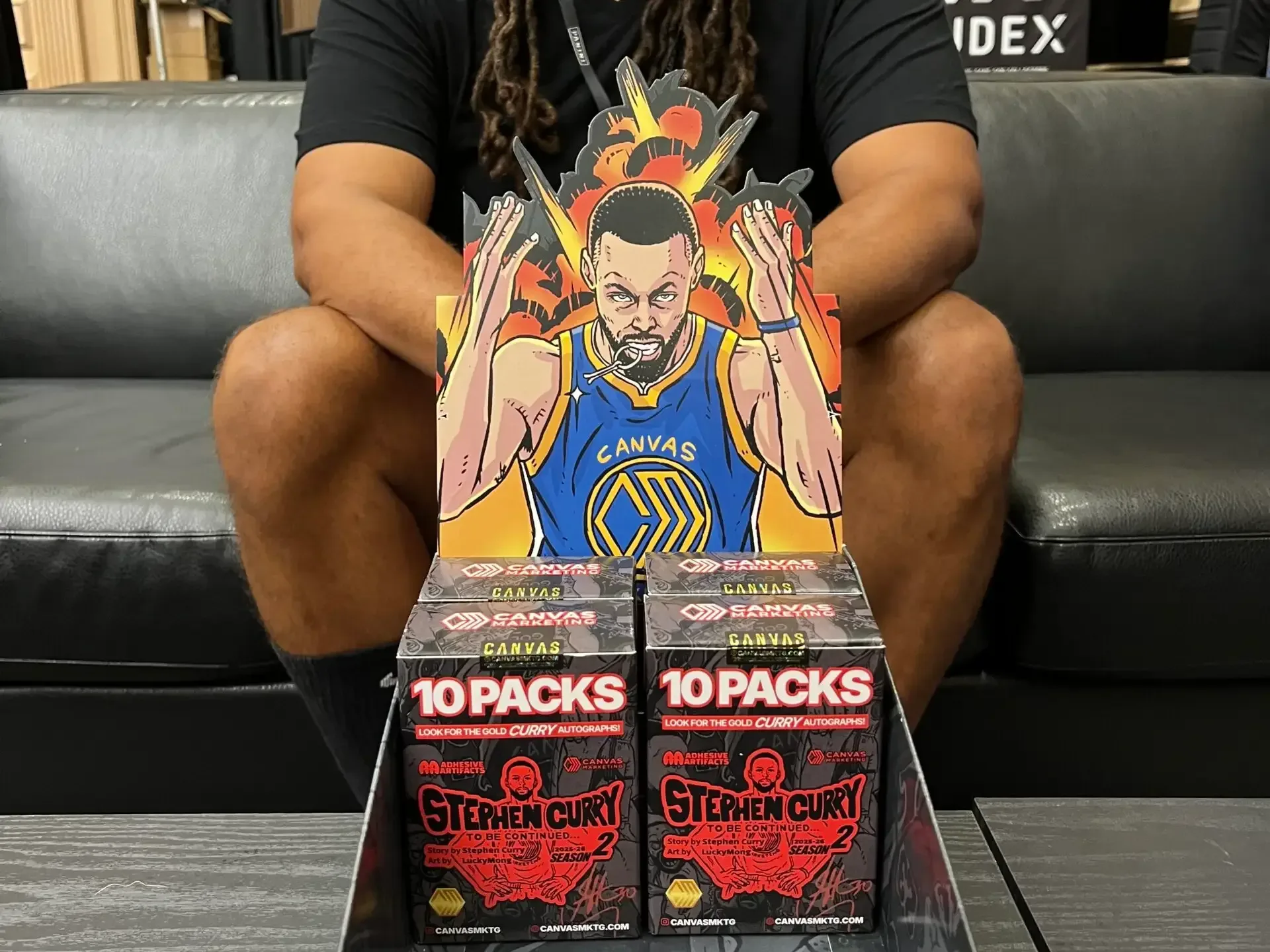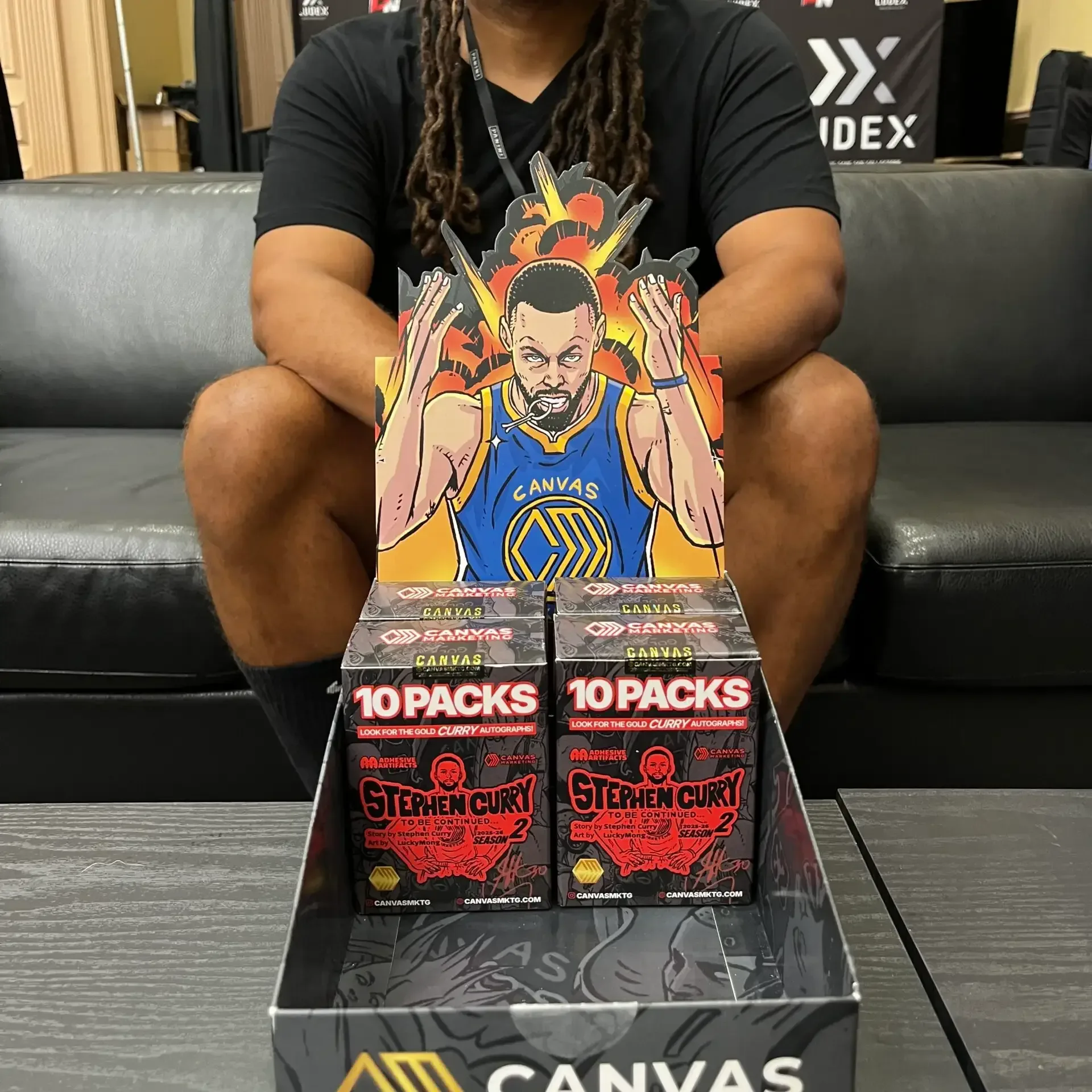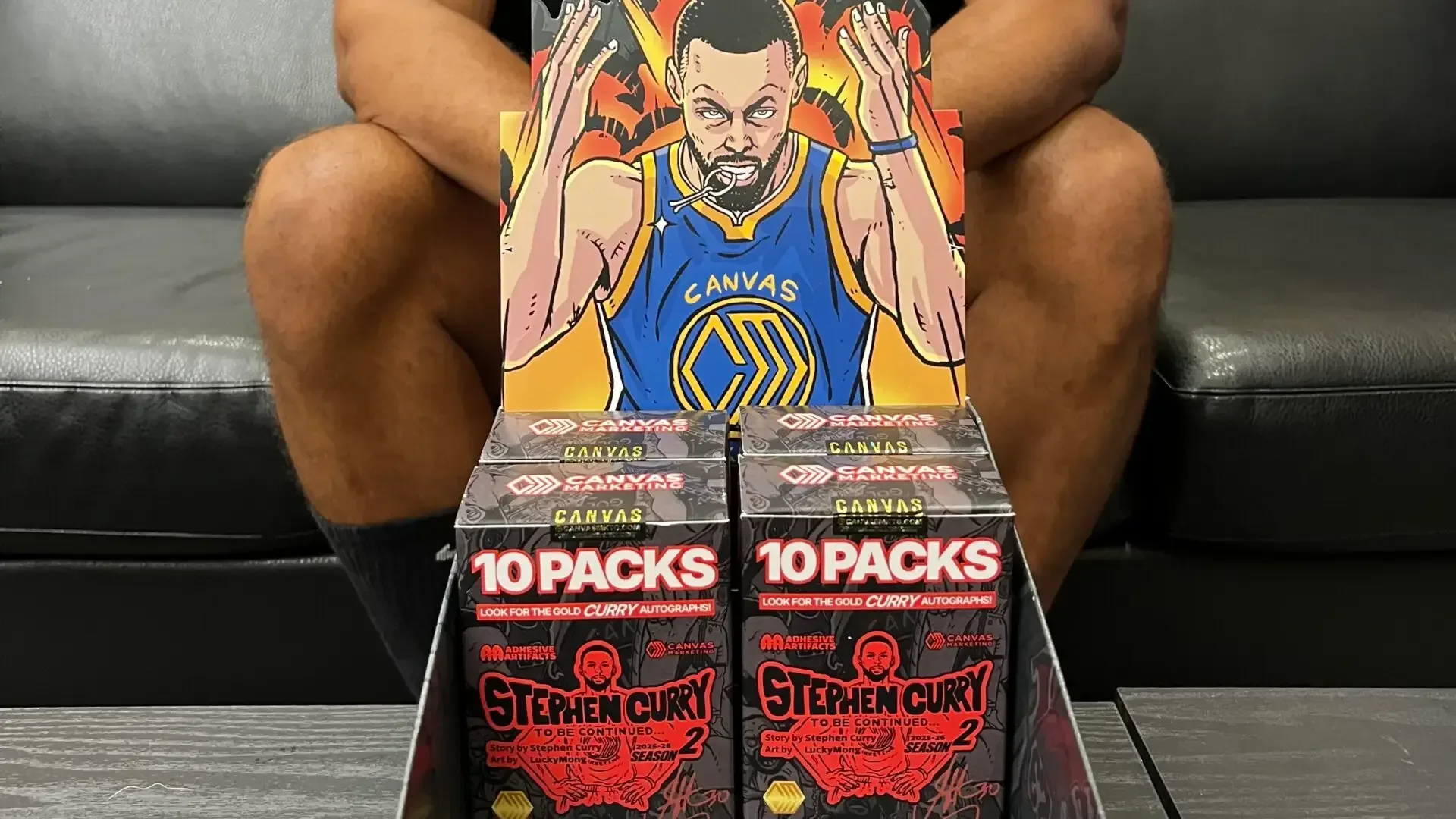
Sports cards often turn a season into a checklist. Will Wade is taking a more personal route with Canvas Marketing, the small card-and-sticker company he founded around the career of his cousin, Stephen Curry. Rather than treating Curry solely as a superstar whose autograph drives a chase product, Wade’s stated goal is to document specific nights, plays and memories through what he calls “adhesive artifacts.”
That phrase is a neat fit for a project that sits between trading cards, stickers and illustrated sports storytelling. Canvas Marketing’s Curry releases use original artwork to commemorate selected games, while the card backs supply the event-specific account. Wade develops the concepts with artist Jay Kim, who works as LuckyMong from Seoul, South Korea. Curry’s role is limited to supplying autographs; he does not run Canvas Marketing or direct its products.
The business also carries a larger personal meaning for Wade. He has spoken openly about addiction, incarceration and rebuilding his life, and frames the company as both a new livelihood and a way to repay the support he received from the Curry family. The result is a collectible venture with an unusually direct family connection—but collectors will ultimately judge it by more familiar questions: What is in the product, how scarce is it, how is it packaged, and how confidently can its history be verified?
From family support to Canvas Marketing
Wade and Curry are close in age, separated by six months, and were especially close as teenagers. Their grandmothers are sisters. When Wade’s parents were incarcerated, he spent time with his grandmother and later lived with the Curry family in Charlotte, North Carolina, during high school. He and Curry shared a bedroom, while Sonya Curry helped Wade prepare for college entrance exams.
Wade’s path later became much more difficult. He has described becoming dependent on intravenous heroin and Xanax in his 20s. Following the death of someone close to him from an overdose, Wade said he spent seven months in jail without bail while fighting an accusation connected to that death and proving his innocence. He says he has now been off drugs for nearly five years.
In 2022, after Curry won his fourth NBA championship with the Golden State Warriors, Wade began considering a business built around preserving Curry’s basketball history. A conversation involving Curry collector Blaine Hunt helped move the idea from aspiration to a practical start. Hunt proposed obtaining signed Curry memorabilia and cards that Wade could sell, and later offered $100,000 as potential capital if Curry would provide and inscribe a game jersey.
Wade received an initial $10,000 rather than the entire sum at once, an approach Curry encouraged because Wade had recently left prison. That first payment became the seed for Canvas Marketing. Wade now describes the company as a family operation that includes his half-brother Deion and cousin Nick.
There is a temptation to make a story like this solely about a famous athlete and a comeback narrative. But the more useful way to view Canvas Marketing is as a very small, creator-led sports-card operation with an unusually intimate subject matter. Wade watches or listens to each Curry game, chooses moments that matter to him, writes the underlying story, and passes that direction to LuckyMong for the visual design.
Related coverage includes Will Wade Turns Steph Curry Family Ties Into a New Trading Card Venture.
A card for a particular night, not just a season
The core creative decision is to pin individual pieces to individual performances. One example comes from the Warriors’ December 22, 2025 game against the Orlando Magic. Curry recorded 26 points on 10-of-23 field-goal shooting, including four three-pointers, plus six assists and two steals. Canvas Marketing’s corresponding design depicts Curry lassoing Steamboat Willie, while the reverse explains what took place in the game.
That approach is closer to a miniature illustrated game journal than a conventional base-card set. A standard base card typically identifies a player within a broad annual release. Wade’s cards instead attempt to preserve a single chapter. The artistic interpretation may not be for collectors who want a uniform, team-licensed visual record, but it establishes an identifiable point of view: Curry’s career seen through the eyes of a family member who has been following it game by game.
Wade says the artwork is also inscribed to the Bitcoin blockchain. In plain terms, a blockchain is a distributed digital ledger: information entered into it is designed to be difficult to change later. The claim here concerns the artwork record, not necessarily the physical card itself. That distinction matters. A blockchain entry can create a persistent digital record associated with art, but it does not by itself prove the condition, ownership, authenticity or contents of a physical item in a collector’s hands. Those remain practical matters for the seller, buyer and any third-party authenticator.
The project’s sticker side was initially aimed at younger collectors who might put waterproof Curry designs on a card case or another personal item. Curry stickers are numbered /222 or lower, meaning the printed number after the slash denotes the maximum stated production quantity for that version. Lower serial numbering can communicate planned scarcity, though it is not the same thing as a guarantee of future market value.
What is in the releases
Canvas Marketing’s first season, The New Era, covers Curry highlights from the 2024-25 season and released on August 10. It uses trading cards rather than the sticker format featured in the subsequent season. Wade’s newer cards include autographs from both Stephen and Seth Curry.
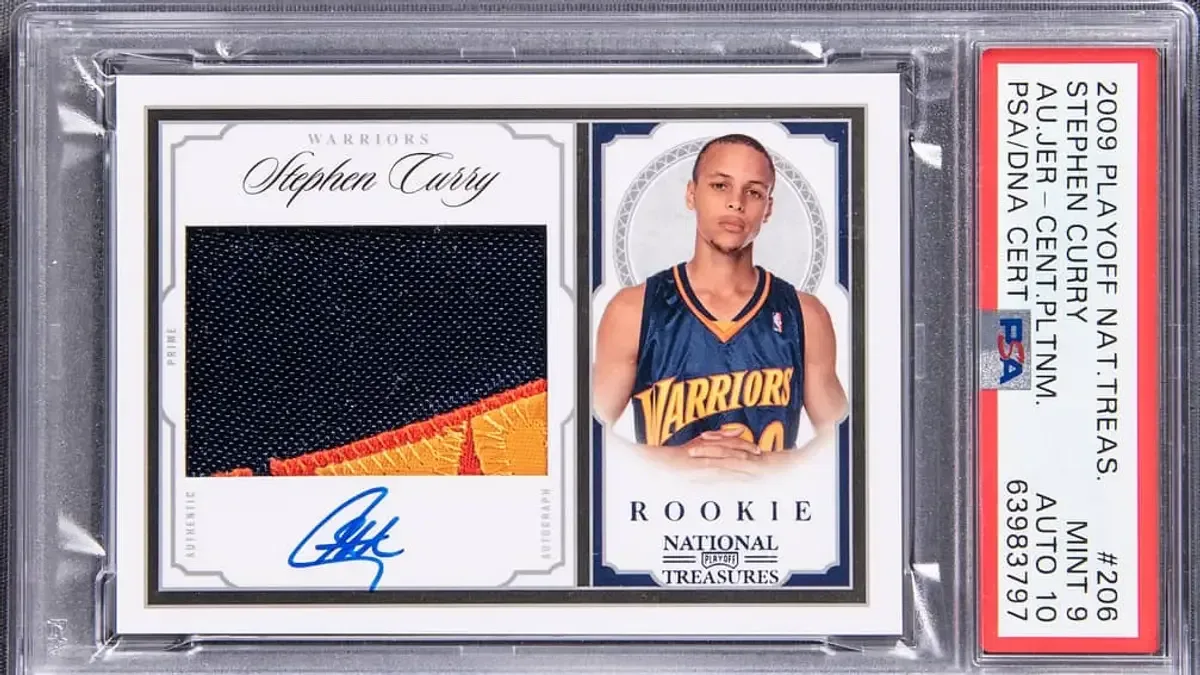
Stephen Curry: To Be Continued Season 2 has a 43-card checklist and is described as containing roughly 500 to 600 on-card Stephen Curry autographs. Every autograph is numbered /10 or lower. An on-card autograph is a signature written directly on the finished card, rather than on a separate sticker later applied to it. Many collectors place a premium on that format because the signature is physically integrated with the card’s design.
- One pack contains one card and costs $50.
- A 10-pack box costs $350.
- A 100-box case costs $3,000 and includes one guaranteed autograph.
Those figures make the configuration worth reading carefully. The case guarantee is explicit, while a single pack or box does not carry the same stated autograph assurance. The lower per-pack cost of buying a box or case may appeal to higher-volume buyers, but no purchase format removes the usual uncertainty attached to opening a randomized product.
Canvas Marketing typically makes one drop per month, with release information posted through its Instagram account, @canvasmktg, and its website. Limited drops can build attention, but they also make a checklist, stated print quantities and clear product details especially important. A collector considering a purchase should distinguish between a card’s story appeal, its stated scarcity, the autograph format and the exact odds or guarantees attached to the configuration being bought.
Packaging and the anti-tampering question
Wade has made packaging integrity a central part of the pitch. Each sticker is placed into a penny sleeve and top loader before being hand-inserted into a pack. Rather than a traditional foil wrapper, the packs use a perforated pull-tab intended to make opening irreversible. Wade’s argument is straightforward: if the tab has been torn, evidence of access should be obvious.
That is an anti-tamper feature, not the same thing as a universal authentication system. Anti-tamper packaging is designed to make interference visible. Authentication is the separate process of evaluating whether an item is genuine, whether a signature is authentic, or whether it matches a documented chain of production. The two concepts can complement each other, but neither automatically replaces the other.
Wade has said Beckett is set to oversee Canvas Marketing’s printing process, take responsibility for the checklist and authenticate cards from inception. If implemented as described, that arrangement would be significant for a boutique release, because it aims to establish documentation at the production stage instead of only after a card reaches the secondary market. Specific scope, procedures and timing remain details collectors should verify directly as products arrive.
The concern itself is easy to understand. Resealing has long been a fear in any hobby product where unopened packaging is part of the value proposition. A pull-tab cannot settle every question surrounding a collectible, but its visible one-time-open design is meant to reduce ambiguity around whether a pack was accessed. For buyers, retaining the wrapper and documenting an opening can be sensible habits when condition and provenance are important. For a broader look at why product-condition questions can matter to collectors and retailers, see this look at damage reports and collector concerns.
A small brand with a defined mission
Canvas Marketing does not present itself as a conventional major-card manufacturer. Its pitch is the opposite: a hand-assembled, limited and intensely focused archive of one player’s continuing career. Wade calls Curry one of basketball’s greatest shooters and wants the collectibles to preserve that legacy in a format that feels personal to him.
That narrower focus brings strengths and constraints. A project tied to one athlete can offer a coherent identity that sprawling releases often lack. Here, the artist, the game recap and the numbered object all point back to a single recurring idea: preserving Curry moments as they happen. Yet collector confidence will depend on sustained execution—consistent communication around releases, transparent checklists, clearly stated serial numbering, and clarity around the reported printing and authentication relationship.
Wade also says he gives 10% of Canvas Marketing’s proceeds to Curry’s Eat.Learn.Play Foundation. Alongside the business, he has continued showing the cards directly to collectors, including by walking the floor at the National Sports Collectors Convention. It is a very hands-on approach, appropriate for a product where the maker’s own account is inseparable from the item being sold.
For Wade, that accountability appears to be the point. Canvas Marketing began as a chance to build something stable after a dangerous period in his life. Now it is a vehicle for family work, Curry-focused art and a running record of NBA moments. The company still has to earn trust in a crowded card market, but its premise is unusually clear: every release is intended to be a piece of Stephen Curry history, told one game at a time.