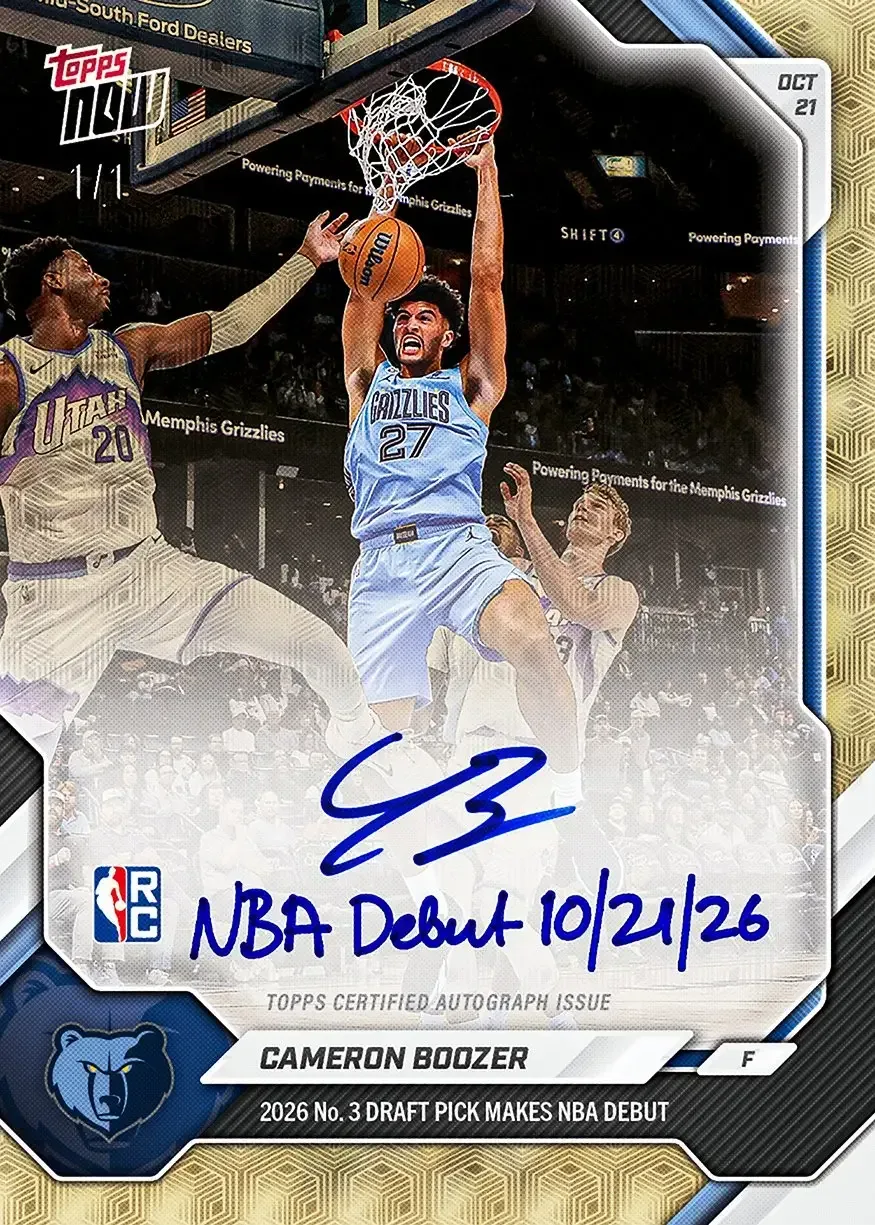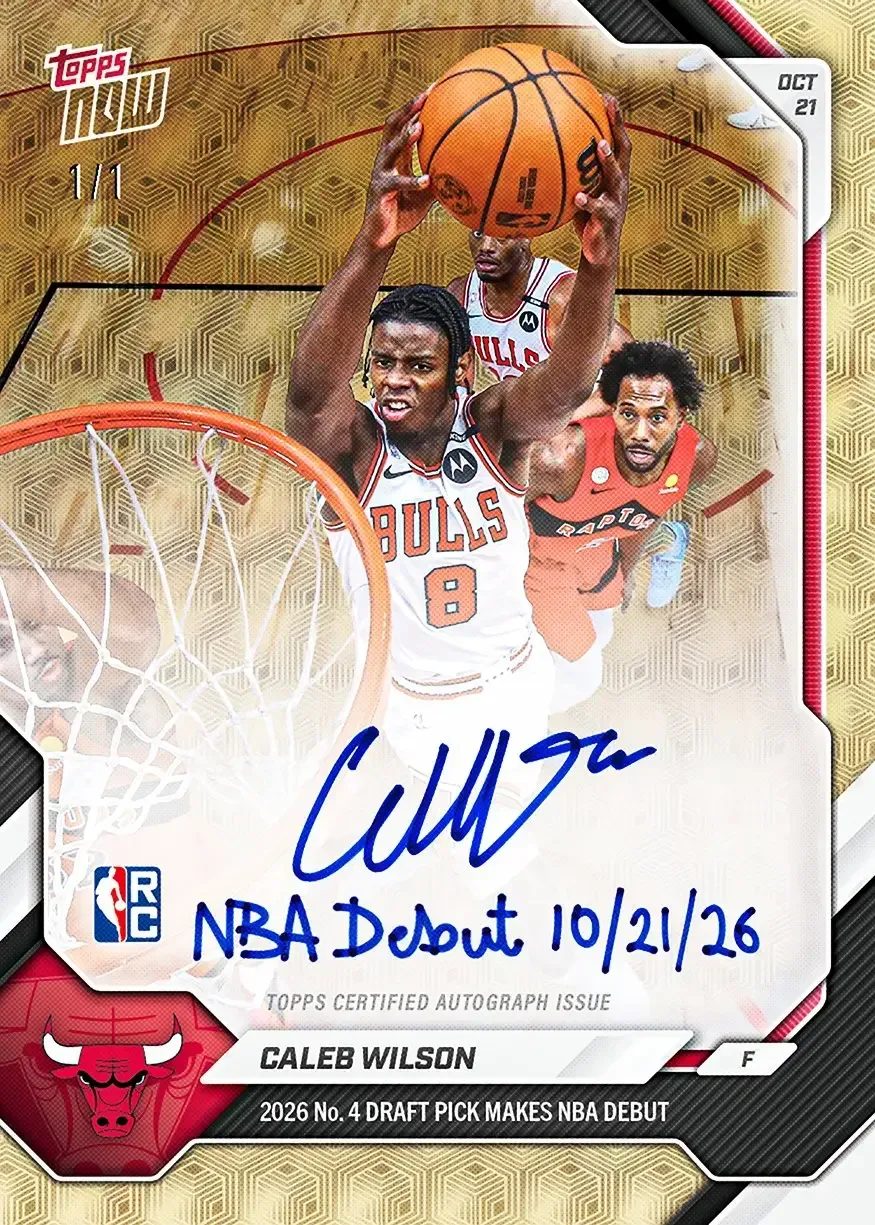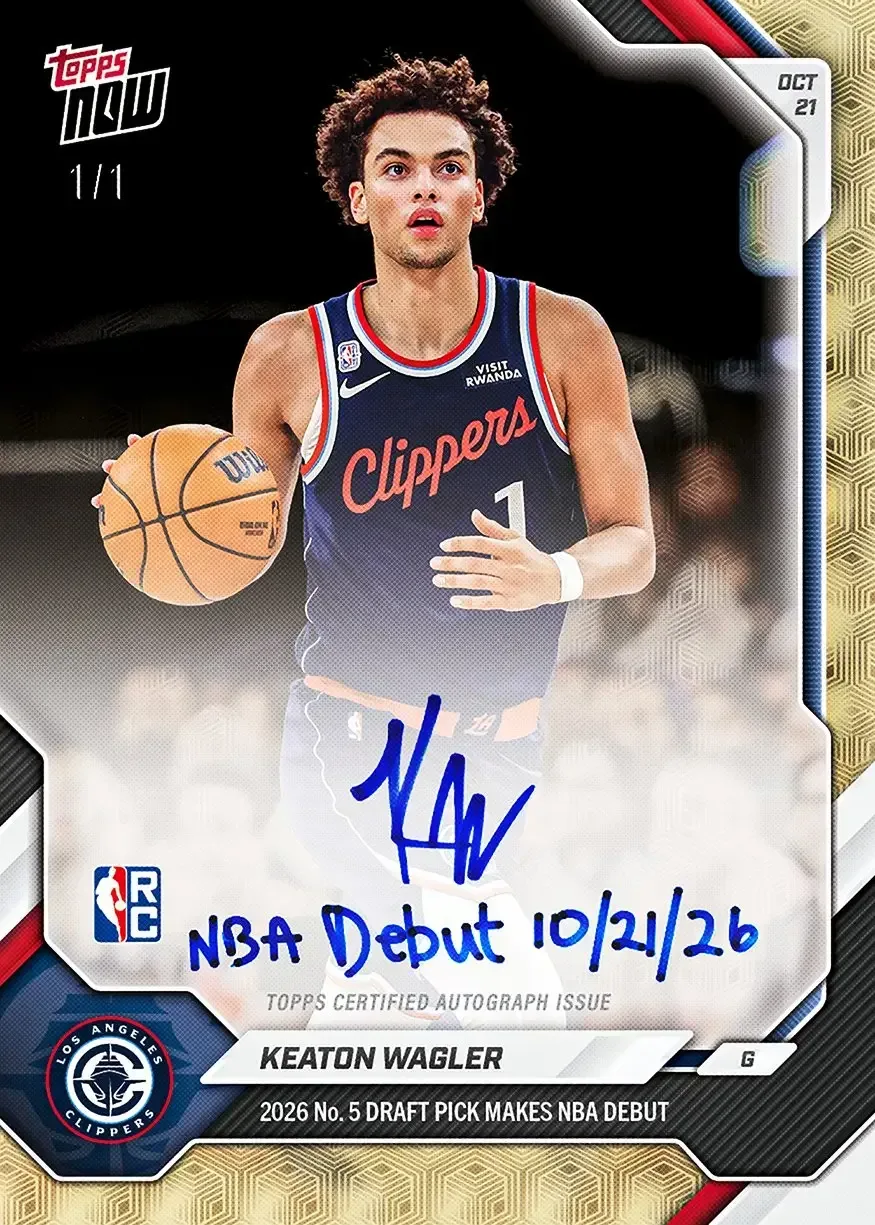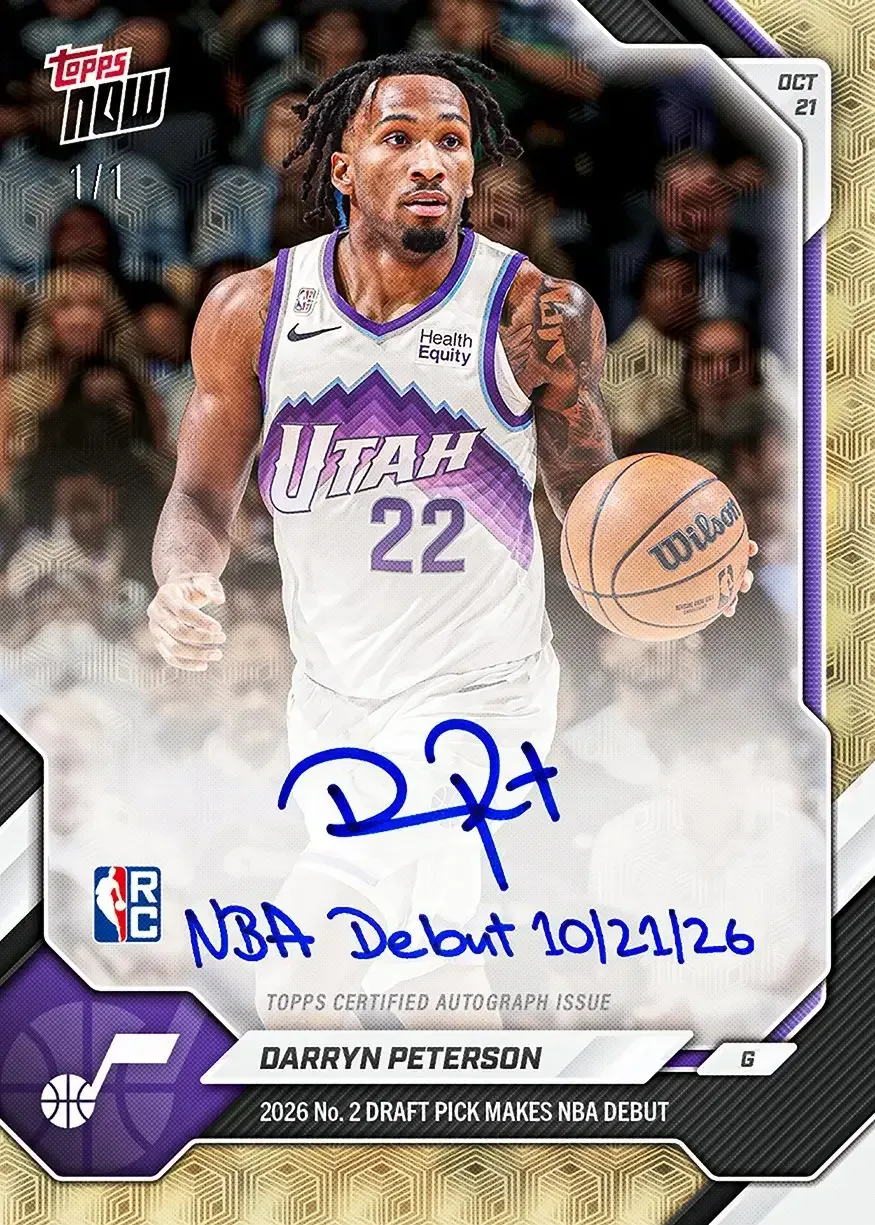
Topps NOW has returned to one of the most immediate forms of rookie-card commemoration: the NBA Debut Inscription Autograph. Four members of the 2026 draft’s top five selections—Utah Jazz guard Darryn Peterson, Memphis Grizzlies forward Cameron Boozer, Chicago Bulls forward Caleb Wilson and Los Angeles Clippers guard Keaton Wagler—have cards connected to their first NBA games.
The release window is notably short. The cards are available to order for 48 hours, with the stated window ending around midday Saturday, October 24. That limited ordering period makes the release different from a conventional season-long card product: collectors are being asked to decide before the full shape of these rookies’ seasons, roles and markets is clear.
AJ Dybantsa, the 2026 first overall pick, is not part of the initial group because he has not yet debuted for the Washington Wizards while recovering from an ankle injury. His absence is an important reminder of what this specific card concept celebrates. It is not simply a high-draft-pick autograph. The hook is the player’s actual NBA debut.
What an NBA Debut Inscription Autograph represents
An inscription autograph is an autograph accompanied by added handwritten text. In this case, the additional writing is intended to mark the player’s entry into the NBA. That connection gives the cards a clear event-based identity: they document the first regular NBA appearance rather than a broad rookie-season milestone.
Topps is issuing the cards through Topps NOW, a format built around timely sports moments. The key practical distinction is the order window. A regular pack-based product is generally released as a defined set, while a NOW-style offering is tied to a moment and can be ordered only during its designated period. For collectors, that makes timing part of the acquisition process. Missing the window can mean relying on the secondary market later, where availability and asking prices may vary.
This is the second year of the NBA Debut Inscription Autograph program following Topps’ NBA licensing rights taking effect on October 1, 2025. The prior year provides one attention-grabbing data point rather than a guaranteed template: a PSA 10 copy of Cooper Flagg’s debut inscription card sold for $140,300 last month.
PSA 10 refers to a card that received the top numerical grade from PSA under that company’s grading scale. Grading evaluates physical condition, including matters such as centering, corners, edges and surface. A high-grade sale can illustrate the premium collectors may place on condition, but it does not establish a fixed value for every player, every copy or every future debut autograph. Player performance, supply, demand, authentication and condition can all affect outcomes.
Collectors looking at the new group may also find it useful to separate a card’s historical meaning from any expectation of resale value. A debut inscription links the signature to a permanently identifiable point in a career. Whether it becomes a major market card is an entirely separate question that will develop over time.
Related coverage includes Topps NOW Revives NBA Debut Inscription Autographs for Four 2026 Rookies.
Darryn Peterson starts for Utah in his first NBA game
Peterson, the No. 2 pick, began his NBA career in the Jazz starting lineup. He finished with nine points, four rebounds and three assists in 31 minutes in Utah’s 123-103 loss to Memphis.
For a debut-focused release, the start and 31-minute workload give the game a substantial on-court footprint even though the Jazz were defeated. Peterson’s card captures a first appearance in which he was immediately trusted with a prominent role. That is a meaningful factual detail for collectors who value game context alongside the inscription itself.
It is also worth keeping the card’s purpose in view. The debut card freezes one event. It does not need Peterson’s first stat line to become a prediction of his eventual output, his standing in the rookie class or the number of later Topps NOW opportunities he may receive. The case for the card is its place at the beginning of that story.
Cameron Boozer posts a full box score in Memphis win
Boozer, selected third overall by the Grizzlies, had one of the more varied stat lines in the opening group. In Memphis’ 20-point victory over Peterson’s Jazz, he recorded seven points, 11 rebounds and five assists in 33 minutes. His shooting was difficult: Boozer went 2-of-15 from the field and 0-of-6 from three-point range.
The combination underscores why a single-game card can be more interesting than a simple highlight snapshot. Boozer’s debut included inefficient scoring, but his rebounding, passing and playing time made the game eventful beyond the points column. For basketball collectors, a box score is context rather than a verdict. The card remains tied to the debut regardless of whether that night becomes known as an early learning experience, an unusual stat line or merely the first entry in a much longer record.
Boozer also arrives with a family connection that some collectors will recognize: he is the son of former NBA big man Carlos Boozer. That background may add narrative interest, but the card itself is centered on Cameron Boozer’s own first NBA appearance with Memphis.
Caleb Wilson sees heavy minutes despite Chicago’s loss
Wilson, the No. 4 selection, had 16 points on 7-of-21 shooting in Chicago’s 135-92 loss to Toronto. He played the most minutes of any Bulls player in the opener, though many of those minutes came after the game had become a blowout. Wilson also committed nine turnovers.
There are two useful ways to read that debut without overstating it. First, 16 points in a first NBA game gives the card a straightforward scoring marker. Second, the high volume of minutes and shot attempts indicates that Wilson had substantial opportunity on the floor, even within a lopsided loss. The turnovers and shooting efficiency add necessary balance to the picture.
For collectors, this is where event cards reward patience. A debut card need not be evaluated as though it were a season report card. Its durable appeal may come from being the autograph associated with Wilson’s first appearance, while the interpretation of that appearance can change as his role develops.
Keaton Wagler delivers the strongest opening-night line of the group
Wagler, drafted fifth by the Clippers, did not start his first game, but he produced the group’s strongest debut statistical performance. In 29 minutes during Los Angeles’ 121-96 win over Sacramento, he scored 15 points on 4-of-8 shooting, including 3-of-6 from three-point range, and added five rebounds and five assists.
The game also placed Wagler opposite another highly drafted rookie guard. Sacramento’s Darius Acuff, the No. 7 pick, finished 5-of-24 from the field in the Kings’ loss. That matchup is part of the game’s context, though only Wagler is included in this particular debut-inscription release group.
Wagler’s card has an especially simple immediate narrative: reserve role, efficient scoring, playmaking, rebounding and a decisive team victory. Still, collectors should resist collapsing an opening-night success into a sweeping market conclusion. Rookie seasons are long, and the value of a signed card is influenced by much more than one excellent debut. The card’s distinctive proposition is that it records the beginning of Wagler’s NBA timeline with an autograph and inscription.
How to approach a brief, event-driven card release
The 48-hour ordering window means collectors should prioritize the information that is already established: which player they most want to collect, whether the debut moment itself matters to them, and whether they are comfortable buying before the rookies have built a larger NBA résumé. There is no supplied basis for predicting print runs, future prices or scarcity, so those should not be treated as known quantities.
- Confirm the deadline: The stated ordering period ends around midday Saturday, October 24.
- Collect the player, not only the draft slot: Peterson, Boozer, Wilson and Wagler each have different debut-game narratives despite being grouped together as early picks.
- Understand the format: The appeal is the debut-specific inscription and the limited ordering interval, not a claim that every card will follow the same market path.
- Separate condition from significance: The Cooper Flagg PSA 10 sale demonstrates how condition can matter, but grading and long-term demand remain variables.
For collectors building a broader sports-card plan rather than chasing every timely release, it can help to set limits before a deadline adds pressure. Our guide to baseball card collecting on a $500 budget explores the value of defining a collecting approach—an idea that applies just as well when basketball rookies arrive with a short purchase window.
The present Topps NOW group is ultimately a snapshot of the 2026 class at the exact point it entered the league. Peterson’s starting debut, Boozer’s all-around line, Wilson’s high-usage night and Wagler’s efficient performance give each autograph a distinct origin story. Dybantsa’s still-to-come debut, meanwhile, shows why the program can remain relevant as the season moves forward: new first appearances create new moments worth documenting.